On This Page:ToggleFunctionHippocampusAmygdalaCingulate GyrusHypothalamusBasal GangliaTreatment
On This Page:Toggle
On This Page:
The limbic system, a complex network of interconnected brain structures, plays a pivotal role in regulating various aspects of human behavior and emotion while also contributing to the processing of memory and motivation.
This neural system encompasses the amygdala, hippocampus, thalamus, hypothalamus, and other structures, all working together to manage emotional responses, especially those tied to survival instincts, social bonding, and memory consolidation.
These functions include but are not limited to emotional processing, memory formation, motivation, and the regulation of essential physiological functions such as stress responses, feeding, reproduction, andthe fight or flight response.
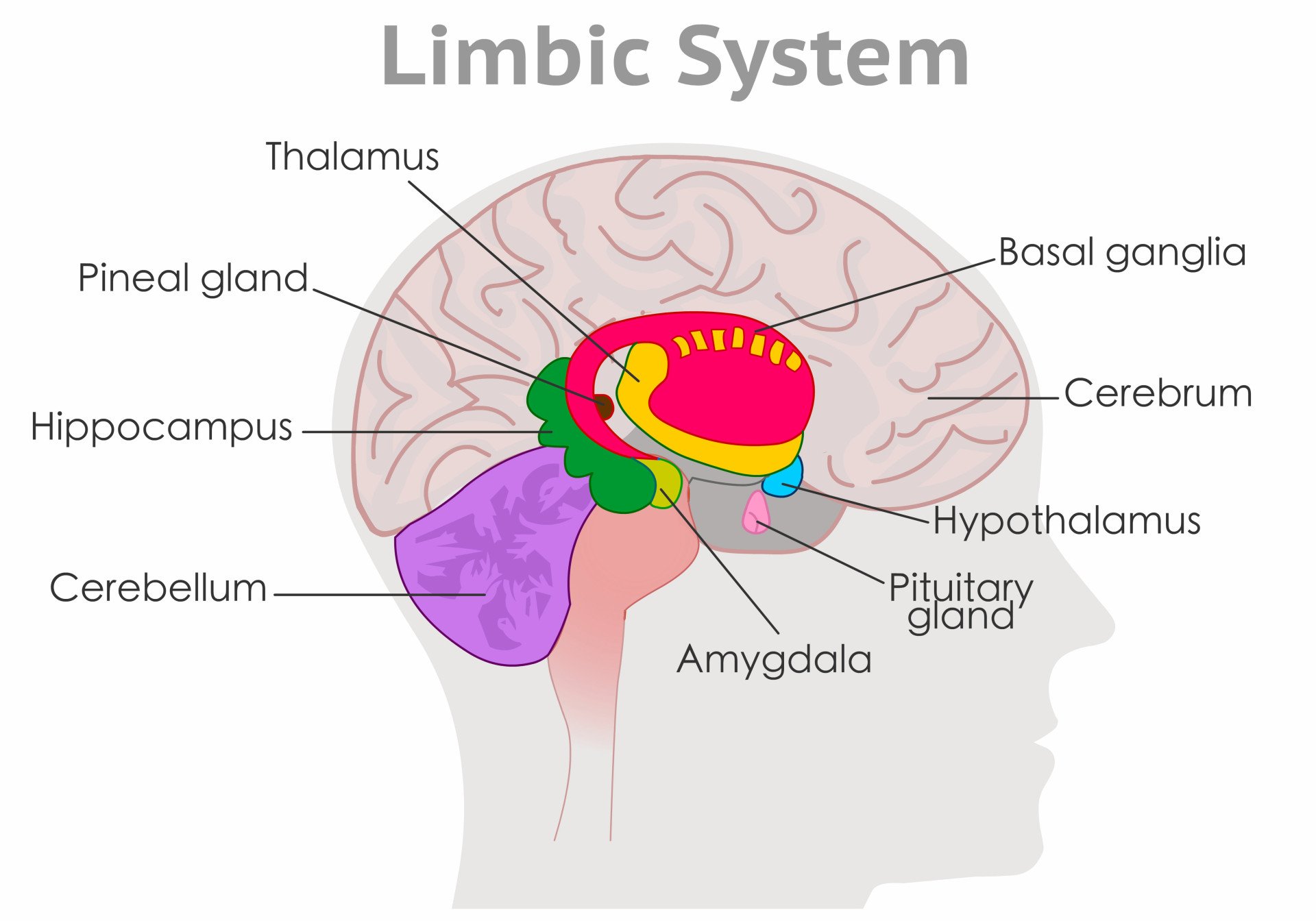 The limbic system is a complex set of brain structures involved in emotion, motivation, memory, and behavior regulation. Key components include the amygdala, hippocampus, thalamus, hypothalamus, basal ganglia, and cingulate gyrus.
Where is the limbic system located?
The limbic system is located within the cerebrum of the brain, immediately below the temporal lobes, and buried under thecerebral cortex(the cortex is the outermost part of the brain).Thenerve cells(neurons) within the limbic system are structured differently from those in the cerebral cortex. In the cerebral cortex, the cells are primarily neocortical, meaning they are formed into six layers.Within the limbic system, the cells are either arranged in fewer layers or are more jumbled. As there is less complexity of the cells within the limbic system, this has led people to believe that this system is evolutionarily older than the cerebral cortex itself.FunctionThe limbic system is responsible for many functions, including:Emotional processingMemory formationBehavioral regulationPhysiological controlEach part of the limbic system plays a role in these functions which will be discussed in more detail below.The limbic system was originally called the rhinencephalon (meaning ‘smell brain’) because it was thought to primarily involve the sense of smell.Psychologists now recognize that the limbic system serves many more functions than previously believed.
The limbic system is located within the cerebrum of the brain, immediately below the temporal lobes, and buried under thecerebral cortex(the cortex is the outermost part of the brain).
Thenerve cells(neurons) within the limbic system are structured differently from those in the cerebral cortex. In the cerebral cortex, the cells are primarily neocortical, meaning they are formed into six layers.
Within the limbic system, the cells are either arranged in fewer layers or are more jumbled. As there is less complexity of the cells within the limbic system, this has led people to believe that this system is evolutionarily older than the cerebral cortex itself.
Function
The limbic system is responsible for many functions, including:
Each part of the limbic system plays a role in these functions which will be discussed in more detail below.
The limbic system was originally called the rhinencephalon (meaning ‘smell brain’) because it was thought to primarily involve the sense of smell.
Psychologists now recognize that the limbic system serves many more functions than previously believed.
Hippocampus
There aretwo hippocampilocated in each hemisphere of the brain. They are seahorse-shaped and mainly associated with being the memory centers of our brains.
Episodic memoriesare formed in the hippocampus and then filed away into long-term storage throughout other parts of the cerebral cortex.
The hippocampus plays a role in spatial navigation and has also been associated with learning and emotions (Tyng, Amin, Saad, & Malik, 2017).
This area also has widespread connections to brain regions involved in cognition and movement control (McEwen et al., 2016).
The hippocampus is also known as a site whereneurogenesis occurs– this means that new nerve cells are made here from adult stem cells.
Damage to the hippocampus
Due to the hippocampus’s involvement in memory, damage to this area can lead to severe memory impairments.
Damage can also be detrimental to spatial memory, for instance, remembering directions to locations that should be familiar to the individual.
Damage to the hippocampus can disrupt cognitive functions such as learning, memory, and spatial navigation and contribute to dementia symptoms like memory loss, disorientation, and confusion (Gulyaeva, 2019)
In Parkinson’s disease, hippocampus damage can worsen cognitive symptoms like executive dysfunction, visual-spatial deficits, and memory problems that many patients experience (Xie et al., 2011).
Amygdala
Theamygdalais an almond-shaped structure located right next to the hippocampus. The main function of the amygdala is in emotional responses, including feelings of happiness, fear, anger, and anxiety.
It has a role in how memorable memories can be – memories with strong emotional components tend to stick rather than those with little emotional content.
‘Fear learning’ is also an element of the amygdala.
Fearful memories can be formed after only a few repetitions, which can result in avoidance of certain fearful stimuli. Therefore, the amygdala is linked with thefight-or-flight response, as stimulating activity can influence the body’s automatic fear response.
In recent years, it has been discovered that neurogenesis also occurs in the amygdala along with the hippocampus, meaning that new neurons are created here, expanding our knowledge of its role in the limbic system (Jhaveriet al.,2018).
Damage to the amygdala
Damage to the amygdala may result in more aggression, irritability, loss of control of emotions, and deficits in recognizing emotions, especially recognizing fear.
Damage to both sides of the amygdala can result in fewer feelings of shame about breaking social rules as well as trouble recognizing fearful and shamed facial expressions correction. This suggests that the amygdala may help detect unclear social situations (Piretti et al., 2020).
Reduced amygdala volume may underlie vulnerability to stress and depression. A study found that childhood violence exposure was linked to reduced amygdala volumes, which interacted with later life stress to predict worsening depression over time (Weissmanet al.,2020).
Cingulate Gyrus
The cingulate gyrus is part of the cingulate cortex of the brain and is thought to be an integral part of the limbic system.
This area is believed to help regulate emotions, behavior, and pain, as well as being responsible for controlling autonomic motor function.
This area is thought to involve fear and the prediction and avoidance of negative stimuli through monitoring the body’s response to unpleasant experiences.
Damage to the cingulate gyrus
Damage to the cingulate gyrus can result in emotions being inappropriate, having a lack of fear, impaired sense of pain, and learning impairments.
This region has also shown differences in structure in those with Autism, depression,obsessive-compulsive disorder, posttraumatic stress disorder, and bipolar disorder due to its role in emotional processing (Yucel et al., 2003).
There is thought to be reduced volume and altered activity in the anterior and posterior cingulate cortex in those with schizophrenia (Ponirakiset al.,2022).
Likewise, there have been reduced gray matter volumes in the anterior cingulate cortex of people with ADHD (Carmonaet al.,2005).
Hypothalamus
The hypothalamus’ most basic function is homeostasis (maintaining a steady internal state).
This region controls most autonomic functions, such as hunger, thirst, body temperature, blood pressure, heart rate, and sexual activity.
The hypothalamus also serves as an interface between the nervous system and the endocrine system and in the regulation of sexual motivation and behavior.
The hypothalamus also has a role in controlling the body’s response to stress. To control these many functions, the hypothalamus integrates information from other parts of the brain and is responsive to a variety of stimuli, such as light, odor, stress, and arousal.
Damage to the hypothalamus
Damage or abnormalities in the hypothalamus have been linked to several mental health conditions, including anxiety, depression, bipolar disorder, aggression, and obsessive-compulsive disorder. (Herman et al., 2016).
This may be because hyperactivity in the hypothalamus can lead to excessive anxiety and agitation, whereas underactivity can contribute to depression and lack of motivation.
Chronic stress and elevated cortisol levels associated with hypothalamic dysfunction may predispose some individuals to mood disorders. (Herman et al., 2016)
Differences inhypothalamic-pituitary-adrenal (HPA) axisresponsiveness related to genetic factors or exposure to early-life stress can make some people more vulnerable to PTSD and mood disorders later in life. (Pagliaccio et al., 2015)
Basal Ganglia
The basal ganglia are a group of structures situated at the base of the forebrain and the top of the midbrain.
Its main functions are to regulate voluntary movements, including eye movements, and help with balance as well as posture.
There is a limbic region of the basal ganglia, which has multiple components (nucleus accumbens, ventral tegmental area, and ventral pallidum).
These areas are involved in cognitive and emotional behaviors and have a role inrewards and reinforcements. Because of this, it can be linked with addictive behaviors and the formation of habits.
Damage to the basal ganglia
Damage to the basal ganglia can result in tremors, involuntary muscle movements, abnormal posture, and links to movement disorders (Parkinson’s and Huntington’s disease).
In relation to the limbic system, the basal ganglia may also contribute to symptoms of depression (Stathis et al., 2007).
Treatment
Treatment approaches for limbic system-related difficulties are tailored to specific symptoms and underlying causes.
Mental health professionals may recommend psychotherapy to help manage emotional regulation challenges, anxiety, or depression stemming from limbic system dysfunction.
Cognitive behavioral therapy (CBT) can be particularly effective in addressing fear responses and emotional processing issues.
For severe cases, psychiatrists may prescribe medications like antidepressants or anti-anxiety drugs that help regulate limbic system activity. Some patients benefit from a combination of medication and therapy.
Self-care strategies can complement professional treatment:
Always consult healthcare providers to determine the most appropriate treatment plan, as needs vary significantly between individuals and conditions.
References
Banwinkler, M., Theis, H., Prange, S., & van Eimeren, T. (2022). Imaging the Limbic System in Parkinson’s Disease-A Review of Limbic Pathology and Clinical Symptoms. Brain Sciences, 12(9), 1248.
Bari, A., Niu, T., Langevin, J. P., & Fried, I. (2014). Limbic neuromodulation: implications for addiction, posttraumatic stress disorder, and memory.Neurosurgery Clinics of North America, 25(1), 137–145.
Carmona, S., Vilarroya, O., Bielsa, A., Tremols, V., Soliva, J. C., Rovira, M., … & Bulbena, A. (2005). Global and regional gray matter reductions in ADHD: a voxel-based morphometric study.Neuroscience letters,389(2), 88-93.
DelBello, M. P., Adler, C. M., & Strakowski, S. M. (2006). The neurophysiology of childhood and adolescent bipolar disorder.CNS Spectrums, 11(4), 298-311.
Grèzes, J., Berthoz, S., & Passingham, R. E. (2006). Amygdala activation when one is the target of deceit: did he lie to you or to someone else?.Neuroimage, 30(2), 601-608.
Gulyaeva, N. V. (2019). Functional neurochemistry of the ventral and dorsal hippocampus: Stress, depression, dementia and remote hippocampal damage. Neurochemical Research.
Herman, J. P., McKlveen, J. M., Ghosal, S., Kopp, B., Wulsin, A., Makinson, R., … & Myers, B. (2016). Regulation of the hypothalamic-pituitary-adrenocortical stress response.Comprehensive physiology,6(2), 603.
Jhaveri, D. J., Tedoldi, A., Hunt, S., Sullivan, R., Watts, N. R., Power, J. M., … & Sah, P. (2018). Evidence for newly generated interneurons in the basolateral amygdala of adult mice.Molecular psychiatry,23(3), 521-532.
Lepage, C., Muehlmann, M., Tripodis, Y., Hufschmidt, J., Stamm, J., Green, K., … & Koerte, I. K. (2019). Limbic system structure volumes and associated neurocognitive functioning in former NFL players.Brain Imaging and Behavior, 13(3), 725-734.
Maletic, V., Robinson, M., Oakes, T., Iyengar, S., Ball, S. G., & Russell, J. (2007). Neurobiology of depression: an integrated view of key findings.International Journal of Clinical Practice, 61(12), 2030-2040.
McEwen, B. S., Nasca, C., & Gray, J. D. (2016). Stress effects on neuronal structure: hippocampus, amygdala, and prefrontal cortex. Neuropsychopharmacology, 41(1), 3–23.
Morris, J. S., Frith, C. D., Perrett, D. I., Rowland, D., Young, A. W., Calder, A. J., & Dolan, R. J. (1996). A differential neural response in the human amygdala to fearful and happy facial expressions.Nature, 383(6603), 812-815.
Piretti, L., Pappaianni, E., Lunardelli, A., Zorzenon, I., Ukmar, M., Pesavento, V., Rumiati, R. I., Job, R., & Grecucci, A. (2020). The role of amygdala in self-conscious emotions in a patient with acquired bilateral damage. Frontiers in Neuroscience, 14, 677.
Ponirakis, G., Ghandi, R., Ahmed, A., Gad, H., Petropoulos, I. N., Khan, A., … & Woodruff, P. W. (2022). Abnormal corneal nerve morphology and brain volume in patients with schizophrenia.Scientific Reports,12(1), 1870.
Rolls, E.T. (2019). The cingulate cortex and limbic systems for emotion, action, and memory. Brain Structure and Function, 224(9), 3001-3018.
Sahin, N., Selouan, R., Markowitz, C. E., Melhem, E. R., & Bilello, M. (2016). Limbic pathway lesions in patients with multiple sclerosis.Acta Radiologica, 57(3), 341-347.
Sapolsky, R. M. (2003). Stress and plasticity in the limbic system. Neurochemical research, 28(11), 1735-1742.
Sergerie, K., Chochol, C., & Armony, J. L. (2008). The role of the amygdala in emotional processing: a quantitative meta-analysis of functional neuroimaging studies.Neuroscience & Biobehavioral Reviews, 32(4), 811-830.
Stathis, P., Panourias, I. G., Themistocleous, M. S., & Sakas, D. E. (2007). Connections of the basal ganglia with the limbic system: implications for neuromodulation therapies of anxiety and affective disorders.Operative Neuromodulation,575-586.
Tyng, C. M., Amin, H. U., Saad, M. N., & Malik, A. S. (2017). The influences of emotion on learning and memory.Frontiers in Psychology, 8,1454.
Weissman, D. G., Lambert, H. K., Rodman, A. M., Peverill, M., Sheridan, M. A., & McLaughlin, K. A. (2020). Reduced hippocampal and amygdala volume as a mechanism underlying stress sensitization to depression following childhood trauma.Depression and anxiety,37(9), 916-925.
White, T., Cullen, K., Rohrer, L. M., Karatekin, C., Luciana, M., Schmidt, M., Hongwanishkul, D., Kumra, S., Schulz, C. & Lim, K. O. (2008). Limbic structures and networks in children and adolescents with schizophrenia.Schizophrenia Bulletin, 34(1), 18-29.
Xie, M., Yi, C., Luo, X., Xu, S., Yu, Z., Tang, Y., Zhu, W., Du, Y., Jia, L., Zhang, Q., Dong, Q., Zhu, W., Zhang, X., Bu, B., & Wang, W. (2011). Glial gap junctional communication involvement in hippocampal damage after middle cerebral artery occlusion. Annals of Neurology, 70(1), 121–132.
Yücel, M., Wood, S. J., Fornito, A., Riffkin, J., Velakoulis, D., & Pantelis, C. (2003). Anterior cingulate dysfunction: implications for psychiatric disorders?.Journal of Psychiatry and Neuroscience, 28(5), 350.
 limbic system structures

Saul McLeod, PhD
BSc (Hons) Psychology, MRes, PhD, University of Manchester
Saul McLeod, PhD., is a qualified psychology teacher with over 18 years of experience in further and higher education. He has been published in peer-reviewed journals, including the Journal of Clinical Psychology.
Olivia Guy-Evans, MSc
BSc (Hons) Psychology, MSc Psychology of Education
Olivia Guy-Evans is a writer and associate editor for Simply Psychology. She has previously worked in healthcare and educational sectors.
