On This Page:ToggleWhere is the Default Mode Network in the Brain?What is the Role of the Default Mode Network?MeditationThe Role of the Default Mode Network in DisordersFAQs
On This Page:Toggle
On This Page:
Since then, the DMN has become a focus of research, and it is now regarded to reflect the brain’s ‘intrinsic’ activity, including its resting state and forms of abstract cognition, such as self-referential thoughts, reminiscing, and future planning (Davey, Pujol and Harrison, 2016; Smallwood et al., 2021).

Where is the Default Mode Network in the Brain?
The DMN is distributed across three major subdivisions (Raichle, 2015):
In restingfunctional magnetic resonance (fMRI)studies, these regions have shown coordinated temporal activity, which is known to represent a feature of large-scale networks (Greicius et al., 2003).
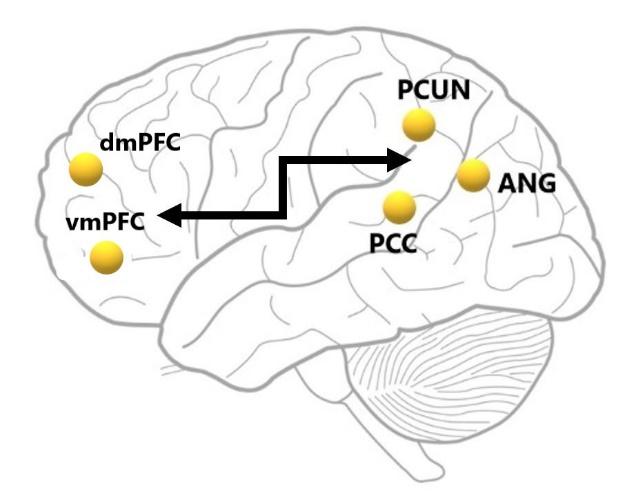
The vmPFC is an integration area involved in different functions, including the generation andregulation of emotions,the attribution of reward valueto stimuli and value-based decision-making, and various aspects of social cognition (Mayeli et al., 2019).
Overall, it plays an important modulatory role when coping with adverse conditions, and it regulates motivational drive in favor of goal-oriented behaviors.
The PCC and medial PCUN, along with the angular gyrus, are thought to support the recollection of past experiences, including autobiographical information and previously studied items.
Overall, the functional and spatial distance of the DMN from brain networks that are more extrinsically driven, such as the sensorimotor system, supports the hypothesis of its role in higher-order, abstract cognition that is often disconnected from events in the immediate environment (Smallwood et al., 2021).
What is the Role of the Default Mode Network?
Self-reflection
Because the DMN was first identified within a resting state and contrasted with ‘task positive’ networks, its functionality has often been associated with spontaneous, self-referential thought patterns that contribute to our sense of self and identity (Yeshurun, Nguyen, and Hasson, 2021).
In fMRI studies where subjects were asked to perform self-referential judgments about trait adjectives, activations were identified within the PCC and medial PFC, as opposed to control conditions that included resting-state and non-self-referential operations (Whitfield-Gabrieli et al., 2011; Davey, Pujol and Harrison, 2016).
In addition, spontaneouselectroencephalography (EEG)studies investigating areas of the DMN could predict individual differences in the frequency of engagement in introspective thoughts (Frewen et al., 2020).
Memories
The ability of the DMN to retrieve previously encoded information is related to its functional connectivity to areas of the medial temporal lobe that are crucial for learning and memory.
In tasks involving autobiographical remembering or interpretation of new stimuli based on previous knowledge, activation of midline DMN regions was observed in association with increased connectivity tohippocampalregions (Chen et al., 2016; Spreng and Grady, 2010), a key area for learning and memory.
The role of the DMN in the retrieval of past memories is also relevant in decision-making, where the accumulation of feedback and learning from previous experiences can guide future behaviors (Buckner and Wheeler, 2001).
Daydreaming
Humans spend nearly half of their time engaged in stimulus-independent thoughts, usually related to their plans, everyday concerns, and experiences. This type of activity, known as “daydreaming” or “mind-wandering,” has been shown to utilize areas in the DMN (Fox et al., 2015).
Specifically, dynamic changes in DMN connectivity have been observed when subjects were involved in fluctuating states of daydreaming. In addition, inter-individual differences in the general tendency to daydream were associated with both static and dynamic functional connectivity between DMN regions (Kucyi and Davis, 2014).
A known primary function of daydreaming is to facilitate routine autobiographical planning, and increased engagement of DMN, in conjunction with medial temporal areas, seems to be related to a greater frequency of future-oriented thoughts (Andrews-Hanna et al., 2010).
Social evaluations
Many studies highlighted the activation of DMN regions in tasks requiring understanding and interacting with others, including interpretation of others’ mental states, inference of intentions and beliefs, and subjective evaluation of their behavior.
While the vmPFC and its connections with affective regions promote general emotional engagement in social interactions, vmPFC-PCC connectivity contributes to making self-other distinctions. An example of this is when attributing descriptions of qualities and feelings to oneself or others (Frewen et al., 2020).
In addition, the dmPFC and its connections with the temporoparietal junction (TPJ) have demonstrated a crucial role intheory of mind(the ability to attribute mental states — beliefs, intents, desires, emotions, and knowledge — to ourselves and others) when subjects are trying to interpret the mental state of others and use it to predict their desires and behaviors (Li, Mai, and Liu, 2014).
How Does Meditation Affect the Default Mode Network?

As opposed to states of mind-wandering, meditation involves maintaining attention to the present moment, on purpose and non-judgementally (Bishop et al., 2004).
During the practice, meditators learn how to become aware of self-related thoughts, emotions, and body sensations, trying to separate the experience of these feelings from self-identifying with them.
As meditation practice ultimately results in betteremotion regulation, focused attention, and a change in self-perspective, greater activation of prefrontal areas associated with executive control and self-monitoring is expected.
This is what has been found in fMRI studies of experienced meditators, where a stronger coupling of prefrontal regions was observed alongside the deactivation of DMN nodes, probably due to reduced mind-wandering (Brewer et al., 2011).
Reduced DMN activity has been found across different styles of meditation, including focused attention, mantra recitation, and loving-kindness. Furthermore, fluctuations in the activation of this network seem to correlate with the degree of focus during the practice.
In an fMRI study, volunteer meditators were asked to press a button every time they perceived they were distracted, and these moments were associated with greater activation of DMN areas (Hasenkamp and Barsalou, 2012).
In the longer term, meditation practice seems to result in weaker connectivity between DMN regions involved in self-referential processing and emotional appraisal, a change that can possibly be utilized for monitoring the therapeutic effects of meditation over time (Taylor et al., 2013; Simon and Engström, 2015).
The Role of the Default Mode Network in Disorders
Alzheimer’s Disease
Studies on the preceding stages of AD involving subjects with amnestic cognitive impairment (aMCI) also identified greater temporal desynchronization between the PCC and hippocampus when compared to normal aging (Mevel et al., 2011).
Finally, delayed switching between resting-state and task-related brain function has been linked to inefficient synchronization of DMN areas in both AD and aMCI (Rombouts et al., 2005).
Schizophrenia
Many fMRI studies have demonstrated altered functional connectivity of the DMN with other brain areas in people with schizophrenia, in association with both positive and negative symptoms (Hu et al., 2017).
In addition, increased functional connectivity within the DMN has been found in patients with schizophrenia and their unaffected siblings, suggesting that hyper-connectivity of intrinsic brain networks might represent an endophenotype of the illness (Liu et al., 2012).
Preliminary findings have argued the potential role of DMN connectivity as a target for treatment, informing the development of future antipsychotic agents; however, more research is needed on DMN response to antipsychotic medication (Hu et al., 2017).
ADHD
Clinical deficits inADHD, including issues with attention and impulsivity, have been reported in association with delayed maturation of the DMN.
Specifically, ADHD studies have consistently displayed increased functional connectivity within the DMN and across the whole brain.
In contrast, delays have been identified in connectivity patterns between the DMN and task-positive networks, such as the ventral attentional system and the frontoparietal network (Sripada, Kessler, and Angstadt, 2014).
Abnormal functional connectivity between DMN regions and areas implicated in attentional control has also been observed in adults with ADHD, supporting the hypothesis of a maturational delay.
However, the contribution of other intellectual impairments, often present in co-morbidity with ADHD, still needs to be clarified (Harikumar et al., 2021).
Depression
fMRI studies have identified areas in the DMN that seem to be critically involved in ruminative processes. Specifically, the dmPFC node and its connections show activation when subjects are reflecting on their own psychological state and ruminating about past adverse events (Zhou et al., 2020).
In major depressive disorder, increased connectivity has also been observed between the DMN and the subgenual prefrontal cortex (sgPFC), an area implicated in the appraisal of negative emotions and affectively laden behavioral withdrawal (Hamilton et al., 2015).
For this reason, novel treatments for depression are exploring the use of transcranial magnetic stimulation (TMS) to inhibit DMN activity and re-establish functional patterns of connectivity, ultimately resulting in a reduction of depressive rumination (Liston et al., 2014).
Frequently Asked Questions
Is the default mode network active during sleep?fMRI studies have shown the persistence of DMN connectivity during lightsleep, probably reflecting the permanence of self-reflective thoughts that gradually decrease as a person falls asleep (Horovitz et al., 2009).In later stages of sleep, changes in consciousness produce a reduction in functional correlations between frontal and posterior regions of DMN regions, finally resulting in mPFC decoupling from the rest of the DMN.Overall, this evidence supports the hypothesis that integrated DMN activity is necessary to promote ongoing mentation and conscious awareness.What is the role of the default mode network during creative activities?Creativity is increasingly acknowledged as a process involving both idea generation and idea evaluation.During the generation phase, subjects were asked to convert conventional mental schemas into alternative ones or to create multiple solutions to a problem. Activation was observed within the DMN and areas supporting novel combinations of associations, such as the insula and hippocampus (Kleinmintz, Ivancovsky, and Shamay-Tsoory, 2019).In the evaluation phase, the involvement of executive control processes is crucial to support the rejection of inappropriate and non-original ideas.Specifically, interactions between frontoparietal regions and correlations with DMN activity can supportworking memoryprocesses that facilitate shifting between different types of thinking modes (Heinonen et al., 2016).How can the default mode network be deactivated?Relaxation techniques, including mindfulness meditation and breathing exercises, can help reduce DMN activity, dampening the impact of self-reflective thoughts and resulting in increased present-moment awareness (Brewer et al., 2011).Engaging in hobbies and novel activities can also induce a shift in thought processes, contributing to an increase in a person’s sense of self-worth and self-efficacy.Finally, engaging in social interactions can help the person assume alternative points of view on problems and disengage from passive, ruminative problem-solving tendencies (Yeshurun, Nguyen, and Hasson, 2021).
Is the default mode network active during sleep?fMRI studies have shown the persistence of DMN connectivity during lightsleep, probably reflecting the permanence of self-reflective thoughts that gradually decrease as a person falls asleep (Horovitz et al., 2009).In later stages of sleep, changes in consciousness produce a reduction in functional correlations between frontal and posterior regions of DMN regions, finally resulting in mPFC decoupling from the rest of the DMN.Overall, this evidence supports the hypothesis that integrated DMN activity is necessary to promote ongoing mentation and conscious awareness.
Is the default mode network active during sleep?
fMRI studies have shown the persistence of DMN connectivity during lightsleep, probably reflecting the permanence of self-reflective thoughts that gradually decrease as a person falls asleep (Horovitz et al., 2009).In later stages of sleep, changes in consciousness produce a reduction in functional correlations between frontal and posterior regions of DMN regions, finally resulting in mPFC decoupling from the rest of the DMN.Overall, this evidence supports the hypothesis that integrated DMN activity is necessary to promote ongoing mentation and conscious awareness.
fMRI studies have shown the persistence of DMN connectivity during lightsleep, probably reflecting the permanence of self-reflective thoughts that gradually decrease as a person falls asleep (Horovitz et al., 2009).
In later stages of sleep, changes in consciousness produce a reduction in functional correlations between frontal and posterior regions of DMN regions, finally resulting in mPFC decoupling from the rest of the DMN.
Overall, this evidence supports the hypothesis that integrated DMN activity is necessary to promote ongoing mentation and conscious awareness.
What is the role of the default mode network during creative activities?Creativity is increasingly acknowledged as a process involving both idea generation and idea evaluation.During the generation phase, subjects were asked to convert conventional mental schemas into alternative ones or to create multiple solutions to a problem. Activation was observed within the DMN and areas supporting novel combinations of associations, such as the insula and hippocampus (Kleinmintz, Ivancovsky, and Shamay-Tsoory, 2019).In the evaluation phase, the involvement of executive control processes is crucial to support the rejection of inappropriate and non-original ideas.Specifically, interactions between frontoparietal regions and correlations with DMN activity can supportworking memoryprocesses that facilitate shifting between different types of thinking modes (Heinonen et al., 2016).
What is the role of the default mode network during creative activities?
Creativity is increasingly acknowledged as a process involving both idea generation and idea evaluation.During the generation phase, subjects were asked to convert conventional mental schemas into alternative ones or to create multiple solutions to a problem. Activation was observed within the DMN and areas supporting novel combinations of associations, such as the insula and hippocampus (Kleinmintz, Ivancovsky, and Shamay-Tsoory, 2019).In the evaluation phase, the involvement of executive control processes is crucial to support the rejection of inappropriate and non-original ideas.Specifically, interactions between frontoparietal regions and correlations with DMN activity can supportworking memoryprocesses that facilitate shifting between different types of thinking modes (Heinonen et al., 2016).
Creativity is increasingly acknowledged as a process involving both idea generation and idea evaluation.
During the generation phase, subjects were asked to convert conventional mental schemas into alternative ones or to create multiple solutions to a problem. Activation was observed within the DMN and areas supporting novel combinations of associations, such as the insula and hippocampus (Kleinmintz, Ivancovsky, and Shamay-Tsoory, 2019).
In the evaluation phase, the involvement of executive control processes is crucial to support the rejection of inappropriate and non-original ideas.
Specifically, interactions between frontoparietal regions and correlations with DMN activity can supportworking memoryprocesses that facilitate shifting between different types of thinking modes (Heinonen et al., 2016).
How can the default mode network be deactivated?Relaxation techniques, including mindfulness meditation and breathing exercises, can help reduce DMN activity, dampening the impact of self-reflective thoughts and resulting in increased present-moment awareness (Brewer et al., 2011).Engaging in hobbies and novel activities can also induce a shift in thought processes, contributing to an increase in a person’s sense of self-worth and self-efficacy.Finally, engaging in social interactions can help the person assume alternative points of view on problems and disengage from passive, ruminative problem-solving tendencies (Yeshurun, Nguyen, and Hasson, 2021).
How can the default mode network be deactivated?
Relaxation techniques, including mindfulness meditation and breathing exercises, can help reduce DMN activity, dampening the impact of self-reflective thoughts and resulting in increased present-moment awareness (Brewer et al., 2011).Engaging in hobbies and novel activities can also induce a shift in thought processes, contributing to an increase in a person’s sense of self-worth and self-efficacy.Finally, engaging in social interactions can help the person assume alternative points of view on problems and disengage from passive, ruminative problem-solving tendencies (Yeshurun, Nguyen, and Hasson, 2021).
Relaxation techniques, including mindfulness meditation and breathing exercises, can help reduce DMN activity, dampening the impact of self-reflective thoughts and resulting in increased present-moment awareness (Brewer et al., 2011).
Engaging in hobbies and novel activities can also induce a shift in thought processes, contributing to an increase in a person’s sense of self-worth and self-efficacy.
Finally, engaging in social interactions can help the person assume alternative points of view on problems and disengage from passive, ruminative problem-solving tendencies (Yeshurun, Nguyen, and Hasson, 2021).
References
Andrews-Hanna, J. R., Reidler, J. S., Sepulcre, J., Poulin, R., & Buckner, R. L. (2010). Functional-anatomic fractionation of the brain’s default network.Neuron,65(4), 550-562.
Bishop, S. R., Lau, M., Shapiro, S., Carlson, L., Anderson, N. D., Carmody, J., … & Devins, G. (2004). Mindfulness: A proposed operational definition.Clinical psychology: Science and practice,11(3), 230.
Braak, H., & Braak, E. (1991). Neuropathological stageing of Alzheimer-related changes.Acta neuropathologica,82(4), 239-259.
Brewer, J. A., Worhunsky, P. D., Gray, J. R., Tang, Y. Y., Weber, J., & Kober, H. (2011). Meditation experience is associated with differences in default mode network activity and connectivity.Proceedings of the National Academy of Sciences,108(50), 20254-20259.
Buckner, R. L., & Wheeler, M. E. (2001). The cognitive neuroscience of remembering.Nature Reviews Neuroscience,2(9), 624-634.
Chen, J., Honey, C. J., Simony, E., Arcaro, M. J., Norman, K. A., & Hasson, U. (2016). Accessing real-life episodic information from minutes versus hours earlier modulates hippocampal and high-order cortical dynamics.Cerebral cortex,26(8), 3428-3441.
Davey, C. G., Pujol, J., & Harrison, B. J. (2016). Mapping the self in the brain’s default mode network.Neuroimage,132, 390-397.
Denny, B. T., Kober, H., Wager, T. D., & Ochsner, K. N. (2012). A meta-analysis of functional neuroimaging studies of self-and other judgments reveals a spatial gradient for mentalizing in medial prefrontal cortex.Journal of Cognitive Neuroscience,24(8), 1742-1752.
Fox, K. C., Spreng, R. N., Ellamil, M., Andrews-Hanna, J. R., & Christoff, K. (2015). The wandering brain: Meta-analysis of functional neuroimaging studies of mind-wandering and related spontaneous thought processes.Neuroimage,111, 611-621.
Frewen, P., Schroeter, M. L., Riva, G., Cipresso, P., Fairfield, B., Padulo, C., … & Northoff, G. (2020). Neuroimaging the consciousness of self: Review, and conceptual-methodological framework. Neuroscience & Biobehavioral Reviews, 112, 164-212.
Greicius, M. D., Krasnow, B., Reiss, A. L., & Menon, V. (2003). Functional connectivity in the resting brain: a network analysis of the default mode hypothesis.Proceedings of the national academy of sciences,100(1), 253-258.
Greicius, M. D., Srivastava, G., Reiss, A. L., & Menon, V. (2004). Default-mode network activity distinguishes Alzheimer’s disease from healthy aging: evidence from functional MRI.Proceedings of the National Academy of Sciences,101(13), 4637-4642.
Hamilton, J. P., Farmer, M., Fogelman, P., & Gotlib, I. H. (2015). Depressive rumination, the default-mode network, and the dark matter of clinical neuroscience.Biological psychiatry,78(4), 224-230.
Harikumar, A., Evans, D. W., Dougherty, C. C., Carpenter, K. L., & Michael, A. M. (2021). A review of the default mode network in autism spectrum disorders and attention deficit hyperactivity disorder.Brain connectivity,11(4), 253-263.
Hasenkamp, W., & Barsalou, L. W. (2012). Effects of meditation experience on functional connectivity of distributed brain networks.Frontiers in human neuroscience,6, 38.
Heinonen, J., Numminen, J., Hlushchuk, Y., Antell, H., Taatila, V., & Suomala, J. (2016). Default mode and executive networks areas: Association with the serial order in divergent thinking.PloS one,11(9), e0162234.
Horovitz, S. G., Braun, A. R., Carr, W. S., Picchioni, D., Balkin, T. J., Fukunaga, M., & Duyn, J. H. (2009). Decoupling of the brain’s default mode network during deep sleep.Proceedings of the National Academy of Sciences,106(27), 11376-11381.
Hu, M. L., Zong, X. F., Mann, J. J., Zheng, J. J., Liao, Y. H., Li, Z. C., … & Tang, J. S. (2017). A review of the functional and anatomical default mode network in schizophrenia.Neuroscience Bulletin,33, 73-84.
Kleinmintz, O. M., Ivancovsky, T., & Shamay-Tsoory, S. G. (2019). The two-fold model of creativity: the neural underpinnings of the generation and evaluation of creative ideas. Current Opinion in Behavioral Sciences, 27, 131-138.
Kucyi, A., & Davis, K. D. (2014). Dynamic functional connectivity of the default mode network tracks daydreaming.Neuroimage,100, 471-480.
Li, W., Mai, X., & Liu, C. (2014). The default mode network and social understanding of others: what do brain connectivity studies tell us.Frontiers in human neuroscience,8, 74.
Liston, C., Chen, A. C., Zebley, B. D., Drysdale, A. T., Gordon, R., Leuchter, B., … & Dubin, M. J. (2014). Default mode network mechanisms of transcranial magnetic stimulation in depression.Biological psychiatry,76(7), 517-526.
Liu, H., Kaneko, Y., Ouyang, X., Li, L., Hao, Y., Chen, E. Y., … & Liu, Z. (2012). Schizophrenic patients and their unaffected siblings share increased resting-state connectivity in the task-negative network but not its anticorrelated task-positive network.Schizophrenia Bulletin,38(2), 285-294.
Mayeli, A., Misaki, M., Zotev, V., Tsuchiyagaito, A., Al Zoubi, O., Phillips, R., … & Bodurka, J. (2020). Self‐regulation of ventromedial prefrontal cortex activation using real‐time fMRI neurofeedback—Influence of default mode network.Human Brain Mapping,41(2), 342-352.
Mevel, K., Chételat, G., Eustache, F., & Desgranges, B. (2011). The default mode network in healthy aging and Alzheimer’s disease.International Journal of Alzheimer’s disease,2011.
Raichle, M. E., MacLeod, A. M., Snyder, A. Z., Powers, W. J., Gusnard, D. A., & Shulman, G. L. (2001). A default mode of brain function.Proceedings of the national academy of sciences,98(2), 676-682.
Rombouts, S. A., Barkhof, F., Goekoop, R., Stam, C. J., & Scheltens, P. (2005). Altered resting state networks in mild cognitive impairment and mild Alzheimer’s disease: an fMRI study. Human brain mapping, 26(4), 231-239.
Shannon, B. J., Dosenbach, R. A., Su, Y., Vlassenko, A. G., Larson-Prior, L. J., Nolan, T. S., … & Raichle, M. E. (2013). Morning-evening variation in human brain metabolism and memory circuits.Journal of Neurophysiology,109(5), 1444-1456.
Simon, R., & Engström, M. (2015). The default mode network as a biomarker for monitoring the therapeutic effects of meditation. Frontiers in Psychology, 6, 776.
Smallwood, J., Bernhardt, B. C., Leech, R., Bzdok, D., Jefferies, E., & Margulies, D. S. (2021). The default mode network in cognition: a topographical perspective.Nature reviews neuroscience,22(8), 503-513.
Spreng, R. N., & Grady, C. L. (2010). Patterns of brain activity supporting autobiographical memory, prospection, and theory of mind, and their relationship to the default mode network.Journal of cognitive neuroscience,22(6), 1112-1123.
Sripada, C. S., Kessler, D., & Angstadt, M. (2014). Lag in maturation of the brain’s intrinsic functional architecture in attention-deficit/hyperactivity disorder.Proceedings of the National Academy of Sciences,111(39), 14259-14264.
Taylor, V. A., Daneault, V., Grant, J., Scavone, G., Breton, E., Roffe-Vidal, S., … & Beauregard, M. (2013). Impact of meditation training on the default mode network during a restful state.Social cognitive and affective neuroscience,8(1), 4-14.
Treynor, W., Gonzalez, R., & Nolen-Hoeksema, S. (2003). Rumination reconsidered: A psychometric analysis. Cognitive therapy and research, 27, 247-259.
Whitfield-Gabrieli, S., Moran, J. M., Nieto-Castañón, A., Triantafyllou, C., Saxe, R., & Gabrieli, J. D. (2011). Associations and dissociations between default and self-reference networks in the human brain. Neuroimage, 55(1), 225-232.
Yeshurun, Y., Nguyen, M., & Hasson, U. (2021). The default mode network: where the idiosyncratic self meets the shared social world.Nature Reviews Neuroscience,22(3), 181-192.
Zhou, H. X., Chen, X., Shen, Y. Q., Li, L., Chen, N. X., Zhu, Z. C., … & Yan, C. G. (2020). Rumination and the default mode network: Meta-analysis of brain imaging studies and implications for depression.Neuroimage,206, 116287.

Olivia Guy-Evans, MSc
BSc (Hons) Psychology, MSc Psychology of Education
Olivia Guy-Evans is a writer and associate editor for Simply Psychology. She has previously worked in healthcare and educational sectors.
Saul McLeod, PhD
BSc (Hons) Psychology, MRes, PhD, University of Manchester
Saul McLeod, PhD., is a qualified psychology teacher with over 18 years of experience in further and higher education. He has been published in peer-reviewed journals, including the Journal of Clinical Psychology.
Sara ViezzerBSc (Hons) Psychology, MSc in Applied NeuropsychologySara Viezzer is a graduate of psychological studies at the University of Bristol and Padova. She has worked as an Assistant Psychologist in the NHS for the past two years in neuroscience and health psychology. Sara is presently pursuing a Doctorate in Clinical Psychology at the South London and Maudsley NHS Foundation Trust.
Sara ViezzerBSc (Hons) Psychology, MSc in Applied Neuropsychology
Sara Viezzer
BSc (Hons) Psychology, MSc in Applied Neuropsychology
Sara Viezzer is a graduate of psychological studies at the University of Bristol and Padova. She has worked as an Assistant Psychologist in the NHS for the past two years in neuroscience and health psychology. Sara is presently pursuing a Doctorate in Clinical Psychology at the South London and Maudsley NHS Foundation Trust.
