On This Page:ToggleWho Is Kitty Genovese?The Murder of Kitty GenoveseThe Aftermath
On This Page:Toggle
On This Page:
Key Takeaways
Who Is Kitty Genovese?
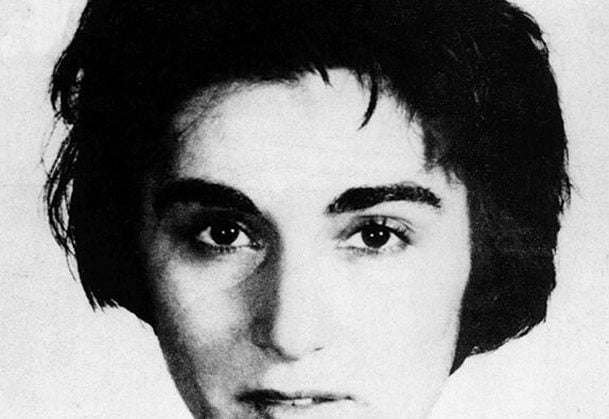
Catherine Susan “Kitty” Genovese was born on July 7th, 1935, in Brooklyn, New York, to Italian-American parents. The oldest of five, Genovese and her siblings were raised in a four-family row house in Park Slope, a neighborhood known for housing Italian and Irish families.
As a teenager, Genovese attended Prospect Heights High School, an all-girls school, where she thrived in her English and music classes and was elected “Class Cut-Up” among her graduating class of 712 students.
She was always known as a talkative and energetic person who was very popular in school (Worthen, 2019).
In 1954, her mother witnessed a horrifying murder that prompted the family to move out of the city and to New Canaan, Connecticut.
Genovese, having just graduated from high school, decided not to follow her family to the suburbs and instead remained in the city with her grandparents to prepare for her upcoming marriage to Rocco Anthony Fazzolare.
Fazzolare, an army officer and engineer, dated Genovese while he was in college and she was in high school. And although the couple did marry on October 31st, 1954, the marriage was soon annulled, and the two divorced in 1956 (Worthen, 2019).
In the late 1950s, Genovese moved to an apartment of her own in Brooklyn and began working as a bartender after she found her work as a secretary to be too unappealing.
But in August of 1961, Genovese was arrested for bookmaking – she and her friend, Dee Guarnieri, had been taking bets on horse races from bar patrons and were fined $50, and she lost her job (Worthen, 2019).
Genovese was a headstrong and hardworking individual, so she soon found a job at Ev’s Eleventh Hour Bar in Hollis, Queens. She eventually became the manager, filling in for the absentee owner.
Genovese’s extremely reliable and positive attitude was even reflected in her salary (she made roughly $750 a month, which is about $6,800 a month today), and she was saving this money to fulfill her dream goal of opening her own Italian restaurant (Worthen, 2019).
On March 13th, 1963, Genovese met Mary Ann Zielonko at Swing Rendezvous, an underground lesbian bar in Greenwich Village. The two fell fast for one another and ultimately decided to move in together.
They found an apartment on the second floor of a two-story building next to the Long Island Railroad (LIRR) in Kew Gardens, Queens (Worthen, 2019).
This new apartment in Kew Gardens would be the last place Genovese ever lived.
On March 13th, 1964, exactly a year after she met Zielonko, Genovese was brutally stabbed to death as she was coming home from a late-night shift at the bar.
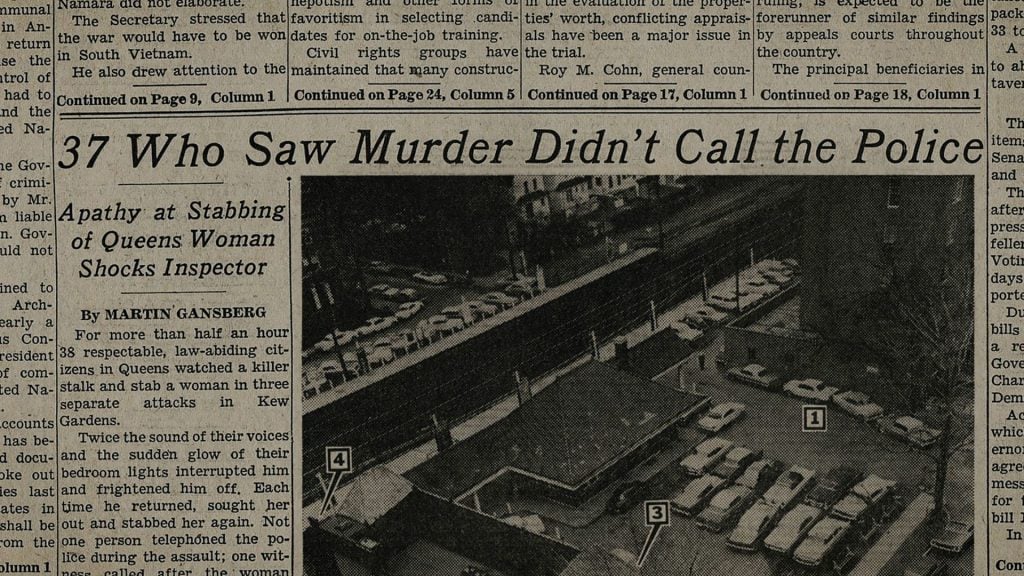
Her brutal murder left the entire community devastated and after startling reports came out that 38 witnesses saw or heard the attack and failed to act, Genovese’s story gained widespread attention.
The Murder of Kitty Genovese
Around 2:30 in the morning on March 13th, 1964, Genovese began to drive home to her Kew Gardens apartment, eager to get home to see her girlfriend on their first anniversary.
He drove around for hours, with a sharp hunting knife in his pocket, looking for a victim. And just as he was about to give up, he spotted Genovese at around 3 a.m. (Skoller, 2008).
Roughly 45 minutes from the time she departed the bar, Genovese arrived home and parked her car in the Kew Gardens LIRR parking lot, in an alleyway just feet from the front door to her building. In the few steps that it took her to walk toward the apartment complex, Moseley exited his vehicle, which was parked at a bus stop on Austin Street (see diagram below).
Moseley approached Genovese with a hunting knife in his hand, and as she tried to run toward the front of the building, he quickly overtook her and stabbed her twice in the back (Skoller, 2008).
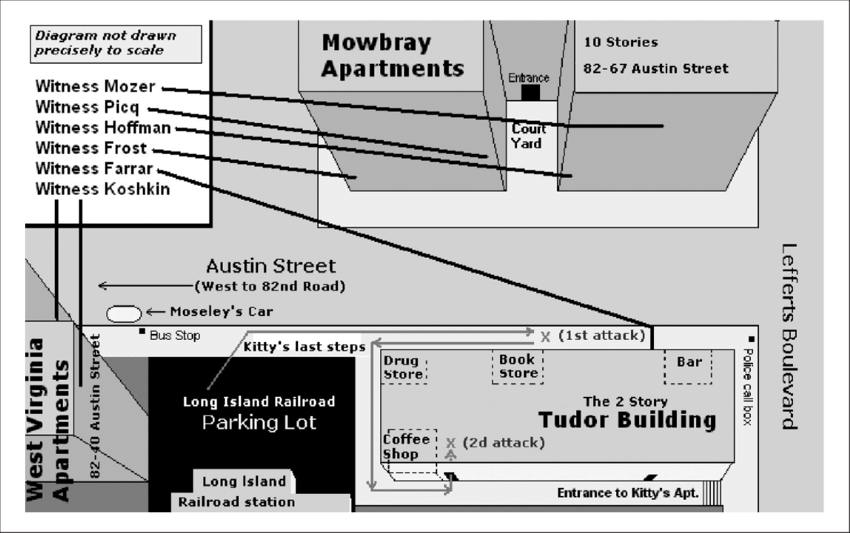
Being three in the morning, the area was completely desolate – Franken’s Pharmacy and Interlude Coffeehouse were both closed and most people were asleep. However, Robert Mozer, one of Genovese’s neighbors, awoke and saw the struggle occurring down below and called out to “Leave that girl alone!” (Krajicek, 2019).
Realizing that residents had awoken after Genovese screamed, “Oh my God, he stabbed me! Help me!” and in fear of being identified, Moseley quickly fled from the scene and back into his car.
Genovese got to her feet, not having suffered any fatal wounds, and tried to make it to her building’s entrance. Finally, inside, she collapsed in the vestibule right before the stairs.
Meanwhile, Moseley had driven away, covering his face with a wide-brimmed hat, but he returned 10 minutes later after having found Genovese lying barely conscious in a hallway at the back of the building. Now out of sight from any neighbors or people on the street, Moseley repeatedly stabbed Genovese before raping her and stealing $49 from her (Krajicek, 2019).
The stab wounds she sustained proved to be fatal, and Genovese died before making it to Queens General Hospital. She was buried three days later in Lakeview Cemetery in New Canaan, Connecticut (Pelonero, 2016).
The Aftermath
Moseley’s Conviction
Homicide detectives began the search for her attacker, initially interviewing Zielonko, Genovese’s girlfriend. They quickly dismissed her as a suspect but only after having grilled her for six hours about her relationship with Genovese.
Just six days after the brutal murder, Winston Moseley was arrested for suspected robbery in Ozone Park, Queens after a television set was found in the trunk of his white Chevrolet Corvair.
He was found guilty of all three murders and sentenced to death on June 15th, 1964. However, his sentence was later reduced to 20 years to life.
After escaping from Attica Prison in 1968 which added an additional 30 years onto his sentence and being denied parole 18 times, he died in prison on March 28th, 2016 at 81 years old (Kassin, 2017).
Public Response
Other than a short blurb titled “Queens Woman Is Stabbed to Death in Front of Home” that appeared in the New York Times on March 14th, Genovese’s murder did not receive much media attention in the initial few days following the brutal incident.
Two weeks later, New York City Commissioner Michael J. Murphy told Times editor Abraham Rosenthal about the murder, which finally motivated the major news outlet to produce a story.
The Bystander Effect
Witnesses may have assumed that others would intervene, diffusing individual responsibility to act. Furthermore, uncertainty or fear of misinterpretation might have deterred action.
This concept refers to the tendency to be less likely to assist a victim when other people are present.It can be difficult to know how to act in a high-pressure situation in which an individual appears to be in danger.
The five steps are: 1) notice that something is wrong; 2) define the situation as an emergency; 3) decide whether they are personally responsible to act; 4) choose how to help; 5) implement the chosen helping behavior.
Ultimately, it is important to prevent factors hindering an individual’s likelihood of intervening in a dangerous situation.
Inaccuracies Uncovered
Despite initial reports claiming that 38 witnesses were there on the night Genovese was stabbed to death, articles and documentaries have since been made to show another side of the story.
Specifically, a 2004 article in The New York Times questioned several claims about the initial report made just two weeks after the incident.
And a 2007 study also demonstrated that there was no actual evidence that 38 witnesses observed the murder and remained inactive (Manning et al., 2007).
In reality, because of the apartment complex’s layout and two separate attacks on Genovese, nobody saw the entire sequence of events.
And although approximately a dozen individuals (not 38) heard or saw parts of the attack, many of these individuals assumed it to be a domestic quarrel or a drunken brawl (Rasenburg, 2006).
Additionally, because the initial attack punctured Genovese’s lungs, it is unlikely she was able to scream at any volume.
It is clear that some individuals were more concerned with constructing a certain narrative that would optimize the story’s attention rather than reporting on what actually happened.
In Pop Culture
In addition to the documentary, Genovese’s story has been the subject of many television episodes, books, and songs.
Both the Law & Order episode “Remand” and the Law & Order: SVU episode “41 Witnesses” were based on the case as is season 2, episode 1 of the Investigation Discovery Channel’s A Crime to Remember series.
Although there are many controversies surrounding this brutal murder, Genovese continues to live on through many avenues of society today.
References
Rentschler, C. A. (2011). An urban physiognomy of the 1964 Kitty Genovese murder. Space and culture, 14(3), 310-329.
Darley, J. M., & Latané´, B. (1968).Bystander intervention in emergencies: Diffusion of responsibility.Journal of Personality and SocialcPsychology, 8, 377–383.
Faul, M., Aikman, S. N., & Sasser, S. M. (2016). Bystander intervention prior to the arrival of emergency medical services: comparing assistance across types of medical emergencies.Prehospital Emergency Care, 20(3), 317-323.
Gansberg, M. (1964). 37 who saw murder didn”t call the police. New York Times, 27.
Kassin, S. M. (2017). The killing of Kitty Genovese: what else does this case tell us?.Perspectives on psychological Science, 12(3), 374-381.
Krajicek, D. (2011). The killing of Kitty Genovese: 47 years later, still holds sway over New Yorkers.New York Daily News.
Lemann, N. (2014). A call for help: What the Kitty Genovese story really means.The New Yorker, 10.
Manning, R., Levine, M., & Collins, A. (2007). The Kitty Genovese murder and the social psychology of helping: The parable of the 38 witnesses.American Psychologist, 62(6), 555.
Pelonero, C. (2016).Kitty Genovese: A true account of a public murder and its private consequences. Simon and Schuster.
Queens Woman Is Stabbed to Death in Front of Home. (1964).The New York Times, p. 26.
Rasenberger, J. (2004). Kitty, 40 years later. Retrieved from https://www.nytimes.com/2004/02/08/nyregion/kitty-40-years-later.html
Rasenberger, J. (2006). Nightmare on Austin street. American Heritage Publishing Company, Incorporated.
Skoller, C. E. (2008).Twisted confessions: The true story behind the Kitty Genovese and Barbara Kralik murder trials. BookPros, LLC.Solomon, J. (Director). (2015). The Witness [Video file]. FilmRise.
Worthen, M. (2019).Kitty Genovese. Retrieved from https://www.biography.com/crime-figure/kitty-genovese
Keep LearningRentschler, C. A. (2011). An urban physiognomy of the 1964 Kitty Genovese murder. Space and culture, 14(3), 310-329.Latané, B., & Nida, S. (1981). Ten years of research on group size and helping. Psychological Bulletin, 89, 308 –324.BBC Radio 4 Case Study: Kitty Genovese
Keep Learning
Rentschler, C. A. (2011). An urban physiognomy of the 1964 Kitty Genovese murder. Space and culture, 14(3), 310-329.Latané, B., & Nida, S. (1981). Ten years of research on group size and helping. Psychological Bulletin, 89, 308 –324.BBC Radio 4 Case Study: Kitty Genovese

Saul McLeod, PhD
BSc (Hons) Psychology, MRes, PhD, University of Manchester
Saul McLeod, PhD., is a qualified psychology teacher with over 18 years of experience in further and higher education. He has been published in peer-reviewed journals, including the Journal of Clinical Psychology.
Charlotte RuhlResearch Assistant & Psychology GraduateBA (Hons) Psychology, Harvard UniversityCharlotte Ruhl, a psychology graduate from Harvard College, boasts over six years of research experience in clinical and social psychology. During her tenure at Harvard, she contributed to the Decision Science Lab, administering numerous studies in behavioral economics and social psychology.
Charlotte RuhlResearch Assistant & Psychology GraduateBA (Hons) Psychology, Harvard University
Charlotte Ruhl
Research Assistant & Psychology Graduate
BA (Hons) Psychology, Harvard University
Charlotte Ruhl, a psychology graduate from Harvard College, boasts over six years of research experience in clinical and social psychology. During her tenure at Harvard, she contributed to the Decision Science Lab, administering numerous studies in behavioral economics and social psychology.
