On This Page:ToggleFunctionTypesSchwann Cells vs OligodendrocytesMyelinationRegenerationDamage
On This Page:Toggle
On This Page:
Schwann cells are a type of glial cell that is responsible for forming the myelin sheath around theneuronsof the peripheral nervous system (PNS) and supplying nutrients to individual axons.
Each Schwann cell comprises a single myelin sheath on an axon. Therefore, numerous Schwann cells are required to myelinate the length of an axon.
A Schwann cell is a type of glial cell in the peripheral nervous system that wraps around nerve fibers, producing the myelin sheath, which insulates and increases the speed of electrical impulses along the axons.

Did you know?Schwann cells are named after Theodor Schwann, a German physiologist who discovered these types of cells in the 19th century.
Function
Schwann cells perform a variety of functions in the PNS, including:
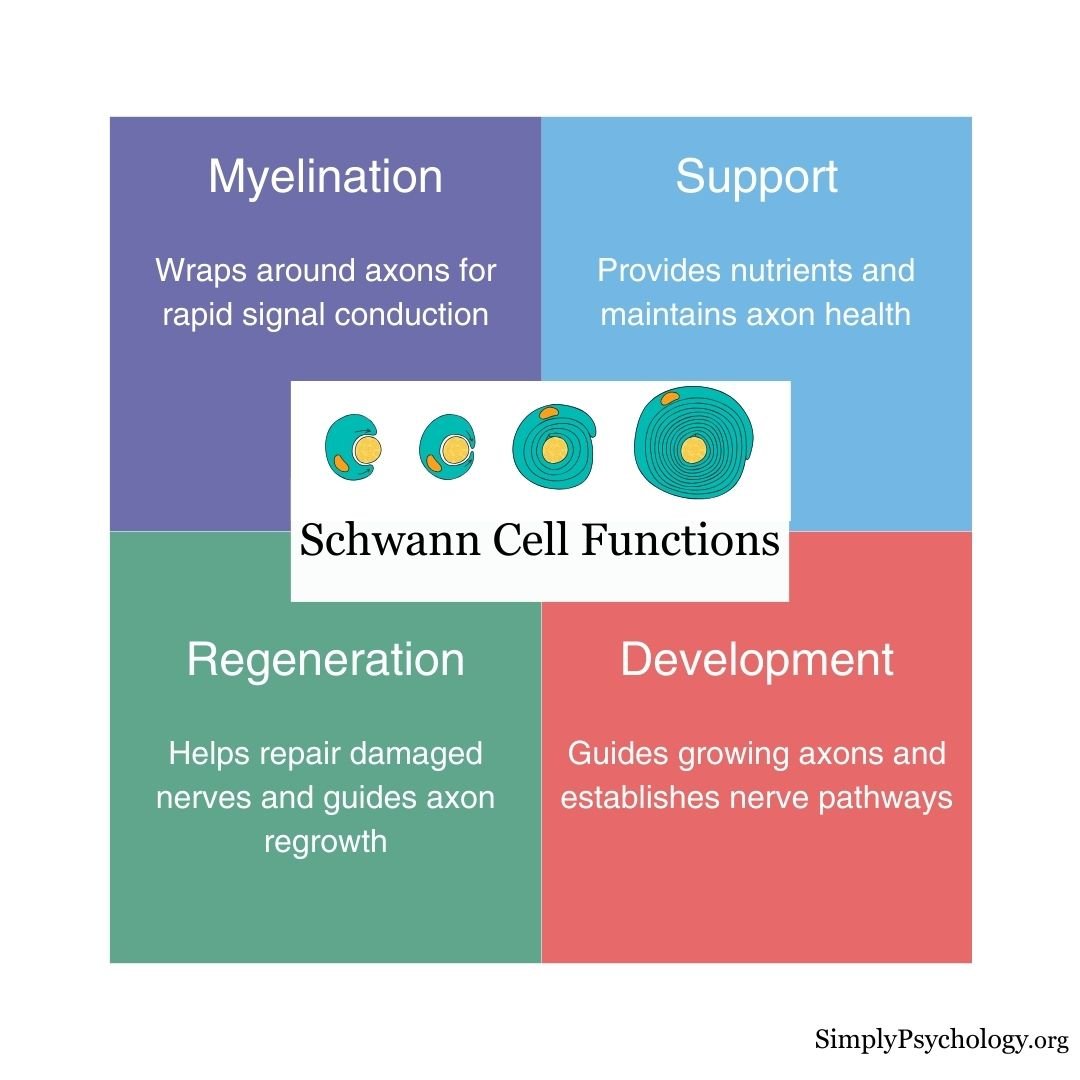
Myelination
The main function of Schwann cells is to wrap layers of myelin around peripheral nerve axons.
This myelin sheath acts as electrical insulation, allowing for rapid conduction of nerve impulses.
Each Schwann cell myelinates a single segment of one axon, with gaps called nodes of Ranvier between segments.
Support and protection
Schwann cells provide physical support and protection to nerve fibres.
Regeneration
They also release growth factors that promote axon regeneration and clear away damaged myelin and axon debris.
Development
Schwann cells play a role in the development of peripheral nerves.
They guide developing axons during embryonic development, help establish proper nerve pathways, and regulate nerve fibre diameter and organization.
Maintenance and communication
Schwann cells also produce factors that help maintain healthy axons such as maintaining bidirectional communication with neurons through various signaling molecules.
Schwann cells are also considered to be a type of glial cell.Glia cellsare non-neuronal cells that do not provide electrical impulses like neurons but function to maintain homeostasis, providing support and protection for neurons. So, although Schwann cells do not conduct electrical activity themselves, they still help ensure the normal conduction of electrical signals.
Types of Schwann Cells
Schwann cells can be either myelinating or non-myelinating.
Both types are vital in the maintenance and regeneration of axons of the neurons within the PNS.
The outside of the basal lamina is covered in a layer of connective tissues known as the endoneurium. The endoneurium contains blood vessels, macrophages, and fibroblasts.
The inner surface area of the lamina layer faces the plasma membrane of the Schwann cells.
Schwann Cells vs Oligodendrocytes
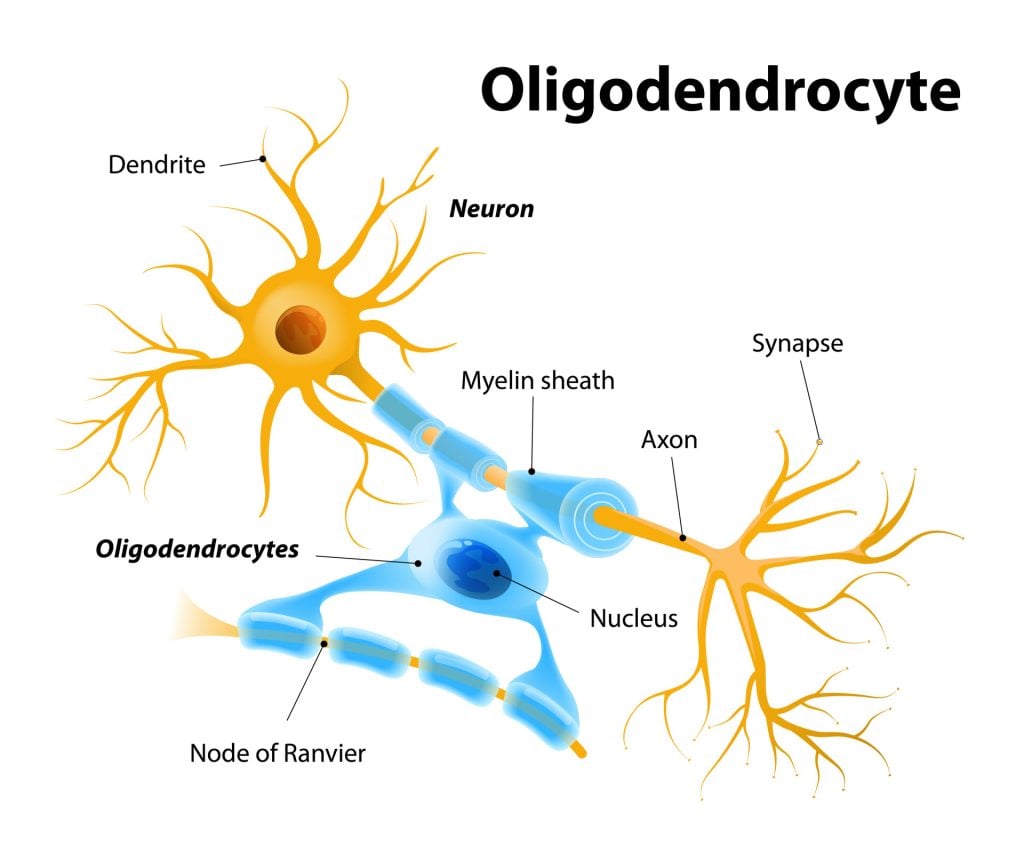
Schwann cells could be confused for oligodendrocytes, which are also myelinating cells.
However, whilst Schwann cells myelinate axons of the PNS, the oligodendrocytes provide myelination to axons in thecentral nervous system(CNS).
Also, each Schwann cell forms a single myelin sheath around an axon, whereas oligodendrocytes form myelin sheaths for multiple surrounding axons.
Oligodendrocytes are a type of glial cell in the central nervous system responsible for producing and maintaining the myelin sheath, which insulates nerve fibers and enhances the speed of electrical impulses along the axons. Unlike Schwann cells in the peripheral nervous system, a single oligodendrocyte can myelinate multiple axon segments.
How do Schwann cells form myelin?
Myelinating Schwann cells begin forming myelin sheaths around axons during fetal development.
This process involves the Schwann cell plasma membrane, which is rich in fat, wrapping concentrically around the axon in a spiral fashion, sometimes making up to 100 revolutions.
The inner layers of these wraps form the insulating myelin sheath, while the outer layers form the nucleated cytoplasmic layer called the neurilemma.
Neuregulin, a protein on the axon surface, is crucial for Schwann cell development and the extent of myelination.
Myelinated axons conduct electrical signals rapidly, enabling efficient brain function, whereas non-myelinated axons are slower conductors and are arranged in bundle-like structures.
How do Schwann cells respond to damaged axons?
When an axon in the PNS is injured, Schwann cells play a vital role in the regeneration process.
During this process, Schwann cells break down myelin and increase the production of cytokines, which are signaling molecules that attract immune cells called macrophages to clean up debris.
Schwann cells also secrete higher levels of growth factors, such as neurotrophins, which help neurons survive and function properly.
To guide the regenerating axon, Schwann cells create a pathway along the basal lamina tube, which is a layer of connective tissue that surrounds the axon.
This tube serves as a conduit for the regrowing axon, directing it towards its original target.
Without the support of Schwann cells, regenerated axons would be unable to reconnect with the muscles and organs they previously controlled, making these cells crucial for successful axon regeneration in the PNS.
Damage
Schwanna cell damage is associated with demyelinating diseases of the PNS.
Damage to Schwann cells can occur due to various factors, including genetic mutations, autoimmune responses, infections, and trauma.
When Schwann cells are damaged, the myelin sheath that insulates and supports axons can be destroyed, leading to impaired nerve conduction and potential neurodegeneration.
Signs of damaged Schwann cells include:
Disorders and diseases associated with Schwann cell damage:
Guillain-Barre Syndrome (GBS)
GBS is a rare autoimmune disorder in which the immune system attacks healthy nerve cells in the PNS.
This leads to damage to both axons and Schwann cells, resulting in secondary demyelination.
Symptoms include weakness, numbness, and potentially life-threatening paralysis if respiratory muscles are affected.
Charcot-Marie-Tooth Disease (CMT)
It disrupts Schwann cell structure and function, leading to abnormal growth and distribution of these cells.
Symptoms include muscle weakness, sensory loss in the feet and legs, difficulty walking, and foot deformities.
Diabetic Neuropathy
High glucose levels associated with diabetes can damage Schwann cells surrounding sensory and motor neuron axons, increasing the risk of neurodegeneration.
Schwannomas
Schwannomas are usually benign tumors that grow from Schwann cells, but in rare cases, they can be harmful or cancerous.
These tumors can cause nerve damage, loss of motor control, pain, muscle weakness, numbness, and tingling sensations.
References
Fallon, M., & Tadi, P. (2019). Histology, Schwann Cells.
Kohama, I., Lankford, K. L., Preiningerova, J., White, F. A., Vollmer, T. L., & Kocsis, J. D. (2001). Transplantation of cryopreserved adult human Schwann cells enhances axonal conduction in demyelinated spinal cord.Journal of Neuroscience, 21(3), 944-950.
Oudega, M., & Xu, X. M. (2006). Schwann cell transplantation for repair of the adult spinal cord.Journal of neurotrauma, 23(3-4), 453-467.
Sinha Dutta, S. (2020, February 4).What are Schwann Cells?News Medical Life Sciences. https://www.news-medical.net/health/What-are-Schwann-Cells.aspx#2

Saul McLeod, PhD
BSc (Hons) Psychology, MRes, PhD, University of Manchester
Saul McLeod, PhD., is a qualified psychology teacher with over 18 years of experience in further and higher education. He has been published in peer-reviewed journals, including the Journal of Clinical Psychology.
Olivia Guy-Evans, MSc
BSc (Hons) Psychology, MSc Psychology of Education
Olivia Guy-Evans is a writer and associate editor for Simply Psychology. She has previously worked in healthcare and educational sectors.
