While both autistic and neurotypical individuals may enjoy similar activities, the depth of engagement and the potential impact on daily life typically differ.
While the exact reasons why autistic people have special interests are unclear, it can relate back to therestricted and repetitive behaviorsthat make up part of the corediagnostic criteria for autism.
Not all autistic individuals will experience special interests, but it can be acommon signamongst those who are autistic.
This article will discuss some of the common special interests in autism, benefits, challenges, and ways you can support your interests.
As someone who is autistic and has experience with special interests, I will also be sharing some of my experiences and those of other autistic individuals throughout.
Common Special Interests in Autism
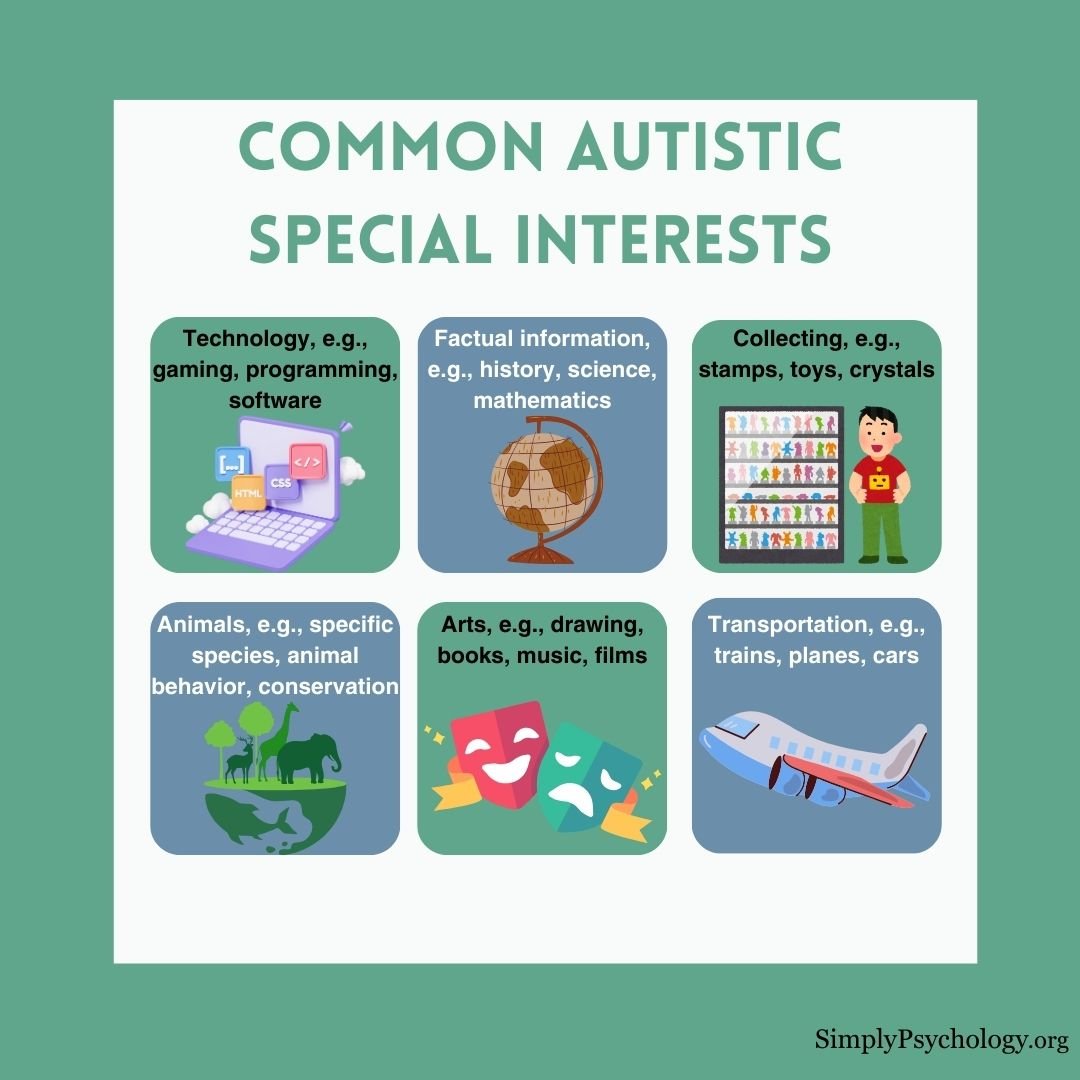
Below are some common autistic special interests:
It’s important to note that this is not an exhaustive list, as special interests can vary widely from person to person. Below are some specific special interests of actual autistic individuals:
“My main special interest is history especially victorian and tudor era but i like pretty much anything historical except military history.”
“A lot of my special interests end up being tv shows. If i really like a show, I’ll watch it like a billion times, talk about it incessantly on Tumblr… i’ll look up other projects that the actors have done and watch some of those if I’m interested…”
“I can spend a few hours talking about musical influences and random facts from bands and artists I like.”
Gender Differences in Special Interests
While both male and female autistic individuals may have special interests in any of the above areas, some studies suggest potential gender differences in the specific content of these interests.
Some research indicatesthat autistic boys and men are more likely to have special interests that are considered ‘stereotypical’ for autism, such as technology, mathematics, and mechanics.
However, autistic girls and women are more likely to have ‘social interests’ that align with typical gender roles for girls, such as animals, fictional characters, celebrities, or music.
One study suggeststhat autistic girls and women are more prone to collecting ‘seemingly random’ items like rocks, pens, or stickers compared to autistic boys and men.
A potential reason for the differences in the types of special interests between boys and girls is societal expectations and gender roles. Girls may be more encouraged to engage in socially oriented or creative activities, while boys may be encouraged to pursue STEM-related interests.
Girls and women are also more likely tocamouflage their autistic traits, which meansthey may gravitate towards intereststhat are more ‘socially acceptable’ for their gender.
Benefits of autistic special interests
Below are some of the benefits of autistic special interests:
Enjoyment and positive impact on wellbeing
Engaging in special interests can bring joy, happiness, and a sense of flow to autistic individuals.
For me, the repetitiveness of engaging in a special interest feels very self-soothing and I feel a spark of excitement when I learn something I didn’t know before.
Social opportunities
Special interests can provide a helpful conversation starter for autistic people. They can help with making connections with like-minded individuals or engage in sharing interesting knowledge and activities with others. Overall, it can create a sense of belonging.
I always used to hold back on speaking about my special interests due to high masking/camougflaging. But after pushing myself to share more, I have had a lot of positive interactions with others and developed stronger bonds. It also helps encourage others to speak about things they are passionate about too.

Enhanced learning and knowledge
The intensity of special interests can facilitate deep learning, enhance research skills, and make the individual essentially an expert on their topic of interest.
These skills can be utilized within an educational setting, leading to more meaningful engagement. For example, a student’s interest in cars could be used to learn about speed, distance, time, and physics.
“My special interest is Latin and Ancient Greek language, culture, literature, art etc. Next year I’m going to uni to study classics and I still can’t believe I’ll get to learn about my special interest full-time.”
Offers predictability in an unpredictable world
Since it is common for autistic people to have a preference for sameness and predictability, it makes sense that having a special interest can provide this predictability for them when things are uncertain.
I know exactly what happens, and I know that I enjoy it, so it does not feel like too much of a mentally demanding ‘risk’ to watch when I want to calm down. It can be a great way tomanage my anxiety.
Potential for career paths
Autistic individuals may be fortunate enough to discover a career path that aligns with their special interests.
Their deep knowledge and passion can make them a highly suitable candidate in various fields. For example, an individual with a special interest in animation may thrive in this career and be very successful at it.
Being on a career path that aligns with your special interest can make life more satisfactory for autistic individuals.
“Around a year ago, I was lucky enough to get a job basically researching and writing about cats in an office filled with cats. I wonder how many other people get lucky enough to be employed in a job that deals with their special interest (cats).”
Challenges Associated with Autistic Special Interests
Below are some of the challenges that may be associated with autistic special interests:
Social Isolation and Bullying
Interference with Daily Functioning
The intensity of autistic special interests can sometimes interfere with daily activities and responsibilities.
This can manifest as finding it difficult to transition between activities, neglecting basic needs, or problems concentrating on tasks outside of the special interest area.
They may become too emotionally invested in their interest and feel distressed when not engaging in it.
“… when my special interest was at its height, I had a hard time doing anything else. I thought about it when I woke up, as I was going about my daily errands, while I took my dog on walks, as I was falling asleep, etc. It took over my brain. I just wanted to think about it, write about it, watch it, and learn more about it. Pivoting to other thoughts and activities was genuinely hard.”
Negative Perceptions and Misunderstandings
This lack of understanding can lead to the invalidation of autistic experiences and create barriers to support.
Supporting Your Special Interests
Below are some ways in which you can support your special interests while being mindful of some of the potential challenges:
Embrace your interests
Recognize that your special interests are valuable aspects of your identity and can contribute to a fulfilling life. Don’t be afraid to embrace your passions, even if they seem unusual to others.
I find that spending dedicated time on my special interests can help me regulate myself if I feel myself close toburnout. It is one of my favorite ways to make the most of my downtime.
Finding Like-Minded Individuals
The internet provides a vast landscape for connecting with people who share your interests. Look for online forums, social media groups, or virtual meetups dedicated to your specific passions. This can be an effective way to engage in discussions, share knowledge, and combat social isolation.
I have usedBumble BFFas a way to meet new friends. You can write a bit about yourself and include your special interests in your bio so that you are catching the attention of those who are similar to you. It can also be a great conversation starter if you share this interest with someone.
Balance Special Interests with Other Aspects of Life
A well-structured schedule can help you allocate time for both your special interests and other responsibilities. Establish a routine that balances dedicated time for your interests with time for work, social activities, self-care, and other obligations.
Sometimes, I find myself feeling a bit too fixated on my interests, where it feels like it is all-encompassing. I know that when I am getting to this stage, I need to have a break for a few days or weeks with a focus on different interests.
This feels important for my mental health, although it depends on what your interests are as to whether you feel you need extended breaks too.
“I can also use it as motivation. When I was still working and my special interest was a weekly anime, I’d just tell myself that at the end of every week, there will be a next episode, and it helped me get through the week…”
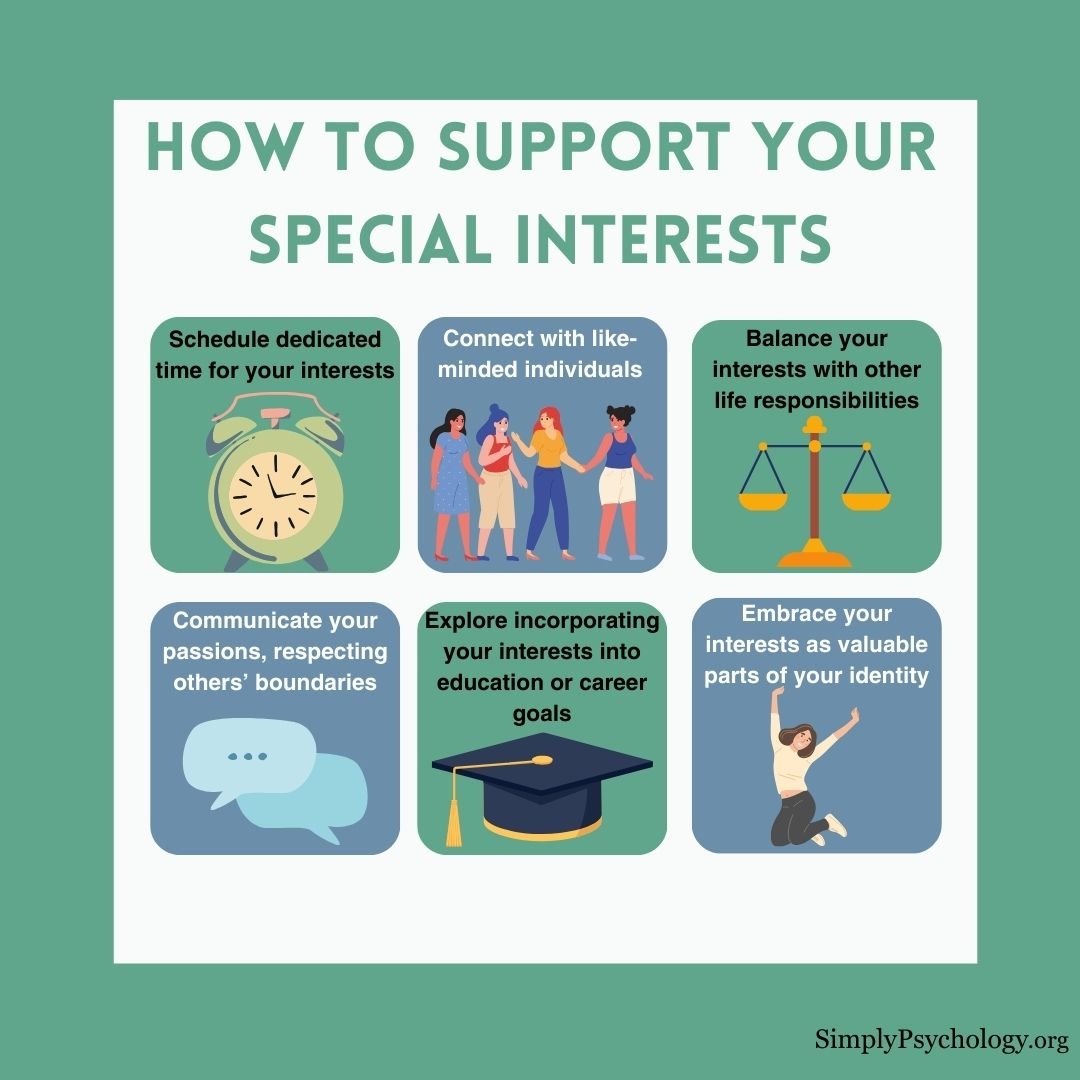
Communicate Your Special Interests Effectively
Be mindful of your audience and the social context when choosing to share your interests. Gauge their level of interest and tailor your approach accordingly.
When introducing your interest, start with a brief and engaging overview to pique their curiosity. Focus on the most intriguing aspects to capture their attention.
Draw connections between your interest and their own experiences or knowledge to make it more relatable and engaging for them.
Remember that not everyone will be interested in hearing about your special interest as much as you would love to talk about it. Try to find a balance in how much you share.
Incorporate Special Interests into Education and Career Goals
While you do not need to have a career in your special interest (it may also be unattainable for you, depending on what it is), this can be an option for some people.
Research academic programs or courses aligned with your passions. This could involve pursuing a degree in a field related to your interest or taking elective courses to expand your knowledge base.
For example, an interest in animals could lead to exploring careers in veterinary science, zoology, or animal behavior.
Likewise, you could try seeking mentors who work in fields related to your interests and ask about volunteering or internship opportunities.
If your interest lends itself to entrepreneurship, explore options for starting your own business or freelance work related to your passion. This can provide greater autonomy and flexibility in how you engage with your interests.
Special Interests vs. Hyperfixations
Autistic special interests may be comparable to hyperfixations, which are common inADHDbut can be experienced in many people.
Both have similarities, including:
However, there are differences between special interests and hyperfixations, including:
Example of a Hyperfixation:
Example of a Special Interest:
Both can provide enjoyment and lead to increased knowledge or skills. However, hyperfixations tend to be more all-consuming and potentially disruptive to daily life.
While special interests are generally seen as positive, frequent hyperfixations may cause stress and benefit from therapeutic support.
Understanding these differences helps in providing appropriate support and accommodations for neurodivergent individuals, recognizing that experiences vary widely among people with autism or ADHD.
References
Allely, C. (2019). Exploring the female autism phenotype of repetitive behaviours and restricted interests (RBRIs): a systematic PRISMA review.Advances in Autism,5(3), 171-186.https://doi.org/10.1108/AIA-09-2018-0030
Davey, L. (2020). Using the special interests of autistic children to facilitate meaningful engagement and learning.Good Autism Practice (GAP),21(1), 43-64.
Edwards, H., Wright, S., Sargeant, C., Cortese, S., & Wood‐Downie, H. (2024). Research review: A systematic review and meta‐analysis of sex differences in narrow constructs of restricted and repetitive behaviours and interests in autistic children, adolescents, and adults.Journal of Child Psychology and Psychiatry,65(1), 4-17.https://doi.org/10.1111/jcpp.13855
Grove, R., Hoekstra, R. A., Wierda, M., & Begeer, S. (2018). Special interests and subjective wellbeing in autistic adults.Autism Research,11(5), 766-775.https://doi.org/10.1002/aur.1931
Hiller, R. M., Young, R. L., & Weber, N. (2014). Sex differences in autism spectrum disorder based on DSM-5 criteria: evidence from clinician and teacher reporting.Journal of abnormal child psychology,42, 1381-1393.https://doi.org/10.1007/s10802-014-9881-x
Spackman, E., Smillie, L. D., Frazier, T. W., Hardan, A. Y., Alvares, G. A., Whitehouse, A., & Uljarević, M. (2023). Characterizing restricted and unusual interests in autistic youth.Autism Research,16(2), 394-405.https://doi.org/10.1002/aur.2863

Saul McLeod, PhD
BSc (Hons) Psychology, MRes, PhD, University of Manchester
Saul McLeod, PhD., is a qualified psychology teacher with over 18 years of experience in further and higher education. He has been published in peer-reviewed journals, including the Journal of Clinical Psychology.
Olivia Guy-Evans, MSc
BSc (Hons) Psychology, MSc Psychology of Education
Olivia Guy-Evans is a writer and associate editor for Simply Psychology. She has previously worked in healthcare and educational sectors.
