Emotional dysregulation inautistic individualsrefers to difficulties in effectively managing emotional responses.
This can manifest as challenges in managing the intensity, duration, and expression of emotions, often resulting in prolonged emotional episodes, rapid mood shifts, or intense reactions to seemingly minor triggers.
Autistic individuals may struggle with identifying and communicating their emotions (alexithymia), leading to heightened frustration.
Signs of emotional dysregulation in autism can vary widely among individuals. These common indicators may help in recognizing and understanding emotional challenges, but remember that each autistic person’s experience is unique and may not include all signs.
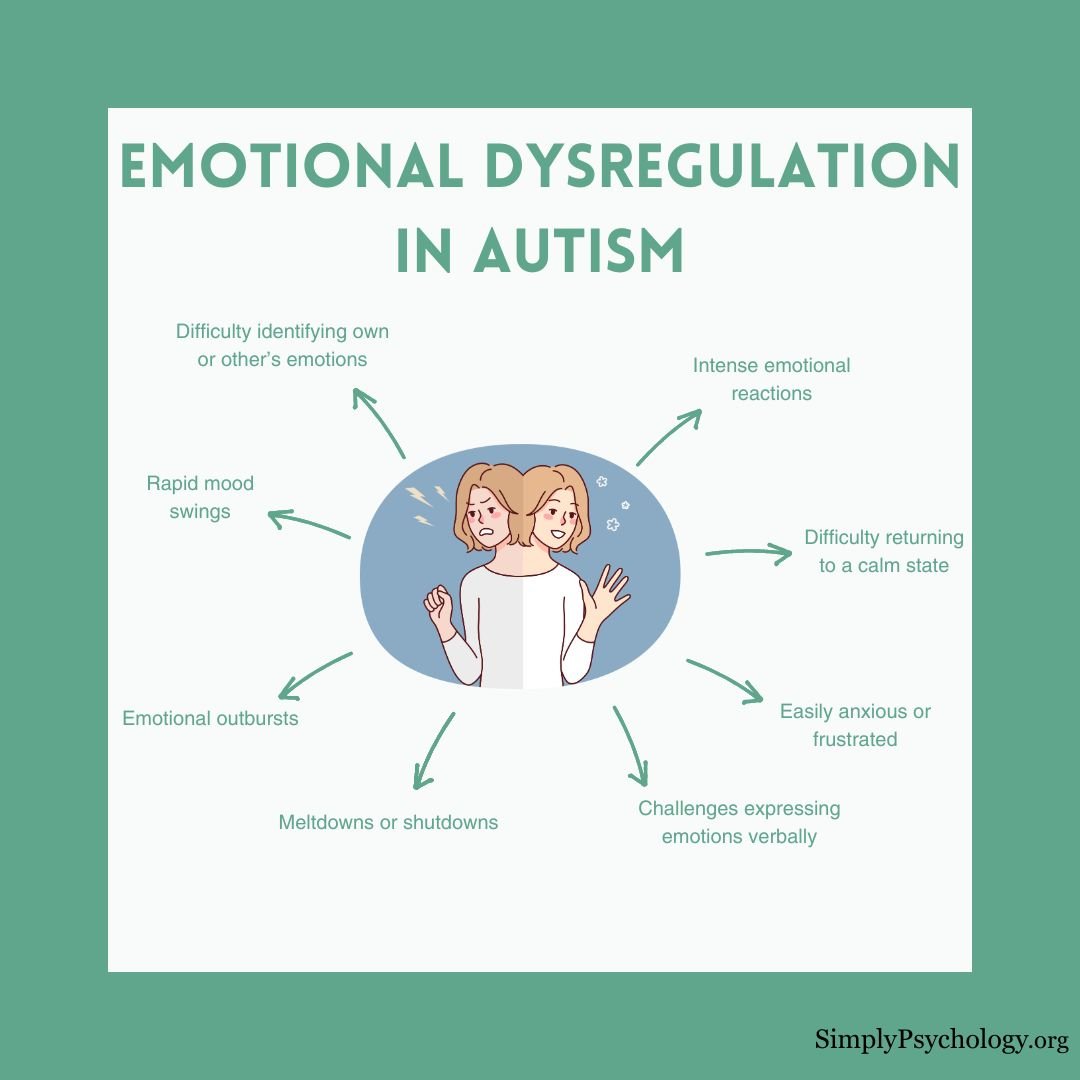
It’s important to note that these experiences can vary widely among autistic individuals and may be context-dependent.
Emotional dysregulation is not exclusive to autism and can be observed in various other neurodevelopmental and mental health conditions.
It’s a prominent feature in Attention Deficit Hyperactivity Disorder (ADHD), where individuals often struggle withregulating their emotions, leading to impulsivity and mood swings.
Similarly, emotional dysregulation is also seen in conditions such as Borderline Personality Disorder, Bipolar Disorder, and even in some cases of anxiety and depression.
Signs of emotional dysregulation in autism
Autistic individuals may display several signs of emotional dysregulation (ED). While ED is not a universal experience for all autistic people, it is a common challenge, often stemming from the interplay of core autistic characteristics and external factors.
Below are some of the signs of emotional regulation differences in autistic individuals.
It’s important to note that these signs are not exhaustive and might vary depending on individual experiences and developmental stages.
Intense and Frequent Negative Emotions
Autistic individuals experiencing ED might exhibit heightened negative emotions like sadness, anger, anxiety, or frustration more frequently and intenselycompared to their neurotypical peers.
Chrisdescribes his emotional dysregulation as feeling an “immense combination of emotions and feelings” that make him feel nauseous.
Intense and frequent negative emotions can manifest as:
Rapid Emotional Shifts
ED can also involve significant fluctuations in emotional states, sometimes referred to as emotional lability.
Megan, a neurodivergent life coach characterizes emotional dysregulation as experiencing rapid and intense emotional shifts, describing it as “emotional whiplash.”
Rapid emotional shifts can look like:
Challenges with Emotional Awareness and Expression
Difficulties identifying, understanding, and communicating emotions effectivelycan significantly contributeto ED in autism.
Chrishighlights that his difficulties in describing his emotions are not due to a lack of feeling, but rather an overwhelming intensity of emotions. This intense experience leaves him feeling “frozen” and unable to express himself.He notes that this can be particularly challenging during a meltdown, a state where forcing communication can be counterproductive.
Challenges can manifest as:
Meltdowns and Shutdowns
Autistic individuals experiencing emotional dysregulation may exhibit meltdowns or shutdowns, which are intense responses to overwhelming emotional or sensory stimuli.
These reactions can be more severe and frequent compared to typical stress responses in neurotypical individuals.
Meltdowns and shutdowns can manifest as:
Coping Mechanisms and Regulatory Behaviors
Autistic individuals with emotional dysregulation may develop various strategies to manage challenging emotions.
While some of these can be helpful, others can be detrimental or pose challenges in certain contexts:
What can trigger emotional dysregulation in autism?
Some common triggers for emotional dysregulation (ED) in autistic individuals include:
Frustrating Situations
Autistic individuals maystruggle with regulating their emotionsin frustrating situations, exhibiting heightened negative affectivity, venting, and avoidance behaviors compared to their non-autistic peers.
For example, consider an autistic person attempting to complete an online job application form. They encounter several challenges:
While these issues might be merely annoying for a neurotypical person, they could trigger an autistic individual to experience intense anger, upset, repetitive self-talk, or complete abandonment of the task.
Sensory Sensitivities
Sensory sensitivities, a common characteristic of autism, could contribute to emotional overload and subsequent dysregulation.
This is because autistic individuals may experience heightened or altered sensory responses to stimuli like sounds, textures, and lights.
For example, an autistic person may become agitated and upset when they experience hot weather, itchy clothing, and the feel of hair on their neck at the same time.
It’s essential to recognize thatsensory overloadcan be overwhelming and potentially lead to emotional distress and dysregulation.
Social Communication Challenges
Differences in social communication, a core feature of autism, can also trigger ED. Misinterpreting social cues or struggling to express oneself effectively can lead to frustration, anxiety, and emotional outbursts.
Imagine receiving a message from your friend that says: “Hey, can we talk?”
For an autistic individual, this vague message could be challenging to interpret. They might not know if they are supposed to phone their friend to talk or whether the friend is suggesting to meet in person or carry on texting. They might not know what their friend wants to talk about or what to expect.
This ambiguity can lead to anxiety about how to respond appropriately, potentially triggering emotional dysregulation.
Likewise, if an autistic person struggles to identify and verbalize how themselves or others are feeling, this can result in misunderstandings and frustration.
Similarly, struggles withtheory of mind, or understanding others’ perspectives,can further complicate social interactionsand heighten emotional vulnerability.
Transitions and Changes in Routine
Many autistic individuals thrive on predictability and routine, and unexpected changes can be highly upsetting.
This can lead to emotional distress and behavioral difficulties, as the familiar structure that provides a sense of security is disrupted.
Imagine having a specific bedtime routine that lasts about 20 minutes before getting into bed. However, one night you get a phone call at the start of your routine which delays you getting to bed on time.
An autistic person may become irritable and snappy with the person who has interrupted their routine, causing confusion, tension, and possibly a falling out.
Difficulties with Cognitive Flexibility
Cognitive inflexibility,often observed in autism, can contribute to ED. This inflexibility refers to challenges with shifting attention, problem-solving, and adapting to new situations.
When confronted with unexpected events or demands, individuals with cognitive inflexibility may struggle to adjust, leading to frustration and emotional outbursts.
For instance, an autistic person is out at a restaurant and is served food that they did not order. While non-autistic people might be able to point out this mistake to the server straight away, an autistic person may take this unexpected event negatively.
They may also take longer to process what happened and also take longer to work out how to solve the problem.
Intolerance of Uncertainty
This intolerance can significantly impact emotional regulation, as the unknown can be highly anxiety-provoking.
IU can lead to attempts to control situations rigidly, and when these attempts are unsuccessful, emotional dysregulation may occur.
For instance, an autistic person is planning to attend a party but feels intense anxiety because they are not sure when the party starts, what specific activities are planned, and when it is all likely to finish. Everyone else seems happy to ‘go with the flow,’ but all the uncertainty makes the autistic person feel reluctant to attend.
Impact on Daily Life and Relationships
Below are some ways that emotional dysregulation (ED) can impact daily life and relationships. It is important to note that this is not an exhaustive list, and the impact of ED can vary from person to person.
How to manage emotional dysregulation
Managing emotional dysregulation in autism depends on what specifically an individual may find challenging. Below are some general tips which may be helpful:
Practice Describing Feelings
Regularly practicing the identification and description of feelings can be beneficial. This can be through using a feelings wheel or journalling for instance.
While this might be challenging, especially during periods of heightened emotions, perseverance with this practice can be helpful.
Cultivate Awareness through Mindfulness
Mindfulness-based interventionscan be helpful in managing emotional dysregulation. It can be difficult to control emotions without first being aware of them.
Developing a consistent language to communicate about emotions, combined with practicing mindfulness, can be a beneficial approach.
Implement structured problem-solving techniques
To address difficulties with cognitive flexibility and intolerance of uncertainty, develop a structured problem-solving approach:
Develop a personalized emotional regulation scale
Create a visual scale representing your emotional states, tailored to your specific experiences. This can help address challenges with emotional awareness and expression:
Use this scale regularly to check in with yourself and communicate your emotional state to others. When you notice yourself moving up the scale, implement the corresponding coping strategies early. Share this scale with trusted individuals to help them understand and support you better. This tool can improve self-awareness, facilitate communication about emotions, and promote proactive regulation.
Utilize special interests
Engaging with special interests can serve as a powerful self-regulation tool for autistic individuals during stressful times.
To implement this strategy:
Develop a “safe space” protocol
Designate a quiet, low-sensory area in your home or workplace as your safe space. Equip it with comfortable seating, soft lighting, and calming items like weighted blankets or noise-cancelling headphones.
Establish clear guidelines with others about respecting this space, such as using a “do not disturb” sign when you need uninterrupted time.
Agree on how long you might need and how others should communicate with you while you’re using it. Regularly use this space, even when not overwhelmed, to make it a familiar and effective retreat for managing emotional dysregulation.
References
Barnes, G. L., Ozsivadjian, A., Baird, G., Absoud, M., & Hollocks, M. J. (2024). Investigating the Effects of Transdiagnostic Processes on Anxiety and Depression Symptoms in Autistic Young People: the Mediating Role of Emotion Dysregulation.Journal of Autism and Developmental Disorders, 1-12.https://doi.org/10.1007/s10803-024-06246-0
Cai, R. Y., Richdale, A. L., Uljarević, M., Dissanayake, C., & Samson, A. C. (2018). Emotion regulation in autism spectrum disorder: Where we are and where we need to go.Autism Research,11(7), 962-978.https://doi.org/10.1002/aur.1968
Dell’Osso, L., Massoni, L., Battaglini, S., De Felice, C., Nardi, B., Amatori, G., … & Carpita, B. (2023). Emotional dysregulation as a part of the autism spectrum continuum: a literature review from late childhood to adulthood.Frontiers in Psychiatry,14, 1234518.https://doi.org/10.3389/fpsyt.2023.1234518
Mills, A. S., Tablon-Modica, P., Mazefksy, C. A., & Weiss, J. A. (2022). Emotion dysregulation in children with autism: A multimethod investigation of the role of child and parent factors.Research in Autism Spectrum Disorders,91, 101911.https://doi.org/10.1016/j.rasd.2021.101911

Saul McLeod, PhD
BSc (Hons) Psychology, MRes, PhD, University of Manchester
Saul McLeod, PhD., is a qualified psychology teacher with over 18 years of experience in further and higher education. He has been published in peer-reviewed journals, including the Journal of Clinical Psychology.
Olivia Guy-Evans, MSc
BSc (Hons) Psychology, MSc Psychology of Education
Olivia Guy-Evans is a writer and associate editor for Simply Psychology. She has previously worked in healthcare and educational sectors.
