On This Page:ToggleNormative InfluenceInformational InfluenceLearning Check
On This Page:Toggle
On This Page:
Deutsch and Gerrard (1955) identified two reasons whypeople conform:
Normative Influence
Normative social influence is where a person conforms to fit in with the group because they don’t want to appear foolish or be left out.
Normative social influence is usually associated with compliance, where a person changes their public behavior but not their private beliefs. This means any change of behavior is temporary.
The human need for affiliation and acceptance in social groups drives normative influence. It can cause individuals to adopt behaviors, attitudes, or values that they might not personally hold to fit in or to avoid disapproval from the group.
This theory plays a fundamental role in understanding group dynamics and social behavior, illustrating how the fear of social rejection can significantly influence individual behaviors and decisions.
Examples
Asch Line Study
In the experiment, participants were shown a target line and asked to select the line (out of three options) that matched its length.
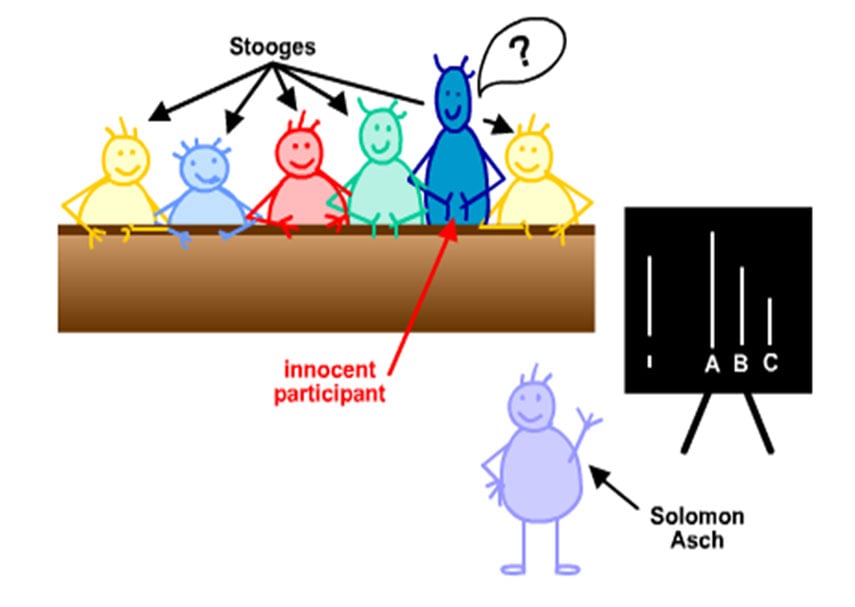 asch
asch
However, each group was mostly comprised of confederates of the experimenter who intentionally selected the wrong line. The actual participant was placed last or near the end in the order of responses.
Despite the obvious answer,Asch foundmany participants conformed to the incorrect majority answer.
Even though participants knew the group’s choice was incorrect, they conformed to avoid the discomfort of disagreeing with the group or standing out.
When the participants were interviewed after the experiment, most said that they did not believe their conforming answers but had gone along with the group for fear of being ridiculed or thought “peculiar.
This study demonstrated the power of normative influence, as individuals were willing to contradict their senses to conform to the group.
Informational Influence
Informational social influence refers to the tendency to conform to what others are doing or saying because we perceive them as a source of accurate information, particularly in ambiguous or uncertain situations.
Informational social influence is where a person conforms because they have the desire to be right and look to others who they believe may have more information. People may experience an ambiguous (i.e., unclear) situation and socially compare their behavior with the group.
This type of conformity occurs when a person isunsure of a situation or lacks knowledge and is associated with internalization. This theory highlights how the desire to make correct or appropriate decisions can lead to social conformity.
Individuals publicly change their behavior to fit in with the group while agreeing with them privately. An internal (private) and external (public) change of behavior.
This is the deepest level of conformity, where the group’s beliefs become part of the individual’s belief system.
Sherif’s Autokinetic Effect Experiment
In this classic study, participants were shown a stationary pinpoint of light in a dark room and asked to estimate how far the light moved.
When individuals made estimates in a group, their estimates converged, illustrating informational social influence as they used others’ estimates as a guide in an ambiguous situation.
Jenness’ Bean Jar Experiment
Jenness conducted a study on conformity where participants were asked to estimate the number of beans in a jar. Initially, each participant made an individual estimate, and then, they estimated it as a group.
His findings indicated that when the task was performed within a social group, participants’ estimates converged to a similar value, despite their initial individual estimates varying significantly.
This study effectively demonstrated the influence of the majority, proving that a group can impact individuals’ behaviors and beliefs.
This is likely an instance of informational social influence, as participants would be unsure about the actual number of beans in the jar.
Learning Check
Here are some real-life examples of conformity. For each one, identify the type of conformity that is happening. You should try toexplain your answers.
 normative social influence
 informational social influence
References
Asch, S. E. (1951). Effects of group pressure upon the modification and distortion of judgment. In H. Guetzkow (ed.)Groups, leadership and men. Pittsburgh, PA: Carnegie Press.
Deutsch, M., & Gerard, H. B. (1955).A study of normative and informational social influences upon individual judgment.The Journal of Abnormal and Social Psychology, 51(3), 629.
Jenness, A. (1932). The role of discussion in changing opinion regarding a matter of fact.The Journal of Abnormal and Social Psychology, 27, 279-296.
Sherif, M. (1935). A study of some social factors in perception.Archives of Psychology, 27(187).

Olivia Guy-Evans, MSc
BSc (Hons) Psychology, MSc Psychology of Education
Olivia Guy-Evans is a writer and associate editor for Simply Psychology. She has previously worked in healthcare and educational sectors.
Saul McLeod, PhD
BSc (Hons) Psychology, MRes, PhD, University of Manchester
Saul McLeod, PhD., is a qualified psychology teacher with over 18 years of experience in further and higher education. He has been published in peer-reviewed journals, including the Journal of Clinical Psychology.
