It is almost like a knee-jerk reaction or the inability to apply the breaks before acting. Thus, people with ADHD tend to react first and think afterward.
Due to the way the ADHD brain is functioning, resisting such impulses can be extremely difficult, with many not fully realizing and recognizing the consequences of what they have done or said until the act is well on its way or already finished (Winstanley, Eagle & Robbins, 2006).

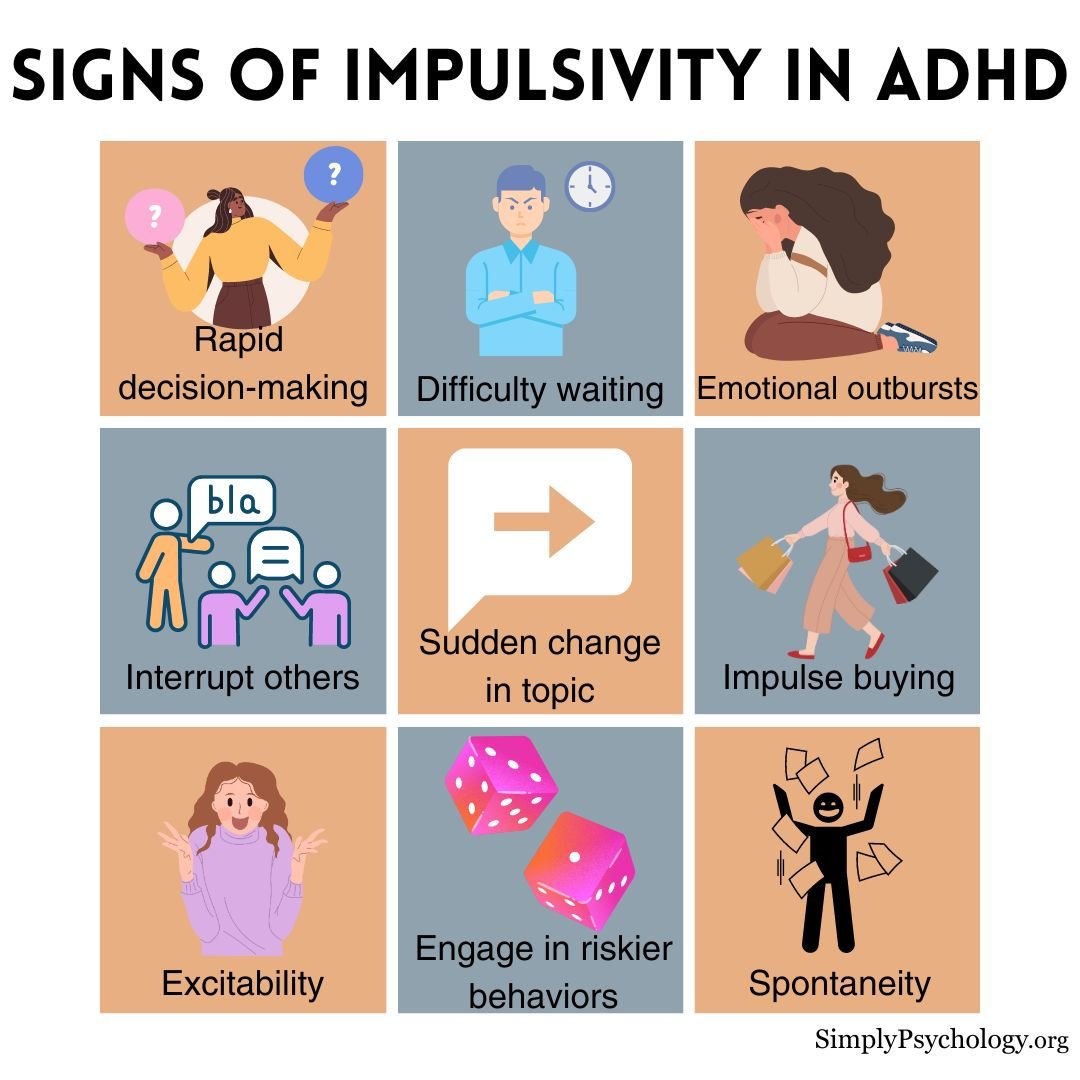
Signs of Impulsivity In ADHD
There are many ways impulsivity can manifest, with some being more obvious than others. Let us now look at some of the most common ways it can be expressed:
Impulsive decision-making
People withADHDare more prone to impulsive decision-making and quicker reactions to situations without thinking about the end result.
For example, Kimberly Quinn, during her TED talk titled “The double-edged sword: ADHD and impulsivity,” described one of her experiences as “there was no way to see around these impulse buys, there was no shut-off switch” (TEDx Talks, 2020).
Such impulsive decision-making can thus have a direct impact on various areas of one’s life, making it difficult to tune out more rational thoughts.
Verbal impulsivity
Verbal impulsivity is the tendency for people to verbally express their thoughts, emotions, and opinions about a situation without much thought over how they make come across or impact others.
For example, they may interrupt people, jump into conversations, change topics suddenly, or even blurt out their thoughts on what you said, did, or are even wearing.
This is not stemming from a malicious point but from them talking without thinking fully about how their words may come across to others.
Emotional impulsivity
For example, crying intensely when receiving constructive criticism, angrily shouting when feeling emotionally attacked, or having more heightened emotional excitability overall.
This type of impulsivity can often stem from other ADHD symptoms, such astroubles with emotional regulation, sensitivity to criticism, and perfectionistic tendencies.
Financial impulses
Financial impulsivity is a form of reactive behavior with people being more susceptible to things such as deals, sales, or limited-time offers.
With the rise of fast fashion and heavily discounted websites, consumerism and the need to buy to get thatdopaminehit of purchasing something new can exacerbate this.
Additionally, big and more expensive purchases may be more rushed without fully considering their value, need, and usability in their lives.
Impatience
People with ADHD are likely to be impatient in many situations, such as at work, in relationships, and even with themselves.
For example, they may get easily frustrated when queuing, waiting for their turn to speak, receiving an answer, or getting something done. They can also often experience a sense of restlessness or uneasiness and this can be exacerbated with the more they have to wait.
Such impatience can then directly link and lead to several other impulses mentioned previously, such as emotional, verbal, and even financial.
Risky behaviors
Lastly, risky behavior in ADHD impulsivity is the tendency to seek out activities and engage in behaviors that could lead to dangerous and negative consequences, sometimes to get that instant stimulation.
For example, this can manifest as reckless driving, pranks, trespassing, gambling, or misuse of substances (Ortal, 2015), gambling, or sexual acts without adequate protection.
These actions can be destructive not only to themselves but also to their loved ones and wider circle.
What are the Consequences of Impulsivity?
Just as impulsivity can manifest in various different forms, so can the consequences of it, which can range from mild to rather dangerous.
A common one will bechallenges with interpersonal relationships, such as misunderstandings, emotions being hurt, or people not feeling heard, which can lead to conflicts and falling outs.
Safety concerns can also arise, especially if the impulsions in question are linked with risky behaviors or quick decision-making on the spot.
People can be reactive without thinking and get themselves in dangerous situations rather quickly. Repercussions of this can range from physical and mental to even law and legal troubles.
Issues at either school, universityor the workplacemay also manifest due to impulses. For example, focusing on tasks can be more challenging, disrupting classes or work meetings and struggling to prioritize work, which can hinder performance.
People may also be labeled as misbehaved or difficult to work with, leading to academic or occupational troubles. In severe cases, being expelled or let go from your job can also happen, or on the flip side, the impulse to quit jobs or switch educational pathways and degrees may also manifest.
Finances may take a hit as well, especially in relation to financial impulses such as erratic spending or impulse buying. Certain sale periods may be especially triggering for people. This can lead to troubles managing finances, having savings, and budgeting for necessities (Bangma, Tucha, Fuermaier, Tucha & Koerts, 2020).

Lastly, someone’s mental and physical well-being can be directly impacted due to all the aforementioned reasons. Feelings of regret over actions and behaviors can arise, which can also lead tohigher stress.
Some people may alsowithdraw sociallyor be ostracised, increasing the chances of social isolation and loneliness (Bastien, 2013).
What Causes Impulsivity in ADHD?
ADHD impulsivity does not have a single attributable cause, but it is more of a collection of neurobiological and environmental factors working together to generate and sustain it.
Primarily, certain dysregulations in how the brain handles executive functions (such as impulsivity and decision-making) have been noted (Swanson, 2003). This can make it more difficult to apply critical thinking and engage in more inhibitory patterns around emotions and behavior.
Neurotransmitterimbalances, especially those responsible forrewardand pleasure such as dopamine, can also be present.
Dysregulation in these pathways can cause a reduction in dopamine, increasing the likelihood of impulsive behavior to get that sense of reward (Williams & Dayan, 2005).
People with ADHD are, thus, far more likely to act impulsively in need of that dopamine hit while also struggling to apply the breaks due to executive function challenges.
Such conditions often exhibit their own symptoms of impulsivity, so cooccurrence increases such behaviors and emotions further.
How to Manage ADHD Impulsivity
As impulsivity is one of the core symptoms of ADHD, its consequences can range and affect several areas of life.
Learning how better to control such actions, emotions, and behaviors can, thus, have wide-reaching benefits on someone’s well-being, relationships, and overall life.
Let us discuss some ways in which ADHD impulsivity can be managed.
Self-compassion
Remember to give yourself time to process and reflect without going into self-destructive talks or using diminishing language to punish yourself.
Identify behaviors
In order to manage impulsivity, you first need to be aware of which behaviors are linked to it. People can be different in how their ADHD is expressed, so understanding how impulsivity manifests for you is a good first step.
You can speak to trusted loved ones and see their opinions as people who know you, and of course, seek advice from a professional who can better help guide you.
You can also keep a journal to document your reflection so you can keep better track of your thoughts and progress.
Remove or reduce triggers
Ensuring your environment is not actively encouraging or triggering impulsive actions or decisions is another way to manage impulsivity.
For example, unsubscribing from marketing emails around sales periods, learning to write down your thoughts first if you tend to have verbal impulses, or asking to hang out at less stimulating places with your friends.
By doing this, you are actively limiting situations that exacerbate any impulsive tendencies.
Create obstacles
On a similar note, you can actively try and create obstacles that will prevent you from engaging in impulsive behaviors. Some examples can be:
Learningemotional management skillscan be a great way to both prevent impulses but also de-escalate them before they enter a more dangerous or distractive zone.
These can be especially helpful if you are prone to verbal and emotional impulses such as outbursts, intense emotional fluctuations, or buying, drinking, or eating your way out of intense emotions.
Some examples of such techniques are breathing exercises, mindfulness (Virone, 2023), and physical exercise (Wigal, Emmerson, Gehricke & Galassetti, 2013).
Take responsibility
Taking responsibility for your actions and behaviors can greatly help in several different areas and show that you have reflected on your behavior.
Firstly, in your interpersonal relationships, take accountability and apologize for any outburst or not consider your loved one’s feelings.
Plan and think ahead
You can use visual cues like Post-Its or even digital apps to help you stay focused and organized. Through trial and error, you can slowly figure out what works best for you.
Break down long-term goals
Lastly, breaking down long-term goals into smaller, more manageable action points can greatly help curb impulses (it can also help withgetting motivated to do tasksyou struggle to focus on due to impulsivity).

You can ask loved ones for their help in keeping you accountable, and remember to celebrate all milestones and small victories.
Consider therapy
Seeking therapycan be invaluable for gaining skills and strategies tailored to your unique needs. A therapist specializing in ADHD and impulsivity can help identify your triggers, teach coping methods, provide accountability through regular check-ins, and support you on harder days.
Whether individual or group therapy, having a safe space to process emotions and experiences can lessen impulses and build self-awareness.
Therapy need not be lifelong either – even short-term can equip you with skills to better manage impulsivity moving forward.
Therapies such as cognitive behavioral therapy (CBT), dialectical behavior therapy (DBT), or acceptance and commitment therapy (ACT) may all be beneficial for learning techniques for managing impulsivity.
FAQs
Is impulsivity always a sign of ADHD?Impulsivity, while being one of the core symptoms of ADHD, is not necessarily always a sign of ADHD. Other people on the neurodiverse spectrum can also experience impulsive tendencies, e.g., individuals with Autistic traits (Hlavatá, Kašpárek, Linhartová, Ošlejšková & Bareš, 2018).In addition, some mental health conditions, such as bipolar (Najt, 2007) or borderline personality disorder (Berlin, Rolls & Iversen, 2005), and even people with dependencies such as drugs or alcohol may show this behavior. Moreover, people in the neurotypical population may express impulsive behavior simply due to their personalities.Lastly, age also plays a factor, e.g., children tend to be more impulsive as they are still in their early developmental stages.
Is impulsivity always a sign of ADHD?
Impulsivity, while being one of the core symptoms of ADHD, is not necessarily always a sign of ADHD. Other people on the neurodiverse spectrum can also experience impulsive tendencies, e.g., individuals with Autistic traits (Hlavatá, Kašpárek, Linhartová, Ošlejšková & Bareš, 2018).In addition, some mental health conditions, such as bipolar (Najt, 2007) or borderline personality disorder (Berlin, Rolls & Iversen, 2005), and even people with dependencies such as drugs or alcohol may show this behavior. Moreover, people in the neurotypical population may express impulsive behavior simply due to their personalities.Lastly, age also plays a factor, e.g., children tend to be more impulsive as they are still in their early developmental stages.
Impulsivity, while being one of the core symptoms of ADHD, is not necessarily always a sign of ADHD. Other people on the neurodiverse spectrum can also experience impulsive tendencies, e.g., individuals with Autistic traits (Hlavatá, Kašpárek, Linhartová, Ošlejšková & Bareš, 2018).
In addition, some mental health conditions, such as bipolar (Najt, 2007) or borderline personality disorder (Berlin, Rolls & Iversen, 2005), and even people with dependencies such as drugs or alcohol may show this behavior. Moreover, people in the neurotypical population may express impulsive behavior simply due to their personalities.
Lastly, age also plays a factor, e.g., children tend to be more impulsive as they are still in their early developmental stages.
Are people with ADHD more prone to angry outbursts?While not every person with ADHD may experience angry outbursts, it can make people more prone to reacting this way. There are several reasons why this might happen, with the most common ones being:– Impulsivity: quick to react verbally and in a negative way to situations– Troubles with emotional regulation: difficulty compartmentalizing feelings and controlling reactions– Reduced ability to sustain attention: more likely to lose patience and lash out– Heightened sensitivity to conflict and criticism: angry outbursts out of being defensiveIf you feel like you are prone to such reactions, reaching out to a mental health professional specializing in ADHD can be a great step in learning about emotional regulation strategies and how to navigate situations better.
Are people with ADHD more prone to angry outbursts?
While not every person with ADHD may experience angry outbursts, it can make people more prone to reacting this way. There are several reasons why this might happen, with the most common ones being:– Impulsivity: quick to react verbally and in a negative way to situations– Troubles with emotional regulation: difficulty compartmentalizing feelings and controlling reactions– Reduced ability to sustain attention: more likely to lose patience and lash out– Heightened sensitivity to conflict and criticism: angry outbursts out of being defensiveIf you feel like you are prone to such reactions, reaching out to a mental health professional specializing in ADHD can be a great step in learning about emotional regulation strategies and how to navigate situations better.
While not every person with ADHD may experience angry outbursts, it can make people more prone to reacting this way. There are several reasons why this might happen, with the most common ones being:
– Impulsivity: quick to react verbally and in a negative way to situations– Troubles with emotional regulation: difficulty compartmentalizing feelings and controlling reactions– Reduced ability to sustain attention: more likely to lose patience and lash out– Heightened sensitivity to conflict and criticism: angry outbursts out of being defensive
If you feel like you are prone to such reactions, reaching out to a mental health professional specializing in ADHD can be a great step in learning about emotional regulation strategies and how to navigate situations better.
Are there any situations where it is beneficial to be impulsive?
Impulsivity is generally considered a more challenging trait; however, there can be situations where reacting a bit more quickly and impulsively can have its benefits.
Firstly, in emergency situations where time is of the essence, thinking quickly is key and can even save a life. Secondly, in fast-paced and time-sensitive work environments, e.g., hospitals, impulsivity may help someone adjust to professional challenges more.
References
Bangma, D. F., Tucha, L., Fuermaier, A. B., Tucha, O., & Koerts, J. (2020). Financial decision-making in a community sample of adults with and without current symptoms of ADHD.PloS one,15(10), e0239343.
Bastien, M. (2013). Examining the relationship between ostracism and ADHD.UC Merced Undergraduate Research Journal,5(1).
Berlin, H. A., Rolls, E. T., & Iversen, S. D. (2005). Borderline personality disorder, impulsivity, and the orbitofrontal cortex.American journal of psychiatry,162(12), 2360-2373.
Gnanavel, S., Sharma, P., Kaushal, P., & Hussain, S. (2019). Attention deficit hyperactivity disorder and comorbidity: A review of literature.World journal of clinical cases,7(17), 2420.
Hlavatá, P., Kašpárek, T., Linhartová, P., Ošlejšková, H., & Bareš, M. (2018). Autism, impulsivity and inhibition a review of the literature.Basal Ganglia,14, 44-53.
Mitchell, J. T., Robertson, C. D., Anastopolous, A. D., Nelson-Gray, R. O., & Kollins, S. H. (2012). Emotion dysregulation and emotional impulsivity among adults with attention-deficit/hyperactivity disorder: results of a preliminary study.Journal of Psychopathology and Behavioral Assessment,34, 510-519.
Najt, P., Perez, J., Sanches, M., Peluso, M. A. M., Glahn, D., & Soares, J. C. (2007). Impulsivity and bipolar disorder.European neuropsychopharmacology,17(5), 313-320.
Ortal, S., van de Glind, G., Johan, F., Itai, B., Nir, Y., Iliyan, I., & van den Brink, W. (2015). The role of different aspects of impulsivity as independent risk factors for substance use disorders in patients with ADHD: a review.Current drug abuse reviews,8(2), 119-133.
Swanson, J. M. (2003). Role of executive function in ADHD.Journal of Clinical Psychiatry,64, 35-39.
TEDx Talks. (2020, June 1).The double-edged sword: ADHD and impulsivity | Kimberly Quinn | TEDxAmoskeagMillyard[Video]. YouTube. https://www.youtube.com/watch?v=34rniXluGxY
Virone, M. L. (2023). The use of mindfulness to improve emotional regulation and impulse control among adolescents with ADHD.Journal of Occupational Therapy, Schools, & Early Intervention,16(1), 78-90.
Wigal, S. B., Emmerson, N., Gehricke, J. G., & Galassetti, P. (2013). Exercise: Applications to childhood ADHD.Journal of attention disorders,17(4), 279-290.
Williams, J., & Dayan, P. (2005). Dopamine, Learning, and Impulsivity: ABiological Account of Attention-Deficit/Hyperactivity Disorder.Journal of Child & Adolescent Psychopharmacology,15(2), 160-179.
Winstanley, C. A., Eagle, D. M., & Robbins, T. W. (2006). Behavioral models of impulsivity in relation to ADHD: translation between clinical and preclinical studies.Clinical psychology review,26(4), 379-395.

Olivia Guy-Evans, MSc
BSc (Hons) Psychology, MSc Psychology of Education
Olivia Guy-Evans is a writer and associate editor for Simply Psychology. She has previously worked in healthcare and educational sectors.
Saul McLeod, PhD
BSc (Hons) Psychology, MRes, PhD, University of Manchester
Saul McLeod, PhD., is a qualified psychology teacher with over 18 years of experience in further and higher education. He has been published in peer-reviewed journals, including the Journal of Clinical Psychology.
Ioanna StavrakiCommunity Wellbeing Professional, EducatorBSc (Hons) Psychology, MSc, Neuropsychology, MBPsSIoanna Stavraki is a healthcare professional leading NHS Berkshire’s Wellbeing Network Team and serving as a Teaching Assistant at The University of Malawi for the “Organisation Psychology” MSc course. With previous experience at Frontiers' “Computational Neuroscience” journal and startup “Advances in Clinical Medical Research,” she contributes significantly to neuroscience and psychology research. Early career experience with Alzheimer’s patients and published works, including an upcoming IET book chapter, underscore her dedication to advancing healthcare and neuroscience understanding.
Ioanna StavrakiCommunity Wellbeing Professional, EducatorBSc (Hons) Psychology, MSc, Neuropsychology, MBPsS
Ioanna Stavraki
Community Wellbeing Professional, Educator
BSc (Hons) Psychology, MSc, Neuropsychology, MBPsS
Ioanna Stavraki is a healthcare professional leading NHS Berkshire’s Wellbeing Network Team and serving as a Teaching Assistant at The University of Malawi for the “Organisation Psychology” MSc course. With previous experience at Frontiers' “Computational Neuroscience” journal and startup “Advances in Clinical Medical Research,” she contributes significantly to neuroscience and psychology research. Early career experience with Alzheimer’s patients and published works, including an upcoming IET book chapter, underscore her dedication to advancing healthcare and neuroscience understanding.
