On This Page:ToggleType A PersonalityType B PersonalityEmpirical ResearchTheoretical Evaluation
On This Page:Toggle
On This Page:
This type of personality concerns how people respond to stress. However, although its name implies a personality typology, it is more appropriately conceptualized as a trait continuum, with extremes of Type A and Type B individuals on each end.
Individuals with a Type A personality generally experience a higher stress level, hate failure, and find it difficult to stop working, even when they have achieved their goals.

Research Background
When the upholsterer arrived to do the work, he carefully inspected the chairs and noted that the upholstery had worn in an unusual way: “there’s something different about your patients, I”ve never seen anyone wear out chairs like this.”
Unlike most patients, who wait patiently, the cardiac patients seemed unable to sit in their seats for long and wore out the arms of the chairs. They tended to sit on the edge of the seat and leaped up frequently.
However, the doctors initially dismissed this remark, and it was only five years later that they began their formal research.
Friedman and Rosenman (1976) labeled this behavior Type A personality. They subsequently conduced research to show that people with type A personality run a higher risk of heart disease and high blood pressure than type Bs.
Type A Behavior Pattern (TABP)
Competitiveness
Type A individuals tend to be very competitive and self-critical. They strive toward goals without feeling a sense of joy in their efforts or accomplishments.
Time Urgency and ImpatienceType A personalities experience a constant sense of urgency: Type A people seem to be in a constant struggle against the clock.Often, they quickly become impatient with delays and unproductive time, schedule commitments too tightly, and try to do more than one thing at a time, such as reading while eating or watching television.
Time Urgency and Impatience
Type A personalities experience a constant sense of urgency: Type A people seem to be in a constant struggle against the clock.Often, they quickly become impatient with delays and unproductive time, schedule commitments too tightly, and try to do more than one thing at a time, such as reading while eating or watching television.
Type A personalities experience a constant sense of urgency: Type A people seem to be in a constant struggle against the clock.
Often, they quickly become impatient with delays and unproductive time, schedule commitments too tightly, and try to do more than one thing at a time, such as reading while eating or watching television.
HostilityType A individuals tend to be easily aroused to anger or hostility, which they may or may not express overtly. Such individuals tend to see the worse in others, displaying anger, envy, and a lack of compassion.When this behavior is expressed overtly (i.e., physical behavior), it generally involves aggression and possible bullying (Forshaw, 2012). Hostility appears to be the main factor linked to heart disease and is a better predictor than the TAPB as a whole.
Hostility
Type A individuals tend to be easily aroused to anger or hostility, which they may or may not express overtly. Such individuals tend to see the worse in others, displaying anger, envy, and a lack of compassion.When this behavior is expressed overtly (i.e., physical behavior), it generally involves aggression and possible bullying (Forshaw, 2012). Hostility appears to be the main factor linked to heart disease and is a better predictor than the TAPB as a whole.
Type A individuals tend to be easily aroused to anger or hostility, which they may or may not express overtly. Such individuals tend to see the worse in others, displaying anger, envy, and a lack of compassion.
When this behavior is expressed overtly (i.e., physical behavior), it generally involves aggression and possible bullying (Forshaw, 2012). Hostility appears to be the main factor linked to heart disease and is a better predictor than the TAPB as a whole.
Type B Personality
The Type B personality is a psychological concept that describes individuals with a more relaxed, patient, and easygoing disposition compared to their Type A counterparts.
Type B individuals generally experience lower levels of stress and may be perceived as more patient and less prone to aggression.
Individuals with Type B personalities work steadily, enjoying achievements, but do not become stressed when goals are not achieved.
People with Type B personalities tend to be more tolerant of others, are more relaxed than Type A individuals, are more reflective, experience lower levels of anxiety, and display a higher level of imagination and creativity.

Empirical Research
Friedman & Rosenman (1976) conducted a longitudinal study to test their hypothesis that Type A personality could predict incidents of heart disease. The Western Collaborative Group Study followed 3154 healthy men, aged between thirty-nine and fifty-nine for eight and a half years.
From their responses, and from their manner, each participant was put into one of two groups:
Type A behavior: competitive, ambitious, impatient, aggressive, fast talking.
Type B behavior: relaxed, non-competitive.
According to the results of the questionnaire, 1589 individuals were classified as Type A personalities, and 1565 Type B.
Findings
The researchers found that more than twice as many Type A people as Type B people developed coronary heart disease. When the figures were adjusted for smoking, lifestyle, etc. it still emerged that Type A people were nearly twice as likely to develop heart disease as Type B people.
For example, eight years later 257 of the participants had developed coronary heart disease. By the end of the study, 70% of the men who had developed coronary heart disease (CHD) were Type A personalities.
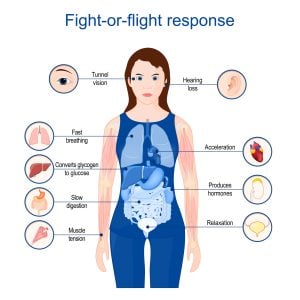
Type A personality behavior makes them more prone tostress-related illnessessuch as CHD, raised blood pressure, etc.
As a result, they are more likely to have the stress hormones present, which over a long period of time leads to a range of stress-related illnesses.
Research Evaluation
Limitations of the study involve problems with external validity. Because the study used an all-male sample, it is unknown if the results could be generalized to a female population, who have different ways to deal with stress and might be less vulnerable.
Studies carried out on women have not shown such a major difference between Type A and Type B and subsequent health. This may suggest that differentcoping strategiesare just as important as personality.
The study was able to control for other important variables, such as smoking and lifestyle. This is good as it makes it less likely that such extraneous variables could confound the results of the study.
The study does not show which trait of personality type A leads to CHD. Matthew and Haynes (1996) found that hostility was most associated with CHD.
Theoretical Evaluation
However, there are several problems with the type A and B approach. Such approaches have been criticized for attempting to describe complex human experiences within narrowly defined parameters. Many people may not fit easily into a type A or B person. Also, inindividualist cultures, men are socialized to display Type A behavior.
We are not sure type A or type B we tend to vary along the continuum depending on the circumstances and the situation we are in.
Some individuals with type A personalities are driven and well-balanced individuals unlikely to develop CHD, while some type Bs are in fact suppressing their hostility and their ambitions, these people are likely to develop CHD despite being classified as type B.
The major problem with the Type A and Type B theory is actually determining which factors are influencing coronary heart disease.
Other research has investigated the way that type A people experience and cope with stress, which is the major factor leading to coronary heart disease.
It would seem that a much more sophisticated model is needed to predict coronary heart disease than Friedman and Rosenman’s Type A & Type B approach. Indeed, personality type A could be the result of prolonged exposure to stress.
References
Carmelli, D., Dame, A., Swan, G., & Rosenman, R. (1991). Long-term changes in Type A behavior: A 27-year follow-up of the Western Collaborative Group Study.Journal of Behavioral Medicine, 14(6), 593-606.
Dembroski, T. M., MacDougall, J. M., Costa, P. T., & Grandits, G. A. (1989). Components of hostility as predictors of sudden death and myocardial infarction in the Multiple Risk Factor Intervention Trial.Psychosomatic Medicine.
Forshaw, M., & Sheffield, D. (Eds.). (2012).Health psychology in action. John Wiley & Sons.
Johnston, D. W. (1993). The current status of the coronary prone behavior pattern.Journal of the Royal Society of Medicine, 86(7), 406.
Rosenman, R. H., Brand, R. J., Sholtz, R. I., & Friedman, M. (1976). Multivariate prediction of coronary heart disease during 8.5 year follow-up in the Western Collaborative Group Study.The American Journal of Cardiology, 37(6), 903-910.
Further InformationJournal Article – The Personality Assessment System as A Conceptual Framework for the Type A Coronary-Prone Behavior PatternJournal Article – Evaluation of Type A personality
Further Information
Journal Article – The Personality Assessment System as A Conceptual Framework for the Type A Coronary-Prone Behavior PatternJournal Article – Evaluation of Type A personality

Olivia Guy-Evans, MSc
BSc (Hons) Psychology, MSc Psychology of Education
Olivia Guy-Evans is a writer and associate editor for Simply Psychology. She has previously worked in healthcare and educational sectors.
Saul McLeod, PhD
BSc (Hons) Psychology, MRes, PhD, University of Manchester
Saul McLeod, PhD., is a qualified psychology teacher with over 18 years of experience in further and higher education. He has been published in peer-reviewed journals, including the Journal of Clinical Psychology.
