On This Page:ToggleSigns of Toxic FriendsConsiderationsStay Or Leave?Setting BoundariesLetting GoToxic Friendship Quiz
On This Page:Toggle
On This Page:
Friendships should be a source of joy and support. Good friends lift you up, cheer you on, and help you shine.
However, sometimes we encounter “toxic friends,” or friendships turn sour, leaving us feeling drained, disrespected, and even belittled.
Researchhas found that developing a “healthy friendship environment” is important for maintaining good psychological well-being. Thus, identifying and addressing toxic friendships is an act of self-care.
Toxic friends who undermine, manipulate, or mistreat you can deeply damage self-esteem and mental health. Setting boundaries or removing them from your life protects well-being.

Signs of Toxic Friends
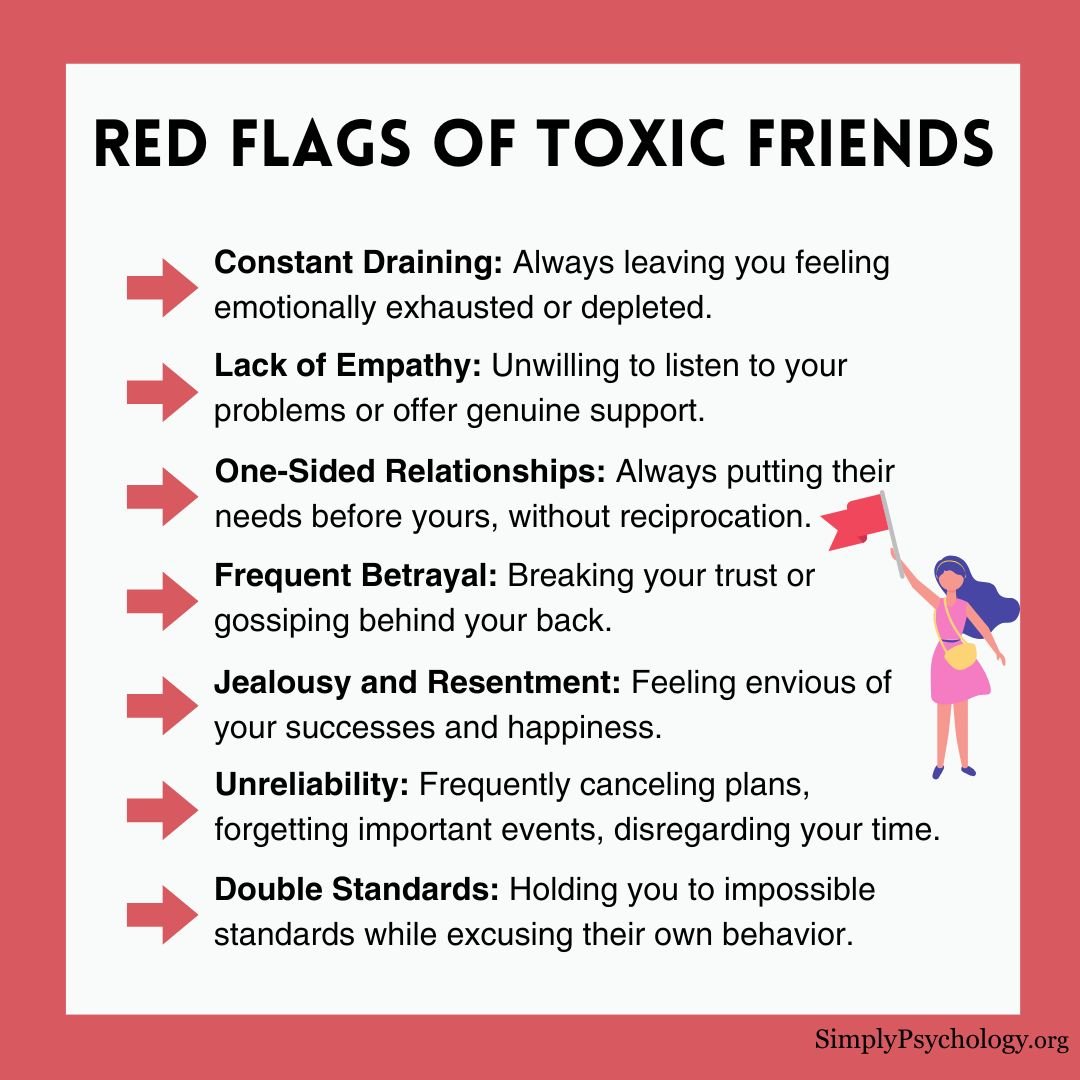
Even one or two of these red flags can indicate an unhealthy dynamic:
Constant Negativity
Lack of Support
Jealousy
Manipulation and Control
Unwarranted Criticism
Double Standards
Unreliable and Flaky
Betrayal
One-Sided Relationships
Learn more about thesigns of toxic people here.
Considering the Roots of Toxic Behavior
While toxic behaviors should not be tolerated long-term, it can be useful to reflect on what may be driving your friend’s toxicity.
If this is new or uncharacteristic behavior, explore whether they are going through a difficult period. Stressors like grief, job loss, or mental health struggles can temporarily impact relationships.
Additionally, certain conditions likeADHDor trauma can affectemotional regulationandimpulsivity. Your friend may benefit from support and compassion during this time. Gently encourage counseling or other help if appropriate.
Examining root causes does not excuse harm but can provide context to better assess if positive change is possible. Momentary grace and empathy may aid that.
However, recurring toxicity without accountability or effort to improve goes beyond circumstance and requires firmer boundaries.
Decide your course of action
It is important to understand that you cannot fix your friend’s toxicity for them. No amount of giving, caring, or listening will ever be able to fix the relationship that someone has with themselves. Only they can do that.
Truly examine the emotional toll of preserving this friendship and its harmful effects on your well-being. Contemplate making a change for your own peace of mind.
You have one of two options –
(1)Communicate and enforce boundaries to minimize contact:Decide to confront your friend and resolve the problems causing this unhealthy dynamic. You may see that this is a bond better kept at a distance, interacting less frequently.
(2) Let go of the friendship:If you conclude the friendship does more injury than good, you could completely dissolve it.
That may seem drastic, but releasing a poisonous tie creates space for more positive, empowering and meaningful connections, potentially lowering stress and bringing you joy.
Communicate and enforce boundaries
If you choose to fix the friendship, learn how to communicate andenforce boundaries below:
How to effectively communicate with your toxic friend
Addressing a toxic friend directly can feel daunting, but effective communication can lead to positive change, possibly salvaging the relationship.
Setting a positive tone in your communication involves expressing your needs and expectations in a clear, direct, and constructive manner.
Articulate your feelings and concerns using “I” statements to express your experiences. Avoid accusatory language, and instead, suggest solutions or boundaries. For example:
Practice recognizing emotional manipulation, suchas gaslightingor guilt trips. Do not engage in arguments or justifications. Simply reaffirm your boundaries. Remember, your feelings are valid.
How to set clear boundaries with your toxic friend
Define what you will and will not tolerate. Explicitly communicating your limits and expectations helps you create respectful friendships that ensure both people feel heard and valued.
This involves defining the qualities and behaviors you consider essential in a healthy friendship. For example, what does emotional support look like to you? Communicate these expectations with your friends.
For instance, if your friend constantly criticizes you, express that you will not tolerate such behavior. Use “I” statements to assert your feelings without sounding accusatory.
Be specific–instead of a vague “please be nicer,” try, “I will not engage in conversations that belittle me, and I expect you to apologize when you cross that line.”
Be clear about the consequences for violating your boundaries. For example: “If you cancel plans again at the last minute, we will not be able to hang out for a while.”
How to limit contact and take a break from your toxic friend
Create emotional space to reassess the relationship and its impact on your mental health.
Remember, this is not abandonment; it is prioritizing and preserving your mental well-being, allowing you to rebuild strength and perspective.
“If you can slow down in your interactions with people whether it’s text message email in person over the phone you will have a lot more control over yourself and it will help you to better protect yourself and your energy and your anger when you are dealing with this person.”
Let Go Of The Friendship
How to safely end the friendship
If setting boundaries has not worked and your well-being remains threatened, ending the friendship is the healthiest choice. Not all friendships can be salvaged.
Concluding the relationship involvesassertive communication. Be honest and clear about your feelings, and express your decision respectfully but firmly.
You can say something like, “Our friendship is causing me more harm than good, so I need to step back.” You do not owe them a lengthy explanation.
Cut ties in a way that minimizes confrontation but prioritizes your well-being.
Practicing self-care after ending a toxic friendship
It is normal to feel a sense of grief after ending a toxic friendship, even if you know it was for the best. Use this time to put yourself first and meet your needs.
Prioritizing your mental, emotional, and physical well-being involves scheduling time for activities that make you feel good and making sure they get done.
Identify activities and practices that bring you comfort, joy, and relaxation, especially during difficult times. Incorporate them into your daily routine.
Create a personalized self-care plan to help replenish your energy. This could include:
Prioritizing self-care is not selfish; it is necessary for maintaining overall health and remaining resilient and better equipped to cultivate positive relationships.
Creating a support network after ending a toxic friendship
Having a reliable support network boosts emotional resilience.A studyreviewed 38 research articles and found that supportive, high-quality friendships are positively correlated with well-being.
A robust support network validates your feelings and reinforces your capacity to make decisions in the best interest of your well-being.
Identify allies who can offer:
Seek out those who have had similar experiences and can offer shared wisdom.
Trusted friends, understanding family members, a therapist, or even colleagues can provide valuable perspectives and a compassionate ear.
Furthermore, do not underestimate the power of online communities or support groups, where anonymity can provide extra comfort and connection.
Healing from the impact of a toxic friend
Explore resources like books, podcasts, or support groups tailored to recovering from unhealthy relationships. These can offer valuable insights and validation.
Recognize that certain patterns or vulnerabilities may have attracted this situation, but avoid self-blame.
Instead explore potential personal patterns that might attract toxic friendships, and use this knowledge to empower future choices.
Reflect on your experience and consider seeking professional help if needed.
Cultivating self-compassion helps you release any burdens of guilt and move toward personal growth and healing:
Practice forgiveness towards the other person, not for them, but for your own peace.
Toxic Friendship Quiz
Ever feel drained, belittled, or manipulated after spending time with a friend? Wondering if your friend might be crossing lines?
Take this quiz to explore if your friendship might be harboring some toxicity. Be honest with yourself and answer based on your gut feeling.
For each question, choose the answer that best describes your experience with your friend.
a. Energized and happy! We lift each other up.
b. Neutral, but not particularly excited or inspired.
c. Drained and emotionally exhausted.
d. Anxious, stressed, or negative, like I am walking on eggshells.
a. Rarely to never. We encourage and support each other.
b. Occasionally, but usually with good intentions.
c. Often, and it feels hurtful and discouraging.
d. Constantly, to the point where I doubt myself.
a. Absolutely! They understand and support my needs. My boundaries are respected, and we communicate openly about them.
b. Sometimes my boundaries are forgotten or ignored, but my friend apologizes later.
c. They often disregard my boundaries or pressure me to bend them.
d. My friend constantly disregards my boundaries without remorse, and I feel unheard.
a. We communicate openly and honestly, addressing issues directly and respectfully.
b. Sometimes communication gets rocky, but we resolve things eventually.
c. Important issues are often avoided or swept under the rug.
d. I feel uncomfortable expressing my feelings due to fear of judgment.
a. Never. They understand my limits and respect my choices.
b. Very rarely, and we always discuss it beforehand.
c. Sometimes, and I feel pressured to give in to avoid conflict.
d. Often, and I feel manipulated into doing things I don’t want to.
a. I trust my friend completely with my secrets and confidences.
b. There have been minor breaches of trust, but we have worked through them.
c. I am hesitant to share some things due to past betrayal.
d. I cannot fully trust my friend, and they regularly break promises.
a. No way! They are trustworthy and keep my secrets.
b. Maybe once or twice, but they apologized and learned from it.
c. Occasionally, and it makes me feel anxious about being talked about.
d. Frequently, and I cannot trust them with anything personal.
a. My friend respects my independence and avoids manipulation tactics.
b. They might occasionally try to influence me, but it is not malicious.
c. I sometimes feel pressured to do things for them I do not want to.
d. My friend constantly tries to control my decisions and uses guilt trips.
a. My friend is my biggest cheerleader, celebrating my successes and supporting my goals.
b. They are generally supportive but might express some doubts.
c. Their support feels conditional or focused on themselves.
d. I rarely feel genuine support from my friend.
a. The friendship feels balanced and supportive, with mutual effort from both sides.
b. There might be some imbalance, but it is not a major concern.
c. I feel as if I give more than I receive in the friendship.
d. My friend takes advantage of me and rarely reciprocates support.
a. Absolutely! They are one of my biggest cheerleaders and celebrate my wins.
b. They are happy for me, but sometimes express doubt or negativity.
c. They might acknowledge my success, but often downplay it or shift the focus.
d. They seem jealous or dismissive of my accomplishments. They often belittle my achievements.
a. The friendship motivates me to grow and inspires me to be a better person.
b. It has some positive aspects, but also hinders my progress sometimes.
c. I feel stuck and discouraged due to the negativity in the friendship.
d. The friendship is overall harmful and hinders my personal growth.
Mostly As: Your friendship seems healthy and supportive! Keep nurturing it, and enjoy your positive connection!
Some Bs or Cs: Your friendship might have some minor issues, but communication and boundary setting can strengthen it.
Multiple Cs or Ds: Watch out for warning signs! This friendship exhibits some toxic behaviors. Evaluate its impact on your well-being, and consider talking to a trusted friend, family member, or therapist for guidance about this friendship.
Mostly Ds: Your friendship appears significantly toxic and is likely causing you emotional harm. Prioritize your well-being and consider taking steps to distance yourself, address the issues, or end the relationship.
Remember:This quiz is a starting point. If you are concerned about your friendship, it is always best to talk to someone you trust or seek professional help. You deserve to be in healthy and supportive relationships.
References
Arzt, N. (2023, December 29).Toxic Friends: 13 Signs of a toxic Friendship.Choosing Therapy.https://www.choosingtherapy.com/toxic-friends/
Dealing with a toxic friendship. (2023, September 20). ReachOut Australia.https://au.reachout.com/articles/dealing-with-a-toxic-friendship
DiveThru Team (2023, February 7).8 Tips on How to Deal with a Toxic Friend.DiveThru.https://divethru.com/8-tips-on-how-to-deal-with-a-toxic-friend/
Geller, L., & Blumberg, P. O. (2023, December 13).15 signs you’re in a toxic friendship, according to experts.Women’s Health.https://www.womenshealthmag.com/relationships/a25939904/signs-of-toxic-friendships/
Lahad, K., & van Hooff, J. (2023). Is my best friend toxic? A textual analysis of online advice on difficult relationships. Families,Relationships and Societies, 12(4), 572-587. Retrieved Jan 19, 2024, fromhttps://doi.org/10.1332/204674321X16613283926068
Lindberg, S. (2023, October 13).How to know if you’re in a toxic friendship (and how to get out of it). Headspace.https://www.headspace.com/articles/toxic-friendships
Pezirkianidis, C., Galanaki, E., Raftopoulou, G., Μoraitou, D., & Stalikas, A. (2023). Adult friendship and wellbeing: A systematic review with practical implications.Frontiers in Psychology, 14.https://doi.org/10.3389/fpsyg.2023.1059057
Rahimah, S., Abidin, M. Z., & Fadhila, M. (2022). The Effect of toxic Relationships in Friendship on the Psychological Well-Being of Islamic University Students.Jurnal Tazkiya, 10(2), 155–164.https://doi.org/10.15408/tazkiya.v10i2.27776

Olivia Guy-Evans, MSc
BSc (Hons) Psychology, MSc Psychology of Education
Olivia Guy-Evans is a writer and associate editor for Simply Psychology. She has previously worked in healthcare and educational sectors.
Saul McLeod, PhD
BSc (Hons) Psychology, MRes, PhD, University of Manchester
Saul McLeod, PhD., is a qualified psychology teacher with over 18 years of experience in further and higher education. He has been published in peer-reviewed journals, including the Journal of Clinical Psychology.
Haddi BrowneMental Health Writer, Mental Health Researcher, ProofreaderEducation BSc (Hons) Psychology, MSc Mental Health StudiesMiss Haddi Browne is a freelance mental health writer and proof-reader with over seven years of experience working as a professional researcher with a diverse range of clients across the lifespan, including young adults with post-traumatic stress disorder (PTSD) and depression.
Haddi BrowneMental Health Writer, Mental Health Researcher, ProofreaderEducation BSc (Hons) Psychology, MSc Mental Health Studies
Haddi Browne
Mental Health Writer, Mental Health Researcher, Proofreader
Education BSc (Hons) Psychology, MSc Mental Health Studies
Miss Haddi Browne is a freelance mental health writer and proof-reader with over seven years of experience working as a professional researcher with a diverse range of clients across the lifespan, including young adults with post-traumatic stress disorder (PTSD) and depression.
