Setting boundaries in the early stages of dating will set the tone for the rest of the relationship.
Boundaries are limits and rules you set within relationships – what you want and need and what is acceptable and unacceptable to you.
Even if you’ve just met someone or you’re dating on a casual basis, boundaries protect your well-being and allow you to enjoy the relationships you have.
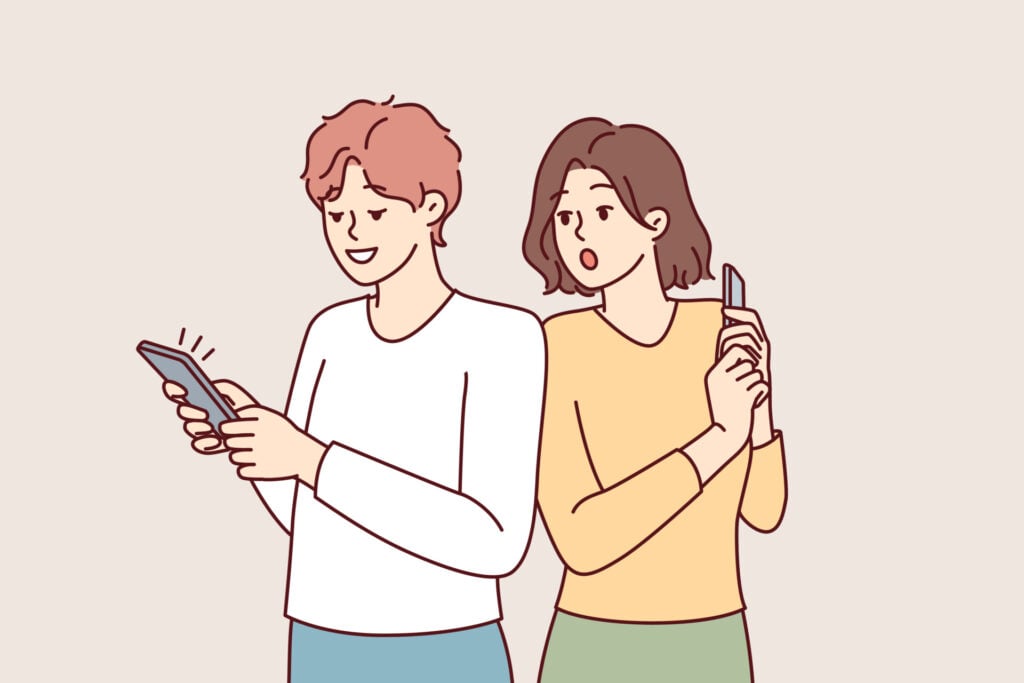 A curious woman looking over her partner’s shoulder at their phone.
Setting Boundaries in the Early Stages of Dating
From the very first moment you meet someone, your language and behaviorcommunicate your boundariesto the other person. They tell them who you are, how you expect to be treated, and how you treat other people.
For example, if someone messages you on social media or a dating app asking for “nudes”, your response (or lack thereof) will communicate a boundary.
The initial conversations between you and how the first date goes will establish the baseline for your relationship.
As therapistJenna Nielsenexplains, “Don’t assume you know what the other person is thinking. You need to have clear expectations from the beginning and not be afraid to ask questions when they arise.”
Boundaries are as much about your rules and limits as they are about choice.
You have to be honest about who you are and what you want otherwise you can’t establish boundaries that are actually helpful. If the other person doesn’t match your values, it’s your choice whether you stay or go.
Your approach should not be, “How can I get that person to like me?” Instead, you should be asking: are we compatible? Do we want the same things? Can I imagine dating/ having a relationship with this person? Do our values align?
Then,youdecide whether you want to continue.
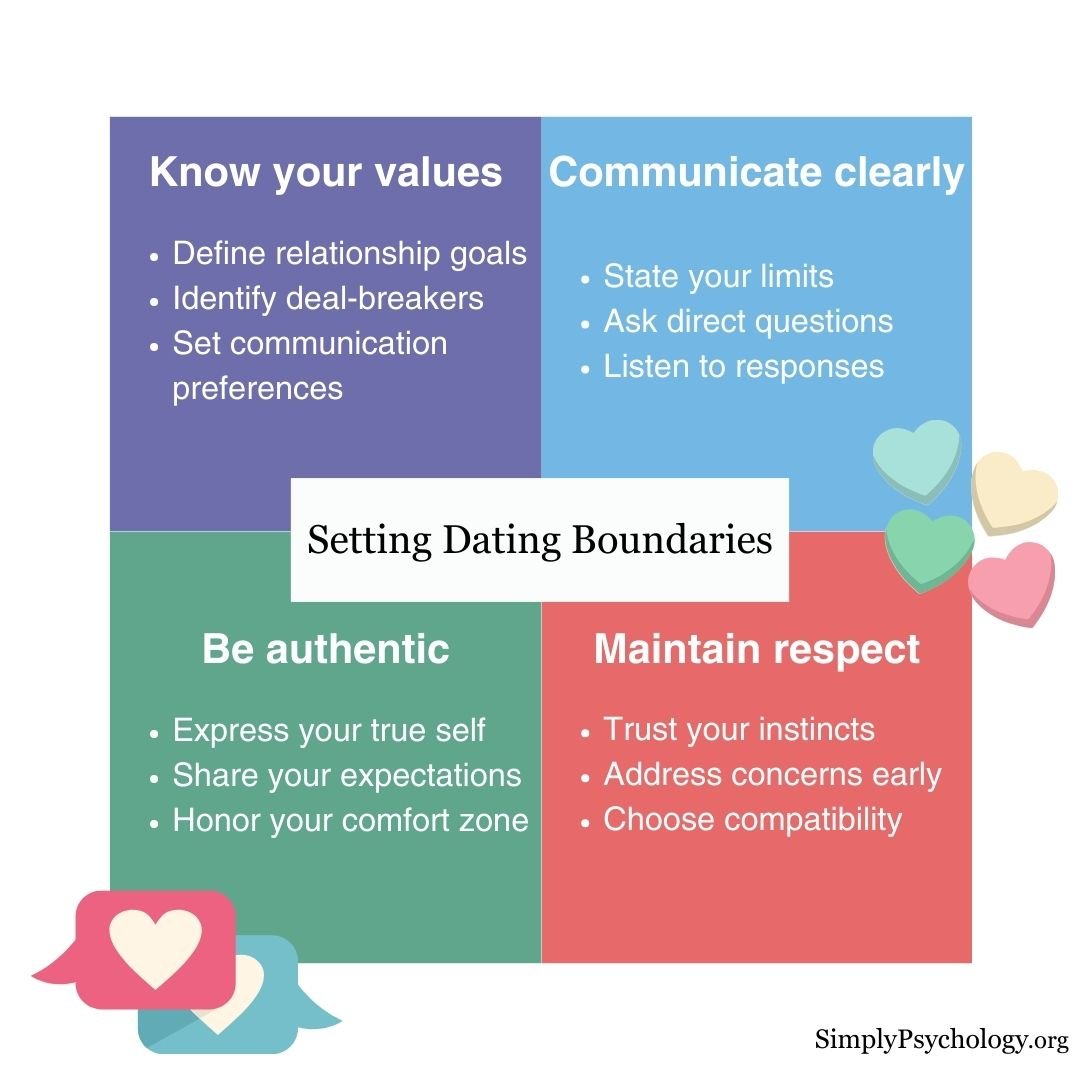
Here’s some advice for setting boundaries early on:
What Are Your Boundaries?
Your boundaries– your choice.
Don’t allow other people to influence what’s okay and what’s not okay for you.
Some boundaries are more fluid and change over time as you get to know someone better; others are set in stone and are not up for discussion.
Be Honest About Who You Are
If you hide yourself and don’t speak up because you want toplease the other personor want them to like you, you’ll find it very difficult to get your needs met and implement your boundaries.
Take Responsibility
Your boundaries are your responsibility.
Don’t wait for the other person to ask what your boundaries are – communicate what you like and don’t like, what you’re looking for, what your deal-breakers are, and what kind of relationship you want.
Approach With Confidence
Knowing your worth and taking responsibility for your feelings, behaviors, and choices means you approach people with confidence.
If they don’t like who you are, move on. If you’re compatible – great, see where it goes!
Questions to Help You Establish Boundaries
Here are some questions you can ask the other person that will allow you to gauge whether you’re on the same page about boundaries and lifestyle.
Maintaining Boundaries
Setting and maintaining boundaries is an ongoing process, as you’re unlikely to figure them all out on the first few dates.
Things will come up as you go along and that means you’re constantly assessing whether you’re comfortable and feel valued.
Even if you’re in a casual relationship or “situationship” you still want yourboundaries to be respected.
Regardless of what kind of relationship you’re having, open and honest communication is always better.
If aboundary has been crossed,you have to communicate that, but make it about yourself (your boundary) rather than them.
For example, if you don’t like being on your phone all day but they constantly message you and expect a response, tell them something like, “I’m not someone that likes texting all day so don’t be offended if I don’t always reply.” Instead of saying “Stop texting me all the time.”
As mentioned above, boundaries are about you and your choices, especially when you’ve only just started dating.
If you don’t like the way someone interacts and treats you, take ownership of your feelings and decide what’s best for you.
Social Media Boundaries
Social mediais a way to connect and relate to other people and therefore requires boundaries.
Setting boundaries on your own social media use is good for your mental health (e.g., how much time you spend scrolling or not using your phone after a certain time).
But it’s just as important to consider and discuss social media with your partner. You might not want them to follow certain accounts or prefer it if they put their phone away when you’re having a conversation.
When it’s a casual relationship, certain boundaries might be desirable like “Please don’t post pictures/ stories of me on your social media”.
Advice on Setting Social Media Boundaries

Saul McLeod, PhD
BSc (Hons) Psychology, MRes, PhD, University of Manchester
Saul McLeod, PhD., is a qualified psychology teacher with over 18 years of experience in further and higher education. He has been published in peer-reviewed journals, including the Journal of Clinical Psychology.
Olivia Guy-Evans, MSc
BSc (Hons) Psychology, MSc Psychology of Education
Olivia Guy-Evans is a writer and associate editor for Simply Psychology. She has previously worked in healthcare and educational sectors.
Anna DrescherMental Health WriterBSc (Hons), Psychology, Goldsmiths University, MSc in Psychotherapy, University of QueenslandAnna Drescher is a freelance writer and solution-focused hypnotherapist, specializing in CBT and meditation. Using insights from her experience working as an NHS Assistant Clinical Psychologist and Recovery Officer, along with her Master’s degree in Psychotherapy, she lends deep empathy and profound understanding to her mental health and relationships writing.
Anna DrescherMental Health WriterBSc (Hons), Psychology, Goldsmiths University, MSc in Psychotherapy, University of Queensland
Anna Drescher
Mental Health Writer
BSc (Hons), Psychology, Goldsmiths University, MSc in Psychotherapy, University of Queensland
Anna Drescher is a freelance writer and solution-focused hypnotherapist, specializing in CBT and meditation. Using insights from her experience working as an NHS Assistant Clinical Psychologist and Recovery Officer, along with her Master’s degree in Psychotherapy, she lends deep empathy and profound understanding to her mental health and relationships writing.
