On This Page:ToggleDark SideAre They Being Manipulative?Too Much Emotional Intelligence?FAQs
On This Page:Toggle
On This Page:
While emotional intelligence is often praised for its positive aspects, it’s essential to acknowledge that there is also a dark side to it.
Emotional intelligence (EI) is a subset of social intelligence that involves the ability toperceive our own and other’s emotions, discriminate between them, and use this information to regulate our thinking and behaviors (Goleman, 1996).
Many scientific studies have provided compelling evidence ofthe importance of EIacross different life domains, including work, personal health, and relationships.

According to Goleman’s theory, there are four attributes that commonly define EI:
The dark side of emotional intelligence
Although EI has been shown to predict various positive outcomes, there is also a “dark side” of EI that has often been overlooked, where this skill might have deleterious effects for a person and those they interact with (Davis and Nichols, 2016).
Emotional manipulation
New evidence suggeststhat when people hone their emotional skills, they can also become better at manipulating others (Grant, 2014).
Indeed, “when we can control our emotions, we can also disguise our true feelings. When we are able to notice other people’s feelings, we can tug at their heartstrings and motivate them to act against their own best interests”.
This represents the dark side of EI: using one’s knowledge of emotions to strategically achieve self-serving goals.
It seems that through EI, people can fabricate favorable impressions of themselves, expressing emotions strategically and reducing others’ ability to think critically (Grant, 2014).
The dark triad
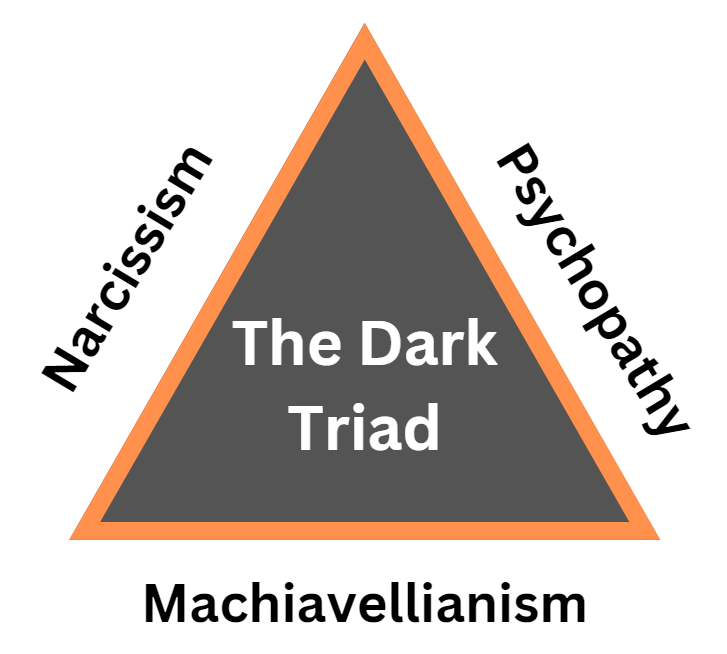
Further research investigated the relationship between EI anddark triad personality traits, including Machiavellianism,Psychopathy, andNarcissism.
These three aversive personality styles share common characteristics, such as a lack of empathy, a need for attention, gravitation toward power, deceit, and callous manipulation (Furnham, Richards, and Paulhus, 2013).
People who score high on these traits appear to be better able to manipulate others using mood worsening (e.g., criticizing others) and inauthentic displays (e.g., flattery and sulking) (Austin et al., 2014).
Psychopathy has also been associated with the tendency to adopt hard tactics in the workplace, with more evident threats of punishment and manipulation of people and situations.
Individuals high in narcissism seem instead to rely on softer or more charming workplace tactics, for example, the promise of reward and integration (Jonason, Slomskiv, and Partyka, 2012).
Their aim is to make good impressions initially and create positive relationships with colleagues that can be later exploited to offset work obligations.
What other types of people are likely to use EI to their advantage?
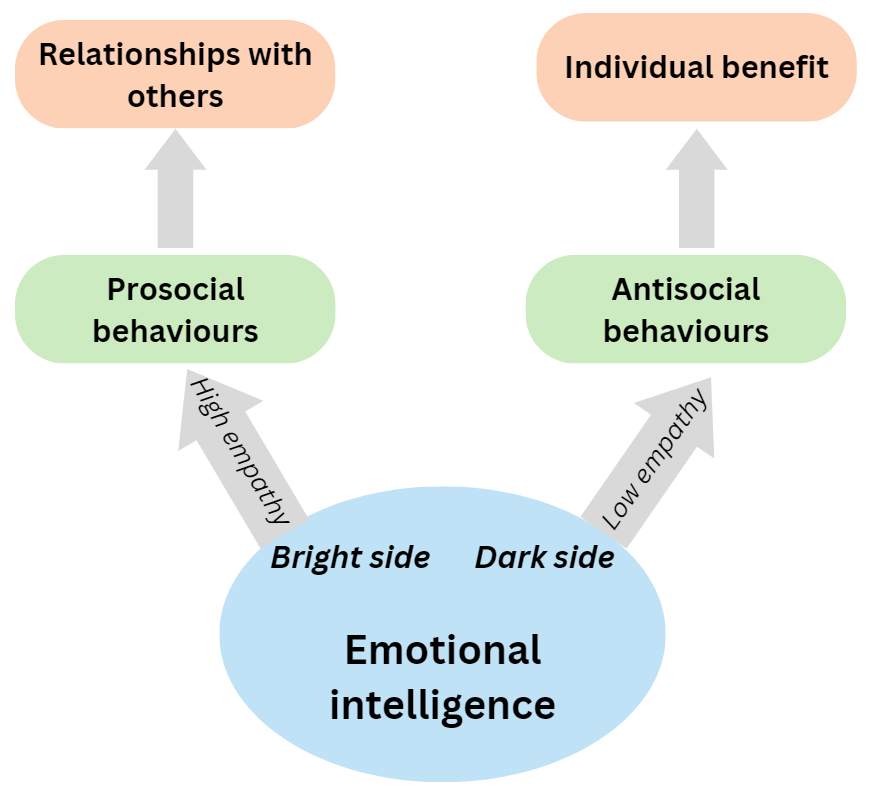
Because EI has some conceptual overlap with empathy but it also represents a separate construct, it has been hypothesized that people with high EI but reduced empathy are more likely to engage in antisocial and manipulative behaviors (Akamatsu and Gherghel, 2021).
Without empathy, EI could, therefore, be ‘abused’ and lead to aggressive as opposed to prosocial behaviors (Figure 2).
This is particularly evident in EI individuals with goal-driven persistence, sensitivity to rewards, and impulsivity, where the adoption of both prosocial andaggressive behaviorsis strategically used to obtain greater control of resources and thrive in the social world. (Bacon, Corr, and Satchell, 2018).
How to tell if someone is using emotional intelligence in a manipulative way?
People with manipulative tendencies might initially appear friendly and charismatic, while their primary intent is to use social interactions for their own personal gain, disguising them as benefits to others (Bradberry and Greaves, 2009).
The first step to avoid being the target of their controlling behavior is recognizing some typical signs that these individuals display.
We might also try to reflect on our feelings when we interact with these people and use them as warning signs:
Can you have too much emotional intelligence?
While emotionally intelligent people are better equipped to interpret others’ emotions and have more successful social interactions, their empathy can also lead them to take things too personally and easily feel emotionally exhausted.
Those who displayed greater sensitivity to emotions also exhibited a higher stress response in a subsequent task requiring them to give job talks in front of judges, assuming stern facial expressions.
Similar studies have shown that attention to emotion was positively associated with greater experience of negative emotions in victims of cyberbullying (Elipe et al., 2015) and more severe symptoms in people with mental health disorders (Lizeretti, Extremera and Rodríguez, 2012).
Overall, it appears that heightened emotional sensitivity may mediate the relationship between EI andover-reactivity to stress. Specifically, individuals with an ‘uneven’ pattern of EI skills – for example, increased emotional awareness coupled with reduced stress management – display lower levels of psychological adaptability.
By contrast, people with uniformly high or average EI profiles seem to respond more successfully to challenging life circumstances, including demanding academic/work environments and traumatic events (Davis and Nichols, 2016).
In the workplace, too high EIhas been associated with various negative outcomes (Chamorro-Premuzic and Yearsley, 2017). For example, people with high interpersonal sensitivity might have difficulty delivering genuine, negative feedback to their colleagues, possibly impacting their growth potential.
In addition, they might be reluctant to make unpopular decisions that often leadership roles require to bring innovation and change to an organization.
People with high EI also tend to take fewer risks due to their high conscientiousness, which can result in excessive self-control and perfectionism.
FAQs
Can emotional intelligence be faked?Although faking EI might work in the short term, with people trying to appear likable, open to listening, and emotionally balanced, it is not a sustainable approach for success in the longer term.EI represents a skill that needs to be developed from the inside out, requiring building greater self-awareness and empathy towards others.Even the most capable leaders will eventually fail if they struggle to show genuine openness to others’ views and authentic willingness to accept feedback to continuously improve professionally.Do dark empaths use emotional intelligence?A dark empath is a person who uses their ability to understand how other people feel and think (i.e., cognitive empathy) for their personal gain.They share the personality traits of the dark triad – narcissism, psychopathy, and Machiavellianism – but with higher levels of empathy. They, therefore, represent potentially more dangerous individuals, as they can connect to people easily and read their emotions to eventually use them to their advantage.Some of the most common strategies emotional empaths use to manipulate othersare gaslighting,love bombing,ghosting, and intimidation (Heym et al., 2021).What should I do if I suspect someone is using emotional intelligence to manipulate me?Being a victim of manipulation is often emotionally draining. Although the first step is recognizing common behaviors and strategies that manipulators use, it is also important to identify our personal weaknesses, for example, the tendency to please others,low confidence and self-esteem, and being emotionally dependent on others.We should try next to be assertive about our needs, stating them directly and persistently. Manipulators will try to change our views and it is therefore important to maintain personal boundaries to prevent them from taking advantage of us (Braiker, 2004).
Can emotional intelligence be faked?Although faking EI might work in the short term, with people trying to appear likable, open to listening, and emotionally balanced, it is not a sustainable approach for success in the longer term.EI represents a skill that needs to be developed from the inside out, requiring building greater self-awareness and empathy towards others.Even the most capable leaders will eventually fail if they struggle to show genuine openness to others’ views and authentic willingness to accept feedback to continuously improve professionally.
Can emotional intelligence be faked?
Although faking EI might work in the short term, with people trying to appear likable, open to listening, and emotionally balanced, it is not a sustainable approach for success in the longer term.EI represents a skill that needs to be developed from the inside out, requiring building greater self-awareness and empathy towards others.Even the most capable leaders will eventually fail if they struggle to show genuine openness to others’ views and authentic willingness to accept feedback to continuously improve professionally.
Although faking EI might work in the short term, with people trying to appear likable, open to listening, and emotionally balanced, it is not a sustainable approach for success in the longer term.
EI represents a skill that needs to be developed from the inside out, requiring building greater self-awareness and empathy towards others.
Even the most capable leaders will eventually fail if they struggle to show genuine openness to others’ views and authentic willingness to accept feedback to continuously improve professionally.
Do dark empaths use emotional intelligence?A dark empath is a person who uses their ability to understand how other people feel and think (i.e., cognitive empathy) for their personal gain.They share the personality traits of the dark triad – narcissism, psychopathy, and Machiavellianism – but with higher levels of empathy. They, therefore, represent potentially more dangerous individuals, as they can connect to people easily and read their emotions to eventually use them to their advantage.Some of the most common strategies emotional empaths use to manipulate othersare gaslighting,love bombing,ghosting, and intimidation (Heym et al., 2021).
Do dark empaths use emotional intelligence?
A dark empath is a person who uses their ability to understand how other people feel and think (i.e., cognitive empathy) for their personal gain.They share the personality traits of the dark triad – narcissism, psychopathy, and Machiavellianism – but with higher levels of empathy. They, therefore, represent potentially more dangerous individuals, as they can connect to people easily and read their emotions to eventually use them to their advantage.Some of the most common strategies emotional empaths use to manipulate othersare gaslighting,love bombing,ghosting, and intimidation (Heym et al., 2021).
A dark empath is a person who uses their ability to understand how other people feel and think (i.e., cognitive empathy) for their personal gain.
They share the personality traits of the dark triad – narcissism, psychopathy, and Machiavellianism – but with higher levels of empathy. They, therefore, represent potentially more dangerous individuals, as they can connect to people easily and read their emotions to eventually use them to their advantage.
Some of the most common strategies emotional empaths use to manipulate othersare gaslighting,love bombing,ghosting, and intimidation (Heym et al., 2021).
What should I do if I suspect someone is using emotional intelligence to manipulate me?Being a victim of manipulation is often emotionally draining. Although the first step is recognizing common behaviors and strategies that manipulators use, it is also important to identify our personal weaknesses, for example, the tendency to please others,low confidence and self-esteem, and being emotionally dependent on others.We should try next to be assertive about our needs, stating them directly and persistently. Manipulators will try to change our views and it is therefore important to maintain personal boundaries to prevent them from taking advantage of us (Braiker, 2004).
What should I do if I suspect someone is using emotional intelligence to manipulate me?
Being a victim of manipulation is often emotionally draining. Although the first step is recognizing common behaviors and strategies that manipulators use, it is also important to identify our personal weaknesses, for example, the tendency to please others,low confidence and self-esteem, and being emotionally dependent on others.We should try next to be assertive about our needs, stating them directly and persistently. Manipulators will try to change our views and it is therefore important to maintain personal boundaries to prevent them from taking advantage of us (Braiker, 2004).
Being a victim of manipulation is often emotionally draining. Although the first step is recognizing common behaviors and strategies that manipulators use, it is also important to identify our personal weaknesses, for example, the tendency to please others,low confidence and self-esteem, and being emotionally dependent on others.
We should try next to be assertive about our needs, stating them directly and persistently. Manipulators will try to change our views and it is therefore important to maintain personal boundaries to prevent them from taking advantage of us (Braiker, 2004).
References
Akamatsu, D., & Gherghel, C. (2021). The bright and dark sides of emotional intelligence: Implications for educational practice and better understanding of empathy.
Austin, E. J., Saklofske, D. H., Smith, M., & Tohver, G. (2014). Associations of the managing the emotions of others (MEOS) scale with personality, the Dark Triad and trait EI.Personality and Individual Differences,65, 8-13.
Bacon, A. M., Corr, P. J., & Satchell, L. P. (2018). A reinforcement sensitivity theory explanation of antisocial behaviour.Personality and Individual Differences,123, 87-93.
Bechtoldt, M. N., & Schneider, V. K. (2016). Predicting stress from the ability to eavesdrop on feelings: Emotional intelligence and testosterone jointly predict cortisol reactivity.Emotion,16(6), 815.
Bradberry, T., & Greaves, J. (2009). Emotional Intelligence 2.0. TalentSmart.
Braiker, H. B. (2004).Who’s pulling your strings(pp. 1-260). New York, NY, USA:: McGraw Hill.
Chamorro-Premuzic, T., & Yearsley, A. (2017). The Downsides of Being Very Emotionally Intelligent.Harvard Business Review.
Cobos-Sánchez, L., Flujas-Contreras, J. M., & Becerra, I. G. (2020). Relation between psychological flexibility, emotional intelligence and emotion regulation in adolescence.Current psychology, 1-10.
Côté, S., DeCelles, K. A., McCarthy, J. M., Van Kleef, G. A., & Hideg, I. (2011). The Jekyll and Hyde of emotional intelligence: Emotion-regulation knowledge facilitates both prosocial and interpersonally deviant behavior.Psychological science,22(8), 1073-1080.
Davis, S. K., & Nichols, R. (2016). Does emotional intelligence have a “dark” side? A review of the literature.Frontiers in psychology,7, 1316.
Elipe, P., Mora-Merchán, J. A., Ortega-Ruiz, R., & Casas, J. A. (2015). Perceived emotional intelligence as a moderator variable between cybervictimization and its emotional impact.Frontiers in psychology,6, 486.
Furnham, A., Richards, S. C., & Paulhus, D. L. (2013). The Dark Triad of personality: A 10 year review.Social and personality psychology compass,7(3), 199-216.
Goleman, D. (1996).Emotional intelligence: Why it can matter more than IQ. Bloomsbury Publishing.
Grant, A. (2014). The dark side of emotional intelligence.The Atlantic,2.
Heym, N., Kibowski, F., Bloxsom, C. A., Blanchard, A., Harper, A., Wallace, L., … & Sumich, A. (2021). The Dark Empath: Characterising dark traits in the presence of empathy.Personality and individual differences,169, 110172.
Jonason, P. K., Slomski, S., & Partyka, J. (2012). The Dark Triad at work: How toxic employees get their way.Personality and individual differences,52(3), 449-453.
Lizeretti, N. P., Extremera, N., & Rodríguez, A. (2012). Perceived emotional intelligence and clinical symptoms in mental disorders.Psychiatric Quarterly,83, 407-418.
O’Connor, P. J., & Athota, V. S. (2013). The intervening role of agreeableness in the relationship between trait emotional intelligence and Machiavellianism: Reassessing the potential dark side of EI.Personality and Individual Differences,55(7), 750-754.
Sánchez-Álvarez, N., Extremera, N., & Fernández-Berrocal, P. (2016). The relation between emotional intelligence and subjective well-being: A meta-analytic investigation.The Journal of Positive Psychology,11(3), 276-285.

Olivia Guy-Evans, MSc
BSc (Hons) Psychology, MSc Psychology of Education
Olivia Guy-Evans is a writer and associate editor for Simply Psychology. She has previously worked in healthcare and educational sectors.
Saul McLeod, PhD
BSc (Hons) Psychology, MRes, PhD, University of Manchester
Saul McLeod, PhD., is a qualified psychology teacher with over 18 years of experience in further and higher education. He has been published in peer-reviewed journals, including the Journal of Clinical Psychology.
Sara ViezzerBSc (Hons) Psychology, MSc in Applied NeuropsychologySara Viezzer is a graduate of psychological studies at the University of Bristol and Padova. She has worked as an Assistant Psychologist in the NHS for the past two years in neuroscience and health psychology. Sara is presently pursuing a Doctorate in Clinical Psychology at the South London and Maudsley NHS Foundation Trust.
Sara ViezzerBSc (Hons) Psychology, MSc in Applied Neuropsychology
Sara Viezzer
BSc (Hons) Psychology, MSc in Applied Neuropsychology
Sara Viezzer is a graduate of psychological studies at the University of Bristol and Padova. She has worked as an Assistant Psychologist in the NHS for the past two years in neuroscience and health psychology. Sara is presently pursuing a Doctorate in Clinical Psychology at the South London and Maudsley NHS Foundation Trust.
