On This Page:ToggleFunctionsStructureDamageProtectionThe temporal lobe, located near the temples, is the second largest lobe of the human cerebrum, accounting for almost one-fourth of the brain’s volume. It processesauditory information, forms memories, comprehends language, andregulates emotionsthrough key structures like thehippocampusand primary auditory cortex.The temporal lobe is located on the side of the head (temporal means“near the temples”). The word temporal refers to the temples of the head, which refers to the temporal lobe’s positioning in the cerebrum.FunctionsThe main functions of the temporal lobe includeunderstanding language, memory acquisition(e.g.,declarativeandlong-term memory),face recognition, object recognition, perception,andprocessing auditory information.The temporal lobes process sensory input, primarily auditory and visual signals, working in conjunction with other brain regions via the corpus callosum.While both temporal lobes share some functions, they have distinct specializations:Did you know?The specific temporal lobe roles can vary among individuals, especially between left-handed and right-handed people.Left Temporal LobeTheleft temporal lobe, typically the most dominant in people, is associated with understanding language, learning, memorizing, forming speech, and remembering verbal information.Auditory Processing: It processes auditory information, deciphering sounds and speech.Language Comprehension: One of its most well-known regions isWernicke’s area, critical for understanding spoken language.Verbal Memory: It’s involved in retaining and recalling verbal information and facts.Speech Production: WhileBroca’s area(located in the frontal lobe) is primary for speech production, the left temporal lobe contributes to the formulation and coherence of speech.Music Perception: Especially the early stages of processing melodies.Emotional Response: It plays a role in interpreting and producing emotional responses, especially those linked to language.Right Temporal LobeTheright temporal lobe, typically the least dominant in people, is associated with learning and memorizing non-verbal information (e.g., drawings and music), recognizing information, and determining facial expressions.Auditory Processing: Like the left temporal lobe, it processes auditory information.Visual Memory: It helps recognize and process visual stimuli, particularly complex visual patterns.Processing of Non-verbal Soundsincludes recognizing different tones or pitches and understanding environmental sounds.Emotional Processing: The right temporal lobe plays a role in processing emotions and understanding the emotional content in sounds, such as the emotional tone in a person’s voice.Facial Recognition: It is particularly involved in recognizing and interpreting faces.Spatial Processing: This involves understanding spatial orientation and the layout of scenes.Substructures of the temporal lobesBelow will discuss some of the main substructures of the temporal lobes:The temporal lobe is structurally divided into the superior, middle, and inferior gyri.Superior Temporal GyrusThesuperior temporalgyrusis situated at the top of the temporal lobes, somewhat above the ears. It contains other areas with specialized functions.Some areas are vital in auditory processing, including language processing. Other areas specialize in processing a combination of frequencies, while others specialize in processing changes in amplitude or frequency.The superior temporal gyrus has been implicated as being critical insocial cognition(Jou, Minshew, Keshaven, Vitale, & Harden, 2010), and in theperceptions of emotionsfrom facial expressions (Raduaet al.,2010).Did you know?The superior temporal gyrus may play a functional role in the ‘cocktail party effect’- the ability to focus auditory attention on a particular stimulus whilst filtering out other auditory stimuli (Vander Ghinstet al.,2016).Wernicke’s AreaWernicke’s areais believed to be situated in the posterior part of the temporal lobe, frequently found in the left hemisphere.It takes its name from Carl Wernicke, who worked with patients with language impairments, to distinguish separate regions for language comprehension and production.Wernicke’s area is particularly important forlanguage development and the comprehension of speech, giving meaning to speech, and the written word.Auditory CortexThe auditory cortex, the main area responsible for processing auditory information, is located within the temporal lobe and is part of the superior temporal gyrus.It receives input from the ears through the brainstem and processes this sensory information into meaningful units such as speech and words.The signals are then transmitted back to the ears and can be interconnected with other parts of thecerebral cortex.This area of the temporal lobes is especially important in processing thesemantics of language and vision.It is also important for performing basic and higher functions relating to hearing and the ability to switch languages.Limbic SystemThe temporal lobe is a significant part of thelimbic system. The limbic system is a group of structures deep within the brain involved in processing and regulating emotions, memory, and motivation.One of the substructures, thehippocampus, is a seahorse-shaped area essential in the formation of new memories.The hippocampus is important for the early storage of long-term memories and is involved in the transition of long-term memory to even more permanent memory.Another substructure of the limbic system, theamygdala, is known as the emotional center of the brain. This is involved in processing emotions,fear, andreward,and plays a role in thefight-or-flight response.The amygdala is involved in the modulation of memory strengthening, especially emotional memories. In essence, the stronger the emotional arousal of a memory, the more likely it will be retained.Did you know?Researchers found superior temporal gyrus activity in individuals experiencing insight-based problem-solving, also known as the ‘Aha!’ moment (Jung-Beemanet al.,2004).Damage to the Temporal LobesBelow are some of the key symptoms that can be associated with damage to the temporal lobes:Problems with speech production and comprehension (Wernicke’s aphasia)Difficulty with verbal and non-verbal memory formationExperience of visual, auditory, or olfactory hallucinationsInability to recognize familiar faces (prosopagnosia)Significant reduction in auditory processing abilitiesDisruption of both recent and distant memoriesChanges in emotional regulation and behavior controlProblems with spatial orientation and navigationCommon Causes & Associated ConditionsThe temporal lobe can be damaged through various means:Physical trauma (head injuries from accidents or sports)Stroke or reduced blood flow to the areaBrain infections (encephalitis, meningitis)Tumors (both cancerous and benign)Prolonged seizure activityLack of oxygen to the brainSeveral neurological conditions are associated with temporal lobe dysfunction:1. Temporal Lobe EpilepsyThis is the most common type of epilepsy that has been found to impactmemory, executive functions,andlanguage abilities(Alloneet al.,2017).Temporal lobe epilepsy may also cause changes in behavior and emotional processing.2. Alzheimer’s DiseaseEarly signs ofAlzheimer’s Diseasemay be identifiable in the medial temporal lobe (Lowndes & Savage, 2007).This makes sense since memory problems are typically the first symptom of this condition, suggesting the hippocampus may have come to damage.3. Autism Spectrum DisordersThe superior temporal sulcus, which plays a role in interpreting social and speech input, may be different in those whoare autistic.This can provide an explanation for the differences insocial cognition and language processingin these individuals (Redcay, 2008).4. SchizophreniaThere were found to be structural abnormalities in thesuperior temporal gyriin individuals withSchizophrenia(Kasaiet al.,2003).This may explain why damage to this area is linked to key symptoms of this condition such as auditory hallucinations.Protecting Your Temporal LobesWhile not all temporal lobe damage can be prevented, several steps may help protect brain health:Wear appropriate protective gear during sports activitiesUse seatbelts and follow vehicle safety guidelinesMaintain healthy blood pressure to prevent strokeStay mentally active through learning and social engagementGet adequate sleep to support memory consolidationManage stress levels through relaxation techniquesExercise regularly to maintain good blood flow to the brainReferencesAllone, C., Buono, V. L., Corallo, F., Pisani, L. R., Pollicino, P., Bramanti, P., & Marino, S. (2017). Neuroimaging and cognitive functions in temporal lobe epilepsy: a review of the literature.Journal of the neurological sciences, 381, 7-15.Jou, R. J., Minshew, N. J., Keshavan, M. S., Vitale, M. P., & Hardan, A. Y. (2010). Enlarged right superior temporal gyrus in children and adolescents with autism.Brain research, 1360, 205–212.Jung-Beeman, M., Bowden, E. M., Haberman, J., Frymiare, J. L., Arambel-Liu, S., Greenblatt, R., Reber, P. J. & Kounios, J. (2004). Neural activity when people solve verbal problems with insight.PLoS Biol, 2(4), e97.Kasai, K., Shenton, M. E., Salisbury, D. F., Hirayasu, Y., Lee, C. U., Ciszewski, A. A., Yurgelun-Todd, D., Kikinis, R., Jolesz, F. A. & McCarley, R. W. (2003). Progressive decrease of left superior temporal gyrus gray matter volume in patients with first-episode schizophrenia. AmericanJournal of Psychiatry, 160(1), 156-164.Lowndes, G., & Savage, G. (2007). Early detection of memory impairment in Alzheimer’s disease: a neurocognitive perspective on assessment. Neuropsychology review, 17(3), 193-202.Redcay, E. (2008). The superior temporal sulcus performs a common function for social and speech perception: implications for the emergence of autism.Neuroscience & Biobehavioral Reviews, 32(1), 123-142.Temporal Brain Lobe. (2020: November 25). The Human Memory. https://human-memory.net/temporal-brain-lobe/Tidy, C. (2016, September 29). Temporal Lobe Lesions. Patient. https://patient.info/doctor/temporal-lobe-lesions-pro#Vander Ghinst, M., Bourguignon, M., de Beeck, M. O., Wens, V., Marty, B., Hassid, S., Choufani, G., Jousmaki, V., Hari, R., Van Bogaert, P, Goldman, S. & De Tiege, X. (2016). Left superior temporal gyrus is coupled to attended speech in a cocktail-party auditory scene.Journal of Neuroscience, 36(5), 1596-1606.Vannucci, M., Dietl, T., Pezer, N., Viggiano, M. P., Helmstaedter, C., Schaller, C., Elger, C. E. & Grunwald, T. (2003). Hippocampal function and visual object processing in temporal lobe epilepsy.Neuroreport, 14(11), 1489-1492.The temporal lobe is one of the brain’s main lobes, located near the temples. It plays key roles in auditory processing, memory, and aspects of language and emotion. Damage can impact hearing, memory, and language comprehension.
On This Page:ToggleFunctionsStructureDamageProtection
On This Page:Toggle
On This Page:
The temporal lobe, located near the temples, is the second largest lobe of the human cerebrum, accounting for almost one-fourth of the brain’s volume. It processesauditory information, forms memories, comprehends language, andregulates emotionsthrough key structures like thehippocampusand primary auditory cortex.The temporal lobe is located on the side of the head (temporal means“near the temples”). The word temporal refers to the temples of the head, which refers to the temporal lobe’s positioning in the cerebrum.FunctionsThe main functions of the temporal lobe includeunderstanding language, memory acquisition(e.g.,declarativeandlong-term memory),face recognition, object recognition, perception,andprocessing auditory information.The temporal lobes process sensory input, primarily auditory and visual signals, working in conjunction with other brain regions via the corpus callosum.While both temporal lobes share some functions, they have distinct specializations:Did you know?The specific temporal lobe roles can vary among individuals, especially between left-handed and right-handed people.Left Temporal LobeTheleft temporal lobe, typically the most dominant in people, is associated with understanding language, learning, memorizing, forming speech, and remembering verbal information.Auditory Processing: It processes auditory information, deciphering sounds and speech.Language Comprehension: One of its most well-known regions isWernicke’s area, critical for understanding spoken language.Verbal Memory: It’s involved in retaining and recalling verbal information and facts.Speech Production: WhileBroca’s area(located in the frontal lobe) is primary for speech production, the left temporal lobe contributes to the formulation and coherence of speech.Music Perception: Especially the early stages of processing melodies.Emotional Response: It plays a role in interpreting and producing emotional responses, especially those linked to language.Right Temporal LobeTheright temporal lobe, typically the least dominant in people, is associated with learning and memorizing non-verbal information (e.g., drawings and music), recognizing information, and determining facial expressions.Auditory Processing: Like the left temporal lobe, it processes auditory information.Visual Memory: It helps recognize and process visual stimuli, particularly complex visual patterns.Processing of Non-verbal Soundsincludes recognizing different tones or pitches and understanding environmental sounds.Emotional Processing: The right temporal lobe plays a role in processing emotions and understanding the emotional content in sounds, such as the emotional tone in a person’s voice.Facial Recognition: It is particularly involved in recognizing and interpreting faces.Spatial Processing: This involves understanding spatial orientation and the layout of scenes.Substructures of the temporal lobesBelow will discuss some of the main substructures of the temporal lobes:The temporal lobe is structurally divided into the superior, middle, and inferior gyri.Superior Temporal GyrusThesuperior temporalgyrusis situated at the top of the temporal lobes, somewhat above the ears. It contains other areas with specialized functions.Some areas are vital in auditory processing, including language processing. Other areas specialize in processing a combination of frequencies, while others specialize in processing changes in amplitude or frequency.The superior temporal gyrus has been implicated as being critical insocial cognition(Jou, Minshew, Keshaven, Vitale, & Harden, 2010), and in theperceptions of emotionsfrom facial expressions (Raduaet al.,2010).Did you know?The superior temporal gyrus may play a functional role in the ‘cocktail party effect’- the ability to focus auditory attention on a particular stimulus whilst filtering out other auditory stimuli (Vander Ghinstet al.,2016).Wernicke’s AreaWernicke’s areais believed to be situated in the posterior part of the temporal lobe, frequently found in the left hemisphere.It takes its name from Carl Wernicke, who worked with patients with language impairments, to distinguish separate regions for language comprehension and production.Wernicke’s area is particularly important forlanguage development and the comprehension of speech, giving meaning to speech, and the written word.Auditory CortexThe auditory cortex, the main area responsible for processing auditory information, is located within the temporal lobe and is part of the superior temporal gyrus.It receives input from the ears through the brainstem and processes this sensory information into meaningful units such as speech and words.The signals are then transmitted back to the ears and can be interconnected with other parts of thecerebral cortex.This area of the temporal lobes is especially important in processing thesemantics of language and vision.It is also important for performing basic and higher functions relating to hearing and the ability to switch languages.Limbic SystemThe temporal lobe is a significant part of thelimbic system. The limbic system is a group of structures deep within the brain involved in processing and regulating emotions, memory, and motivation.One of the substructures, thehippocampus, is a seahorse-shaped area essential in the formation of new memories.The hippocampus is important for the early storage of long-term memories and is involved in the transition of long-term memory to even more permanent memory.Another substructure of the limbic system, theamygdala, is known as the emotional center of the brain. This is involved in processing emotions,fear, andreward,and plays a role in thefight-or-flight response.The amygdala is involved in the modulation of memory strengthening, especially emotional memories. In essence, the stronger the emotional arousal of a memory, the more likely it will be retained.Did you know?Researchers found superior temporal gyrus activity in individuals experiencing insight-based problem-solving, also known as the ‘Aha!’ moment (Jung-Beemanet al.,2004).Damage to the Temporal LobesBelow are some of the key symptoms that can be associated with damage to the temporal lobes:Problems with speech production and comprehension (Wernicke’s aphasia)Difficulty with verbal and non-verbal memory formationExperience of visual, auditory, or olfactory hallucinationsInability to recognize familiar faces (prosopagnosia)Significant reduction in auditory processing abilitiesDisruption of both recent and distant memoriesChanges in emotional regulation and behavior controlProblems with spatial orientation and navigationCommon Causes & Associated ConditionsThe temporal lobe can be damaged through various means:Physical trauma (head injuries from accidents or sports)Stroke or reduced blood flow to the areaBrain infections (encephalitis, meningitis)Tumors (both cancerous and benign)Prolonged seizure activityLack of oxygen to the brainSeveral neurological conditions are associated with temporal lobe dysfunction:1. Temporal Lobe EpilepsyThis is the most common type of epilepsy that has been found to impactmemory, executive functions,andlanguage abilities(Alloneet al.,2017).Temporal lobe epilepsy may also cause changes in behavior and emotional processing.2. Alzheimer’s DiseaseEarly signs ofAlzheimer’s Diseasemay be identifiable in the medial temporal lobe (Lowndes & Savage, 2007).This makes sense since memory problems are typically the first symptom of this condition, suggesting the hippocampus may have come to damage.3. Autism Spectrum DisordersThe superior temporal sulcus, which plays a role in interpreting social and speech input, may be different in those whoare autistic.This can provide an explanation for the differences insocial cognition and language processingin these individuals (Redcay, 2008).4. SchizophreniaThere were found to be structural abnormalities in thesuperior temporal gyriin individuals withSchizophrenia(Kasaiet al.,2003).This may explain why damage to this area is linked to key symptoms of this condition such as auditory hallucinations.Protecting Your Temporal LobesWhile not all temporal lobe damage can be prevented, several steps may help protect brain health:Wear appropriate protective gear during sports activitiesUse seatbelts and follow vehicle safety guidelinesMaintain healthy blood pressure to prevent strokeStay mentally active through learning and social engagementGet adequate sleep to support memory consolidationManage stress levels through relaxation techniquesExercise regularly to maintain good blood flow to the brainReferencesAllone, C., Buono, V. L., Corallo, F., Pisani, L. R., Pollicino, P., Bramanti, P., & Marino, S. (2017). Neuroimaging and cognitive functions in temporal lobe epilepsy: a review of the literature.Journal of the neurological sciences, 381, 7-15.Jou, R. J., Minshew, N. J., Keshavan, M. S., Vitale, M. P., & Hardan, A. Y. (2010). Enlarged right superior temporal gyrus in children and adolescents with autism.Brain research, 1360, 205–212.Jung-Beeman, M., Bowden, E. M., Haberman, J., Frymiare, J. L., Arambel-Liu, S., Greenblatt, R., Reber, P. J. & Kounios, J. (2004). Neural activity when people solve verbal problems with insight.PLoS Biol, 2(4), e97.Kasai, K., Shenton, M. E., Salisbury, D. F., Hirayasu, Y., Lee, C. U., Ciszewski, A. A., Yurgelun-Todd, D., Kikinis, R., Jolesz, F. A. & McCarley, R. W. (2003). Progressive decrease of left superior temporal gyrus gray matter volume in patients with first-episode schizophrenia. AmericanJournal of Psychiatry, 160(1), 156-164.Lowndes, G., & Savage, G. (2007). Early detection of memory impairment in Alzheimer’s disease: a neurocognitive perspective on assessment. Neuropsychology review, 17(3), 193-202.Redcay, E. (2008). The superior temporal sulcus performs a common function for social and speech perception: implications for the emergence of autism.Neuroscience & Biobehavioral Reviews, 32(1), 123-142.Temporal Brain Lobe. (2020: November 25). The Human Memory. https://human-memory.net/temporal-brain-lobe/Tidy, C. (2016, September 29). Temporal Lobe Lesions. Patient. https://patient.info/doctor/temporal-lobe-lesions-pro#Vander Ghinst, M., Bourguignon, M., de Beeck, M. O., Wens, V., Marty, B., Hassid, S., Choufani, G., Jousmaki, V., Hari, R., Van Bogaert, P, Goldman, S. & De Tiege, X. (2016). Left superior temporal gyrus is coupled to attended speech in a cocktail-party auditory scene.Journal of Neuroscience, 36(5), 1596-1606.Vannucci, M., Dietl, T., Pezer, N., Viggiano, M. P., Helmstaedter, C., Schaller, C., Elger, C. E. & Grunwald, T. (2003). Hippocampal function and visual object processing in temporal lobe epilepsy.Neuroreport, 14(11), 1489-1492.The temporal lobe is one of the brain’s main lobes, located near the temples. It plays key roles in auditory processing, memory, and aspects of language and emotion. Damage can impact hearing, memory, and language comprehension.
The temporal lobe, located near the temples, is the second largest lobe of the human cerebrum, accounting for almost one-fourth of the brain’s volume. It processesauditory information, forms memories, comprehends language, andregulates emotionsthrough key structures like thehippocampusand primary auditory cortex.
The temporal lobe is located on the side of the head (temporal means“near the temples”). The word temporal refers to the temples of the head, which refers to the temporal lobe’s positioning in the cerebrum.

Functions
The main functions of the temporal lobe includeunderstanding language, memory acquisition(e.g.,declarativeandlong-term memory),face recognition, object recognition, perception,andprocessing auditory information.
The temporal lobes process sensory input, primarily auditory and visual signals, working in conjunction with other brain regions via the corpus callosum.

While both temporal lobes share some functions, they have distinct specializations:
Left Temporal Lobe
Theleft temporal lobe, typically the most dominant in people, is associated with understanding language, learning, memorizing, forming speech, and remembering verbal information.
Right Temporal Lobe
Theright temporal lobe, typically the least dominant in people, is associated with learning and memorizing non-verbal information (e.g., drawings and music), recognizing information, and determining facial expressions.
Substructures of the temporal lobes
Below will discuss some of the main substructures of the temporal lobes:
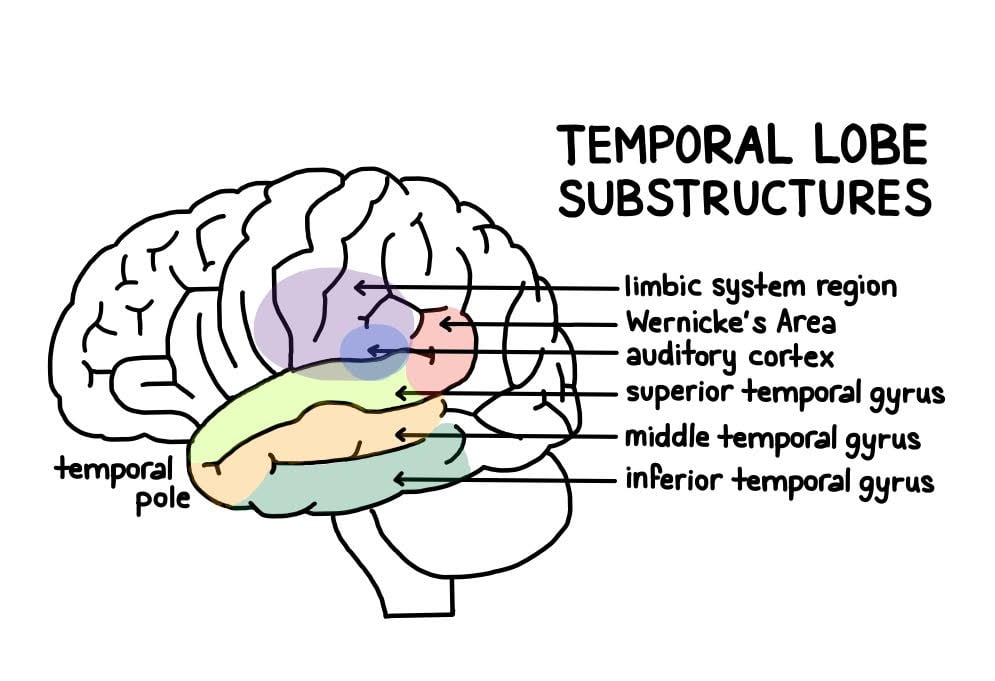
The temporal lobe is structurally divided into the superior, middle, and inferior gyri.
Superior Temporal Gyrus
Thesuperior temporalgyrusis situated at the top of the temporal lobes, somewhat above the ears. It contains other areas with specialized functions.
Some areas are vital in auditory processing, including language processing. Other areas specialize in processing a combination of frequencies, while others specialize in processing changes in amplitude or frequency.
The superior temporal gyrus has been implicated as being critical insocial cognition(Jou, Minshew, Keshaven, Vitale, & Harden, 2010), and in theperceptions of emotionsfrom facial expressions (Raduaet al.,2010).
Wernicke’s Area
Wernicke’s areais believed to be situated in the posterior part of the temporal lobe, frequently found in the left hemisphere.
It takes its name from Carl Wernicke, who worked with patients with language impairments, to distinguish separate regions for language comprehension and production.
Wernicke’s area is particularly important forlanguage development and the comprehension of speech, giving meaning to speech, and the written word.
Auditory Cortex
The auditory cortex, the main area responsible for processing auditory information, is located within the temporal lobe and is part of the superior temporal gyrus.
It receives input from the ears through the brainstem and processes this sensory information into meaningful units such as speech and words.
The signals are then transmitted back to the ears and can be interconnected with other parts of thecerebral cortex.
This area of the temporal lobes is especially important in processing thesemantics of language and vision.
It is also important for performing basic and higher functions relating to hearing and the ability to switch languages.
Limbic System
The temporal lobe is a significant part of thelimbic system. The limbic system is a group of structures deep within the brain involved in processing and regulating emotions, memory, and motivation.

One of the substructures, thehippocampus, is a seahorse-shaped area essential in the formation of new memories.
The hippocampus is important for the early storage of long-term memories and is involved in the transition of long-term memory to even more permanent memory.
Another substructure of the limbic system, theamygdala, is known as the emotional center of the brain. This is involved in processing emotions,fear, andreward,and plays a role in thefight-or-flight response.
The amygdala is involved in the modulation of memory strengthening, especially emotional memories. In essence, the stronger the emotional arousal of a memory, the more likely it will be retained.
Damage to the Temporal Lobes
Below are some of the key symptoms that can be associated with damage to the temporal lobes:
Common Causes & Associated Conditions
The temporal lobe can be damaged through various means:
Several neurological conditions are associated with temporal lobe dysfunction:
This is the most common type of epilepsy that has been found to impactmemory, executive functions,andlanguage abilities(Alloneet al.,2017).
Temporal lobe epilepsy may also cause changes in behavior and emotional processing.
Early signs ofAlzheimer’s Diseasemay be identifiable in the medial temporal lobe (Lowndes & Savage, 2007).
This makes sense since memory problems are typically the first symptom of this condition, suggesting the hippocampus may have come to damage.
The superior temporal sulcus, which plays a role in interpreting social and speech input, may be different in those whoare autistic.
This can provide an explanation for the differences insocial cognition and language processingin these individuals (Redcay, 2008).
There were found to be structural abnormalities in thesuperior temporal gyriin individuals withSchizophrenia(Kasaiet al.,2003).
This may explain why damage to this area is linked to key symptoms of this condition such as auditory hallucinations.
Protecting Your Temporal Lobes
While not all temporal lobe damage can be prevented, several steps may help protect brain health:
ReferencesAllone, C., Buono, V. L., Corallo, F., Pisani, L. R., Pollicino, P., Bramanti, P., & Marino, S. (2017). Neuroimaging and cognitive functions in temporal lobe epilepsy: a review of the literature.Journal of the neurological sciences, 381, 7-15.Jou, R. J., Minshew, N. J., Keshavan, M. S., Vitale, M. P., & Hardan, A. Y. (2010). Enlarged right superior temporal gyrus in children and adolescents with autism.Brain research, 1360, 205–212.Jung-Beeman, M., Bowden, E. M., Haberman, J., Frymiare, J. L., Arambel-Liu, S., Greenblatt, R., Reber, P. J. & Kounios, J. (2004). Neural activity when people solve verbal problems with insight.PLoS Biol, 2(4), e97.Kasai, K., Shenton, M. E., Salisbury, D. F., Hirayasu, Y., Lee, C. U., Ciszewski, A. A., Yurgelun-Todd, D., Kikinis, R., Jolesz, F. A. & McCarley, R. W. (2003). Progressive decrease of left superior temporal gyrus gray matter volume in patients with first-episode schizophrenia. AmericanJournal of Psychiatry, 160(1), 156-164.Lowndes, G., & Savage, G. (2007). Early detection of memory impairment in Alzheimer’s disease: a neurocognitive perspective on assessment. Neuropsychology review, 17(3), 193-202.Redcay, E. (2008). The superior temporal sulcus performs a common function for social and speech perception: implications for the emergence of autism.Neuroscience & Biobehavioral Reviews, 32(1), 123-142.Temporal Brain Lobe. (2020: November 25). The Human Memory. https://human-memory.net/temporal-brain-lobe/Tidy, C. (2016, September 29). Temporal Lobe Lesions. Patient. https://patient.info/doctor/temporal-lobe-lesions-pro#Vander Ghinst, M., Bourguignon, M., de Beeck, M. O., Wens, V., Marty, B., Hassid, S., Choufani, G., Jousmaki, V., Hari, R., Van Bogaert, P, Goldman, S. & De Tiege, X. (2016). Left superior temporal gyrus is coupled to attended speech in a cocktail-party auditory scene.Journal of Neuroscience, 36(5), 1596-1606.Vannucci, M., Dietl, T., Pezer, N., Viggiano, M. P., Helmstaedter, C., Schaller, C., Elger, C. E. & Grunwald, T. (2003). Hippocampal function and visual object processing in temporal lobe epilepsy.Neuroreport, 14(11), 1489-1492.
References
Allone, C., Buono, V. L., Corallo, F., Pisani, L. R., Pollicino, P., Bramanti, P., & Marino, S. (2017). Neuroimaging and cognitive functions in temporal lobe epilepsy: a review of the literature.Journal of the neurological sciences, 381, 7-15.Jou, R. J., Minshew, N. J., Keshavan, M. S., Vitale, M. P., & Hardan, A. Y. (2010). Enlarged right superior temporal gyrus in children and adolescents with autism.Brain research, 1360, 205–212.Jung-Beeman, M., Bowden, E. M., Haberman, J., Frymiare, J. L., Arambel-Liu, S., Greenblatt, R., Reber, P. J. & Kounios, J. (2004). Neural activity when people solve verbal problems with insight.PLoS Biol, 2(4), e97.Kasai, K., Shenton, M. E., Salisbury, D. F., Hirayasu, Y., Lee, C. U., Ciszewski, A. A., Yurgelun-Todd, D., Kikinis, R., Jolesz, F. A. & McCarley, R. W. (2003). Progressive decrease of left superior temporal gyrus gray matter volume in patients with first-episode schizophrenia. AmericanJournal of Psychiatry, 160(1), 156-164.Lowndes, G., & Savage, G. (2007). Early detection of memory impairment in Alzheimer’s disease: a neurocognitive perspective on assessment. Neuropsychology review, 17(3), 193-202.Redcay, E. (2008). The superior temporal sulcus performs a common function for social and speech perception: implications for the emergence of autism.Neuroscience & Biobehavioral Reviews, 32(1), 123-142.Temporal Brain Lobe. (2020: November 25). The Human Memory. https://human-memory.net/temporal-brain-lobe/Tidy, C. (2016, September 29). Temporal Lobe Lesions. Patient. https://patient.info/doctor/temporal-lobe-lesions-pro#Vander Ghinst, M., Bourguignon, M., de Beeck, M. O., Wens, V., Marty, B., Hassid, S., Choufani, G., Jousmaki, V., Hari, R., Van Bogaert, P, Goldman, S. & De Tiege, X. (2016). Left superior temporal gyrus is coupled to attended speech in a cocktail-party auditory scene.Journal of Neuroscience, 36(5), 1596-1606.Vannucci, M., Dietl, T., Pezer, N., Viggiano, M. P., Helmstaedter, C., Schaller, C., Elger, C. E. & Grunwald, T. (2003). Hippocampal function and visual object processing in temporal lobe epilepsy.Neuroreport, 14(11), 1489-1492.
Allone, C., Buono, V. L., Corallo, F., Pisani, L. R., Pollicino, P., Bramanti, P., & Marino, S. (2017). Neuroimaging and cognitive functions in temporal lobe epilepsy: a review of the literature.Journal of the neurological sciences, 381, 7-15.
Jou, R. J., Minshew, N. J., Keshavan, M. S., Vitale, M. P., & Hardan, A. Y. (2010). Enlarged right superior temporal gyrus in children and adolescents with autism.Brain research, 1360, 205–212.
Jung-Beeman, M., Bowden, E. M., Haberman, J., Frymiare, J. L., Arambel-Liu, S., Greenblatt, R., Reber, P. J. & Kounios, J. (2004). Neural activity when people solve verbal problems with insight.PLoS Biol, 2(4), e97.
Kasai, K., Shenton, M. E., Salisbury, D. F., Hirayasu, Y., Lee, C. U., Ciszewski, A. A., Yurgelun-Todd, D., Kikinis, R., Jolesz, F. A. & McCarley, R. W. (2003). Progressive decrease of left superior temporal gyrus gray matter volume in patients with first-episode schizophrenia. AmericanJournal of Psychiatry, 160(1), 156-164.
Lowndes, G., & Savage, G. (2007). Early detection of memory impairment in Alzheimer’s disease: a neurocognitive perspective on assessment. Neuropsychology review, 17(3), 193-202.
Redcay, E. (2008). The superior temporal sulcus performs a common function for social and speech perception: implications for the emergence of autism.Neuroscience & Biobehavioral Reviews, 32(1), 123-142.
Temporal Brain Lobe. (2020: November 25). The Human Memory. https://human-memory.net/temporal-brain-lobe/
Tidy, C. (2016, September 29). Temporal Lobe Lesions. Patient. https://patient.info/doctor/temporal-lobe-lesions-pro#
Vander Ghinst, M., Bourguignon, M., de Beeck, M. O., Wens, V., Marty, B., Hassid, S., Choufani, G., Jousmaki, V., Hari, R., Van Bogaert, P, Goldman, S. & De Tiege, X. (2016). Left superior temporal gyrus is coupled to attended speech in a cocktail-party auditory scene.Journal of Neuroscience, 36(5), 1596-1606.
Vannucci, M., Dietl, T., Pezer, N., Viggiano, M. P., Helmstaedter, C., Schaller, C., Elger, C. E. & Grunwald, T. (2003). Hippocampal function and visual object processing in temporal lobe epilepsy.Neuroreport, 14(11), 1489-1492.
The temporal lobe is one of the brain’s main lobes, located near the temples. It plays key roles in auditory processing, memory, and aspects of language and emotion. Damage can impact hearing, memory, and language comprehension.


Karina Ascunce GonzálezNeuroscience B.A. (Hons), Harvard UniversityPhD Neuroscience Student, Yale University
Karina Ascunce González
Neuroscience B.A. (Hons), Harvard University
PhD Neuroscience Student, Yale University
PhD Student at the Yale Biological & Biomedical Sciences' Interdepartmental Neuroscience Program interested in neurodegeneration, stem cell culture, and bioethics. AB in Neuroscience with a Secondary in Global Health & Health Policy from Harvard University. Karina has been published in peer reviewed journals.
Saul McLeod, PhD
BSc (Hons) Psychology, MRes, PhD, University of Manchester
Saul McLeod, PhD., is a qualified psychology teacher with over 18 years of experience in further and higher education. He has been published in peer-reviewed journals, including the Journal of Clinical Psychology.
Olivia Guy-Evans, MSc
BSc (Hons) Psychology, MSc Psychology of Education
Olivia Guy-Evans is a writer and associate editor for Simply Psychology. She has previously worked in healthcare and educational sectors.
