12 pairs of cranial nerves are linked directly to the brain, without having to pass through the spinal cord. Therefore, these allow sensory information to pass from the organs of the head, such as the ears and eyes, to the brain.
These also convey motor information from the brain to these organs, such as giving directions to the mouth to move in order to eat or speak.
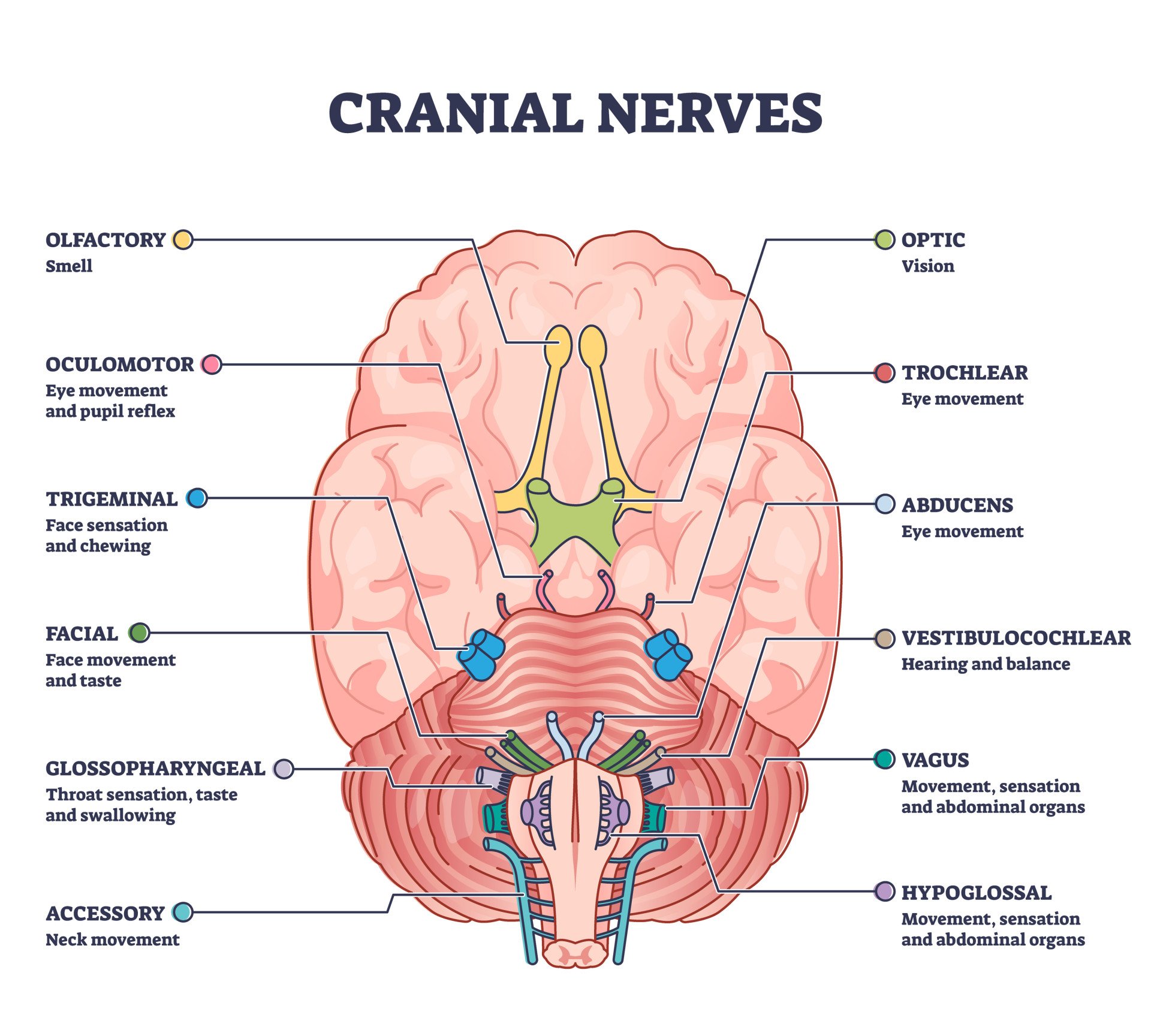 Cranial nerves pairs with anatomical sensory functions in outline diagram. Labeled educational collection with neurology brain system and how nerve relay information to human body vector illustration.
All the cranial nerves originate from nuclei in the brain. Two cranial nerves, the optic nerve and the olfactory nerve originate from thecerebrum. The accessory nerve has a nucleus in the spinal cord.
The rest of the cranial nerves originate from the brain stem. These can arise from a specific brain stem region, either themidbrain, pons, or medulla, or from a junction between two parts.
The functions of the cranial nerves are typically described as either sensory or motor in function. The sensory cranial nerves are involved with the senses, search as sight, smell, hearing, and touch.
Whereas themotor nervescontrol the movements and functions of muscles and glands, cranial nerves supply sensory and motor information to areas of the head and neck.
One nerve, the vagus nerve, extends beyond the neck to the thoracic and abdominal organs.
Modalities (Functions)
Each type of cranial nerve either has sensory functions, motor functions, or both. The types of information that cranial nerves transport can all differ.
There are seven types of modalities of information that can be sent, with three of these being unique to cranial nerves.
Sensory modalities
Motor modalities
Types of Cranial Nerves
There are 12 pairs of cranial nerves attached to thebrain. The cranial nerves are named after the body parts that they serve, and are also assigned Roman numerals, based off their location from front to back.
Mnemonic for Function of Cranial Nerves:
Oh,Oh,Oh,ToTouchAndFeelVeryGoodVelvet, such-AHeaven
Mnemonic for Order of Cranial Nerves:
SomeSayMarryMoneyButMyBrotherSaysBigBrainsMatterMore
Ⅰ. Olfactory nerveThe olfactory nerves are associated with the function of smell. The smell molecules in the nasal cavity trigger nerve impulses that pass along this nerve to the olfactory bulb, then onto limbic areas.The type of modality is sensory, of the special visceral sensory variety.
Ⅰ. Olfactory nerve
The olfactory nerves are associated with the function of smell. The smell molecules in the nasal cavity trigger nerve impulses that pass along this nerve to the olfactory bulb, then onto limbic areas.The type of modality is sensory, of the special visceral sensory variety.
The olfactory nerves are associated with the function of smell. The smell molecules in the nasal cavity trigger nerve impulses that pass along this nerve to the olfactory bulb, then onto limbic areas.
The type of modality is sensory, of the special visceral sensory variety.
Ⅱ. Optic nerve
Both optic nerves from the eyes meet to form something called an optic chiasm. At the optic chiasm, signals from both fields of vision are sent to opposite sides of the brain via two separate optic tracts.
These signals will then eventually reach the visual cortex at the back of the brain. The type of modality of the optic nerve is sensory, of the special somatic sensory variety.
Ⅲ. Oculomotor nerveThe oculomotor nerve is also associated with vision. This nerve provides motor function to most of the muscles around the eyes to help them move and focus on objects.This nerve also functions in pupillary response to help control the size of the pupils as it responds to light, dilating and constricting the pupils.This nerve originates from the front of the midbrain, which is part of the brain stem, moving from this area until it reaches the area of the eye sockets. The modality of this cranial nerve is motor, of the general somatic and general visceral motor variety.
Ⅲ. Oculomotor nerve
The oculomotor nerve is also associated with vision. This nerve provides motor function to most of the muscles around the eyes to help them move and focus on objects.This nerve also functions in pupillary response to help control the size of the pupils as it responds to light, dilating and constricting the pupils.This nerve originates from the front of the midbrain, which is part of the brain stem, moving from this area until it reaches the area of the eye sockets. The modality of this cranial nerve is motor, of the general somatic and general visceral motor variety.
The oculomotor nerve is also associated with vision. This nerve provides motor function to most of the muscles around the eyes to help them move and focus on objects.
This nerve also functions in pupillary response to help control the size of the pupils as it responds to light, dilating and constricting the pupils.
This nerve originates from the front of the midbrain, which is part of the brain stem, moving from this area until it reaches the area of the eye sockets. The modality of this cranial nerve is motor, of the general somatic and general visceral motor variety.
Ⅳ. Trochlear nerveThe trochlear nerve controls the superior oblique muscles, which are the muscles that are responsible for downward, outward, and inward eye movements.This nerve travels from the back of the midbrain to the eye sockets, where it stimulates these superior oblique muscles. The trochlear nerve is motor in modality of the general somatic motor variety.
Ⅳ. Trochlear nerve
The trochlear nerve controls the superior oblique muscles, which are the muscles that are responsible for downward, outward, and inward eye movements.This nerve travels from the back of the midbrain to the eye sockets, where it stimulates these superior oblique muscles. The trochlear nerve is motor in modality of the general somatic motor variety.
The trochlear nerve controls the superior oblique muscles, which are the muscles that are responsible for downward, outward, and inward eye movements.
This nerve travels from the back of the midbrain to the eye sockets, where it stimulates these superior oblique muscles. The trochlear nerve is motor in modality of the general somatic motor variety.
Ⅴ. Trigeminal nerveThe trigeminal nerve is the largest of the cranial nerves and can be further divided into three divisions: ophthalmic, maxillary, and mandibular.The ophthalmic division sends information from the scalp, forehead, and upper eyelids (the upper parts of the head) and is sensory in modality, of the general somatic sensory variety.The maxillary division sends information from the middle of the head, such as cheeks, lower eyelids, upper lip, and nasal cavity. This is also sensory or the general somatic sensory variety.The mandibular division sends both sensory and motor information of the general somatic sensory and special visceral motor modalities.This division sends information from the lower parts of the head, such as the tongue, lower lip, chin, and jaw.
Ⅴ. Trigeminal nerve
The trigeminal nerve is the largest of the cranial nerves and can be further divided into three divisions: ophthalmic, maxillary, and mandibular.The ophthalmic division sends information from the scalp, forehead, and upper eyelids (the upper parts of the head) and is sensory in modality, of the general somatic sensory variety.The maxillary division sends information from the middle of the head, such as cheeks, lower eyelids, upper lip, and nasal cavity. This is also sensory or the general somatic sensory variety.The mandibular division sends both sensory and motor information of the general somatic sensory and special visceral motor modalities.This division sends information from the lower parts of the head, such as the tongue, lower lip, chin, and jaw.
The trigeminal nerve is the largest of the cranial nerves and can be further divided into three divisions: ophthalmic, maxillary, and mandibular.
The ophthalmic division sends information from the scalp, forehead, and upper eyelids (the upper parts of the head) and is sensory in modality, of the general somatic sensory variety.
The maxillary division sends information from the middle of the head, such as cheeks, lower eyelids, upper lip, and nasal cavity. This is also sensory or the general somatic sensory variety.
The mandibular division sends both sensory and motor information of the general somatic sensory and special visceral motor modalities.
This division sends information from the lower parts of the head, such as the tongue, lower lip, chin, and jaw.
Ⅵ. Abducens nerveThe abducens nerve is another nerve that controls a muscle of the eye, called the lateral rectus muscle. This muscle is responsible for outward eye movements such as looking to the side.This nerve originates in the pons and travels to the eye socket to control this muscle. This nerve sends motor information about the general somatic motor modality.
Ⅵ. Abducens nerve
The abducens nerve is another nerve that controls a muscle of the eye, called the lateral rectus muscle. This muscle is responsible for outward eye movements such as looking to the side.This nerve originates in the pons and travels to the eye socket to control this muscle. This nerve sends motor information about the general somatic motor modality.
The abducens nerve is another nerve that controls a muscle of the eye, called the lateral rectus muscle. This muscle is responsible for outward eye movements such as looking to the side.
This nerve originates in the pons and travels to the eye socket to control this muscle. This nerve sends motor information about the general somatic motor modality.
Ⅶ. Facial nerveFacial nerves have both sensory and motor functions, such as collecting information from the taste buds of the tongue, controlling muscle movements required for facial expressions, and supplying glands that produce saliva and secrete tears.Facial nerves originate from the pons area of the brainstem, where it has both motor and sensory roots, before fusing together to form the facial nerve.The sensations from part of the external ear are of the general somatic sensory modality, taste is part of the special visceral sensory modality, the muscles of facial expressions are part of the special visceral sensory modality, and the lacrimal and mucous glands of the eyes, mouth, and nose are of the general visceral motor modality.
Ⅶ. Facial nerve
Facial nerves have both sensory and motor functions, such as collecting information from the taste buds of the tongue, controlling muscle movements required for facial expressions, and supplying glands that produce saliva and secrete tears.Facial nerves originate from the pons area of the brainstem, where it has both motor and sensory roots, before fusing together to form the facial nerve.The sensations from part of the external ear are of the general somatic sensory modality, taste is part of the special visceral sensory modality, the muscles of facial expressions are part of the special visceral sensory modality, and the lacrimal and mucous glands of the eyes, mouth, and nose are of the general visceral motor modality.
Facial nerves have both sensory and motor functions, such as collecting information from the taste buds of the tongue, controlling muscle movements required for facial expressions, and supplying glands that produce saliva and secrete tears.
Facial nerves originate from the pons area of the brainstem, where it has both motor and sensory roots, before fusing together to form the facial nerve.
The sensations from part of the external ear are of the general somatic sensory modality, taste is part of the special visceral sensory modality, the muscles of facial expressions are part of the special visceral sensory modality, and the lacrimal and mucous glands of the eyes, mouth, and nose are of the general visceral motor modality.
Ⅷ. Vestibulocochlear nerveThe vestibulocochlear nerve is associated with the function of hearing and consists of two divisions: cochlear and vestibular.The vestibular branch collects information regarding the inner ear and head orientation and balance. The cochlear branch is concerned with sound and hearing signals from the ear, detecting vibrations from a sound’s volume and pitch. This information is sensory to the special somatic sensory modality.
Ⅷ. Vestibulocochlear nerve
The vestibulocochlear nerve is associated with the function of hearing and consists of two divisions: cochlear and vestibular.The vestibular branch collects information regarding the inner ear and head orientation and balance. The cochlear branch is concerned with sound and hearing signals from the ear, detecting vibrations from a sound’s volume and pitch. This information is sensory to the special somatic sensory modality.
The vestibulocochlear nerve is associated with the function of hearing and consists of two divisions: cochlear and vestibular.
The vestibular branch collects information regarding the inner ear and head orientation and balance. The cochlear branch is concerned with sound and hearing signals from the ear, detecting vibrations from a sound’s volume and pitch. This information is sensory to the special somatic sensory modality.
Ⅸ. Glossopharyngeal nerveThe glossopharyngeal nerve has both motor and sensory functions originating from a part of the brainstem called the medulla oblongata, extending into the neck and throat.This nerve sends sensory information from the external ear and middle ear cavity (general somatic sensory modality), the back part of the tongue (special visceral sensory modality), and from the sinuses at the back of the throat (general visceral sensory modality).This nerve also sends motor information from two salivary glands called parotid glands (general visceral motor modality), and movement from a muscle at the back of the throat called the stylopharyngeus (special visceral motor modality).
Ⅸ. Glossopharyngeal nerve
The glossopharyngeal nerve has both motor and sensory functions originating from a part of the brainstem called the medulla oblongata, extending into the neck and throat.This nerve sends sensory information from the external ear and middle ear cavity (general somatic sensory modality), the back part of the tongue (special visceral sensory modality), and from the sinuses at the back of the throat (general visceral sensory modality).This nerve also sends motor information from two salivary glands called parotid glands (general visceral motor modality), and movement from a muscle at the back of the throat called the stylopharyngeus (special visceral motor modality).
The glossopharyngeal nerve has both motor and sensory functions originating from a part of the brainstem called the medulla oblongata, extending into the neck and throat.
This nerve sends sensory information from the external ear and middle ear cavity (general somatic sensory modality), the back part of the tongue (special visceral sensory modality), and from the sinuses at the back of the throat (general visceral sensory modality).
This nerve also sends motor information from two salivary glands called parotid glands (general visceral motor modality), and movement from a muscle at the back of the throat called the stylopharyngeus (special visceral motor modality).
Ⅹ. Vagus nerveThe vagus nerve has a variety of functions and is the longest and most branched of all the cranial nerves with sensory, motor, and autonomic fibers.It receives sensory information from the ear canal as well as the larynx and pharynx, which are parts of the throat (general somatic sensory modality), information from the organs of the chest and trunk such as the heart and intestines (general visceral sensory modality), and a sense of taste from the root of the tongue (special visceral sensory modality).It also receives motor information from the smooth muscles of parts of the throat (general visceral motor modality), as well as most of the muscles of the throat (special visceral motor modality).
Ⅹ. Vagus nerve
The vagus nerve has a variety of functions and is the longest and most branched of all the cranial nerves with sensory, motor, and autonomic fibers.It receives sensory information from the ear canal as well as the larynx and pharynx, which are parts of the throat (general somatic sensory modality), information from the organs of the chest and trunk such as the heart and intestines (general visceral sensory modality), and a sense of taste from the root of the tongue (special visceral sensory modality).It also receives motor information from the smooth muscles of parts of the throat (general visceral motor modality), as well as most of the muscles of the throat (special visceral motor modality).
The vagus nerve has a variety of functions and is the longest and most branched of all the cranial nerves with sensory, motor, and autonomic fibers.
It receives sensory information from the ear canal as well as the larynx and pharynx, which are parts of the throat (general somatic sensory modality), information from the organs of the chest and trunk such as the heart and intestines (general visceral sensory modality), and a sense of taste from the root of the tongue (special visceral sensory modality).
It also receives motor information from the smooth muscles of parts of the throat (general visceral motor modality), as well as most of the muscles of the throat (special visceral motor modality).
Ⅺ. Spinal accessory nerve
The spinal accessory nerve has motor functions associated with the muscles and movements of the head, neck, and shoulders. This also stimulates the muscles of the larynx and pharynx, which are responsible for swallowing.
Ⅻ. Hypoglossal nerveThe hypoglossal nerve is responsible for most of the movements in the tongue. These originate in the medulla oblongata and move down into the jaw, reaching the tongue.This nerve is of the general somatic motor modality.
Ⅻ. Hypoglossal nerve
The hypoglossal nerve is responsible for most of the movements in the tongue. These originate in the medulla oblongata and move down into the jaw, reaching the tongue.
This nerve is of the general somatic motor modality.
Cranial Nerve Damage
As cranial nerves play a vital role in the proper functioning of the face, head, and neck, damage to these nerves could be detrimental. Cranial nerve damage can be the result of many causes, such as head trauma.
Symptoms of damage to cranial nerves depend on the nerves which are damaged. For instance, damage to the optic nerves may affect vision, even blindness in worse conditions.
Damage to the olfactory nerve may affect the sense of smell, as well as the ability to taste food due to smell being an important factor in taste. If the facial nerve is damaged, this may impair the ability to make facial expressions on one side of the face.
More generally, damage to cranial nerves may result in the following symptoms:
Some cranial neuropathies may go away independently, but some could be more permanent or life-threatening. Medication or physical/occupational therapy may be required to assist someone suffering from cranial nerve damage.
Preventative measures to avoid cranial nerve damage include following a healthy lifestyle of regular exercise, eating a balanced diet, maintaining a healthy weight, and not smoking.
Similarly, avoiding the risk of diabetes, aiming to lower blood pressure, and reducing risk of head injury can all help to avoid cranial nerve damage.
References
Cedars Sinai (n.d.). Cranial Neuropathies. Retrieved July 21, 2021, from: https://www.cedars-sinai.org/health-library/diseases-and-conditions/c/cranial-neuropathies.html
Seladi-Schulman, J. (2019, March 14). The 12 Cranial Nerves. Healthline. https://www.healthline.com/health/12-cranial-nerves#x-vagus-nerve
Sonne, J., & Lopez-Ojeda, W. (2020). Neuroanatomy, cranial nerve. StatPearls [Internet].
Teach Me Anatomy (n.d). Summary of the Cranial Nerves. Retrieved July 21, 2021, from: https://teachmeanatomy.info/head/cranial-nerves/summary/
Further InformationCranial Nerve Summary TableCranial Nerves: Anatomy and Physiology
Further Information
Cranial Nerve Summary TableCranial Nerves: Anatomy and Physiology
 cranial nerves
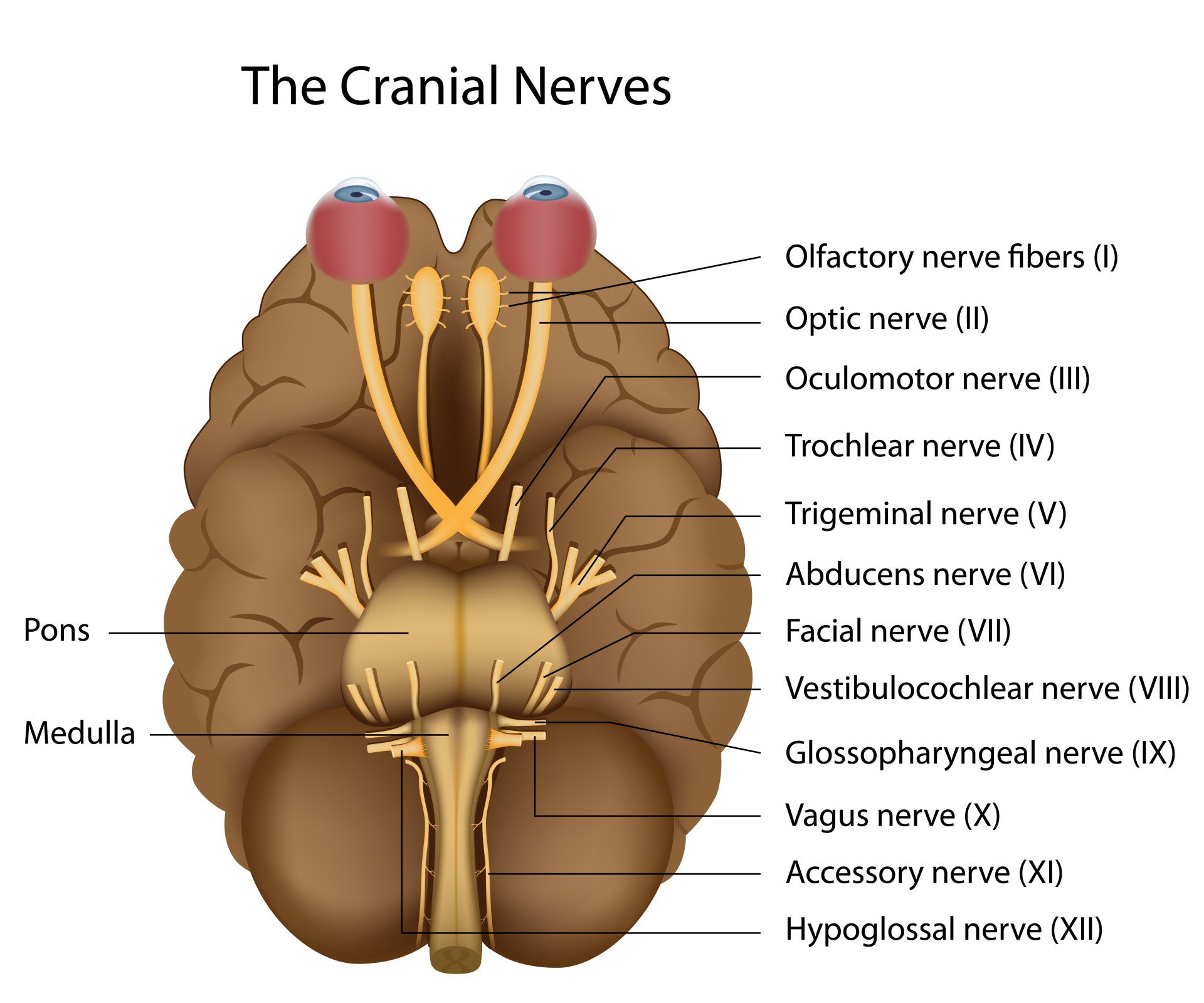 The 12 cranial nerves

Saul McLeod, PhD
BSc (Hons) Psychology, MRes, PhD, University of Manchester
Saul McLeod, PhD., is a qualified psychology teacher with over 18 years of experience in further and higher education. He has been published in peer-reviewed journals, including the Journal of Clinical Psychology.
Olivia Guy-Evans, MSc
BSc (Hons) Psychology, MSc Psychology of Education
Olivia Guy-Evans is a writer and associate editor for Simply Psychology. She has previously worked in healthcare and educational sectors.
