On This Page:ToggleWhat Is The Stroop Effect?The First Stroop ExperimentHow It WorksAdditional ResearchOther Uses and VersionsCritical Evaluation
On This Page:Toggle
On This Page:
Take-home Messages
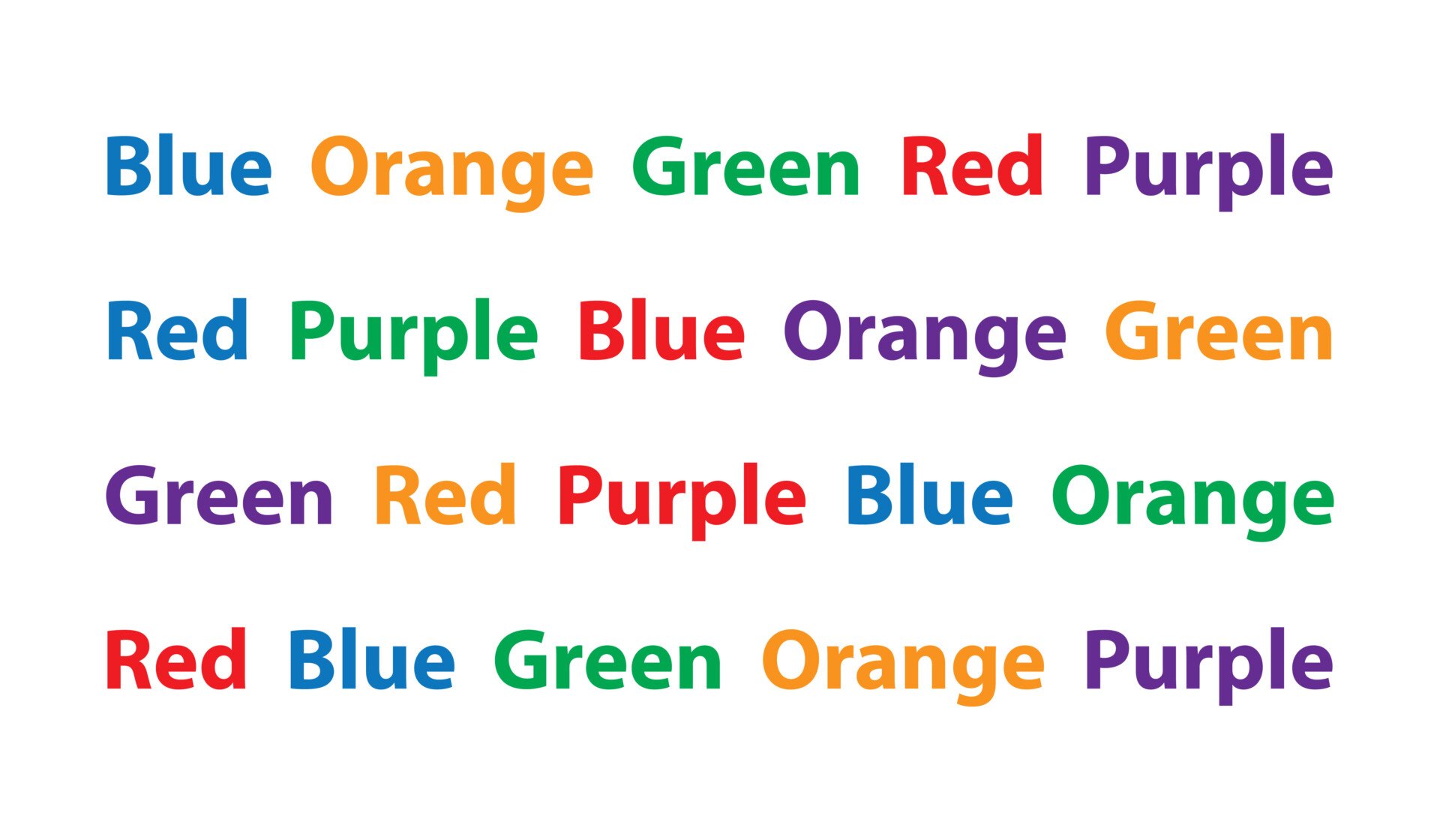 The Stroop test measures the interference between reading and naming the ink color of words, highlighting the conflict between automatic and controlled cognitive processes.
What Is The Stroop Effect?
The Stroop effect refers to a delay in reaction times between congruent and incongruent stimuli (MacLeod, 1991).
Congruency, or agreement, occurs when a word’s meaning and font color are the same. For example, if the word “green” is printed in green.
Incongruent stimuli are just the opposite. That is the word’s meaning and the color in which it is written do not align. For example, the word “green” might be printed in red ink.
The Stroop task asks individuals to name the color of the word instead of reading the word itself.

The delay in reaction time reveals that it is much harder to name the color of a word when the word itself spells another color (the incongruent stimuli) than it is to name the color of the word when the word itself spells that same color (the congruent stimuli).
The First Stroop Experiment
Aims
Building off previous research, Stroop had two main aims in his groundbreaking paper:
Method
To empirically study these two major aims, Stroop ran three different experiments:
1)Experiment 1:
Participants (70 college undergraduates) were tasked with reading the word aloud, irrespective of its color. In other words, participants must read aloud the word “green” even if written in a different color.
2)Experiment 2:
The second experiment was the opposite of the first. Participants (100 college students) were first asked to name the color of individual squares (instead of the color of words) as a training mechanism for the subsequent task. Afterward, participants had to say the color of the word, regardless of its meaning – the opposite of the experiment 1 procedure.
3)Experiment 3:
The third and final experiment integrated all of the previously mentioned tests with an undergraduate population of 32 participants.
Theindependent variable(IV) was the congruency of the font name and color.
Thedependent variable(DV) was reaction time (ms) in reporting the letter color.
Findings
After running the three experiments, Stroop drew two main conclusions:
Conclusion
The word stimulus has been associated with the specific response “to read,” while the color stimulus has been associated with various responses: “to admire,” “to name,” etc.
The observed results might reflect the fact that people have more experience consciously reading words than consciously labeling colors, illustrating a difference in the mechanisms that control these two processes.
How the Stroop Effect Works
Why does the Stroop effect occur? We can tell our brain to do lots of things – store memories, sleep, think, etc. – so why can’t we tell it to do something as easy as naming a color? Isn’t that something we learn to do at a very young age?
Researchers have analyzed this question and come up with multiple different theories that seek to explain the occurrence of the Stroop effect (Sahinoglu & Dogan, 2016).
Speed of processing theory:
The processing speed theory claims that people can read words much faster than they can name colors (i.e., word processing is much faster than color processing).
When we look at the incongruent stimuli (the word “green” printed in red, for example), our brain first reads the word, making it much more difficult to then have to name the color.
As a result, a delay occurs when trying to name the color because doing so is not our brain’s first instinct (McMahon, 2013).
Selective attention theory:
The theory ofselective attentionholds that recognizing colors, compared to reading words, requires more attention.
Because of this, the brain needs to use more attention when attempting to name a color, making this process take slightly longer (McMahon, 2013).
Automaticity:
A prevalent explanation for the Stroop effect is the automatic nature of reading. When we see a word, its meaning is almost instantly recognized. Thus, when presented with a conflicting color, there’s interference between the automatic reading process and the task of naming the ink color.
This theory argues that recognizing colors is not anautomatic process, and thus there is a slight hesitancy when carrying out this action.
Automatic processing is processed in the mind that is relatively fast and requires few cognitive resources.
This type of information processing generally occurs outside of conscious awareness and is common when undertaking familiar and highly practiced tasks.
However, the brain is able to automatically understand the meaning of a word as a result of habitual reading (think back to Stroop’s initial study in 1935 – this theory explains why he wanted to test the effects of practice on the ability to name colors).
Researchers in support of this theory posit that automatic reading does not needcontrolled attentionbut still uses enough of the brain’s attentional resources to reduce the amount left for color processing (Monahan, 2001).
In a way, this parallels the brain’s dueling modes of thinking – that of “System 1” and “System 2.” Whereas the former is more automatic and instinctive, the latter is slower and more controlled (Kahneman, 2011).
This is similar to the Stroop effect, in which we see a more automatic process trying to dominate over a more deliberative one. The interference occurs when we try to use System 2 to override System 1, thus producing that delay in reaction time.
Parallel distributed processing:
The fourth and final theory proposes that unique pathways are developed when the brain completes different tasks. Some of these pathways, such as reading words, are stronger than others, such as naming colors (Cohen et al., 1990).
Thus, interference is not an issue of processing speed, attention, or automaticity but rather a battle between the stronger and weaker neural pathways.
Additional Research
John Ridley Stroop helped lay the groundwork for future research in this field.
Numerous studies have tried to identify the specific brain regions responsible for this phenomenon, identifying two key regions: the anterior cingulate cortex (ACC) and dorsolateral prefrontal cortex (DLFPC).
Both MRI and fMRI scans show activity in the ACC and DLPFC while completing the Stroop test or related tasks (Milham et al., 2003).
The DLPFC assists with memory and executive functioning, and its role during the task are to activate color perception and inhibit word encoding. The ACC is responsible for selecting the appropriate response and properly allocating attentional resources (Banich et al., 2000).
Countless studies that repeatedly test the Stroop effect reveal a few key recurring findings (van Maanen et al., 2009):
Other experiments have slightly modified the original Stroop test paradigm to provide additional findings.
One study found that participants were slower to name the color of emotion words as opposed to neutral words (Larsen et al., 2006).
Another experiment examined the differences between participants with panic disorder and OCD. Even with using threat words as stimuli, they found that there was no difference among panic disorder, OCD, and neutral participants’ ability to process colors (Kampman et al., 2002).
A third experiment investigated the relationship between duration and numerosity processing instead of word and color processing.
Participants were shown two series of dots in succession and asked either (1) which series contained more dots or (2) which series lasted longer from the appearance of the first to the last dots of the series.
The researchers found that numerical cues interfered with duration processing. That is, when fewer dots were shown for longer, it was harder for participants to figure out which set of dots appeared on the screen for longer (Dormal et al., 2006).
Thus, there is a difference between the processing of numerosity and duration. Together, these experiments illustrate not only all of the doors of research that Stroop’s initial work opened but also shed light on all of the intricate processing associations that occur in our brains.
Other Uses and Versions
The purpose of the Stroop task is to measure interference that occurs in the brain. The initial paradigm has since been adopted in several different ways to measure other forms of interference (such as duration and numerosity, as mentioned earlier).
Additional variations measure interference between picture and word processing, direction and word processing, digit and numerosity processing, and central vs. peripheral letter identification (MacLeod, 2015).
The below figure provides illustrations for these four variations:

The Stroop task is also used as a mechanism for measuring selective attention, processing speed, and cognitive flexibility (Howieson et al., 2004).
The Stroop task has also been utilized to study populations with brain damage or mental disorders, such as dementia, depression, orADHD(Lansbergen et al., 2007; Spreen & Strauss, 1998).
For individuals with depression, an emotional Stroop task (where negative words, such as “grief,” “violence,” and “pain,” are used in conjunction with more neutral words, such as “clock,” “door,” and “shoe”) has been developed.
Research reveals that individuals who struggle with depression are more likely to say the color of a negative word slower than that of a neutral word (Frings et al., 2010).
The versatility of the Stroop task paradigm lends itself to be useful in a wide variety of fields within psychology. What was once a test that only examined the relationship between word and color processing has since been expanded to investigate additional processing interferences and to contribute to the fields of psychopathology and brain damage.
The development of the Stroop task not only provides novel insights into the ways in which our brain mechanisms operate but also sheds light on the power of psychology to expand and build on past research methods as we continue to uncover more and more about ourselves.
Critical Evaluation
Dishon-Berkovits and Algom (2000) argue that the Stroop effect is not a result of automatic processes but is due to incidental correlations between the word and its color across stimuli.
They suggest that participants unconsciously recognize these correlations, using word cues to anticipate the correct color hue they should name.
When testing with word-word stimuli, Dishon-Berkovits and Algom created positive, negative, and zero correlations.
They observed that zero correlations nearly eliminated Stroop effects, implying that the effects might be more about the way stimuli are presented rather than true indicators of automaticity or attention.
However, their methodology raised concerns:
Despite these considerations, the correlational approach does not invalidate Stroop’s original paradigm or the many studies based on it.
Stroop-based findings have been instrumental in understanding various clinical conditions like anxiety, schizophrenia, ADHD, dyslexia, PTSD, racial attributions, and others.
Describe why the Stroop test is challenging for us.The Stroop test is challenging due to the cognitive conflict it creates between two mental processes: reading and color recognition. Reading is a well-learned, automatic process, whereas color recognition requires more cognitive effort.When the word’s color and its semantic meaning don’t match, our brain’s automatic response to reading the word interferes with naming the color, causing a delay in response time and an increase in mistakes. This is known as the Stroop effect.
Describe why the Stroop test is challenging for us.
The Stroop test is challenging due to the cognitive conflict it creates between two mental processes: reading and color recognition. Reading is a well-learned, automatic process, whereas color recognition requires more cognitive effort.When the word’s color and its semantic meaning don’t match, our brain’s automatic response to reading the word interferes with naming the color, causing a delay in response time and an increase in mistakes. This is known as the Stroop effect.
The Stroop test is challenging due to the cognitive conflict it creates between two mental processes: reading and color recognition. Reading is a well-learned, automatic process, whereas color recognition requires more cognitive effort.
When the word’s color and its semantic meaning don’t match, our brain’s automatic response to reading the word interferes with naming the color, causing a delay in response time and an increase in mistakes. This is known as the Stroop effect.
References
Banich, M. T., Milham, M. P., Atchley, R., Cohen, N. J., Webb, A., Wszalek, T., … & Magin, R. (2000).fMRI studies of Stroop tasks reveal unique roles of anterior and posterior brain systems in attentional selection.Journal of cognitive neuroscience, 12(6), 988-1000.
Cohen, J. D., Dunbar, K., & McClelland, J. L. (1990).On the control of automatic processes: a parallel distributed processing account of the Stroop effect.Psychological Review, 97(3), 332.
Dishon-Berkovits, M., & Algom, D. (2000).The Stroop effect: It is not the robust phenomenon that you have thought it to be.Memory & Cognition,28, 1437-1449.
Dormal, V., Seron, X., & Pesenti, M. (2006).Numerosity-duration interference: A Stroop experiment.Acta psychologica, 121(2), 109-124.
Frings, C., Englert, J., Wentura, D., & Bermeitinger, C. (2010).Decomposing the emotional Stroop effect.Quarterly journal of experimental psychology, 63(1), 42-49.
Howieson, D. B., Lezak, M. D., & Loring, D. W. (2004). Orientation and attention.Neuropsychological assessment, 365-367.
Kahneman, D. (2011).Thinking, fast and slow. Macmillan.
Kampman, M., Keijsers, G. P., Verbraak, M. J., Näring, G., & Hoogduin, C. A. (2002). The emotional Stroop: a comparison of panic disorder patients, obsessive–compulsive patients, and normal controls, in two experiments.Journal of anxiety disorders, 16(4), 425-441.
Lansbergen, M. M., Kenemans, J. L., & Van Engeland, H. (2007).Stroop interference and attention-deficit/hyperactivity disorder: a review and meta-analysis.Neuropsychology, 21(2), 251.
Larsen, R. J., Mercer, K. A., & Balota, D. A. (2006).Lexical characteristics of words used in emotional Stroop experiments.Emotion, 6(1), 62.
MacLeod, C. M. (1991).Half a century of research on the Stroop effect: an integrative review.Psychological bulletin, 109(2), 163.
MacLeod, C. M. (2015). The stroop effect. Encyclopedia of Color Science and Technology.
McMahon, M. (2013). What Is the Stroop Effect.Retrieved November, 11.
Milham, M. P., Banich, M. T., Claus, E. D., & Cohen, N. J. (2003).Practice-related effects demonstrate complementary roles of anterior cingulate and prefrontal cortices in attentional control.Neuroimage, 18(2), 483-493.
Monahan, J. S. (2001).Coloring single Stroop elements: Reducing automaticity or slowing color processing?.The Journal of general psychology, 128(1), 98-112.
Sahinoglu B, Dogan G. (2016). Event-Related Potentials and the Stroop Effect.Eurasian J Med, 48(1), 53‐57.
Spreen, O., & Strauss, E. (1998).A compendium of neuropsychological tests: Administration, norms, and commentary. Oxford University Press.
Stroop, J. R. (1935).Studies of interference in serial verbal reactions.Journal of experimental psychology, 18(6), 643.
van Maanen, L., van Rijn, H., & Borst, J. P. (2009).Stroop and picture—word interference are two sides of the same coin.Psychonomic bulletin & review, 16(6), 987-999.
Further information

Saul McLeod, PhD
BSc (Hons) Psychology, MRes, PhD, University of Manchester
Saul McLeod, PhD., is a qualified psychology teacher with over 18 years of experience in further and higher education. He has been published in peer-reviewed journals, including the Journal of Clinical Psychology.
Charlotte RuhlResearch Assistant & Psychology GraduateBA (Hons) Psychology, Harvard UniversityCharlotte Ruhl, a psychology graduate from Harvard College, boasts over six years of research experience in clinical and social psychology. During her tenure at Harvard, she contributed to the Decision Science Lab, administering numerous studies in behavioral economics and social psychology.
Charlotte RuhlResearch Assistant & Psychology GraduateBA (Hons) Psychology, Harvard University
Charlotte Ruhl
Research Assistant & Psychology Graduate
BA (Hons) Psychology, Harvard University
Charlotte Ruhl, a psychology graduate from Harvard College, boasts over six years of research experience in clinical and social psychology. During her tenure at Harvard, she contributed to the Decision Science Lab, administering numerous studies in behavioral economics and social psychology.
