On This Page:ToggleApplicationsTechniqueExample SituationsAdvantagesLimitationsCluster Sampling vs. StratifiedQuota vs. StratifiedKey Terms
On This Page:Toggle
On This Page:
Stratified random sampling is amethod of selecting a samplein which researchers first divide a population into smaller subgroups, or strata, based on shared characteristics of the members and then randomly select among each stratum to form the final sample.These shared characteristics can include gender, age, sex, race, education level, or income.Stratified sampling is a method of sampling that involves dividing a population into homogeneous subgroups or ‘strata’, and then randomly selecting individuals from each group for study.The process of classifying the population into groups before sampling is called stratification. The strata must be mutually exclusive, and all members of the population can only be in one stratum.When stratifying, researchers tend to use proportionate sampling, where they maintain the correct proportions to represent the population as a whole.For example, if the larger population contains 40% history majors and 60% English majors, the final sample should reflect these percentages.Disproportionate sampling is typically only used when studying an underrepresented group.ApplicationsWhen studying polling of elections, population demographics, or life expectancy.When studying the income of varying populations or the income for different jobs across a nation.When time is limited, or budgeting is tight as stratified sampling is quicker and cheaper than many other sampling methods.When the samples of a population vary drastically as forming strata helps organize a group of people.When researchers do not have access to an entire population.TechniqueDefine your population of interest and choose the characteristic(s) that you will use to divide your groups.Divide your sample into strata depending on the relevant characteristic(s). Each stratum must be mutually exclusive, but together, they must represent the entire population.Define the sample size for each stratum and decide whether your sample will be proportionate or disproportionate. The sample size in each stratum should ideally be in proportion to the members of that group within the target population or sampling frame.Draw arandom samplefrom each stratum and combine them to form your final sample.
Stratified random sampling is amethod of selecting a samplein which researchers first divide a population into smaller subgroups, or strata, based on shared characteristics of the members and then randomly select among each stratum to form the final sample.
These shared characteristics can include gender, age, sex, race, education level, or income.Stratified sampling is a method of sampling that involves dividing a population into homogeneous subgroups or ‘strata’, and then randomly selecting individuals from each group for study.The process of classifying the population into groups before sampling is called stratification. The strata must be mutually exclusive, and all members of the population can only be in one stratum.When stratifying, researchers tend to use proportionate sampling, where they maintain the correct proportions to represent the population as a whole.For example, if the larger population contains 40% history majors and 60% English majors, the final sample should reflect these percentages.Disproportionate sampling is typically only used when studying an underrepresented group.ApplicationsWhen studying polling of elections, population demographics, or life expectancy.When studying the income of varying populations or the income for different jobs across a nation.When time is limited, or budgeting is tight as stratified sampling is quicker and cheaper than many other sampling methods.When the samples of a population vary drastically as forming strata helps organize a group of people.When researchers do not have access to an entire population.TechniqueDefine your population of interest and choose the characteristic(s) that you will use to divide your groups.Divide your sample into strata depending on the relevant characteristic(s). Each stratum must be mutually exclusive, but together, they must represent the entire population.Define the sample size for each stratum and decide whether your sample will be proportionate or disproportionate. The sample size in each stratum should ideally be in proportion to the members of that group within the target population or sampling frame.Draw arandom samplefrom each stratum and combine them to form your final sample.
These shared characteristics can include gender, age, sex, race, education level, or income.
Stratified sampling is a method of sampling that involves dividing a population into homogeneous subgroups or ‘strata’, and then randomly selecting individuals from each group for study.
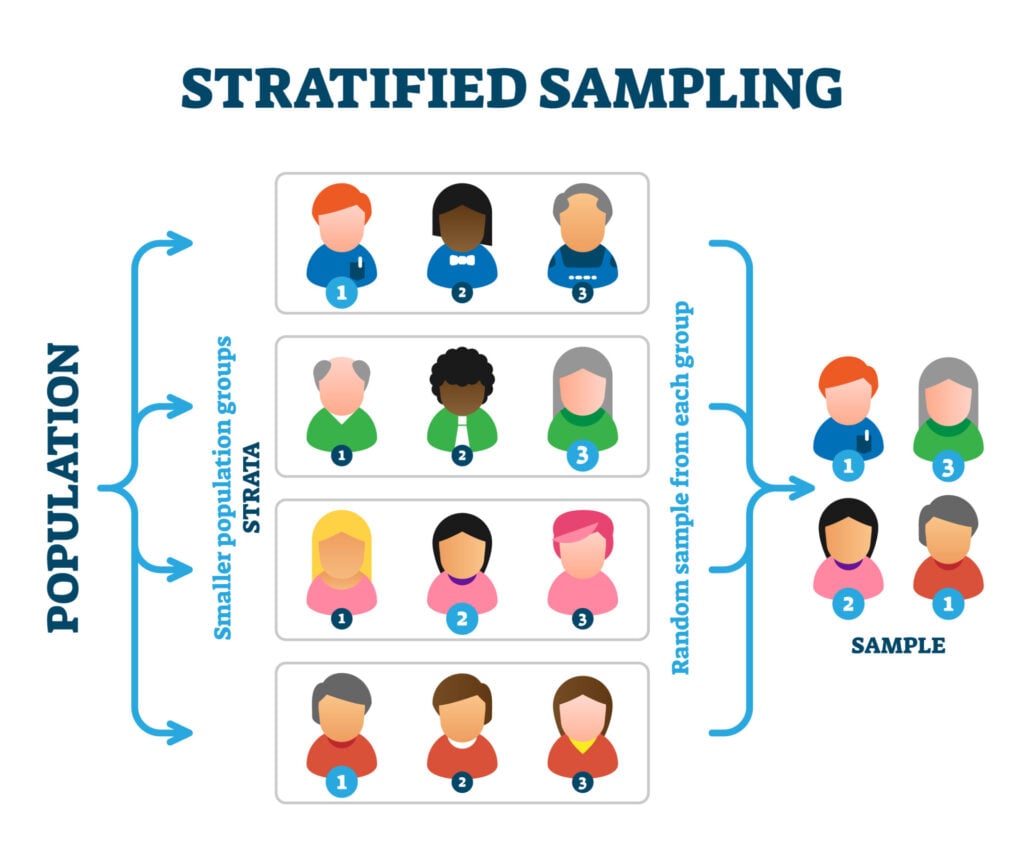
The process of classifying the population into groups before sampling is called stratification. The strata must be mutually exclusive, and all members of the population can only be in one stratum.
When stratifying, researchers tend to use proportionate sampling, where they maintain the correct proportions to represent the population as a whole.
For example, if the larger population contains 40% history majors and 60% English majors, the final sample should reflect these percentages.
Disproportionate sampling is typically only used when studying an underrepresented group.
ApplicationsWhen studying polling of elections, population demographics, or life expectancy.When studying the income of varying populations or the income for different jobs across a nation.When time is limited, or budgeting is tight as stratified sampling is quicker and cheaper than many other sampling methods.When the samples of a population vary drastically as forming strata helps organize a group of people.When researchers do not have access to an entire population.
Applications
Technique
Stratified sampling method in statistics. Research on sample collecting data in scientific survey techniques.
Example Situations
Advantages
Efficient and manageable
By organizing a population into groups with similar characteristics, researchers save data collection time and can better manage a sample that would otherwise be too large to analyze.
Cheap
Accuracy
Stratified sampling can produce more precise estimates than simple random sampling when members of the subpopulations are homogeneous relative to the entire population. This gives a study more statistical power.
Limitations
Too many differences within the population
A population can’t be organized into subgroups if there are too many differences within the population or if there is not enough information about the population at hand.
Planning
Researchers must ensure that every member of the population fits into only one stratum and that all the strata collectively contain every member of the greater population. This involves extra planning and information gathering that simple random sampling does not require.
Sampling errors
Sampling errors can occur when the sample does not accurately represent the population as a whole. If this occurs, the researcher would need to restart the sampling process.
Cluster Sampling vs. Stratified Sampling
Stratified sampling and cluster sampling both involve dividing a large population into smaller groups and then selecting randomly among the subgroups to form a sample.
However, the main difference is that researchers in stratified sampling divide the population into groups based on age, religion, ethnicity, or income level and randomly choose from these strata to form a sample.
Alternatively, researchers incluster samplingwill use naturally divided groups to separate the population (i.e., city blocks or school districts) and then randomly select elements from these clusters to be a part of the sample.
Stratified Sampling vs. Quota Sampling
Quota samplingand stratified sampling both involve dividing a population into mutually exclusive subgroups and sampling a predetermined number of individuals from each.
However, the most significant difference between these two techniques is that quota sampling is a non-probability sampling method, while stratified sampling is a probability sampling method.
In a stratified sample, individuals within each stratum are selected randomly, while in a quota sample, researchers choose the sample instead of randomly selecting it.
Stratified sampling is also known as quota random sampling.
Key Terms
References
Barnett, R. C., & Baruch, G. K. (1985). Women’s involvement in multiple roles and psychological distress. Journal of Personality and Social Psychology, 49(1), 135–145.
Briere, J., & Elliott, D. M. (2003). Prevalence and psychological sequelae of self-reported childhood physical and sexual abuse in a general population sample of men and women. Child abuse & neglect, 27(10), 1205-1222.
How to use stratified random sampling to your advantage. Qualtrics. (n.d.). Retrieved from https://www.qualtrics.com/experience-management/research/stratified-random-sampling/
Llewellyn, D. J., & Wilson, K. M. (2003). The controversial role of personality traits in entrepreneurial psychology. Education+ Training.
Nickolas, S. (2021, May 19). How stratified random sampling works. Investopedia. Retrieved January 27, 2022, from https://www.investopedia.com/ask/answers/032615/what-are-some-examples-stratified-random-sampling.asp
Shi, F. (2015). Study on a stratified sampling investigation method for resident travel and the sampling rate. Discrete Dynamics in Nature and Society, 2015.
Syme, G. J., & Williams, K. D. (1993). The psychology of drinking water quality: an exploratory study. Water Resources Research, 29(12), 4003-4010.

Saul McLeod, PhD
BSc (Hons) Psychology, MRes, PhD, University of Manchester
Saul McLeod, PhD., is a qualified psychology teacher with over 18 years of experience in further and higher education. He has been published in peer-reviewed journals, including the Journal of Clinical Psychology.
Olivia Guy-Evans, MSc
BSc (Hons) Psychology, MSc Psychology of Education
Olivia Guy-Evans is a writer and associate editor for Simply Psychology. She has previously worked in healthcare and educational sectors.
Julia Simkus
BA (Hons) Psychology, Princeton University
Julia Simkus is a graduate of Princeton University with a Bachelor of Arts in Psychology. She is currently studying for a Master’s Degree in Counseling for Mental Health and Wellness in September 2023. Julia’s research has been published in peer reviewed journals.
