On This Page:ToggleConformity (Majority Influence)ObedienceResistance to Social InfluenceMinority InfluenceSocial Change
On This Page:Toggle
On This Page:
Conformity (Majority Influence)
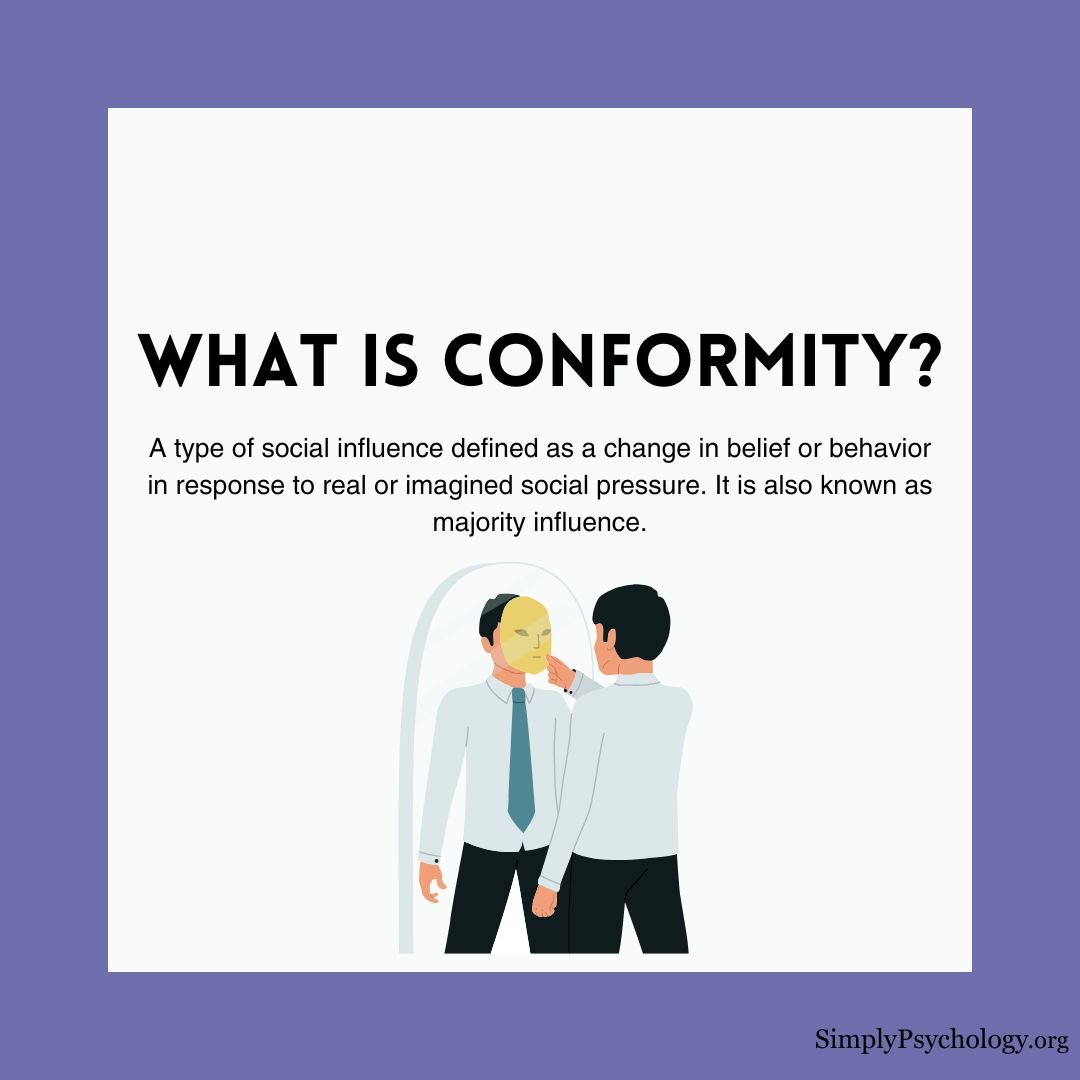
Conformityis a type of social influence defined as a change in belief or behavior in response to real or imagined social pressure. It is also known as majority influence.
Types of Conformity
ComplianceAO1
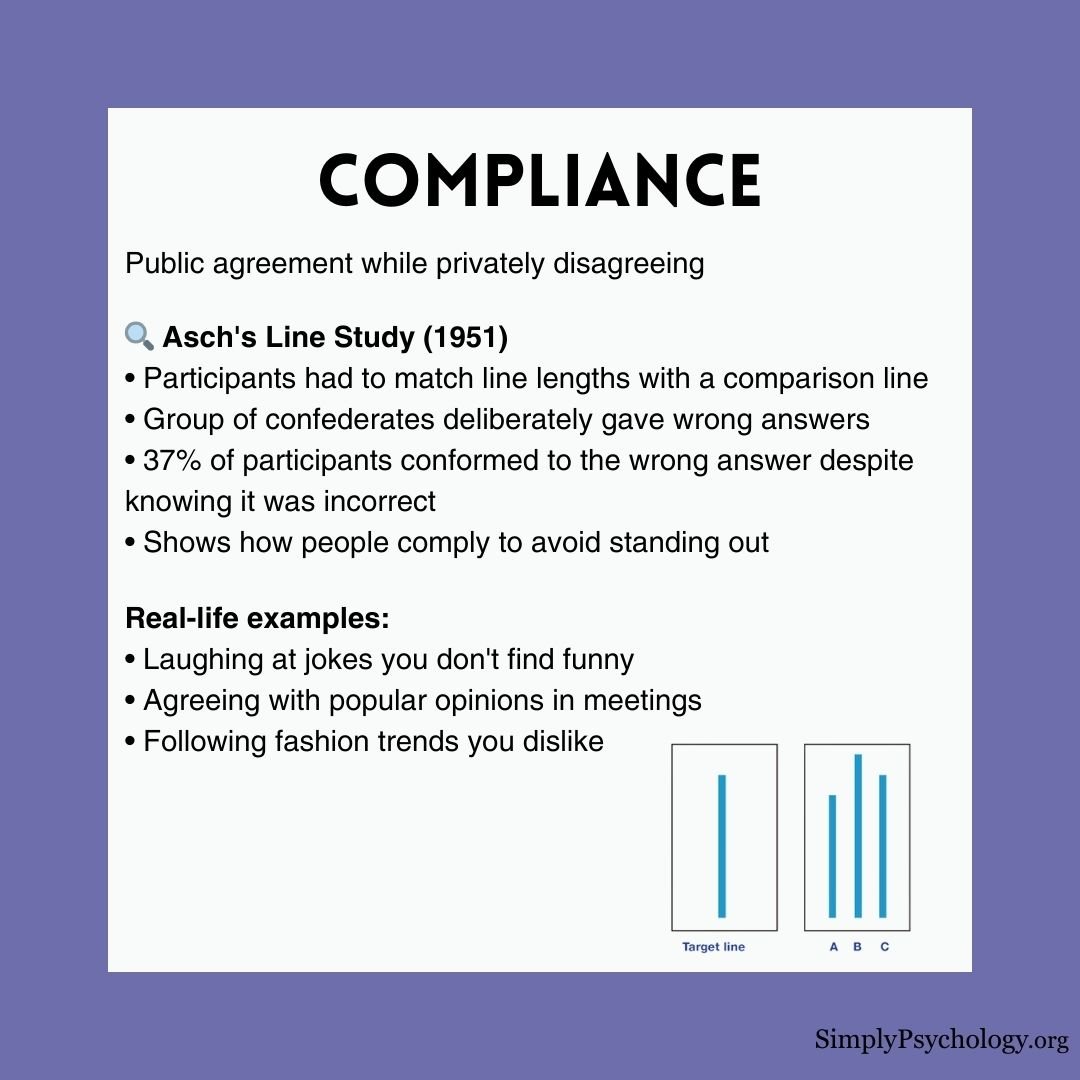
This refers to instances where a person may agree in public with a group of people, but the person privately disagrees with the group’s viewpoint or behavior. The individual changes their views, but it is a temporary change.
For example, a person may laugh at a joke because their group of friends find it funny but deep down the person does not find the joke funny.
For a study on compliance refer toAsch’s Line Study.
InternalisationAO1
Publicly changing behavior to fit in with the group while also agreeing with them privately. An internal (private) and external (public) change of behavior. This is the deepest level of conformity were the beliefs of the group become part of the individual’s own belief system.
An example of internalisation is if someone lived with a vegetarian at university and then decides to also become one too because they agree with their friend’s viewpoint / someone converting religions would also be a good example.
For a study on internalisation refer to Jenness (see below).
IdentificationAO1
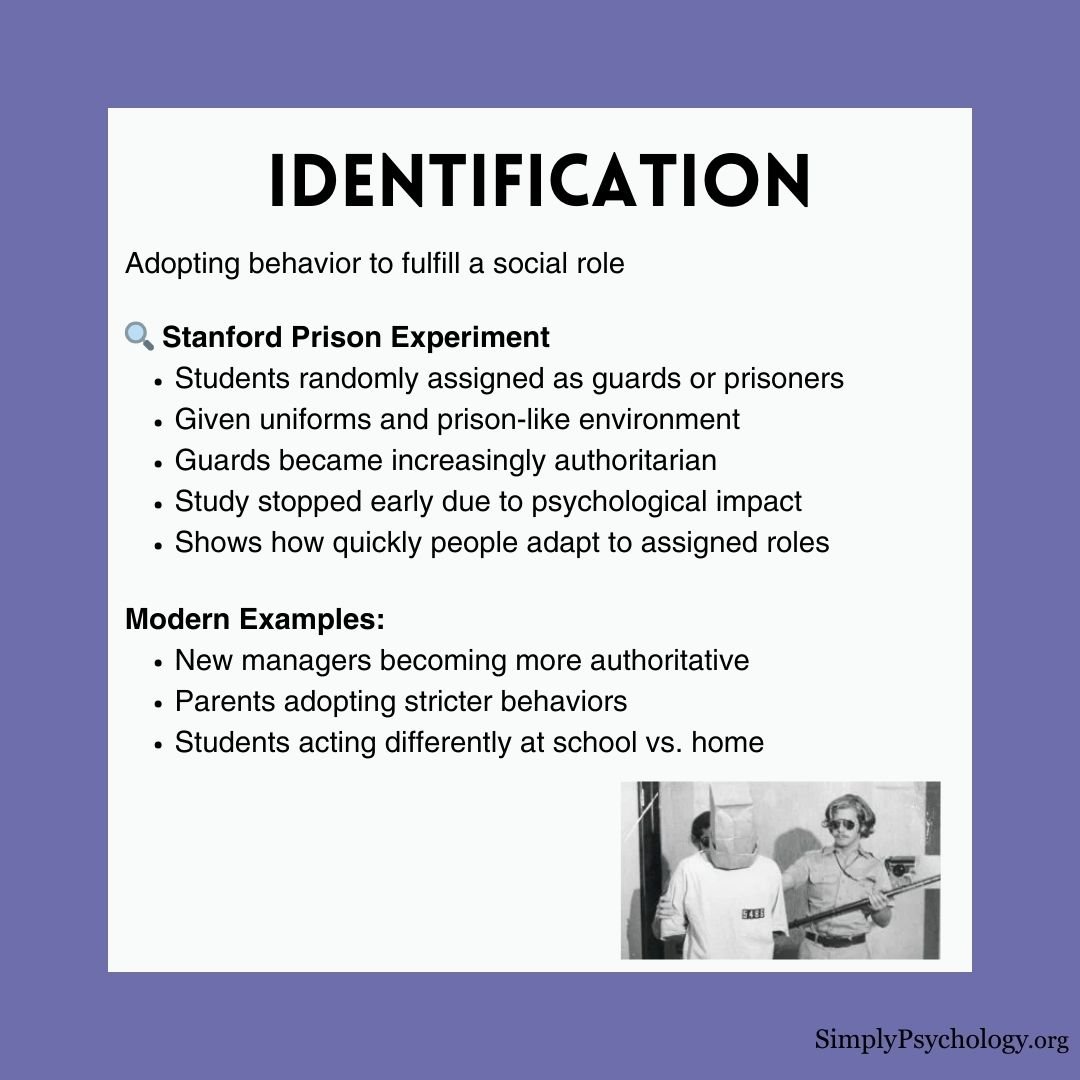
Identification occurs when someone conforms to the demands of a given social role in society. For example, a policeman, teacher or politician. This type of conformity extends over several aspects of external behavior. However, there still be no changed to internal personal opinion.
A good example isZimbardo’s prison study.
Explanations for Conformity
Normative Influence(AO1/AO3)

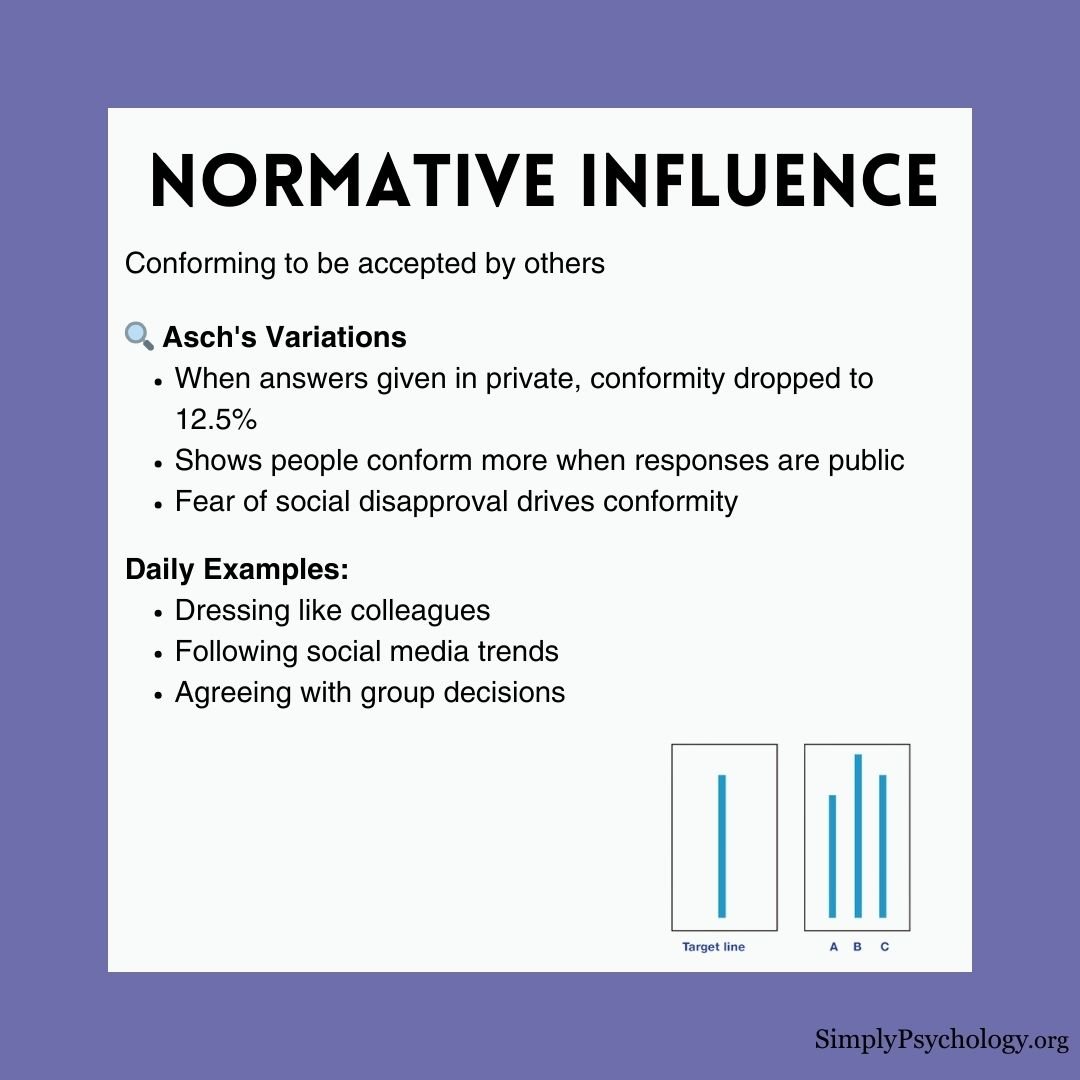
Normative social influence is where a person conformsto fit in with the group because they don’t want to appear foolish or be left out. Normative social influence is usually associated with compliance,
where a person changes their public behavior but not their private beliefs.
For example, a person may feel pressurised to smoke because the rest of their friends are. Normative Social influence tends to lead tocompliancebecause the person smokes just for show but deep down they wish not to smoke. This means any change of behavior istemporary.
For a study on normative influence refer toAsch.
Informational Influence(AO1/AO3)
Informational social influenceis where a person conforms because they have adesire to be right, and look to others who they believe may have more information.
This type of conformity occurs when a person isunsure of a situationorlacks knowledgeand is associated withinternalisation.
For a study on informational influence refer to Jenness (see below).
Jenness’ Bean Jar ExperimentAO1
Jenness carried out a study into conformity – in his experiment participants were asked to estimate how many beans they thought were in a jar. Each participant had to make an individual estimate, and then do the same as a group.
He found that when the task was carried out in a social group, the participants would report estimates of roughly the same value (even though they had previously reported quite different estimates as individuals).
Variables Affecting Conformity
Asch’s Line StudyAO1Asch wanted to investigate whether people would conform to the majority in situations where an answer was obvious.Procedure: InAsch’s studythere were 5-7 participants per group. Each group was presented with a standard line and three comparison lines. Participants had to say aloud which comparison line matched the standard line in length.In each group there was only one real participant the remaining 6 were confederates. The confederates were told to give the incorrect answer on 12 out of 18 trails.Results: Real participants conformed on 32% of the critical trials where confederates gave the wrong answers. Additionally, 75% of the sample conformed to the majority on at least one trial.
Asch’s Line StudyAO1

Asch wanted to investigate whether people would conform to the majority in situations where an answer was obvious.
Procedure: InAsch’s studythere were 5-7 participants per group. Each group was presented with a standard line and three comparison lines. Participants had to say aloud which comparison line matched the standard line in length.In each group there was only one real participant the remaining 6 were confederates. The confederates were told to give the incorrect answer on 12 out of 18 trails.
Results: Real participants conformed on 32% of the critical trials where confederates gave the wrong answers. Additionally, 75% of the sample conformed to the majority on at least one trial.
Factors Affecting ConformityAO3
In further trials, Asch (1952, 1956) changed the procedure (i.e., independent variables) to investigate whichsituational factorsinfluenced the level ofconformity(dependent variable). His results and conclusions are given below:
Group SizeAsch altered the number of confederates in his study to see how this effected conformity. The bigger the majority group (number ofconfederates), the more people conformed, but only up to a certain point.With one other person (i.e., confederate) in the group conformity was 3%, with two others it increased to 13%, and with three or more it was 32% (or 1/3). However, conformity did not increase much after the group size was about 4/5.Because conformity does not seem to increase in groups larger than four, this is considered the optimal group size.Brown and Byrne (1997) suggest that people might suspectcollusion if the majority rises beyond three or four.According to Hogg & Vaughan (1995), the most robust finding is that conformity reaches its full extent with 3-5person majority, with additional members having little effect.
Group Size
Asch altered the number of confederates in his study to see how this effected conformity. The bigger the majority group (number ofconfederates), the more people conformed, but only up to a certain point.With one other person (i.e., confederate) in the group conformity was 3%, with two others it increased to 13%, and with three or more it was 32% (or 1/3). However, conformity did not increase much after the group size was about 4/5.Because conformity does not seem to increase in groups larger than four, this is considered the optimal group size.Brown and Byrne (1997) suggest that people might suspectcollusion if the majority rises beyond three or four.According to Hogg & Vaughan (1995), the most robust finding is that conformity reaches its full extent with 3-5person majority, with additional members having little effect.
Asch altered the number of confederates in his study to see how this effected conformity. The bigger the majority group (number ofconfederates), the more people conformed, but only up to a certain point.
With one other person (i.e., confederate) in the group conformity was 3%, with two others it increased to 13%, and with three or more it was 32% (or 1/3). However, conformity did not increase much after the group size was about 4/5.
Because conformity does not seem to increase in groups larger than four, this is considered the optimal group size.

Brown and Byrne (1997) suggest that people might suspectcollusion if the majority rises beyond three or four.
According to Hogg & Vaughan (1995), the most robust finding is that conformity reaches its full extent with 3-5person majority, with additional members having little effect.
Group UnanimityA person is more likely to conform when all members of the group agree and give the same answer.When one other person in the group gave a different answer from the others, and the group answer was not unanimous, conformity dropped. Asch (1951) found that even the presence of just one confederate that goes against the majority choice can reduce conformity as much as 80%.
Group Unanimity
A person is more likely to conform when all members of the group agree and give the same answer.When one other person in the group gave a different answer from the others, and the group answer was not unanimous, conformity dropped. Asch (1951) found that even the presence of just one confederate that goes against the majority choice can reduce conformity as much as 80%.
A person is more likely to conform when all members of the group agree and give the same answer.
When one other person in the group gave a different answer from the others, and the group answer was not unanimous, conformity dropped. Asch (1951) found that even the presence of just one confederate that goes against the majority choice can reduce conformity as much as 80%.
Difficulty of TaskWhen the (comparison) lines (e.g., A, B, C) were made more similar in length it was harder to judge the correct answer and conformity increased.When we are uncertain, it seems we look to others for confirmation. The more difficult the task, the greater the conformity.
Difficulty of Task
When the (comparison) lines (e.g., A, B, C) were made more similar in length it was harder to judge the correct answer and conformity increased.When we are uncertain, it seems we look to others for confirmation. The more difficult the task, the greater the conformity.
When the (comparison) lines (e.g., A, B, C) were made more similar in length it was harder to judge the correct answer and conformity increased.
When we are uncertain, it seems we look to others for confirmation. The more difficult the task, the greater the conformity.
Answer in PrivateWhen participants were allowed to answer in private (so the rest of the group does not know their response) conformity decreases.This is because there are fewer group pressures and normative influence is not as powerful, as there is no fear of rejection from the group.
Answer in Private
When participants were allowed to answer in private (so the rest of the group does not know their response) conformity decreases.This is because there are fewer group pressures and normative influence is not as powerful, as there is no fear of rejection from the group.
Conformity to Social Roles
Social roles are the part people play as members of a social group (e.g., student, teacher, policeman, etc.). There is considerable pressure to conform to the expectations of asocial role, whichis called identification.
Stanford Prison ExperimentAO1
Zimbardowanted to investigate how readily people would conform to the social roles of guard and prisoner in a role-playing exercise that simulated prison life.
Procedure: To study the roles people play in prison situations, Zimbardo converted a basement of the Stanford University psychology building into a mock prison.
He advertised for students to play the roles of prisoners and guards for a fortnight. Participants were randomly assigned to either the role of prisoner or guard in a simulated prison environment.


Zimbardo observed the behavior of the prisoners and guards (as a researcher), and also acted as prison warden.
Findings: Within a very short time both guards and prisoners were settling into their new roles, with the guards adopting theirs quickly and easily. Within hours of beginning the experiment some guards began to harass prisoners. T
hey behaved in a brutal and sadistic manner, apparently enjoying it. Other guards joined in, and other prisoners were also tormented.
The prisoners soon adopted prisoner-like behavior too. They talked about prison issues a great deal of the time. They ‘told tales’ on each other to the guards. They started taking the prison rules very seriously, and some even began siding with the guards against prisoners who did not obey the rules.
As the prisoners became more submissive, the guards became more aggressive and assertive. They demanded ever greater obedience from the prisoners.
The prisoners were dependent on the guards for everything so tried to find ways to please the guards, such as telling tales on fellow prisoners.
Obedience
Obedienceis a type of social influence where a person follows an order from another person who is usually an authority figure.
Explanations for Obedience
Milgram’s Shock StudyAO1
Milgramwanted to know why Germans were willing to kill Jews during the Holocaust. He thought that it might have been because German’s were just evil.
He thought that Americans were different and would not have followed such orders. To test this ‘German’s are different’ hypothesis he carried out this study (outlined below).

Procedure: Milgram wanted to see whether people would obey a legitimate authority figure when given instructions to harm another human being.
He conducted a lab experiment in which two participants were assigned either the role of a teacher (this was always given to the true participant) or learner (a confederate called Mr. Wallace).

The experimenter (Mr Williams) wore a grey lab coat and his role was to give a series of orders / prods when the participant refused to administer a shock. There were 4 prods and if one was not obeyed then the experimenter read out the next prod, and so on.
Results: The results were that all participants went to 300 volts and 65% were willing to go all the way to 450 volts. Milgram did more than one experiment – he carried out 18 variations of his study.
The Agentic State
For example, when participants were reminded that they had responsibility for their own actions, almost none of them were prepared to obey. In contrast, many participants who were refusing to go on did so if the experimenter said that he would take responsibility’.
LimitationsAO3
Situational Factors
Milgram’s experimenter (Mr. Williams) wore a laboratory coat (a symbol of scientific expertise) which gave him a high status. However, when the experimenter dressed in everyday clothes, obedience was very low. The uniform of the authority figure can give them status.
Status of LocationMilgram’s obedience experiment was conducted at Yale, a prestigious university in America. The high status of the university gave the study credibility and respect in the eyes of the participants, thus making them more likely to obey.When Milgram moved his experiment to a set of run down offices rather than the impressive Yale University obedience dropped to 47.5%. This suggests that status of location effects obedience.
Status of Location
Milgram’s obedience experiment was conducted at Yale, a prestigious university in America. The high status of the university gave the study credibility and respect in the eyes of the participants, thus making them more likely to obey.When Milgram moved his experiment to a set of run down offices rather than the impressive Yale University obedience dropped to 47.5%. This suggests that status of location effects obedience.
Milgram’s obedience experiment was conducted at Yale, a prestigious university in America. The high status of the university gave the study credibility and respect in the eyes of the participants, thus making them more likely to obey.
When Milgram moved his experiment to a set of run down offices rather than the impressive Yale University obedience dropped to 47.5%. This suggests that status of location effects obedience.
Adorno felt that personality (i.e. dispositional) factors rather than situational (i.e. environmental) factors could explain obedience. He proposed that there was such a thing as an authoritarian personality, i.e. a person who favours an authoritarian social system and, admires obedience to authority figures.
One of the various characteristics of theauthoritarian personalityis that the individual is hostile to those who are of inferior status, but obedient of people with high status.
He investigated 2000 middle class, white Americans and their unconscious attitudes towards other racial groups using the F-scale to measure authoritarian personality.
Resistance to Social Influence
Social Support
In one of Asch’s experimental variations he showed that the presence of a dissident (a confederate who did not conform) led to a decrease in the conformity levels in true participants.
This is thought to be because the presence of a dissident gave the true participant social support and made them feel more confident in their own decision and more confident in rejecting the majority position.
Social support also decreases obedience to authority. In a variation of Milgram” study two other participants (confederates) were also teachers but refused to obey. Confederate 1 stopped at 150 volts and confederate 2 stopped at 210 volts. The presence of others who are seen to disobey the authority figure reduced the level of obedience to 10%.
Locus of Control
The term ‘Locus of control’ refers to how much control a person feels they have in their own behavior. A person can either have an internal locus of control or an external locus of control.
There is a continuum, with most people lying in between.
People with a high internal locus of control perceive (see) themselves as having a great deal of personal control over their behavior and are therefore more likely to take responsibility for the way they behave. For example, I did well on the exams because I revised extremely hard.
In contrast a person with a high external locus of control perceive their behaviors as being a result of external influences or luck – e.g. I did well on the test because it was easy.
Research has shown that people with an internal locus of control tend to be less conforming and less obedient (i.e. more independent). Rotter proposes that people with internal locus of control are better at resisting social pressure to conform or obey, perhaps because they feel responsible for their actions.
Minority Influence
Minority influenceoccurs when a small group (minority) influences the opinion of a much larger group (majority). This can happen when the minority behaves in the following ways.
Consistency
Moscovici stated that being consistent and unchanging in a view is more likely to influence the majority than if a minority is inconsistent and chops and changes their mind.
Procedure: Moscovici conducted an experiment in which female participants were shown 36 blue slides of different intensity and asked to report the colours. There were two confederates (the minority) and four participants (the majority).In the first part of the experiment the two confederates answered green for each of the 36 slides. They were totally consistent in their responses. In the second part of the experiment they answered green 24 times and blue 12 times. In this case they were inconsistent in their answers. A control group was also used consisting of participants only – no confederates.Findings: When the confederates were consistent in their answers about 8% of participants said the slides were green. When the confederates answered inconsistently about 1% of participants Said the slides were green.
Procedure: Moscovici conducted an experiment in which female participants were shown 36 blue slides of different intensity and asked to report the colours. There were two confederates (the minority) and four participants (the majority).
In the first part of the experiment the two confederates answered green for each of the 36 slides. They were totally consistent in their responses. In the second part of the experiment they answered green 24 times and blue 12 times. In this case they were inconsistent in their answers. A control group was also used consisting of participants only – no confederates.
Findings: When the confederates were consistent in their answers about 8% of participants said the slides were green. When the confederates answered inconsistently about 1% of participants Said the slides were green.
Commitment
When the majority is confronted with someone with self-confidence and dedication to take a popular stand and refuses to back own, they may assume that he or she has a point.
Flexibility
A number of researchers have questioned whether consistency alone is sufficient for a minority to influence a majority. They argue that the key is how the majority interprets consistency. If the consistent minority are seen as inflexible, rigid, uncompromising and dogmatic, they will be unlikely to change the views of the majority.
However, if they appear flexible and compromising, they are likely to be seen as less extreme, as more moderate, cooperative and reasonable. As a result, they will have a better chance of changing majority views.
Their experiment was based on a mock jury in which groups of three participants and one confederate had to decide on the amount of compensation to be given to the victim of a ski-lift accident. When the consistent minority (the confederate) argued for a very low amount and refused to change his position, he had no effect on the majority.
However, when he compromised and moved some way towards the majority position, the majority also compromised and changed their view.
This experiment questions the importance of consistency. The minority position changed, it was not consistent, and it was this change that apparently resulted in minority influence.
Social Change
Social change occurs when a whole society adopts a new belief or behavior which then becomes widely accepted as the ‘norm’ which was not before. Social influence processes involved in social change include minority influence (consistency, commitment and flexibility), internal locus of control and disobedience to authority.
Social change is usually a result of minority influence. This is when a small group of people (the minority) manage to persuade the majority to adopt their point of view.
This also links to independent behavior, because the minority resists pressures to conform and/or obey. Usually the minority have an internal locus of control.
Committed minorities, such as those who risk themselves for their cause has an effect on the majority through an augmentation principle, this means the majority value the importance of the cause – as the minority are risking their lives for it.
Through these processes more and more of the majority will gradually change towards the cause resulting in thesnowball effectwhich will ultimately result in societal change, once this has happened social cryptomnesia occurs which is when people can remember a change but not how it came about.
Moscovici found thatconsistencyis the most important factor in deciding whether the minority are influential or not. This means that the minority must be clear on what they are asking for and not change their minds, or disagree amongst themselves. This creates uncertainty amongst the majority.
Moscovici investigated the importance of consistency. He had a group of 6 participants and a range of blue/ green slides varying in intensity – they all had to state the colour they saw.
The study had two conditions, confederates who consistently said green and an inconsistent group and a control group with no confederates. He found that the consistent minority group had a greater effect on the other participants than the inconsistent group. This confirms that consistency is a major factor in minority influence.
It has been found that once the minority begin to persuade people round to their way of thinking, asnowball effectbegins to happen. This means that more and more people adopt the minority opinion, until gradually the minority becomes the majority.
At this point, the people who have not changed their opinion are the minority, and they will often conform to the majority view as a result of group pressures.
The majority opinion then becomes law, and people have to obey this law. Once this happens, the minority opinion has become the dominant position in society, and people do often not even remember where the opinion originated from. This is a process known ascrypto amnesia.
Further social influence research from Asch and Milgram demonstrates that a minority can have an affect on the majority – both studies involved a dissenter or disobedient role model who influenced the behavior of the majority. However, there are methodological issues in these areas of research: these studies are both based on artificial tasks (judging line lengths).
The application of minority influence is further limited due to the importance of identification which is overlooked in minority influence research. Psychologists have suggested that people are less likely to behave in environmentally friendly ways due to the negative connotations associated with them (“tree huggers”).
Minorities wanting social change should avoid behaviors that reinforce social change – essentially off-putting to the majority.
This suggests that being able to identify with a minority group is just as important as agreeing with their views in order to change the behavior of the major.
A-Level Psychology Revision Notes
A-Level Psychology Attachment
Psychology Memory Revision NotesSocial Influence Revision NotesPsychopathology Revision NotesPsychology Approaches Revision for A-levelResearch Methods: Definition, Types, & Examples
Psychology Memory Revision Notes
Social Influence Revision NotesPsychopathology Revision NotesPsychology Approaches Revision for A-levelResearch Methods: Definition, Types, & Examples
Social Influence Revision Notes
Psychopathology Revision NotesPsychology Approaches Revision for A-levelResearch Methods: Definition, Types, & Examples
Psychopathology Revision Notes
Psychology Approaches Revision for A-levelResearch Methods: Definition, Types, & Examples
Psychology Approaches Revision for A-level
Research Methods: Definition, Types, & Examples
Issues and Debates in Psychology (A-Level Revision)



Olivia Guy-Evans, MSc
BSc (Hons) Psychology, MSc Psychology of Education
Olivia Guy-Evans is a writer and associate editor for Simply Psychology. She has previously worked in healthcare and educational sectors.
Saul McLeod, PhD
BSc (Hons) Psychology, MRes, PhD, University of Manchester
Saul McLeod, PhD., is a qualified psychology teacher with over 18 years of experience in further and higher education. He has been published in peer-reviewed journals, including the Journal of Clinical Psychology.
