Key Features
On This Page:ToggleStages of DevelopmentPiaget’s TheoryEducational ApplicationsCriticismsPiaget’s LegacyComparisons With Other Theories
On This Page:Toggle
On This Page:
Stages of Development
Jean Piaget’s theory of cognitive development suggests that children move through four different stages of intellectual development which reflect the increasing sophistication of children’s thought.
At each stage of development, the child’s thinking is qualitatively different from the other stages, that is, each stage involves a different type of intelligence.
StageAgeGoalSensorimotorBirth to 18-24 monthsObject permanencePreoperational2 to 7 yearsSymbolic thoughtConcrete operational7 to 11 yearsLogical thoughtFormal operationalAdolescence to adulthoodScientific reasoningPiaget’s 4 Stages of Cognitive Development
Although no stage can be missed out, there are individual differences in the rate at which children progress through stages, and some individuals may never attain the later stages.
Piaget did not claim that a particular stage was reached at a certain age – although descriptions of the stages often include an indication of the age at which the average child would reach each stage.
The Sensorimotor Stage
Ages: Birth to 2 YearsDuring thesensorimotor stage(birth to age 2) infants develop basic motor skills and learn to perceive and interact with their environment through physical sensations and body coordination.Major Characteristics and Developmental Changes:The infant learns about the world through their senses and through their actions (moving around and exploring their environment).During the sensorimotor stage, a range of cognitive abilities develop. These include: object permanence; self-recognition (the child realizes that other people are separate from them); deferred imitation; and representational play.Cognitive abilities relate to the emergence of the general symbolic function, which is the capacity to represent the world mentally.At about 8 months, the infant will understand the permanence of objects and that they will still exist even if they can’t see them, and the infant will search for them when they disappear.
During thesensorimotor stage(birth to age 2) infants develop basic motor skills and learn to perceive and interact with their environment through physical sensations and body coordination.

Major Characteristics and Developmental Changes:
At the beginning of this stage, the infant lives in the present. It does not yet have a mental picture of the world stored in its memory, so it does not have a sense of object permanence.
If the child cannot see something, then it does not exist. This is why you can hide a toy from an infant, while it watches, but it will not search for the object once it has gone out of sight.
The main achievement during this stage isobject permanence– knowing that an object still exists, even if it is hidden. It requires the ability to form a mental representation (i.e., a schema) of the object.
Towards the end of this stage the general symbolic function begins to appear where children show in their play that they can use one object to stand for another. Language starts to appear because they realise that words can be used to represent objects and feelings.
The child begins to be able to store information about the world, recall it, and label it.
Individual Differences
Learn More:The Sensorimotor Stage of Cognitive Development
The Preoperational Stage
For example, a child might think a tall, thin glass contains more liquid than a short, wide glass, even if both hold the same amount, because the child focuses on the height rather than considering both dimensions.
Furthermore, the child is egocentric; he assumes that other people see the world as he does, as shown in the Three Mountains study.
As the preoperational stage develops, egocentrism declines, and children begin to enjoy the participation of another child in their games, and let’s pretend play becomes more important.
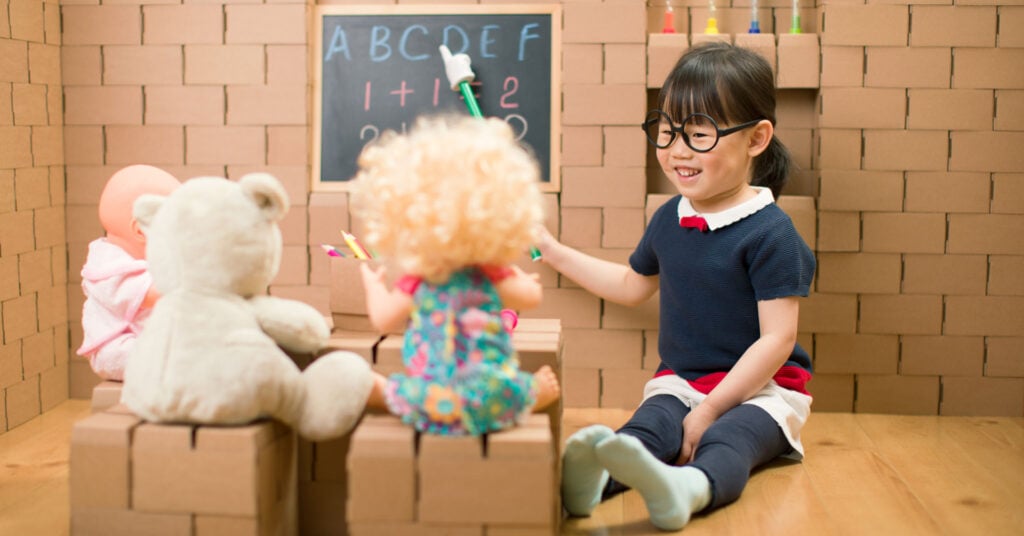
Toddlers often pretend to be people they are not (e.g. superheroes, policemen), and may play these roles with props that symbolize real-life objects. Children may also invent an imaginary playmate.
By 2 years, children have made some progress toward detaching their thoughts from the physical world. However, have not yet developed logical (or “operational”) thought characteristics of later stages.
Thinking is still intuitive (based on subjective judgments about situations) and egocentric (centered on the child’s own view of the world).
Learn More:The Preoperational Stage of Cognitive Development
The Concrete Operational StageAges: 7 – 11 YearsBy the beginning of theconcrete operational stage, the child can use operations (a set of logical rules) so they can conserve quantities, realize that people see the world in a different way (decentring), and demonstrate improvement in inclusion tasks.Children still have difficulties with abstract thinking.Major Characteristics and Developmental Changes:During this stage, children begin to think logically about concrete events.Children begin to understand the concept of conservation; understanding that, although things may change in appearance, certain properties remain the same.During this stage, children can mentally reverse things (e.g., picture a ball of plasticine returning to its original shape).During this stage, children also become less egocentric and begin to think about how other people might think and feel.
The Concrete Operational Stage
By the beginning of theconcrete operational stage, the child can use operations (a set of logical rules) so they can conserve quantities, realize that people see the world in a different way (decentring), and demonstrate improvement in inclusion tasks.
Children still have difficulties with abstract thinking.

The stage is called concrete because children can think logically much more successfully if they can manipulate real (concrete) materials or pictures of them.
Piaget considered the concrete stage a major turning point in the child’s cognitive development because it marks the beginning of logical or operational thought. This means the child can work things out internally in their head (rather than physically try things out in the real world).
Children can conserve number (age 6), mass (age 7), and weight (age 9). Conservation is the understanding that something stays the same in quantity even though its appearance changes.
But operational thought is only effective here if the child is asked to reason about materials that are physically present. Children at this stage will tend to make mistakes or be overwhelmed when asked to reason about abstract or hypothetical problems.
Learn More:The Concrete Operational Stage of Development
The Formal Operational Stage
Theformal operational periodbegins at about age 11. As adolescents enter this stage, they gain the ability to think abstractly, the ability to combine and classify items in a more sophisticated way, and the capacity for higher-order reasoning.

Adolescents can think systematically and reason about what might be as well as what is (not everyone achieves this stage). This allows them to understand politics, ethics, and science fiction, as well as to engage in scientific reasoning.
Adolescents can deal with abstract ideas; for example, they can understand division and fractions without having to actually divide things up, and solve hypothetical (imaginary) problems.
From about 12 years, children can follow the form of a logical argument without reference to its content. During this time, people develop the ability to think about abstract concepts, and logically test hypotheses.
This stage sees the emergence ofscientific thinking, formulating abstract theories and hypotheses when faced with a problem.
Learn More:The Formal Operational Stage of Development
Piaget’s Theory
1.History of Piaget’s Theory of Cognitive Development
Piaget was employed at the Binet Institute in the 1920s, where his job was to develop French versions of questions on English intelligence tests. He became intrigued with the reasons children gave for their wrong answers to the questions that required logical thinking.
He believed that these incorrect answers revealed important differences between the thinking of adults and children.
Piaget did not want to measure how well children could count, spell, or solve problems as a way of grading their I.Q.
He was more interested in how fundamental concepts emerged, such as the very ideas of number, time, quantity, causality, andjustice.
Piaget studied children from infancy to adolescence using naturalistic observation of his own three babies and sometimes controlled observation too. From these, he wrote diary descriptions charting their development.
He also used clinical interviews and observations of older children who were able to understand questions and hold conversations.
2. Piaget’s Clinical Method
Piaget’s clinical method is a research technique used to investigate children’s cognitive development.
It is a research approach for understanding children’s thinking that Piaget adapted from the diagnostic clinical interview used in psychopathology.
Unlike standardized tests, the clinical method uses flexible, open-ended questions to explore the child’s thinking in depth.
The interviewer adapts their questions based on the child’s initial responses, prompting further explanation and clarification.
Piaget provided detailed criteria for evaluating the quality of children’s responses, emphasizing the need to consider factors like resistance to suggestion, the depth of the child’s thinking, and the consistency of the response over time
Piaget’s clinical method has been influential in the field ofdevelopmental psychology and has helped to shape the way researchers and educators understand children’s thinking.
It’s important to note that the clinical method evolved throughout Piaget’s career.
As he continued to refine his approach, he began incorporating physical objects and manipulations into his interviews, leading to what he termed the critical method.
While the clinical method primarily relies on verbal dialogue, the critical method involves children actively manipulating objects, allowing researchers to observe their actions and reasoning in relation to physical phenomena.
For example, a researcher might ask a child to predict whether a ball of clay will weigh more or less after being rolled into a snake (conservation of mass).
By observing the child’s actions and explanations, researchers can gain insight into their understanding of the concept.
Piaget believed thatengaging children with a concrete challenge helped to put them at ease, minimized the amount of verbal instruction required, and allowed the interviewer to use the child’s language when discussing the phenomenon.
By incorporating physical objects into his research, he could observe how children’s actions and manipulations influenced their thinking.
For example, to understand how children transition from animistic to mechanistic thinking, Piaget explored children’s conceptions of material force through a series of experiments involving physical demonstrations
However, the core principles of the clinical examination, such as open-ended inquiry, a focus on underlying reasoning, and sensitive interviewing, remained essential elements of his research, even as his methods became more complex
3. Piaget’s Theory Differs From Others In Several Ways:
Piaget’s (1936, 1950) theory of cognitive development explains how a child constructs a mental model of the world.
He disagreed with the idea thatintelligencewas a fixed trait, and regarded cognitive development as a process that occurs due to biological maturation and interaction with the environment.
Children’s ability to understand, think about, and solve problems in the world develops in a stop-start, discontinuous manner (rather than gradual changes over time).
To Piaget, cognitive development was a progressive reorganization of mental processes as a result of biological maturation and environmental experience.
Children construct an understandingof the world around them, then experience discrepancies between what they already know and what they discover in their environment.
4. Schemas
Aschemais a mental framework or concept that helps us organize and interpret information. It’s like a mental file folder where we store knowledge about a particular object, event, or concept.
According to Piaget (1952), schemas are fundamental building blocks of cognitive development. They are constantly being created, modified, and reorganized as we interact with the world.
Wadsworth (2004) suggests that schemata (the plural of schema) be thought of as “index cards” filed in the brain, each one telling an individual how to react to incoming stimuli or information.
According to Piaget, we are born with a few primitive schemas, such as sucking, which give us the means to interact with the world. These initial schemas are physical, but as the child develops, they become mental schemas.
When Piaget discussed the development of a person’s mental processes, he referred to increases in the number and complexity of the schemata that the person had learned.
Operationsare more sophisticated mental structures that allow us to combine schemas in a logical (reasonable) way. For example, picking up a rattle would combine three schemas, gazing, reaching and grasping.

As children grow, they can carry out more complex operations and begin to imagine hypothetical (imaginary) situations.
Operations are learned through interaction with other people and the environment, and they represent a key advancement in cognitive development beyond simple schemas.
As children grow and interact with their environment, these basic schemas become more complex and numerous, and new schemas are developed through the processes ofassimilation and accommodation.
5. The Process of Adaptation
Jean Piaget (1952) viewed intellectual growth as a process ofadaptation(adjustment) to the world.
This happens through assimilation, accommodation, equilibration, and disequilibrium.
When a child’s existing schemas are capable of explaining what it can perceive around it, it is said to be in a state ofequilibrium, i.e., a state of cognitive (i.e., mental) balance.
Disequilibriumoccurs when new information conflicts with existing schemas, creating cognitive discomfort. This cognitive conflict drives cognitive development and learning.
These processes are continuous and interactive, allowing schemas to evolve and become more sophisticated.

When encountering new information, a child first attempts toassimilateit into existing schemas.
If assimilation fails,disequilibriumoccurs, prompting the need for accommodation.
Throughaccommodation, the child adjusts their schemas to restoreequilibrium.
This cycle continues, driving cognitive development in a non-linear fashion – progressing through “leaps and bounds” rather than at a steady rate.

Equilibration acts as a regulatory mechanism, balancing assimilation and accommodation. This balance is crucial because:
By maintaining this balance, equilibration facilitates cognitive growth, allowing children to build increasingly complex and accurate mental representations of the world.
Applications to Education

Piaget is partly responsible for the change that occurred during the 1960s to early children’s education.
Piaget (1972, p. 27)
Plowden Report
In the 1960s, the Plowden Committee investigated deficiencies in United Kingdom education and incorporated many of Piaget’s ideas into its final report, published in 1967.
This was notable because Piaget’s (1952) work was not originally designed for educational applications.
The report made three key recommendations based on Piaget’s theories:
ThePlowden Reportemphasized several recurring themes aligned with Piaget’s work:
Importantly, the report cautioned that teachers should “not assume that only what is measurable is valuable,” encouraging a holistic approach to assessing children’s development.
Educational Strategies Based on Piaget’s Theory
Teachers should encourage students to take an active role in discovering and constructing knowledge. The teacher’s role is to facilitate learning rather than direct tuition.
Because Piaget’s theory is based upon biological maturation and stages, the notion of “readiness” is important. Readiness concerns when certain information or concepts should be taught.
According to Piaget’s theory, children should not be taught certain concepts until they have reached the appropriate stage of cognitive development.
Consequently, education should be stage-specific, with curricula developed to match the age and stage of thinking of the child. For example, abstract concepts like algebra or atomic structure are not suitable for primary school children.
Assimilation and accommodation require an active learner, not a passive one, because problem-solving skills cannot be taught, they must be discovered (Piaget, 1958).
Therefore, teachers should encourage the following within the classroom:
Classroom Activities
Although most kids in this age range are not in a traditional classroom setting, they can still benefit from games that stimulate their senses and motor skills.
Individual Differences In Learning
Social identities play a critical role in shaping cognitive development, necessitating a more nuanced and culturally responsive approach to understanding child development.
Piaget’s stages may manifest differently based on social identities like race, gender, and culture:
Overcoming Challenges and Barriers in Implementing Piagetian Strategies
Can Piaget’s Ideas Be Applied to Children with Special Educational Needs and Disabilities?
Yes, Piaget’s ideas can be adapted to support children with special educational needs and disabilities (SEND), though with important considerations:
While Piaget’s theory offers valuable insights, it should be part of a broader, evidence-based approach that recognizes the diverse factors influencing development in children with SEND.
Social Media (Digital Learning)
Jean Piaget could not have anticipated the expansive digital age we now live in.
They view it as an integral part of their identity, with most using it extensively in their daily lives, from keeping in touch with loved ones to consuming news and entertainment (Nielsen, 2014).
Social media platforms offer a dynamic environment conducive to Piaget’s principles. These platforms allow interactions that nurture knowledge evolution through cognitive processes like assimilation and accommodation.
They emphasize communal interaction and shared activity, fostering both cognitive and socio-cultural constructivism. This shared activity promotes understanding and exploration beyond individual perspectives, enhancing social-emotional learning (Gehlbach, 2010).
A standout advantage of social media in an educational context is its capacity to extend beyond traditional classroom confines. As the material indicates, these platforms can foster more inclusive learning, bridging diverse learner groups.
This inclusivity can equalize learning opportunities, potentially diminishing biases based on factors like race or socio-economic status, resonating with Kegan’s (1982) concept of “recruitability.”
However, there are challenges. While social media’s potential in learning is vast, its practical application necessitates intention and guidance. Cuban, Kirkpatrick, and Peck (2001) note that certain educators and students are hesitant about integrating social media into educational contexts.
This hesitancy can stem from technological complexities or potential distractions. Yet, when harnessed effectively, social media can provide a rich environment for collaborative learning and interpersonal development, fostering a deeper understanding of content.
In essence, the rise of social media aligns seamlessly with constructivist philosophies. Social media platforms act as tools for everyday cognition, merging daily social interactions with the academic world, and providing avenues for diverse, interactive, and engaging learning experiences.
Weaknesses of Piaget’s theory include:
Criticisms of Research Methods
Some critics argue that Piaget’s clinical method lacked standardization and objectivity, making it difficult to replicate findings and generalize results.
The open-ended nature of questioning, while allowing for flexibility, also introduced potential biases from the researcher’s interpretations.
Additionally, the focus on verbal explanations may have underestimated the cognitive abilities of younger children or those with limited language skills.
The lack of inter-rater reliability and potential issues with clinical interviews (e.g., children misunderstanding questions or trying to please the experimenter) may have led to biased or inaccurate conclusions.
Using multiple researchers and more standardized methods could have improved reliability (Donaldson, 1978).
As several studies have shown Piaget underestimated the abilities of children because his tests were sometimes confusing or difficult to understand (e.g.,Hughes, 1975).
Challenges to Key Concepts and Theories
VygotskyandBrunerwould rather not talk about stages at all, preferring to see development as a continuous process.
Others have queried the age ranges of the stages. Some studies have shown that progress to theformal operational stageis not guaranteed.
For example, Keating (1979) reported that 40-60% of college students fail at formal operational tasks, and Dasen (1994) states that only one-third of adults ever reach the formal operational stage.
Current perspectives acknowledge greater variability in the timing and sequence of developmental milestones.
There’s greater recognition of thebrain’s plasticityand the potential for cognitive growth throughout the lifespan.
This challenges the idea of fixed developmental endpoints proposed in stage theories.
Cultural differences in cognitive development challenge the universality of Piaget’s stages
The fact that the formal operational stage is not reached in all cultures and not all individuals within cultures suggests that it might not be biologically based.
Cross-cultural studies show that the stages of development (except the formal operational stage) occur in the same order in all cultures suggesting that cognitive development is a product of a biological maturation process.
However, the age at which the stages are reached varies between cultures and individuals which suggests that social and cultural factors and individual differences influence cognitive development.
Dasen (1994) cites studies he conducted in remote parts of the central Australian desert with 8—to 14-year-old Indigenous Australians.
He gave them conservation of liquid tasks and spatial awareness tasks. He found that the ability to conserve came later in the Aboriginal children, between the ages of 10 and 13 (as opposed to between 5 and 7, with Piaget’s Swiss sample).
However, he found that spatial awareness abilities developed earlier among Aboriginal children than among Swiss children.
Such a study demonstrates that cognitive development is not purely dependent on maturation but on cultural factors as well—spatial awareness is crucial for nomadic groups of people.
While Piaget’s theory focuses primarily on individual cognitive development, it arguably underestimates the crucial role of social and emotional factors.
Lev Vygotsky, a contemporary of Piaget, emphasized the social nature of learning in his sociocultural theory.
Vygotsky argued that cognitive development occurs through social interactions, particularly with more knowledgeable others (MKOs) such as parents, teachers, or skilled peers.
He introduced the concept of the Zone of Proximal Development (ZPD), which represents the gap between what a child can do independently and what they can achieve with guidance.
Furthermore, Vygotsky viewed language as fundamental to thought development, asserting that social dialogue becomes internalized as inner speech, driving cognitive processes. This perspective highlights how cultural tools, especially language, shape thinking.
Emotional factors, including motivation, self-esteem, and relationships, also play significant roles in learning and development – aspects not thoroughly addressed in Piaget’s cognitive-focused theory.
This social-emotional dimension of development has gained increasing recognition in modern educational and developmental psychology.
Critics argue that Piaget may have underestimated children’s cognitive abilities due to methodological issues.
Piaget failed to distinguish between competence (what a child can do) and performance (what a child can show when given a particular task).
When tasks were altered, performance (and therefore competence) was affected. Therefore, Piaget might have underestimated children’s cognitive abilities.
For example, a child might have object permanence (competence) but still be unable to search for objects (performance). When Piaget hid objects from babies, he found that it wasn’t until after nine months that they looked for them.
However, Piaget relied on manual search methods – whether the child was looking for the object or not.
Later, researchers such as Baillargeon and Devos (1991) reported that infants as young as four months looked longer at a moving carrot that didn’t do what it expected, suggesting they had some sense of permanence, otherwise they wouldn’t have had any expectation of what it should or shouldn’t do.
Jean Piaget’s Legacy and Ongoing Influence
Piaget’s ideas on developmental psychology have had an enormous influence. He changed how people viewed the child’s world and their methods of studying children.
He inspired many who followed and took up his ideas. Piaget’s theories inspired extensive research in the field of cognitive development.
Theoretical Contributions
His emphasis on qualitative, exploratory research, as opposed to strictly quantitative measures, opened new avenues for studying children’s cognitive development and challenged prevailing assumptions about their capabilities.
Piaget’s legacy continues to influence contemporary research methods, highlighting the importance of considering children’s perspectives and the dynamic nature of their reasoning.
Impact on Educational Practices
Early Childhood Education:Piaget’s theories underpin many early childhood programs that emphasize play-based learning, sensory experiences, and exploration.
Constructivist Pedagogy:Piaget’s idea that children construct knowledge through interaction with their environment led to a shift from teacher-centered to child-centered approaches.This emphasizes exploration, discovery, and hands-on activities.
By understanding Piaget’s stages, educators can create environments and activities that challenge children appropriately.
The National Association for the Education of Young Children (NAEYC) has incorporated Piagetian principles into its DAP framework, influencing early childhood education policies worldwide.
Parenting Practices
Parents can use Piaget’s stages to have realistic developmental expectations of their children’s behavior and cognitive capabilities.
For instance, understanding that a toddler is in the pre-operational stage can help parents be patient when the child is egocentric.
Recognizing the importance of play in cognitive development, many parents provide toys and games suited for their child’s developmental stage.
Parents can offer activities that are slightly beyond their child’s current abilities, leveraging Vygotsky’s concept of the “Zone of Proximal Development,” which complements Piaget’s ideas.
Comparing Jean Piaget’s Ideas with Other Theorists
Integrating diverse theories enables early years professionals to develop a comprehensive view of child development.
This allows for creating holistic learning experiences that support cognitive, social, and emotional growth.
By recognizing various developmental factors, professionals can tailor their practices to each child’s unique needs and background.
Comparison with Lev Vygotsky
Vygotsky argues that the development of language and thought go together and that the origin of reasoning has more to do with our ability to communicate with others than with our interaction with the material world.
Comparison with Erik Erikson
Erikson’s (1958)psychosocial theoryoutlines 8 stages of psychosocial development from infancy to late adulthood.
At each stage, individuals face a conflict between two opposing states that shapes personality. Successfully resolving conflicts leads to virtues like hope, will, purpose, and integrity. Failure leads to outcomes like mistrust, guilt, role confusion, and despair.
Comparison with Urie Bronfenbrenner
Bronfenbrenner’s theory offers a more comprehensive view of the multiple influences on a child’s development, complementing Piaget’s focus on cognitive processes with a broader ecological perspective.
FAQs
What is cognitive development?
Cognitive development is how a person’s ability to think, learn, remember, problem-solve, and make decisions changes over time.
This includes the growth and maturation of the brain, as well as the acquisition and refinement of various mental skills and abilities.
Cognitive development is a major aspect of human development, and both genetic and environmental factors heavily influence it. Key domains of cognitive development include attention, memory, language skills, logical reasoning, and problem-solving.
What are the 4 stages of Piaget’s theory?Piaget divided children’s cognitive development into four stages; each of the stages represents a new way of thinking and understanding the world.He called them (1)sensorimotor intelligence, (2)preoperational thinking, (3)concrete operational thinking, and (4)formal operational thinking. Each stage is correlated with an age period of childhood, but only approximately.According to Piaget, intellectual development takes place through stages that occur in a fixed order and which are universal (all children pass through these stages regardless of social or cultural background).Development can only occur when the brain has matured to a point of “readiness”.
What are the 4 stages of Piaget’s theory?
Piaget divided children’s cognitive development into four stages; each of the stages represents a new way of thinking and understanding the world.He called them (1)sensorimotor intelligence, (2)preoperational thinking, (3)concrete operational thinking, and (4)formal operational thinking. Each stage is correlated with an age period of childhood, but only approximately.According to Piaget, intellectual development takes place through stages that occur in a fixed order and which are universal (all children pass through these stages regardless of social or cultural background).Development can only occur when the brain has matured to a point of “readiness”.
Piaget divided children’s cognitive development into four stages; each of the stages represents a new way of thinking and understanding the world.
He called them (1)sensorimotor intelligence, (2)preoperational thinking, (3)concrete operational thinking, and (4)formal operational thinking. Each stage is correlated with an age period of childhood, but only approximately.
According to Piaget, intellectual development takes place through stages that occur in a fixed order and which are universal (all children pass through these stages regardless of social or cultural background).
Development can only occur when the brain has matured to a point of “readiness”.
What are some of the weaknesses of Piaget’s theory?Cross-cultural studies show that the stages of development (except the formal operational stage) occur in the same order in all cultures suggesting that cognitive development is a product of a biological maturation process.However, the age at which the stages are reached varies between cultures and individuals, suggesting thatsocial and cultural factorsand individual differences influence cognitive development.
What are some of the weaknesses of Piaget’s theory?
Cross-cultural studies show that the stages of development (except the formal operational stage) occur in the same order in all cultures suggesting that cognitive development is a product of a biological maturation process.However, the age at which the stages are reached varies between cultures and individuals, suggesting thatsocial and cultural factorsand individual differences influence cognitive development.
However, the age at which the stages are reached varies between cultures and individuals, suggesting thatsocial and cultural factorsand individual differences influence cognitive development.
What are Piaget’s concepts of schemas?Schemas are mental structures that contain all of the information relating to one aspect of the world around us.According to Piaget, we are born with a few primitive schemas, such as sucking, which give us the means to interact with the world.These are physical, but as the child develops, they become mental schemas. These schemas become more complex with experience.
What are Piaget’s concepts of schemas?
Schemas are mental structures that contain all of the information relating to one aspect of the world around us.According to Piaget, we are born with a few primitive schemas, such as sucking, which give us the means to interact with the world.These are physical, but as the child develops, they become mental schemas. These schemas become more complex with experience.
Schemas are mental structures that contain all of the information relating to one aspect of the world around us.
According to Piaget, we are born with a few primitive schemas, such as sucking, which give us the means to interact with the world.
These are physical, but as the child develops, they become mental schemas. These schemas become more complex with experience.
According to Piaget, how does a child’s verbal thought relate to their active and concrete thought?
Piaget acknowledged the complex relationship between a child’s verbal expressions and their active engagement with the concrete world.
He recognized that children, like adults, possess a layer of “purely verbal thought” that can be superimposed over their “active and concrete thought”.
This verbal layer can manifest in various ways, including:
Inventing Stories: Piaget observed that children frequently invent stories, both during questioning and in their everyday lives.
He argued that these stories offer insights into the child’s thought processes, as they often reflect the child’s understanding of causality, relationships, and the workings of the world
Responding to Hypothetical Scenarios:In his studies on moral judgment, Piaget used hypothetical dilemmas to explore children’s reasoning.
He recognized that these verbal scenarios, while not directly mirroring the child’s lived experience, could still elicit valuable insights into their moral reasoning processes.
However, Piaget also expressed concerns about the limitations of relying solely on verbal expressions to understand children’s thinking.
Verbal Thought as a Potential Distraction:Piaget cautioned that focusing too heavily on a child’s verbalizations might lead researchers away from observing their active engagement with the world, which he considered a crucial aspect of their cognitive development.
He emphasized the need to balance verbal inquiry with observations of the child’s actions and manipulations of physical objects.
To address these challenges, Piaget advocated for integrating verbal inquiry with observations of the child’s active and concrete engagement with the world:
Combining Verbal and Concrete Tasks:As his clinical method evolved, Piaget increasingly incorporated concrete tasks and manipulations into his research protocols.
By engaging children in activities that involved interacting with physical objects, he believed he could gain a more comprehensive understanding of their reasoning processes.
This shift is exemplified in his research on physical causality, where he presented children with concrete demonstrations, such as dropping a pebble into a glass of water, and then questioned them about their observations and explanations.
Using Language Rooted in the Child’s Experience:Piaget emphasized the importance of using language and concepts that were familiar to the child and connected to their concrete experiences.
He believed that this approach helped to ensure that the child understood the question and that their responses reflected their genuine thinking.
Ultimately, Piaget saw the relationship between verbal and concrete thought as a dynamic interplay that evolves as the child develops.
References
Further Reading



Olivia Guy-Evans, MSc
BSc (Hons) Psychology, MSc Psychology of Education
Olivia Guy-Evans is a writer and associate editor for Simply Psychology. She has previously worked in healthcare and educational sectors.
Saul McLeod, PhD
BSc (Hons) Psychology, MRes, PhD, University of Manchester
Saul McLeod, PhD., is a qualified psychology teacher with over 18 years of experience in further and higher education. He has been published in peer-reviewed journals, including the Journal of Clinical Psychology.
