On This Page:TogglePavlovian ConditioningPavlov’s Dog ExperimentImpact of Pavlov’s ResearchCritical Evaluation
On This Page:Toggle
On This Page:
 pavlov2 e1698175375621
Like many great scientific advances, Pavlovian conditioning (aka classical conditioning) was discovered accidentally. Ivan Petrovich Pavlov (1849–1936) was a physiologist, not a psychologist.
During the 1890s, Pavlov researched salivation in dogs in response to being fed. He inserted a small test tube into the cheek of each dog to measure saliva when the dogs were fed (with a powder made from meat).
Pavlov predicted the dogs would salivate in response to the food in front of them, but he noticed that his dogs would begin to salivate whenever they heard the footsteps of his assistant, who was bringing them the food.
When Pavlov discovered that any object or event that the dogs learned to associate with food (such as the lab assistant) would trigger the same response, he realized that he had made an important scientific discovery.
Accordingly, he devoted the rest of his career to studying this type of learning.
Pavlovian Conditioning: Theory of Learning
Pavlov’s theory of learning, known as classical conditioning, or Pavlovian conditioning, posits that behaviors can be learned through the association between different stimuli.
Pavlov developed some rather unfriendly technical terms to describe this process:
Pavlov’s Dog Experiment
Pavlov (1902) started from the idea that there are some things that a dog does not need to learn. For example, dogs don’t learn to salivate whenever they see food. This reflex is ‘hard-wired’ into the dog.
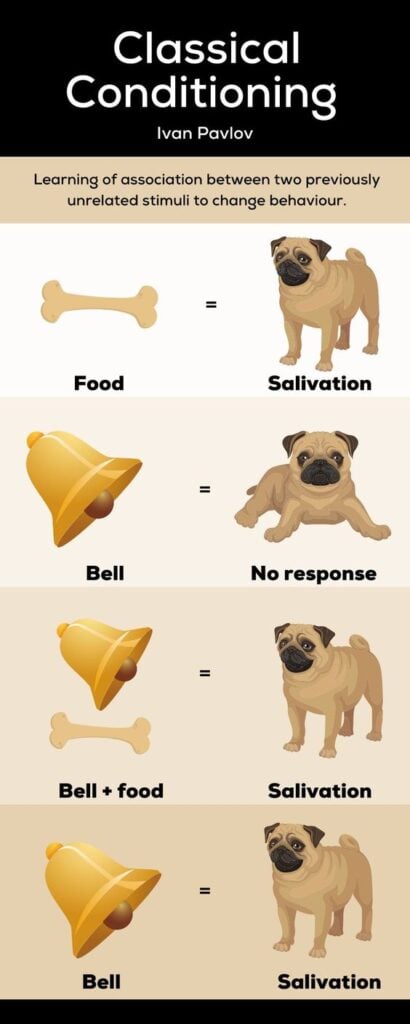
Pavlov showed that dogs could be conditioned to salivate at the sound of a bell if that sound was repeatedly presented at the same time that they were given food.
Pavlov’s studies of classical conditioning have become famous since his early work between 1890 and 1930. Classical conditioning is “classical” in that it is the first systematic study of the basic laws of learning (also known as conditioning).

Pavlov’s dogs were individually situated in secluded environments, secured within harnesses. A food bowl was positioned before them, and a device was employed to gauge the frequency of their salivary gland secretions.
The data from these measurements were systematically recorded onto a rotating drum, allowing Pavlov to meticulously monitor the rates of salivation throughout the course of the experiments.
First, the dogs were presented with the food, and they salivated. The food was the unconditioned stimulus and salivation was an unconditioned (innate) response. (i.e., a stimulus-response connection that required no learning).
Unconditioned Stimulus(Food) >Unconditioned Response(Salivate)
In his experiment, Pavlov used a metronome as his neutral stimulus. By itself, the metronome did not elicit a response from the dogs.
Neutral Stimulus(Metronome) >No Response
As you might expect, the sound of the clicking metronome on its own now caused an increase in salivation.
Conditioned Stimulus(Metronome) >Conditioned Response(Salivate)
So, the dog had learned an association between the metronome and the food, and a new behavior had been learned.
Because this response was learned (or conditioned), it is called a conditioned response (and also known as a Pavlovian response). The neutral stimulus has become a conditioned stimulus.

Temporal contiguity
Pavlov found that for associations to be made, the two stimuli had to be presented close together in time (such as a bell).
He called this the law of temporal contiguity. If the time between the conditioned stimulus (bell) and the unconditioned stimulus (food) is too great, then learning will not occur.
‘Unconditioning’ through experimental extinction
In extinction, the conditioned stimulus (the bell) is repeatedly presented without the unconditioned stimulus (the food).
Over time, the dog stops associating the sound of the bell with the food, and the conditioned response (salivation) weakens and eventually disappears.
In other words, the conditioned response is “unconditioned” or “extinguished.”
Spontaneous recovery
Pavlov noted the occurrence of “spontaneous recovery,” where the conditioned response can briefly reappear when the conditioned stimulus is presented after a rest period, even though the response has been extinguished.
This discovery added to the understanding of conditioning and extinction, indicating that these learned associations, while they can fade, are not completely forgotten.
Generalization
The principle of generalization suggests that after a subject has been conditioned to respond in a certain way to a specific stimulus, the subject will also respond in a similar manner to stimuli that are similar to the original one.
In Pavlov’s famous experiments with dogs, he found that after conditioning dogs to salivate at the sound of a bell (which was paired with food), the dogs would also salivate in response to similar sounds, like a buzzer.
This demonstrated the principle of generalization in classical conditioning.
However, the response tends to be more pronounced when the new stimulus closely resembles the original one used in conditioning.
This relationship between the similarity of the stimulus and the strength of the response is known as the generalization gradient.
Impact of Pavlov’s Research
Ivan Pavlov’s key contribution to psychology was the discovery of classical conditioning, demonstrating how learned associations between stimuli can influence behavior.
His work laid the foundation for behaviorism, influenced therapeutic techniques, and informed our understanding of learning and memory processes.
Behaviorism:Pavlov’s work laid the foundation forbehaviorism, a major school of thought in psychology. The principles of classical conditioning have been used to explain a wide range of behaviors, from phobias to food aversions.
Therapy Techniques:Techniques based on classical conditioning, such assystematic desensitizationandexposure therapy, have been developed to treat a variety of psychological disorders, including phobias and post-traumatic stress disorder (PTSD).
Educational Strategies:Educational strategies, like repetitive learning and rote memorization, can be seen as applications of the principles of classical conditioning. The repeated association between stimulus and response can help to reinforce learning.
Marketing and Advertising:Principles from Pavlov’s conditioning experiments are often used in advertising to build brand recognition and positive associations.
For instance, a brand may pair its product with appealing stimuli (like enjoyable music or attractive visuals) to create a positive emotional response in consumers, who then associate the product with it.
Critical Evaluation
Pavlovian conditioning is traditionally described as learning an association between a neutral conditioned stimulus (CS) and an unconditioned stimulus (US), such that the CS comes to elicit a conditioned response (CR). This fits many lab studies but misses the adaptive function of conditioning (Domjan, 2005).
From a functional perspective, conditioning likely evolves to help organisms effectively interact with biologically important unconditioned stimuli (US) in their natural environment.
For conditioning to happen naturally, the conditioned stimulus (CS) can’t be arbitrary, but must have a real ecological relationship to the US as a precursor or feature of the US object.
The critical behavior change from conditioning may not be conditioned responses (CRs), but rather conditioned modifications of unconditioned responses (URs) to the US that improve the organism’s interactions with it.
Evidence shows conditioning occurs readily with naturalistic CSs, like tastes before illness, infant cues before nursing, prey sights before attack. This conditioning is more robust and resistant to effects like blocking.
Traditional descriptions of Pavlovian conditioning as simply the acquired ability of one stimulus to evoke the original response to another stimulus paired with it are inadequate and misleading (Rescorla, 1988).
New research shows conditioning is actually about learning relationships between events, which allows organisms to build mental representations of their environment.
Just pairing stimuli together doesn’t necessarily cause conditioning. It depends on whether one stimulus gives information about the other.
Conditioning rapidly encodes relations among a broad range of stimuli, not just between a neutral stimulus and one eliciting a response. The learned associations allow complex representations of the world.
The simulations suggest HeiDI explains Rescorla’s results via two mechanisms:
HeiDI refers to the authors of the model (Honey, Dwyer, Iliescu) as well as highlighting a key feature of the model – the bidirectional or reciprocal associations it proposes between conditioned stimuli and unconditioned stimuli.
H – Honey (the lead author’s surname), ei – Bidirectional (referring to the reciprocal associations), D – Dwyer (the second author’s surname), I – Iliescu (the third author’s surname).
References
Further ReadingLogan, C. A. (2002). When scientific knowledge becomes scientific discovery: The disappearance of classical conditioning before Pavlov.Journal of the History of the Behavioral Sciences, 38(4), 393-403.Learning and Behavior PowerPoint
Further Reading
Logan, C. A. (2002). When scientific knowledge becomes scientific discovery: The disappearance of classical conditioning before Pavlov.Journal of the History of the Behavioral Sciences, 38(4), 393-403.Learning and Behavior PowerPoint
What was the main point of Ivan Pavlov’s experiment with dogs?
The main point of Ivan Pavlov’s experiment with dogs was to study and demonstrate the concept of classical conditioning.
This experiment highlighted the learning process through the association of stimuli and laid the foundation for understanding how behaviors can be modified through conditioning.
What is Pavlovian response?
When did Pavlov discover classical conditioning?Ivan Pavlov discovered classical conditioning during his dog experiments in the late 1890s and early 1900s. His seminal work on classical conditioning, often called Pavlovian conditioning, laid the foundation for our understanding of associative learning and its role in behavior modification.
When did Pavlov discover classical conditioning?
Ivan Pavlov discovered classical conditioning during his dog experiments in the late 1890s and early 1900s. His seminal work on classical conditioning, often called Pavlovian conditioning, laid the foundation for our understanding of associative learning and its role in behavior modification.
 pavlovs dogs

Olivia Guy-Evans, MSc
BSc (Hons) Psychology, MSc Psychology of Education
Olivia Guy-Evans is a writer and associate editor for Simply Psychology. She has previously worked in healthcare and educational sectors.
Saul McLeod, PhD
BSc (Hons) Psychology, MRes, PhD, University of Manchester
Saul McLeod, PhD., is a qualified psychology teacher with over 18 years of experience in further and higher education. He has been published in peer-reviewed journals, including the Journal of Clinical Psychology.
