On This Page:ToggleObsessionsCompulsionsWhy Am I Obsessed with Order?Effects On Daily LifeTreatment
On This Page:Toggle
On This Page:
Thissubtype of OCDshares similar symptoms with Perfection (Just Right) OCD.
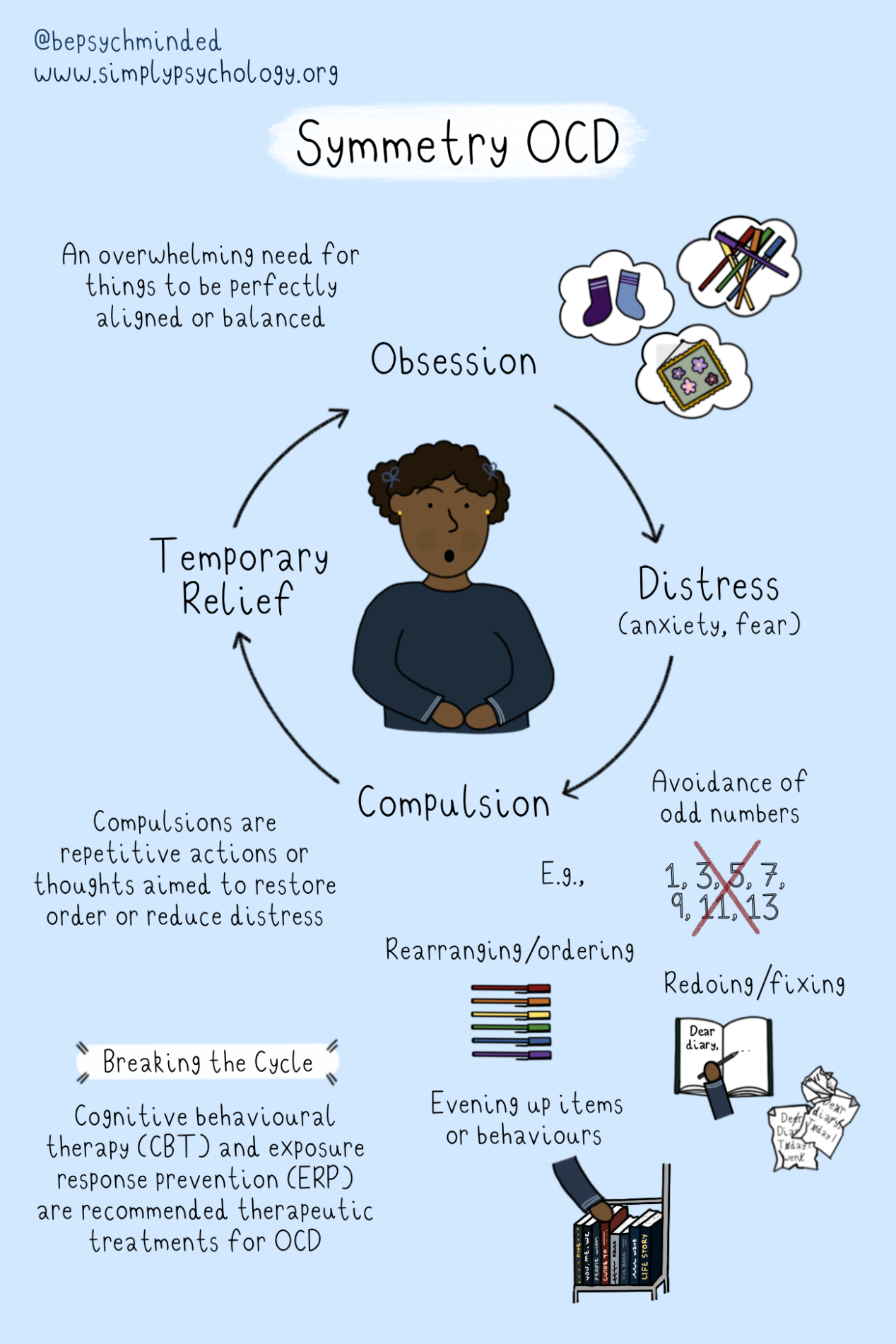
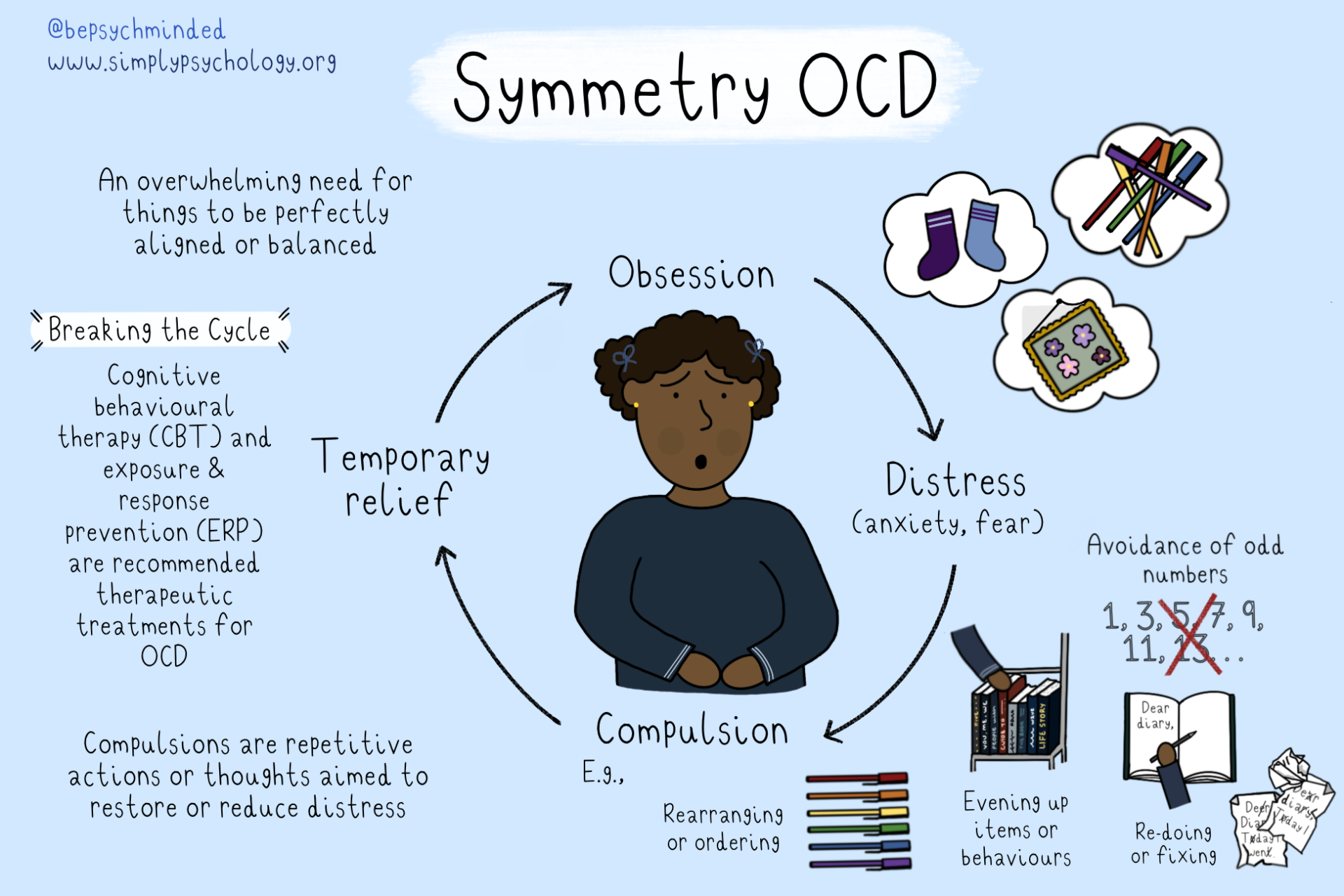
People with symmetry OCD will experience frequent obsessions around things not feeling symmetrical or ordered. They will become fixated on the position or arrangement of certain objects and will feel uncomfortable and distressed when items are not aligned correctly or appear in disarray.
“As a child if my left shoulder bumped into something I would focus (unhappily) on how my right shoulder felt weird or dirty until I could go back to the same spot and bump my right shoulder”.
People with this form of OCD may also struggle when written words are shaped imperfectly or are not correctly positioned along the lines on a page. These obsessions with symmetry tend to make individuals feel very uncomfortable and distressed with anything that does not meet their sense of order.
As a result, people with this form of OCD will compulsively fix, order, or rearrange items in an attempt to position objects in a perfect and acceptable manner, or will rewrite handwritten words over and over again until they appear aligned.
Individuals might experience a sense of dread or unease that something bad will happen unless they engage in compulsive behavior to neutralize it.
Research has shown that about 36-50% of people with OCD have this subtype (Lochner et al., 2016; Vellozo et al., 2021).
Symmetry OCD Obsessions
An obsession is an intrusive, unwanted thought or urge that can pop into one’s mind anytime. People with OCD will dwell on theseintrusive thoughtsand experience significant anxiety or distress.
Some common obsessions that occur with Symmetry OCD include:
 Failure to arrange objects or perform tasks in a specific, symmetrical manner triggers significant anxiety, leading to compulsive behaviors to restore perceived “order” or “balance.”
Because these obsessions cause high emotional discomfort, people with OCD will perform ritualistic behaviors to lessen these feelings and manage their distress. These are referred to as compulsions.
 ocd cycle
Symmetry OCD Compulsions
Compulsions are behaviors or rituals that people with OCD perform in response to an obsession. People perform these compulsions to suppress their anxiety and neutralize their fears. They also carry them out to keep things safe, ensure that the thoughts do not come true, and/or that something bad does not happen.
Even if the individual is aware that their compulsions are not logical, they are still compelled to carry them out, either for fear that something bad will happen if they do not, or because they feel incredibly anxious and distressed.
Some common compulsions that are seen with Symmetry OCD include:
Why Am I Obsessed with Order?
Reasons behind Symmetry OCD include magical thinking, dysfunctional protecting, and the simple need to feel right.
Effects On Daily Life
The severity of one’s OCD symptoms and their impact on one’s daily life will vary from individual to individual. For some, they may find that their triggers are specific and easy to target and manage, while others with more general triggers might notice that they constantly feel overwhelmed in daily life situations.
In all cases, however, living with OCD is very challenging and can take a toll on one’s physical and mental health wellbeing. When left untreated, it can infiltrate nearly every aspect of someone’s life.
Symmetry OCD obsessions can be all consuming and feel impossible to stop. Individuals with Symmetry OCD will spend hours a day ruminating on their obsessive thoughts and engaging in compulsive behaviors.
This can affect one’s ability to concentrate at work, stay in school, attend scheduled activities, spend time with family and friends, or maintain a relationship.
“I used to struggle (and am still working through some things) with relationships because every face is asymmetrical and I could ignore it when we first started going out but the longer I’d be with someone the more I would notice the asymmetry and imperfection go the point where even looking at them made me anxious. Currently practicing my ERP, and it’s been getting a lot better”.
Many people with this form of OCD feel miserable and helpless because although they hate the condition, they feel powerless to stop these behaviors due to the intense anxiety that arises when they attempt to do so. They might withdraw socially due to heightened anxiety, lack of energy, or their need to carry out compulsions at different points throughout the day.
Living with such a debilitating disorder can reduce confidence and weaken one’s sense of self. The impact of Symmetry OCD can lead to depression, hopelessness, and social isolation.
However, there are effective treatments that can help you gain relief from your OCD symptoms and live a fulfilling life.
Is Symmetry OCD Treatable?
OCD can be treated and managed effectively. You can learn to manage how your symptoms affect your daily life through medication, therapy, mindfulness, or a combination of treatments.
At least half of the people who seektreatment for OCDwill show symptomatic remission over the long term and experience an increased quality of life and improved functioning.
The best outcomes occur in individuals who are diagnosed early and start an intense treatment program right away.
Depending on the severity of OCD, some people may need longer-term or more intensive treatment.
Exposure and Response Prevention
Like with most types of OCD,Exposure and Response Prevention(ERP) therapy is a type of Cognitive-Behavioral Therapy considered the first-line psychotherapy for OCD. It has been found effective for 80% of people with OCD.
In ERP, patients are exposed to feared situations or objects meant to set off their compulsions. This therapy is intended to purposely invoke anxiety and sit with it in an attempt to disrupt the neural circuit between the processing and action parts of the brain.
Over time, people learn to resist the urge to perform compulsive rituals and manage their OCD thoughts and actions.
By staying in a feared situation without anything terrible happening, people learn that they don’t need their compulsions to cope, and that their fearful thoughts have no power over them.
They would need to resist the urge to touch their left shoulder to balance things out and sit with the anxiety that this asymmetry or incompleteness brings. For people who experience OCD, exercises like these can feel incredibly difficult and challenging.
You should only complete exposures if you can maintain good response prevention while doing so. Even the most challenging, high-level exposures will be ineffective if you are not maintaining good response prevention.
ERP takes time, effort, and practice, but people learn to cope with their thoughts without relying on ritualistic behaviors.
The compulsion to avoid anxiety is a powerful driver of OCD. Still, ERP is one of the most powerful tools available for treating OCD because it directs the person to live with the anxiety and see that nothing bad will happen.
Sources
Lochner, C., McGregor, N., Hemmings, S., Harvey, B. H., Breet, E., Swanevelder, S., & Stein, D. J. (2016). Symmetry symptoms in obsessive-compulsive disorder: clinical and genetic correlates. Braz J Psychiatry, 38(1), 17-23. doi:10.1590/1516-4446-2014-1619
Radomsky, A. S., & Rachman, S. (2004). Symmetry, ordering and arranging compulsive behavior.Behaviour Research and Therapy,42(8), 893-913.
Timpano, K. R., Carbonella, J. Y., Zuckerman, S. E., & Çek, D. (2016). Treatment of symmetry-obsessive-compulsive disorder.Clinical handbook of obsessive-compulsive and related disorders: A case-based approach to treating pediatric and adult populations, 69-83.
Vellozo, A. P., Fontenelle, L. F., Torresan, R. C., Shavitt, R. G., Ferrão, Y. A., Rosário, M. C., … & Torres, A. R. (2021). Symmetry dimension in obsessive–compulsive disorder: prevalence, severity and clinical correlates.Journal of Clinical Medicine,10(2), 274.
 Orderliness Symmetry OCD

Florence Yeung
BSc (Hons), Psychology, MSc, Clinical Mental Health Sciences
Florence Yeung is a certified Psychological Wellbeing Practitioner with three years of clinical experience in NHS primary mental health care. She is presently pursuing a ClinPsyD Doctorate in Clinical Psychology at the Hertfordshire Partnership University NHS Foundation Trust (HPFT). In her capacity as a trainee clinical psychologist, she engages in specialist placements, collaborating with diverse borough clinical groups and therapeutic orientations.
Saul McLeod, PhD
BSc (Hons) Psychology, MRes, PhD, University of Manchester
Saul McLeod, PhD., is a qualified psychology teacher with over 18 years of experience in further and higher education. He has been published in peer-reviewed journals, including the Journal of Clinical Psychology.
Julia Simkus
BA (Hons) Psychology, Princeton University
Julia Simkus is a graduate of Princeton University with a Bachelor of Arts in Psychology. She is currently studying for a Master’s Degree in Counseling for Mental Health and Wellness in September 2023. Julia’s research has been published in peer reviewed journals.
