On This Page:ToggleControlled ObservationNaturalistic ObservationParticipant ObservationRecording of DataCoding SystemsCoder DriftObserver BiasData Analysis Approaches
On This Page:Toggle
On This Page:
The observation method in psychology involves directly and systematically witnessing and recording measurable behaviors, actions, and responses in natural or contrived settings without attempting to intervene or manipulate what is being observed.
There are different types of observational methods, and distinctions need to be made between:
Controlled Observations
Naturalistic Observations
Participant Observations
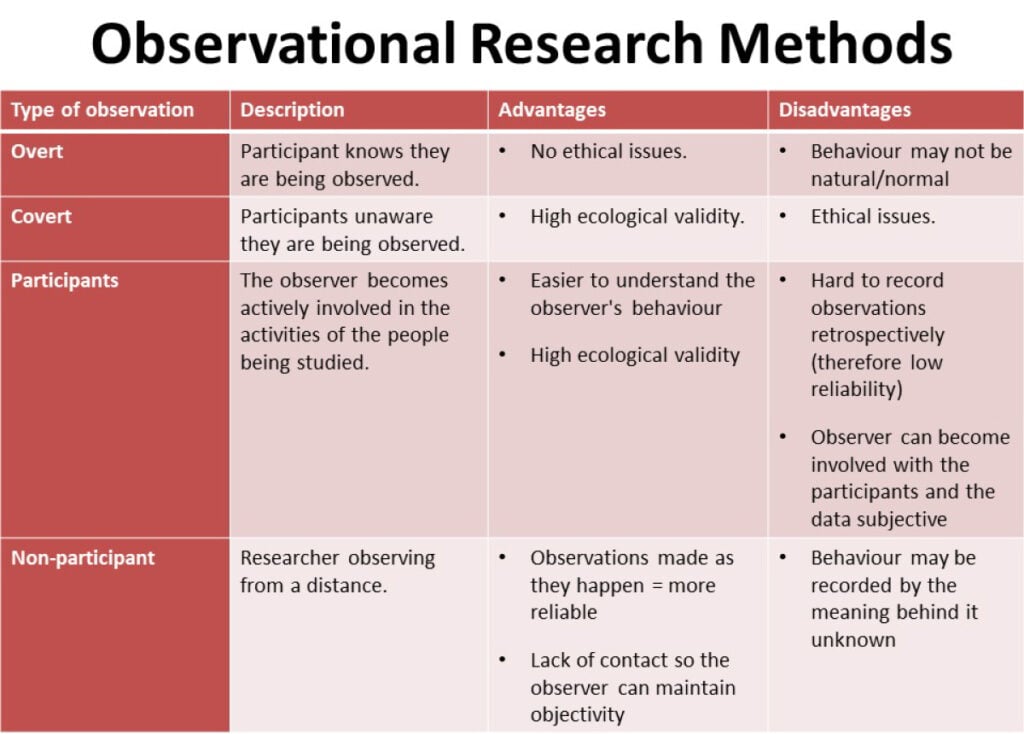
In addition to the above categories, observations can also be either overt/disclosed (the participants know they are being studied) or covert/undisclosed (the researcher keeps their real identity a secret from the research subjects, acting as a genuine member of the group).
In general, conducting observational research is relatively inexpensive, but it remains highly time-consuming and resource-intensive in data processing and analysis.
The considerable investments needed in terms of coder time commitments for training, maintaining reliability, preventing drift, and coding complex dynamic interactions place practical barriers on observers with limited resources.
Controlled Observation
Controlled observation is a research method for studying behavior in a carefully controlled and structured environment.
The researcher sets specific conditions, variables, and procedures to systematically observe and measure behavior, allowing for greater control and comparison of different conditions or groups.
The researcher decides where the observation will occur, at what time, with which participants, and in what circumstances, and uses a standardized procedure. Participants arerandomly allocatedto each independent variable group.
Rather than writing a detailed description of all behavior observed, it is often easier to code behavior according to a previously agreed scale using a behavior schedule (i.e., conducting a structured observation).
The researcher systematically classifies the behavior they observe into distinct categories. Coding might involve numbers or letters to describe a characteristic or the use of a scale to measure behavior intensity.
The categories on the schedule are coded so that the data collected can be easily counted and turned into statistics.
For example,Mary Ainsworthused a behavior schedule to study how infants responded to brief periods of separation from their mothers. During the Strange Situation procedure, the infant’s interaction behaviors directed toward the mother were measured, e.g.,
The observer noted down the behavior displayed during 15-second intervals and scored the behavior for intensity on a scale of 1 to 7.

Sometimes participants’ behavior is observed through a two-way mirror, or they are secretly filmed. Albert Bandura used this method to study aggression in children (theBobo doll studies).
A lot of research has been carried out in sleep laboratories as well. Here, electrodes are attached to the scalp of participants. What is observed are the changes in electrical activity in the brain during sleep (the machine is called an EEG).
Controlled observations are usually overt as the researcher explains the research aim to the group so the participants know they are being observed.
Controlled observations are also usually non-participant as the researcher avoids direct contact with the group and keeps a distance (e.g., observing behind a two-way mirror).
Strengths
Limitations
Naturalistic Observation
Naturalistic observation is a research method in which the researcher studies behavior in its natural setting without intervention or manipulation.
It involves observing and recording behavior as it naturally occurs, providing insights into real-life behaviors and interactions in their natural context.
This technique involves observing and studying the spontaneous behavior of participants in natural surroundings. The researcher simply records what they see in whatever way they can.
In unstructured observations, the researcher records all relevant behavior with a coding system. There may be too much to record, and the behaviors recorded may not necessarily be the most important, so the approach is usually used as apilot studyto see what type of behaviors would be recorded.
Compared with controlled observations, it is like the difference between studying wild animals in a zoo and studying them in their natural habitat.
Collecting Naturalistic Behavioral Data
Technological advances are enabling new, unobtrusive ways of collecting naturalistic behavioral data.
The Electronically Activated Recorder (EAR) is a digital recording device participants can wear to periodically sample ambient sounds, allowing representative sampling of daily experiences (Mehl et al., 2012).
Studies program EARs to record 30-50 second sound snippets multiple times per hour. Although coding the recordings requires extensive resources, EARs can capture spontaneous behaviors like arguments or laughter.
EARs minimize participant reactivity since sampling occurs outside of awareness. This reduces the Hawthorne effect, where people change behavior when observed.
The SenseCam is another wearable device that passively captures images documenting daily activities. Though primarily used in memory research currently (Smith et al., 2014), systematic sampling of environments and behaviors via the SenseCam could enable innovative psychological studies in the future.
Participant Observation
Participant observation is a variant of the above (natural observations) but here, the researcher joins in and becomes part of the group they are studying to get a deeper insight into their lives.
If it wereresearch on animals, we would now not only be studying them in their natural habitat but be living alongside them as well!
Leon Festinger used this approach in a famous study into a religious cult that believed that the end of the world was about to occur. He joined the cult and studied how they reacted when the prophecy did not come true.
Participant observations can be either covert or overt. Covert is where the study is carried out “undercover.” The researcher’s real identity and purpose are kept concealed from the group being studied.
The researcher takes a false identity and role, usually posing as a genuine member of the group.
On the other hand, overt is where the researcher reveals his or her true identity and purpose to the group and asks permission to observe.
Recording of Data
With controlled/structured observation studies, an important decision the researcher has to make is how to classify and record the data. Usually, this will involve a method of sampling.
In most coding systems, codes or ratings are made either per behavioral event or per specified time interval (Bakeman & Quera, 2011).
Event-based coding involves identifying and segmenting interactions into meaningful events rather than timed units.
For example, parent-child interactions may be segmented into control or teaching events to code. Interval recording involves dividing interactions into fixed time intervals (e.g., 6-15 seconds) and coding behaviors within each interval (Bakeman & Quera, 2011).
Event recording allows counting event frequency and sequencing while also potentially capturing event duration through timed-event recording. This provides information on time spent on behaviors.
Coding Systems
The coding system should focus on behaviors, patterns, individual characteristics, or relationship qualities that are relevant to the theory guiding the study (Wampler & Harper, 2014).
Codes vary in how much inference is required, from concrete observable behaviors like frequency of eye contact to more abstract concepts like degree of rapport between a therapist and client (Hill & Lambert, 2004). More inference may reduce reliability.
Coding schemes can vary in their level of detail or granularity. Micro-level schemes capture fine-grained behaviors, such as specific facial movements, while macro-level schemes might code broader behavioral states or interactions. The appropriate level of granularity depends on the research questions and the practical constraints of the study.
Another important consideration is the concreteness of the codes. Some schemes use physically based codes that are directly observable (e.g., “eyes closed”), while others use more socially based codes that require some level of inference (e.g., “showing empathy”). While physically based codes may be easier to apply consistently, socially based codes often capture more meaningful behavioral constructs.
Most coding schemes strive to create sets of codes that are mutually exclusive and exhaustive (ME&E). This means that for any given set of codes, only one code can apply at a time (mutual exclusivity), and there is always an applicable code (exhaustiveness). This property simplifies both the coding process and subsequent data analysis.
For example, a simple ME&E set for coding infant state might include: 1) Quiet alert, 2) Crying, 3) Fussy, 4) REM sleep, and 5) Deep sleep. At any given moment, an infant would be in one and only one of these states.
Macroanalytic coding systems
Macroanalytic coding systems involve rating or summarizing behaviors using larger coding units and broader categories that reflect patterns across longer periods of interaction rather than coding small or discrete behavioral acts.
Macroanalytic coding systems focus on capturing overarching themes, global qualities, or general patterns of behavior rather than specific, discrete actions.
For example, a macroanalytic coding system may rate the overall degree of therapist warmth or level of client engagement globally for an entire therapy session, requiring the coders to summarize and infer these constructs across the interaction rather than coding smaller behavioral units.
These systems require observers to make more inferences (more time-consuming) but can better capture contextual factors, stability over time, and the interdependent nature of behaviors (Carlson & Grotevant, 1987).
Microanalytic coding systems
Microanalytic coding systems involve rating behaviors using smaller, more discrete coding units and categories.
For example, a microanalytic system may code each instance of eye contact or head nodding during a therapy session. These systems code specific, molecular behaviors as they occur moment-to-moment rather than summarizing actions over longer periods.
Microanalytic systems require less inference from coders and allow for analysis of behavioral contingencies and sequential interactions between therapist and client. However, they are more time-consuming and expensive to implement than macroanalytic approaches.
Mesoanalytic coding systems
Mesoanalytic coding systems attempt to balance macro- and micro-analytic approaches.
In contrast to macroanalytic systems that summarize behaviors in larger chunks, mesoanalytic systems use medium-sized coding units that target more specific behaviors or interaction sequences (Bakeman & Quera, 2017).
For example, a mesoanalytic system may code each instance of a particular type of therapist statement or client emotional expression. However, mesoanalytic systems still use larger units than microanalytic approaches coding every speech onset/offset.
The goal of balancing specificity and feasibility makes mesoanalytic systems well-suited for many research questions (Morris et al., 2014). Mesoanalytic codes can preserve some sequential information while remaining efficient enough for studies with adequate but limited resources.
In this way, mesoanalytic coding allows reasonable reliability and specificity without requiring extensive training or observation. The mid-level focus offers a pragmatic compromise between depth and breadth in analyzing interactions.
Preventing Coder Drift
This type of error creeps in when coders fail to regularly review what precise observations constitute or do not constitute the behaviors being measured.
Preventing drift refers to taking active steps to maintain consistency and minimize changes or deviations in how coders rate or evaluate behaviors over time. Specifically, some key ways to prevent coder drift include:
Essentially, the goal of preventing coder drift is maintaining standardization and minimizing unintentional biases that may slowly alter how observational data gets rated over periods of extensive coding.
Through the upkeep of skills, continuing calibration to benchmarks, and monitoring consistency, researchers can notice and correct for any creeping changes in coder decision-making over time.
Reducing Observer Bias
Observational research is prone toobserver biasesresulting from coders’ subjective perspectives shaping the interpretation of complex interactions (Burghardt et al., 2012). When coding, personal expectations may unconsciously influence judgments. However, rigorous methods exist to reduce such bias.
Coding Manual
High-quality manuals have strong theoretical and empirical grounding, laying out explicit coding procedures and providing rich behavioral examples to anchor code definitions (Lindahl, 2001).
Clear delineation of the frequency, intensity, duration, and type of behaviors constituting each code facilitates reliable judgments and reduces ambiguity for coders. Application risks inconsistency across raters without clarity on how codes translate to observable interaction.
Coder Training
Competent coders require both interpersonal perceptiveness and scientific rigor (Wampler & Harper, 2014). Training thoroughly reviews the theoretical basis for coded constructs and teaches the coding system itself.
Multiple “gold standard” criterion videos demonstrate code ranges that trainees independently apply. Coders then meet weekly to establish reliability of 80% or higher agreement both among themselves and with master criterion coding (Hill & Lambert, 2004).
Ongoing training manages coder drift over time. Revisions to unclear codes may also improve reliability. Both careful selection and investment in rigorous training increase quality control.
Blind Methods
To prevent bias, coders should remain unaware of specific study predictions or participant details (Burghardt et al., 2012). Separate data gathering versus coding teams helps maintain blinding.
Coders should be unaware of study details or participant identities that could bias coding (Burghardt et al., 2012).
Separate teams collecting data versus coding data can reduce bias.
In addition, scheduling procedures can prevent coders from rating data collected directly from participants with whom they have had personal contact. Maintaining coder independence and blinding enhances objectivity.
Data Analysis Approaches
Data analysis in behavioral observation aims to transform raw observational data into quantifiable measures that can be statistically analyzed.
Interval data (where behavior is recorded at fixed time points), event data (where the occurrence of behaviors is noted as they happen), and timed-event data (where both the occurrence and duration of behaviors are recorded) may require different analytical approaches.
Similarly, the level of measurement (categorical, ordinal, or continuous) will influence the choice of statistical tests.
Researchers typically start with simple descriptive statistics to get a feel for their data before moving on to more complex analyses. This stepwise approach allows for a thorough understanding of the data and can often reveal unexpected patterns or relationships that merit further investigation.
simple descriptive statistics
Descriptive statistics give an overall picture of behavior patterns and are often the first step in analysis.
These simple statistics form the foundation of behavioral analysis, providing researchers with a broad picture of behavioral patterns.
They can reveal which behaviors are most common, how long they typically last, and how they might vary across different conditions or subjects.
For instance, in a study of classroom behavior, these statistics might show how often students raise their hands, how long they typically stay focused on a task, or what proportion of time is spent on different activities.
contingency analyses
Contingency analyses help identify if certain behaviors tend to occur together or in sequence.
For example, in a study of parent-child interactions, contingency analyses might reveal whether a parent’s praise is more likely to follow a child’s successful completion of a task, or whether a child’s tantrum is more likely to occur after a parent’s refusal of a request.
These analyses can uncover important patterns in social interactions, learning processes, or behavioral chains.
sequential analyses
Sequential analyses are crucial for understanding processes and temporal relationships between behaviors.
These methods are particularly valuable for understanding processes that unfold over time, such as conversation patterns, problem-solving strategies, or the development of social skills.
observer agreement
Since human observers often code behaviors, it’s important to checkreliability. This is typically done through measures of observer agreement.
Good observer agreement is crucial for the validity of the study, as it demonstrates that the observed behaviors are consistently identified and coded across different observers or time points.
advanced statistical approaches
As researchers delve deeper into their data, they often employ more advanced statistical techniques.
representation techniques
Representation techniques help organize and visualize data:
 Advances in video/computer technology have made behavioral observation more feasible, but it still requires careful planning of coding schemes, observer training, and data analysis approaches.
References
Bakeman, R., & Quera, V. (2017).Sequential analysis and observational methods for the behavioral sciences.Cambridge University Press.
Burghardt, G. M., Bartmess-LeVasseur, J. N., Browning, S. A., Morrison, K. E., Stec, C. L., Zachau, C. E., & Freeberg, T. M. (2012). Minimizing observer bias in behavioral studies: A review and recommendations.Ethology, 118(6), 511-517.
Hill, C. E., & Lambert, M. J. (2004). Methodological issues in studying psychotherapy processes and outcomes. In M. J. Lambert (Ed.), Bergin and Garfield’s handbook of psychotherapy and behavior change (5th ed., pp. 84–135). Wiley.
Lindahl, K. M. (2001). Methodological issues in family observational research. In P. K. Kerig & K. M. Lindahl (Eds.),Family observational coding systems: Resources for systemic research(pp. 23–32). Lawrence Erlbaum Associates.
Mehl, M. R., Robbins, M. L., & Deters, F. G. (2012). Naturalistic observation of health-relevant social processes: The electronically activated recorder methodology in psychosomatics.Psychosomatic Medicine, 74(4), 410–417.
Morris, A. S., Robinson, L. R., & Eisenberg, N. (2014). Applying a multimethod perspective to the study of developmental psychology. In H. T. Reis & C. M. Judd (Eds.),Handbook of research methods in social and personality psychology(2nd ed., pp. 103–123). Cambridge University Press.
Smith, J. A., Maxwell, S. D., & Johnson, G. (2014). The microstructure of everyday life: Analyzing the complex choreography of daily routines through the automatic capture and processing of wearable sensor data. In B. K. Wiederhold & G. Riva (Eds.),Annual Review of Cybertherapy and Telemedicine 2014: Positive Change with Technology(Vol. 199, pp. 62-64). IOS Press.
Traniello, J. F., & Bakker, T. C. (2015). The integrative study of behavioral interactions across the sciences. In T. K. Shackelford & R. D. Hansen (Eds.),The evolution of sexuality(pp. 119-147). Springer.
Wampler, K. S., & Harper, A. (2014). Observational methods in couple and family assessment. In H. T. Reis & C. M. Judd (Eds.),Handbook of research methods in social and personality psychology(2nd ed., pp. 490–502). Cambridge University Press.

Olivia Guy-Evans, MSc
BSc (Hons) Psychology, MSc Psychology of Education
Olivia Guy-Evans is a writer and associate editor for Simply Psychology. She has previously worked in healthcare and educational sectors.
Saul McLeod, PhD
BSc (Hons) Psychology, MRes, PhD, University of Manchester
Saul McLeod, PhD., is a qualified psychology teacher with over 18 years of experience in further and higher education. He has been published in peer-reviewed journals, including the Journal of Clinical Psychology.
