It is a manipulative tactic that typically occurs in the early stages of a relationship when the narcissist is trying to win over their partner.
The cycle generally begins with love bombing, where the narcissist showers their partner with intense affection and attention to create a strong bond. This leads to idealization, where the partner is placed on a pedestal and a deep sense of connection is established.
Gradually, the narcissist will begin to devalue their partner, becoming critical, degrading, and distant. This cycle often culminates in a discard where the narcissist abruptly ends the relationship with little explanation.
In some cases, the narcissist might engage in “hoovering,” which involves attempting to draw the partner back into the relationship through love bombing and promises of change. If the partner returns to the relationship, the cycle often repeats itself, only to end in eventual devaluation and discard.
What Happens during the love bombing phase?
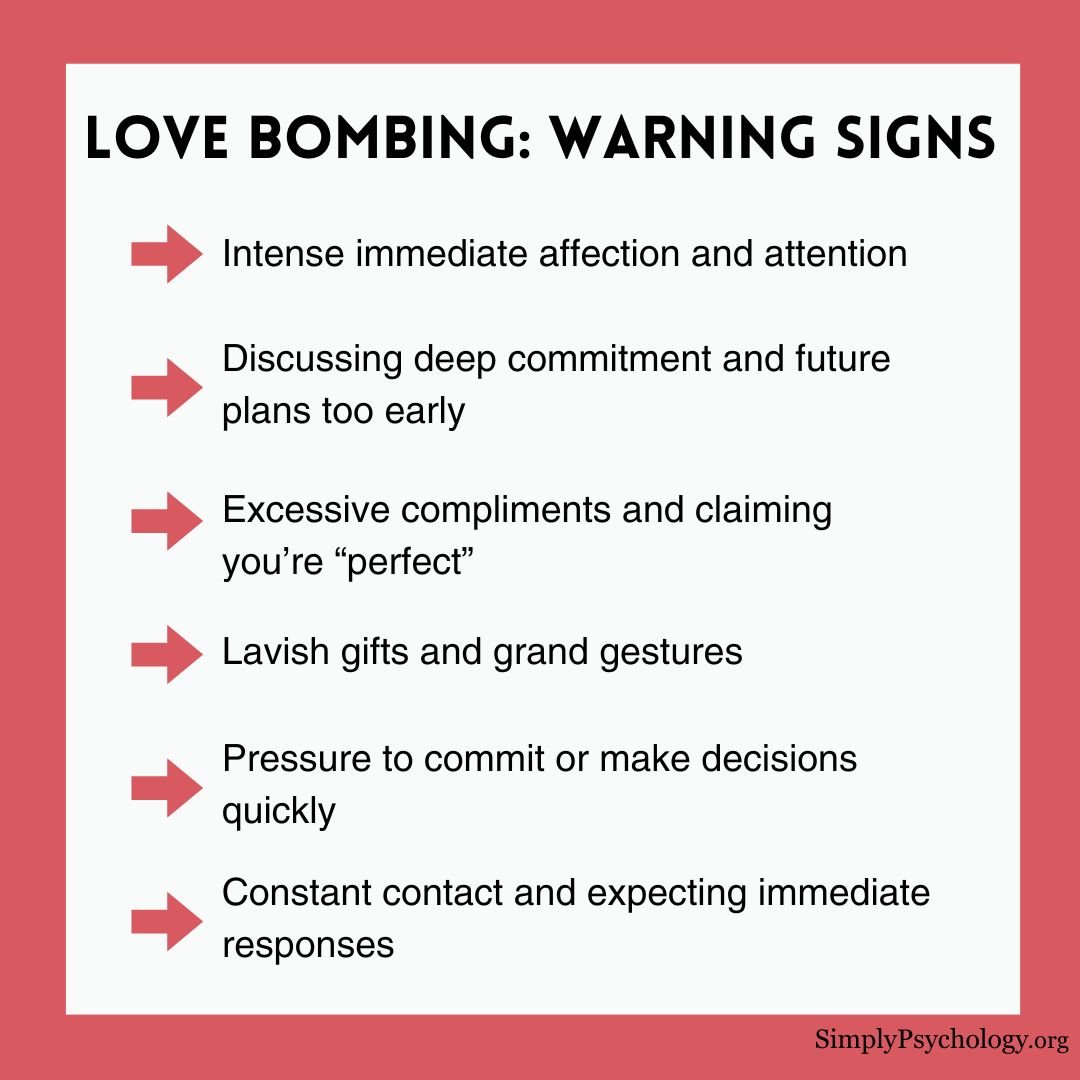
During the love bombing phase, the narcissist will shower their partner with an overwhelming amount of affection, compliments, and attention. They may engage in excessive communication, buy lavish gifts, make future plans, or execute grand romantic gestures to make their partner feel special.
The goal is to create a sense of deep connection and dependency, making the partner more vulnerable to the narcissist’s manipulation and control tactics as the relationship progresses.
Narcissists can be incredibly charming and seductive, so it can be difficult for the partner to see the potential manipulative nature behind their behavior.
“At first, it was great. He made it seem like he was my saviour. He was kind, loving and attentive.”
Another woman expressed:
“Our early relationship felt like a fairy tale; I’d never been adored and idealized before and was totally sucked in. [He] was very charming in the beginning.
He pursued me hard and fast and I didn’t quite know what was happening…He complimented me, put me on a pedestal, and told me he loved me really early on in the game. I was flattered.”
How Long Does the Love Bombing Phase Last With a Narcissist?
The duration of the love bombing phase can vary depending on several factors, including the narcissist’s tactics, the personality of the partner, and the specific circumstances of the relationship
The love bombing phase tends to be relatively short-lived, though, compared to the entire duration of the relationship. It can last anywhere from a few weeks to a few months or even a year.
One surveyconducted among 500 individuals who experienced love bombing from their partners estimated that the average duration of the love bombing phase is five-and-a-half months with narcissistic men and three-and-a-half months with narcissistic women.
The maximum duration of the love bombing phase reported in the survey was six months.
Narcissists will use love bombing to quickly establish a strong emotional connection and gain control over their partner. Once they feel that they have secured the partner’s emotional attachment and dependence, they will start transitioning into the devaluation phase, where they begin to show less interest and affection and start exhibiting manipulative behaviors.
What Comes After Love Bombing With a Narcissist?
As the relationship progresses, the narcissist’s behavior starts to change. After the love bombing phase with a narcissist comes the phase of devaluation.
Devaluation
The “devaluation” phase is when the dynamics of the relationship start to shift dramatically, and the intense affection and positive attention give way to more negative behaviors.
The narcissist will become critical, dismissive, and potentially evenemotionallyorverbally abusivetowards their partner. The narcissist may also use manipulative tactics, such as gaslighting or blame-shifting, to control the partner’s emotions and behavior.
The affection and intimacy that were abundant during the love bombing phase start to diminish, leaving the partner feeling isolated and unloved.
This abrupt shift can be deeply hurtful and confusing for the partner, who may struggle to understand where the relationship went wrong.
Discard or Hoovering
When the victim no longer serves a purpose or holds value for the narcissist, or when the narcissist has found a new source of attention or validation, they often will discard their victim.
During the discard phase of thenarcissistic love pattern, the narcissist might abruptly end the relationship or pull away emotionally.
“He pressured me into getting married very quickly. After we got married he changed [and] became prone to extreme anger if I didn’t compliment him enough. He is explosive, seems totally unemotional, and unstable.”
“When we first met he drew me in fast…I was so taken in with this guy. He made himself to be everything I had ever wanted.
After several months the lectures started…he would spend hours criticizing me, blaming me for everything. I had no local family or friends and the loneliness was horrible… Over the next years the lectures became more frequent and more harsh with increased name calling and blame.
Anytime he was in a bad mood or had a bad day, where something didn’t go his way, he would spend the rest of the night lecturing me. He would use sex as a means to get the lectures to stop, saying that he would stop talking if I sexually gratified him.”
Instead of a discard, the narcissist might engage in “hoovering,” which involves attempting to draw the partner back into the relationship after the devaluation (or discard) phase. They may use manipulation, guilt-tripping, promises of change, or even renewed love bombing to regain the partner’s attention and control.
What are the Warning Signs of Love Bombing?
Recognizing the warning signs of love bombing is crucial in identifying if you are in a manipulative and unhealthy relationship. Here are some common warning signs of love bombing to look out for:
Signs of Love Bombing
Things to Pay Attention to Within Yourself
When dealing with potential love bombing or manipulative behavior, paying attention to your own feelings, thoughts, and reactions is crucial for maintaining your emotional well-being and making informed decisions.
Here are some things to pay attention to within yourself:
If you suspect you’re in a relationship with someone who exhibits this cycle or you’re concerned about the dynamics of your relationship, consider seeking support from a trusted friend, family member, or mental health professional.
FAQs
Do Narcissists Enjoy Love Bombing?Yes, narcissists often enjoy love bombing.Love bombing is a tactic that aligns with many narcissists’ desire for attention, admiration, and control over others. It allows them to create an intense and seemingly perfect connection with their target, fostering dependency and emotional manipulation.
Do Narcissists Enjoy Love Bombing?
Yes, narcissists often enjoy love bombing.Love bombing is a tactic that aligns with many narcissists’ desire for attention, admiration, and control over others. It allows them to create an intense and seemingly perfect connection with their target, fostering dependency and emotional manipulation.
Yes, narcissists often enjoy love bombing.
Love bombing is a tactic that aligns with many narcissists’ desire for attention, admiration, and control over others. It allows them to create an intense and seemingly perfect connection with their target, fostering dependency and emotional manipulation.
Why do Narcissists Use Love Bombing?Narcissists use love bombing as a strategic tactic to manipulate and control their targets.Love bombing establishes a deep emotional connection and dependency, giving the narcissist control over their target’s emotions and decisions.Additionally, successful love bombing reinforces the narcissist’s inflated sense of self-worth as the positive reactions from their targets feed their ego and emphasize their belief that they are exceptional.
Why do Narcissists Use Love Bombing?
Narcissists use love bombing as a strategic tactic to manipulate and control their targets.Love bombing establishes a deep emotional connection and dependency, giving the narcissist control over their target’s emotions and decisions.Additionally, successful love bombing reinforces the narcissist’s inflated sense of self-worth as the positive reactions from their targets feed their ego and emphasize their belief that they are exceptional.
Narcissists use love bombing as a strategic tactic to manipulate and control their targets.
Love bombing establishes a deep emotional connection and dependency, giving the narcissist control over their target’s emotions and decisions.
Additionally, successful love bombing reinforces the narcissist’s inflated sense of self-worth as the positive reactions from their targets feed their ego and emphasize their belief that they are exceptional.
While love bombing is generally associated with narcissistic behavior, it is not exclusive to narcissists.
Love bombing can also be seen in individuals who are genuinely infatuated or excited about a new relationship. They might express their feelings intensely and passionately without having manipulative intentions.
Are Narcissists Aware of Love Bombing?
Narcissists are typically aware of their use of love bombing as a manipulative tactic.
However, it’s important to note that narcissists may not see their behavior as problematic. They might rationalize their actions, believing that their love bombing is a way to show their partner how much they care or that they genuinely believe in the intensity of their feelings in the moment.
Sources
Akin, E. (2023). How Long Does the Love Bombing Phase Last? (Survey).Unfilteredd. https://unfilteredd.net/how-long-does-the-love-bombing-phase-last-case-study/
Day, N. J. S., Townsend, M. L., & Grenyer, B. F. S. (2022). Pathological narcissism: An analysis of interpersonal dysfunction within intimate relationships.Personality and Mental Health, 16( 3), 204– 216.
Strutzenberg, C. C., Wiersma-Mosley, J. D., Jozkowski, K. N., & Becnel, J. N. (2017). Love-bombing: A Narcissistic Approach to Relationship Formation. Discovery, The Student Journal of Dale Bumpers College of Agricultural, Food and Life Sciences, 18(1), 81-89.

Saul McLeod, PhD
BSc (Hons) Psychology, MRes, PhD, University of Manchester
Saul McLeod, PhD., is a qualified psychology teacher with over 18 years of experience in further and higher education. He has been published in peer-reviewed journals, including the Journal of Clinical Psychology.
Julia Simkus
BA (Hons) Psychology, Princeton University
Julia Simkus is a graduate of Princeton University with a Bachelor of Arts in Psychology. She is currently studying for a Master’s Degree in Counseling for Mental Health and Wellness in September 2023. Julia’s research has been published in peer reviewed journals.
Anna DrescherMental Health WriterBSc (Hons), Psychology, Goldsmiths University, MSc in Psychotherapy, University of QueenslandAnna Drescher is a freelance writer and solution-focused hypnotherapist, specializing in CBT and meditation. Using insights from her experience working as an NHS Assistant Clinical Psychologist and Recovery Officer, along with her Master’s degree in Psychotherapy, she lends deep empathy and profound understanding to her mental health and relationships writing.
Anna DrescherMental Health WriterBSc (Hons), Psychology, Goldsmiths University, MSc in Psychotherapy, University of Queensland
Anna Drescher
Mental Health Writer
BSc (Hons), Psychology, Goldsmiths University, MSc in Psychotherapy, University of Queensland
Anna Drescher is a freelance writer and solution-focused hypnotherapist, specializing in CBT and meditation. Using insights from her experience working as an NHS Assistant Clinical Psychologist and Recovery Officer, along with her Master’s degree in Psychotherapy, she lends deep empathy and profound understanding to her mental health and relationships writing.
