On This Page:ToggleFunctionMyelination Formation and DevelopmentDamage
On This Page:Toggle
On This Page:
Myelin sheath is the protective layer that wraps around the axons of neurons to aid in insulating theneuronsand to increase the number of electrical signals being transferred.


Myelin Sheath Function
The myelin sheath serves as the nervous system’s critical insulation system, similar to the protective coating on electrical wires.
Its unique structure enables three essential functions.
First, as a low electrical condenser with high electrical resistance, it dramatically increases the speed of nerve signal transmission.
The most heavily myelinated axons can conduct impulses at an impressive 70 to 120 meters per second – comparable to the speed of a race car.
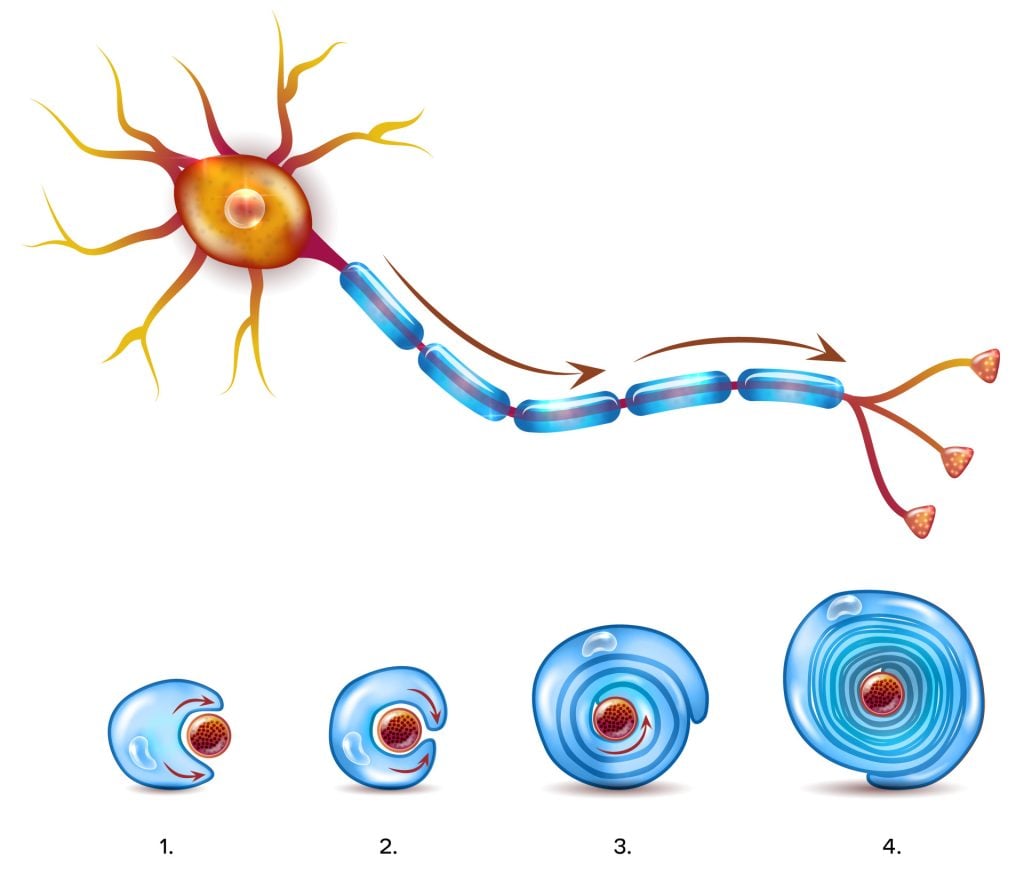
Second, the myelin sheath prevents electrical signals from leaking out of the axon and controls ion movement through a process called depolarization, ensuring signals flow efficiently in the intended direction.
Third, the nodes of Ranvier create a unique form of signal transmission called saltatory conduction, where electrical impulses “jump” from node to node.
This jumping mechanism not only increases transmission speed but also requires less energy than continuous signal conduction.
The nodes contain specialized clusters of voltage-sensitive sodium and potassium ion channels that help maintain this efficient signaling system.
Together, these functions allow neurons to communicate effectively, supporting healthy brain function through rapid and precise electrical signal transmission.

Myelin’s Role in Nerve Signal Conduction
History
In 1854, Rudolf Virchow introduced the term “myelin”, deriving it from the Greek word for marrow, to describe a structure richly present in the brain.
Since 1949, thepredominant viewhas been that myelin’s sole function is to optimize nerve conduction speed and minimize energy use in axons.
Recent research
Additionally,evidence is growingthat these cells offer metabolic support to neurons through their myelin sheaths.
This expanded understanding of myelin and its relationship with neurons sheds light not only on its role in normal physiological functions but also in the pathology of various neurological and psychiatric disorders.
Myelination: Formation and Development
Formation Process
Myelin sheath is a lipid-rich, white substance that forms a protective layer around nerve cell axons throughout the nervous system.
Two specialized cell types are responsible for producing this vital structure: oligodendrocytes in thecentral nervous system(brain and spinal cord) andSchwann cellsin theperipheral nervous system.
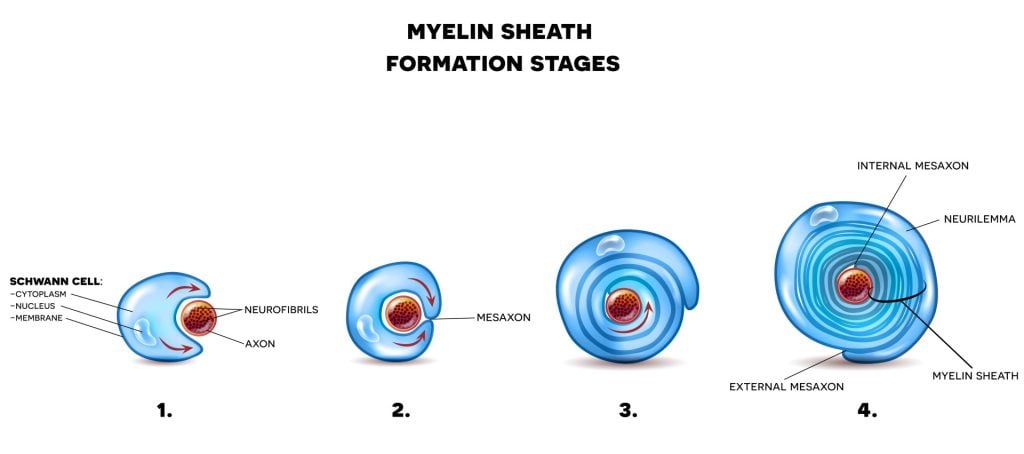
While Schwann cells can only myelinate one axon segment at a time, oligodendrocytes can simultaneously myelinate multiple axon segments through their star-shaped structure.
The resulting sheath isn’t continuous along the axon; instead, it has small gaps called nodes of Ranvier that occur every 0.2 to 2 millimeters along its length.When axons lack this myelin covering, they are considered “unmyelinated” and conduct electrical signals more slowly than their myelinated counterparts.
The resulting sheath isn’t continuous along the axon; instead, it has small gaps called nodes of Ranvier that occur every 0.2 to 2 millimeters along its length.
When axons lack this myelin covering, they are considered “unmyelinated” and conduct electrical signals more slowly than their myelinated counterparts.

Development Throughout Life
Early Childhood (Ages 5-7)
Young Adulthood (20s-30s)
Middle Age
Damage
When the myelin sheath is damaged or doesn’t form properly, it disrupts the normal flow of electrical signals along nerve cells.
This can happen due to various causes including infections, injuries, or autoimmune conditions where the body’s immune system mistakenly attacks the myelin.
The most well-known condition affecting myelin is Multiple Sclerosis (MS), where damage to the myelin in the central nervous system leads to communication problems between the brain and the rest of the body.
When myelin is damaged or destroyed (a process called demyelination), it can cause a range of symptoms:
Most conditions affecting myelin can be managed with medical treatment, though the specific approach depends on the underlying cause. While damage to myelin can be serious, the body does have some ability to repair and rebuild myelin, particularly in the early stages of damage.

References
Fields, R. D. (2008). White matter in learning, cognition and psychiatric disorders.Trends in neurosciences,31(7), 361-370.
Fünfschilling, Ursula, Lotti M. Supplie, Don Mahad, Susann Boretius, Aiman S. Saab, Julia Edgar, Bastian G. Brinkmann et al. “Glycolytic oligodendrocytes maintain myelin and long-term axonal integrity.”Nature485, no. 7399 (2012): 517-521.
Huxley, A. F., & Stämpfli, R. (1949). Evidence for saltatory conduction in peripheral myelinated nerve fibres.The Journal of physiology,108(3), 315.
Moore, S., Meschkat, M., Ruhwedel, T., Trevisiol, A., Tzvetanova, I. D., Battefeld, A., Kusch, K., Kole, M. H. P., Strenzke, N., Möbius, W., de Hoz, L. & Nave, K. A. (2020). A role of oligodendrocytes in information processing.Nature communications, 11(1), 1-15.
Kirkwood, C. (2015, March 24).Myelin: An Overview. Brain Facts. https://www.brainfacts.org/brain-anatomy-and-function/anatomy/2015/myelin
Ratini, M. (2019, August 7).What Is a Myelin Sheath?WebMD. https://www.webmd.com/multiple-sclerosis/myelin-sheath-facts
Osika, A. (2020, October 29).The myelin sheath and myelination. Kenhub. https://www.kenhub.com/en/library/anatomy/the-myelin-sheath-and-myelination
Stadelmann, C., Timmler, S., Barrantes-Freer, A., & Simons, M. (2019). Myelin in the central nervous system: structure, function, and pathology.Physiological reviews,99(3), 1381-1431.


Saul McLeod, PhD
BSc (Hons) Psychology, MRes, PhD, University of Manchester
Saul McLeod, PhD., is a qualified psychology teacher with over 18 years of experience in further and higher education. He has been published in peer-reviewed journals, including the Journal of Clinical Psychology.
Olivia Guy-Evans, MSc
BSc (Hons) Psychology, MSc Psychology of Education
Olivia Guy-Evans is a writer and associate editor for Simply Psychology. She has previously worked in healthcare and educational sectors.
