On This Page:ToggleStanley Cohen’s TheoryCharacteristicsSocial ActorsExamplesSummary
On This Page:Toggle
On This Page:
Moral panic is a widespread fear and often an irrational threat to society’s values, interests, and safety.
Key Takeaways
The criminological and sociological concept known as moral panic offers valuable insight into why and how powerful social agents like the media create public concern.
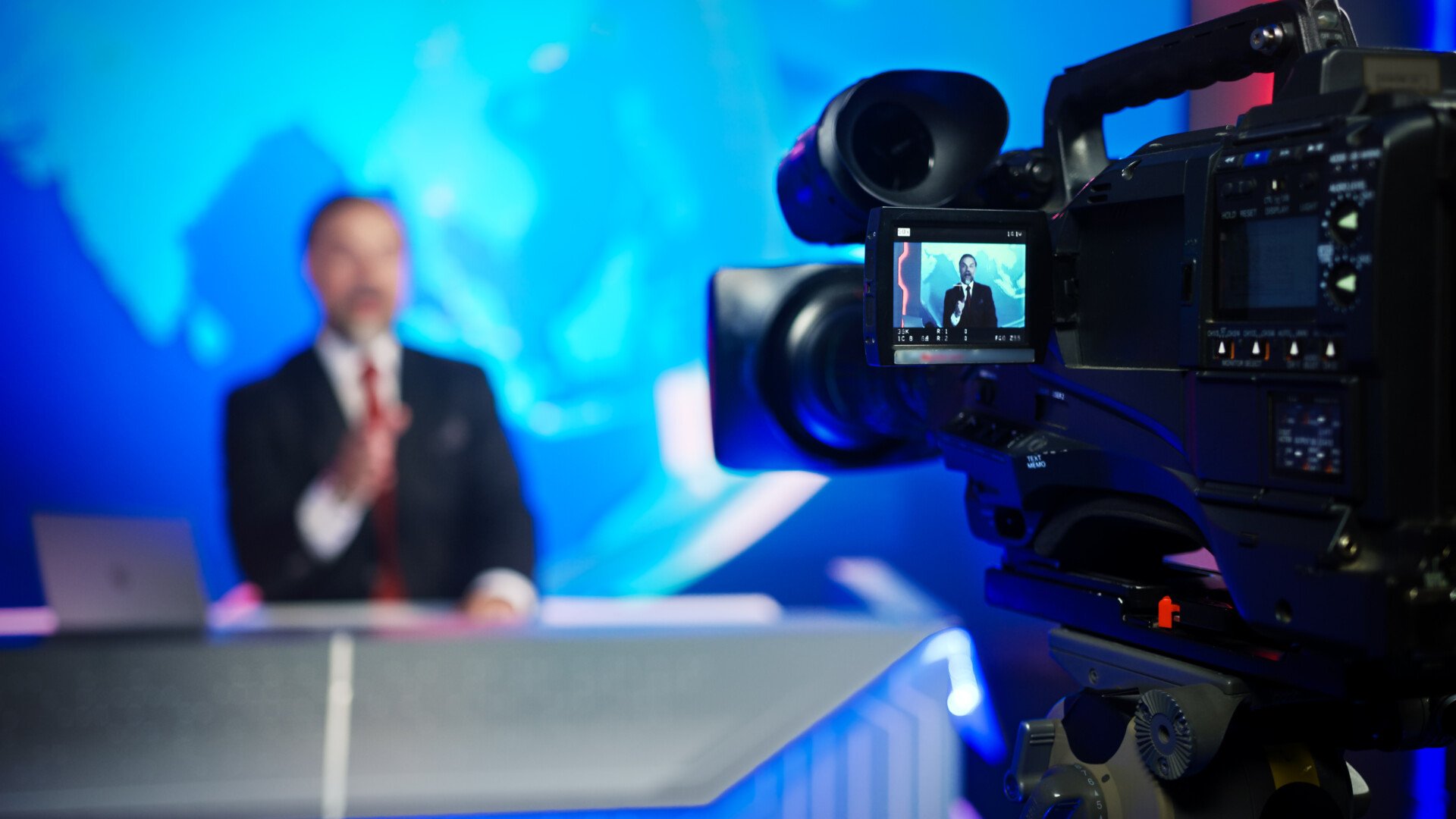 Professional TV Camera Standing in Live News Studio with Anchor seen in Small Display. Unfocused TV Broadcasting Channel with Presenter, Newscaster Talking. Mock-up Television Channel Newsroom Set
Stanley Cohen’s Theory
He developed and popularized the term and stated that moral panic occurs when “a condition, episode, person or group of persons emerges to become defined as a threat to societal values and interests.” (Cohen, 1972, p. 1).
He clarified that while the issues addressed and identified were real, the claims made exaggerated the harm’s seriousness or inevitability.
Both groups were the first two youth subcultures in consumer society and were mainly concerned with style, music, and having fun.
To summarize what happened, one holiday weekend, both the mods and rockers had a party where minor acts of vandalism occurred between the groups.
This led to the news media arriving at the next party involving the mods and rockers, ready to report any disturbances. Once again, minor vandalism happened, and the media published highly exaggerated reports of the extent of violence between the two groups.
Since its development, the moral panic concept has been applied to many social problems, including youth gangs and school violence.
Characteristics of Moral Panic
Central to the moral panic concept, there is an argument that public fear or concern over a social problem is mutually beneficial to state officials, law enforcement authorities, politicians, and the news media.
There is an apparent symbiotic relationship between the news media and state officials in that law enforcement and politicians need communication channels to distribute their stories and rhetoric, and the media is constantly looking for compelling news content to attract a big audience, also attracting advertisers.
Therefore, moral panics arise when exaggerated and distorted mass media campaigns are used to create fear, reinforce stereotypes, and add tension to preexisting divisions based on race/ethnicity and social class.
Let’s go over the three distinguishing characteristics moral panics have:
Social Actors of Moral Panic
Folk DevilsAs we previously touched upon, in the lexicon of moral panic scholars, folk devils are individuals who are socially alleged or defined to be responsible for bringing a threat to society.Unlike other malicious characters, folk devils are entirely evil and are stripped from anything positive or anything that could possibly contribute to their likeability. They are simply the embodiment of a “bad guy” and are deemed the antagonists in a moral panic drama.
Folk Devils
As we previously touched upon, in the lexicon of moral panic scholars, folk devils are individuals who are socially alleged or defined to be responsible for bringing a threat to society.Unlike other malicious characters, folk devils are entirely evil and are stripped from anything positive or anything that could possibly contribute to their likeability. They are simply the embodiment of a “bad guy” and are deemed the antagonists in a moral panic drama.
As we previously touched upon, in the lexicon of moral panic scholars, folk devils are individuals who are socially alleged or defined to be responsible for bringing a threat to society.
Unlike other malicious characters, folk devils are entirely evil and are stripped from anything positive or anything that could possibly contribute to their likeability. They are simply the embodiment of a “bad guy” and are deemed the antagonists in a moral panic drama.
Rule or Law Enforcers
The police, prosecutors, or the military are crucial to a moral panic as they are deemed to enforce and uphold the codes of conduct and the official laws of the country or state.
These agents of the government are expected to detect, apprehend, and punish the so-called folk devils. Law enforcers have a strong obligation as they have sworn duty and moral responsibility to protect society from folk devils when they are present.
The Media
As we know, the media is compelling in the creation and continuity of a moral panic. Usually, news media coverage of particular events involving labeled folk devils is greatly exaggerated or distorted.
Moreover, two critical media practices contribute to moral panic, which include priming and framing. Priming is when exposure to one stimulus impacts how a person responds to a subsequent, relevant stimulus. Framing refers to how an issue is given to the public or the specific angle in which the media presents it.
It involves calling attention to certain aspects of a problem while ignoring or obscuring other elements. In other words, framing gives perspective meaning to an issue.
Priming, on the other hand, is a psychological process where the news emphasizes a specific issue to increase the salience of the matter publicly and activate previously acquired information about the case from people’s memories.
The priming technique explains how the news frame is used in a certain story to trigger an individual’s subconscious and preexisting attitudes, prejudices, and beliefs regarding the presented issue.
Politicians
Again, politicians are vital actors in the moral panic drama. As elected officials operate in the stage of public opinion, they must present themselves as the protectors or heroes of the moral high ground in society.
Hand in hand with law enforcers, politicians have a sworn duty and moral obligation to protect the community from alleged folk devils if and when they arise.
An example would be PresidentRonald Reaganin the late 1980s, where he defined the folk devils as cocaine dealers and precipitated a moral panic over the evils of crack cocaine and the alleged threats of the present sins.
The Public
There is no doubt that the public is the most crucial factor in the creation of moral panic. Public agitation, concern, and anxiety over the identified folk devils is the key element of moral panic.
Moreover, the success of politicians, the media, and law enforcers in accelerating and maintaining a moral panic is ultimately contingent upon how successfully they arouse and fuel concern, outrage, and anxiety toward the folk devils among the public.
Examples of Moral Panics
During 2020 we all experienced a situation where public fears greatly exceeded the threat that was posed to society – the COVID-19 pandemic.
Since the virus, illness, and spread happened so suddenly, the information from the experts was not disseminated fast enough to reach the community at the right time.
And because of this lack of knowledge and abundance of misinformation, there were exaggerated media headlines that fueled the health-related fears and phobias circulating around, still today.
This public fear, and those responsible for creating and promoting it, is an important topic of discussion, especially amidst the pandemic.

Another aspect of moral panic can be centered around marginalized people in society due to race or ethnicity, sexuality, nationality, class, or religion (e.g., the LGBT+ community.)
Therefore, moral panic can draw on known stereotypes and reinforce them while exacerbating the actual and perceived divisions and differences between communities and people.
Moral panic is recognized in the sociology of deviance and crime as well as being related to the labeling theory of deviance.
Technology Moral Panics

Summary
To summarize the moral panic, let’s skim through the stages again:
References
Cannon, W. B. (1915).Bodily changes in pain, hunger, fear, and rage.New York: Appleton-Century-Crofts.
Schauer, M., & Elbert, T. (2010). Dissociation following traumatic stress.Journal of Psychology,218, 109-127.
What Happens During Fight or Flight Response. (2019, December 09). Retrieved from https://health.clevelandclinic.org/what-happens-to-your-body-during-the-fight-or-flight-response/
Further ReadingDavid, M., Rohloff, A., Petley, J., & Hughes, J. (2011). The idea of moral panic–ten dimensions of dispute.Crime, Media, Culture, 7(3), 215-228.Folk Devils and Moral Panics – CohenMoral Panic – COVID-19
Further Reading
David, M., Rohloff, A., Petley, J., & Hughes, J. (2011). The idea of moral panic–ten dimensions of dispute.Crime, Media, Culture, 7(3), 215-228.Folk Devils and Moral Panics – CohenMoral Panic – COVID-19
David, M., Rohloff, A., Petley, J., & Hughes, J. (2011). The idea of moral panic–ten dimensions of dispute.Crime, Media, Culture, 7(3), 215-228.
Folk Devils and Moral Panics – Cohen
Moral Panic – COVID-19

Saul McLeod, PhD
BSc (Hons) Psychology, MRes, PhD, University of Manchester
Saul McLeod, PhD., is a qualified psychology teacher with over 18 years of experience in further and higher education. He has been published in peer-reviewed journals, including the Journal of Clinical Psychology.
Olivia Guy-Evans, MSc
BSc (Hons) Psychology, MSc Psychology of Education
Olivia Guy-Evans is a writer and associate editor for Simply Psychology. She has previously worked in healthcare and educational sectors.
Mia Belle Frothingham
BA with minors in Psychology and Biology, MRes University of Edinburgh
Mia Belle Frothingham is a Harvard University graduate with a Bachelor of Arts in Sciences with minors in biology and psychology
