On This Page:ToggleEffectivenessMindfulness PracticesIncorporating MindfulnessLimitations
On This Page:Toggle
On This Page:
Mindfulnessmeditation trains attention control and emotion regulation – areas of deficit in ADHD. Regular practice shows promise for reducing inattentive symptoms and impulsivity. Though more evidence is still needed, this affordable, accessible therapy empowers individuals with ADHD to improve their own functioning.
Core symptoms like difficulty sustaining attention, distractibility, restlessness, and acting without thinking can significantly impact school, work, relationships, and more.
Mindfulness refers to purposefully paying attention to the present moment with curiosity, openness, and acceptance. Through mindful meditation, individuals learn to observe thoughts and sensations without judgment, which research shows strengthens attention networks in the brain.
 An illustration of a woman sat cross-legged doing breath work and sat in nature, completing a mindfulness practice
By training present-moment awareness, mindfulness enables people to focus better, think before acting, and manage unhelpful impulses. Because of this, it is possible that mindfulness could be a useful method formanaging the key symptoms of ADHD.
Although more research is still needed, mindfulness shows early promise as an accessible, low-risk supplemental treatment that empowers people with ADHD to improve their own functioning through awareness training. This article explores the science behind using mindfulness strategies to mitigate ADHD symptoms.
Is Mindfulness Effective For ADHD?
Research suggests that mindfulness interventions may help reduce some symptoms of ADHD, especially problems with inattention. Multiple studies have found that mindfulness meditation can lead to improved attention and concentrationin both childrenandadults with ADHD.
For example,one meta-analysisshowed a moderate-to-large effect size for reductions in parent- and teacher-rated inattentive symptoms following mindfulness programs for children with ADHD.
Research in adultshas also indicated that mindfulness may decrease self- and clinician-rated symptoms of inattention.
There is less consistent evidence regarding the effects of mindfulness on hyperactivity and impulsivity. Whilesome studieshave found reductions in hyperactive/impulsive symptoms as well,othershave only seen significant improvements in the inattentive domain. This aligns withfindings thatmindfulness specifically targets attention networks in the brain.
Beyond core ADHD symptoms, mindfulness interventions may also positively impactexecutive functioning,like inhibition, working memory, and cognitive flexibility.
Preliminary research showsparticipants report some improvements in these areas of self-regulation. However, more objective neuropsychological measures havehad mixed results, indicating a need for further study.
Research suggests mindfulness could additionally help reduce commonly co-occurring difficulties for people with ADHD, like anxiety and depression.
Multiple trialsdemonstrate decreased depressive symptoms, andone meta-analysisconfirmed this effect specifically in adults.
Mindfulness Practices That Could Help Someone With ADHD
Below are some common mindfulness techniques:
Body Scans
Body scans involve systematically focusing your attention on different parts of your body. Typically, you would start at your toes and slowly move your attention up through your legs, hips, back, arms, shoulders, neck, and face.
As you focus on each body part, notice any sensations you feel there without judging them. If your mind wanders, gently return your focus. Body scans increase bodily awareness and attention regulation.
Grounding
Grounding techniques quickly shift your attention from thoughts back to sensory perceptions. For example, you could name and focus on things you see, hear, and physically feel during an activity.
 grounding techniques
Focused Attention Meditation
This involves concentrating your attention exclusively on one thing like your breathing. Sit comfortably and breathe naturally. Focus all your attention on the physical sensations of each inhale and exhale.
When inevitable thoughts arise, note them briefly and return to your breath. This builds attentional control capacity over time.
Open Monitoring Meditation
Rather than fixating on any one thing, open monitoring involves letting your attention rest in a relaxed, open state. Sit quietly and let your attention expansively observe anything arising without focusing on any particular sensations, thoughts, or feelings.
Walking Meditation
This mindful movement practice involves focusing closely on the physical sensations and rhythm of walking.
Walk at a natural pace, but shift your awareness acutely onto your feet touching the ground, muscles contracting, etc. If thoughts intrude, return to sensing the walk.
How to Incorporate Mindfulness into Your Life
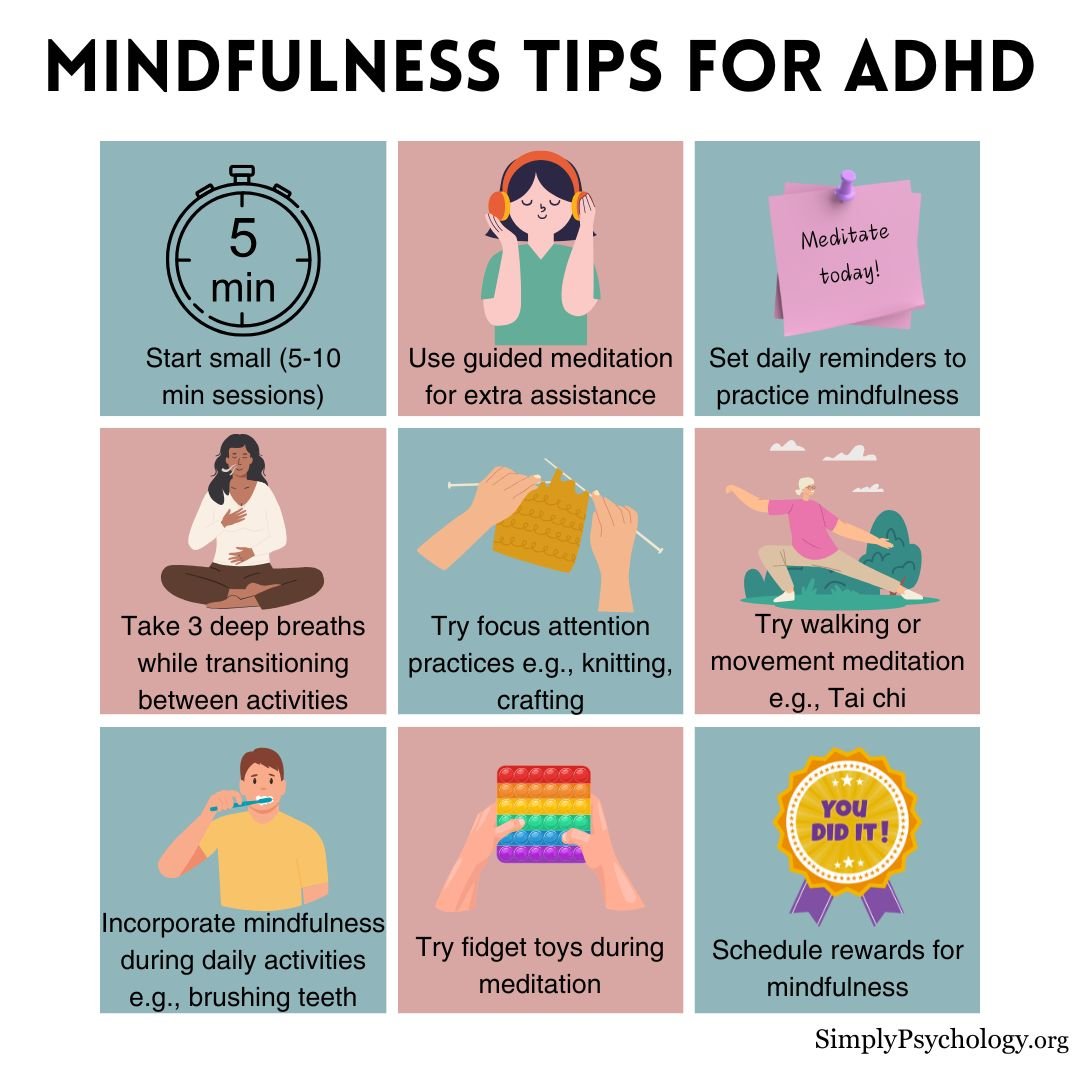
If you are unsure where to start when it comes to using mindfulness techniques, below are some ways to incorporate this practice into your life:
Establish a Regular Mindfulness Practice
Practice Mindful Awareness Throughout the Day
Use Mindfulness for Emotion Regulation
Use a Technique That Works for You
Be Patient with Yourself
If mindfulness meditation increases anxiety or depression, it may not be advisable. Pay attention to whether you feel better after practicing. The key is finding what works for you and being patient and compassionate with yourself.
Some ways in which to incorporate mindfulness practice into your life if you have ADHD.

Limitations of Mindfulness for ADHD
Despite evidence that mindfulness can be beneficial for people with ADHD, it may not be the best management method for several reasons, as discussed below:
References
Cairncross, M., & Miller, C. J. (2020). The effectiveness of mindfulness-based therapies for ADHD: a meta-analytic review.Journal of attention disorders,24(5), 627-643.
Evans, S., Ling, M., Hill, B., Rinehart, N., Austin, D., & Sciberras, E. (2018). Systematic review of meditation-based interventions for children with ADHD.European Child & Adolescent Psychiatry,27, 9-27.
Hepark, S., Janssen, L., de Vries, A., Schoenberg, P. L., Donders, R., Kan, C. C., & Speckens, A. E. (2019). The efficacy of adapted MBCT on core symptoms and executive functioning in adults with ADHD: a preliminary randomized controlled trial.Journal of Attention Disorders,23(4), 351-362.
Janssen, L., Kan, C. C., Carpentier, P. J., Sizoo, B., Hepark, S., Schellekens, M. P. J., & Speckens, A. E. M. (2018). Mindfulness-based cognitive therapy v. treatment as usual in adults with ADHD: A multicentre, single-blind, randomised controlled trial. Psychological Medicine, 49(1), 55–65.https://doi.org/10.1017/S0033291718000429
López-Pinar, C., Martínez-Sanchís, S., Carbonell-Vayá, E., Sánchez-Meca, J., & Fenollar-Cortés, J. (2020). Efficacy of nonpharmacological treatments on comorbid internalizing symptoms of adults with attention-deficit/hyperactivity disorder: A meta-analytic review.Journal of Attention Disorders,24(3), 456-478.
Lutz, A., Slagter, H. A., Rawlings, N. B., Francis, A. D., Greischar, L. L., & Davidson, R. J. (2009). Mental training enhances attentional stability: neural and behavioral evidence.Journal of Neuroscience,29(42), 13418-13427.
Mak, C., Whittingham, K., Cunnington, R., & Boyd, R. N. (2018). Efficacy of mindfulness-based interventions for attention and executive function in children and adolescents—A systematic review.Mindfulness,9, 59-78.
Poissant, H., Mendrek, A., Talbot, N., Khoury, B., & Nolan, J. (2019). Behavioral and cognitive impacts of mindfulness-based interventions on adults with attention-deficit hyperactivity disorder: A systematic review.Behavioural neurology,2019.
Ramsay, J. R. (2021). Adult attention-deficit/hyperactivity disorder. In A. Wenzel (Ed.),Handbook of cognitive behavioral therapy: Applications(pp. 389–421). American Psychological Association.https://doi.org/10.1037/0000219-012
Ramsay, J. R. (2020). Cognitive interventions adapted to adult ADHD. In J. R. Ramsay,Rethinking adult ADHD: Helping clients turn intentions into actions(pp. 63–85). American Psychological Association.https://doi.org/10.1037/0000158-005
Vekety, B., Logemann, H. A., & Takacs, Z. K. (2021). The effect of mindfulness-based interventions on inattentive and hyperactive–impulsive behavior in childhood: A meta-analysis.International Journal of Behavioral Development,45(2), 133-145.

Saul McLeod, PhD
BSc (Hons) Psychology, MRes, PhD, University of Manchester
Saul McLeod, PhD., is a qualified psychology teacher with over 18 years of experience in further and higher education. He has been published in peer-reviewed journals, including the Journal of Clinical Psychology.
Olivia Guy-Evans, MSc
BSc (Hons) Psychology, MSc Psychology of Education
Olivia Guy-Evans is a writer and associate editor for Simply Psychology. She has previously worked in healthcare and educational sectors.
