On This Page:ToggleExperiential Learning CycleLearning StylesEducational Implications
On This Page:Toggle
On This Page:
David Kolb published his learning styles model in 1984, from which he developed his learning style inventory.
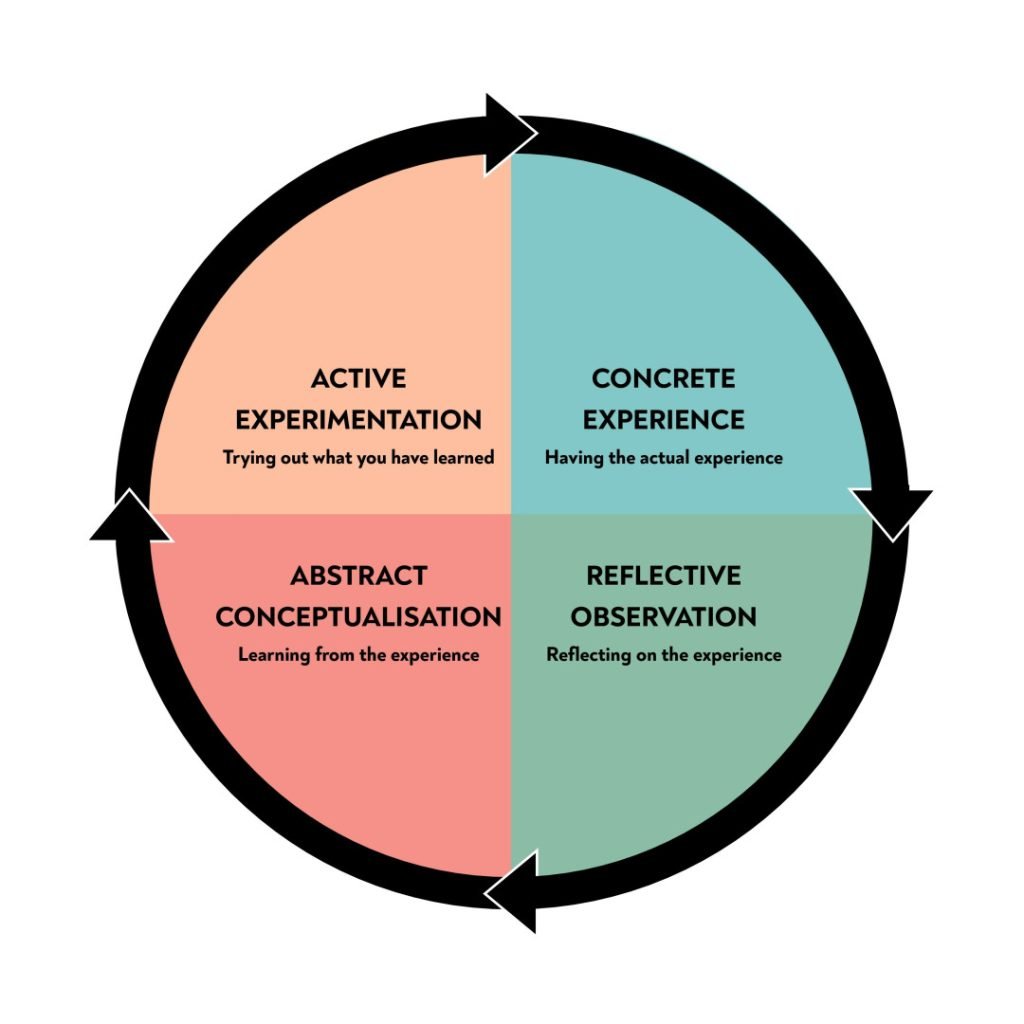
Kolb’s experiential learning theory works on two levels: a four-stage learning cycle and four separate learning styles. Much of Kolb’s theory concerns the learner’s internal cognitive processes.
The Experiential Learning Cycle
 learning cycle kolb
The terms “Reflective Cycle” and “Experiential Learning Cycle” are often used interchangeably when referring to this four-stage learning process. The main idea behind both terms is that effective learning occurs through a continuous cycle of experience, reflection, conceptualization, and experimentation.
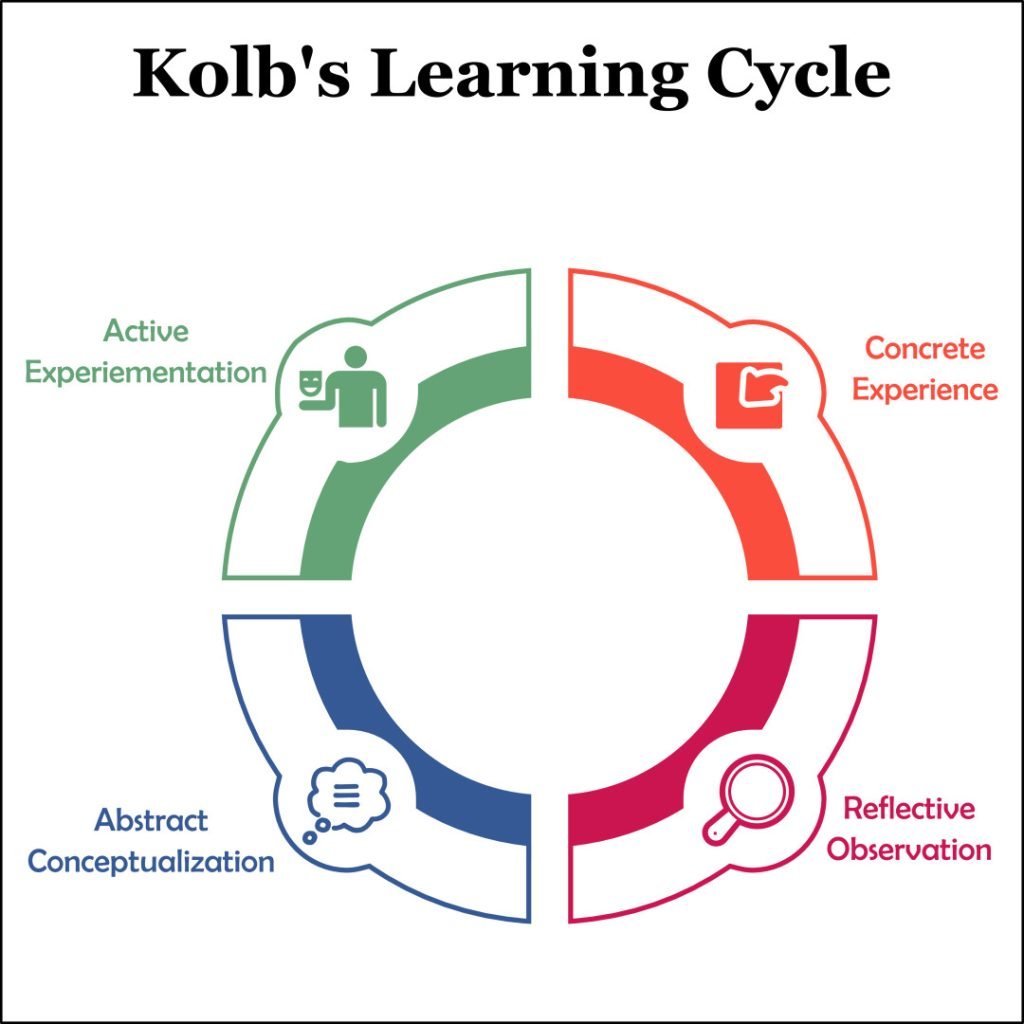
Kolb (1984) views learning as an integrated process, with each stage mutually supporting and feeding into the next. It is possible to enter the cycle at any stage and follow it through its logical sequence.
However, effective learning only occurs when a learner can execute all four stages of the model. Therefore, no one stage of the cycle is effective as a learning procedure on its own.
The process of going through the cycle results in the formation of increasingly complex and abstract ‘mental models’ of whatever the learner is learning about.
Learning Styles
Kolb’s learning theory (1984) sets out four distinct learning styles, which are based on a four-stage learning cycle (see above). Kolb explains that different people naturally prefer a certain single different learning style.
Various factors influence a person’s preferred style. For example, social environment, educational experiences, or the basic cognitive structure of the individual.
Whatever influences the choice of style, the learning style preference itself is actually the product of two pairs of variables, or two separate “choices” that we make, which Kolb presented as lines of an axis, each with “conflicting” modes at either end.
A typical presentation of Kolb’s two continuums is that the east-west axis is called the Processing Continuum (how we approach a task), and the north-south axis is called the Perception Continuum (our emotional response, or how we think or feel about it).
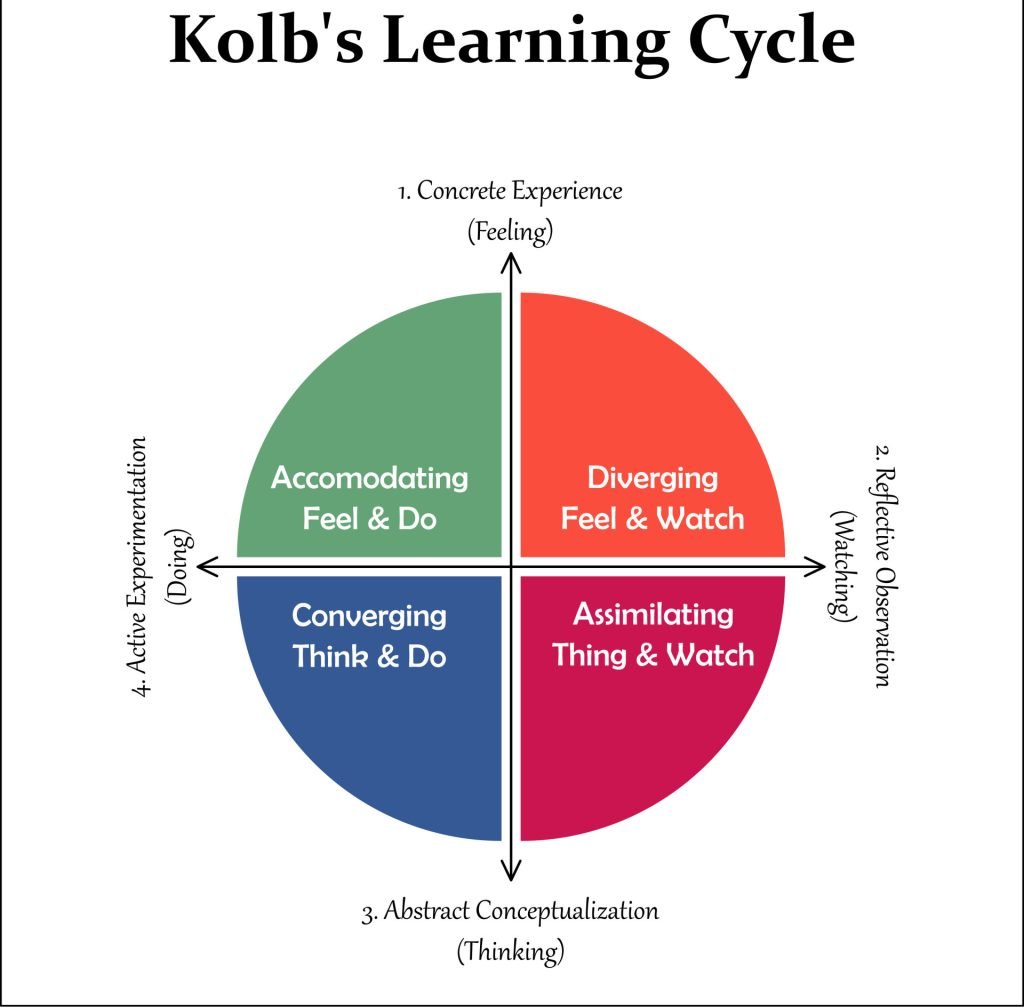
Kolb believed that we cannot perform both variables on a single axis simultaneously (e.g., think and feel). Our learning style is a product of these two choice decisions.
The matrix also highlights Kolb’s terminology for the four learning styles; diverging, assimilating, and converging, accommodating:
Knowing a person’s (and your own) learning style enables learning to be orientated according to the preferred method.
That said, everyone responds to and needs the stimulus of all types of learning styles to one extent or another – it’s a matter of using emphasis that fits best with the given situation and a person’s learning style preferences.

Here are brief descriptions of the four Kolb learning styles:
Diverging(feeling and watching – CE/RO)
These people are able to look at things from different perspectives. They are sensitive. They prefer to watch rather than do, tending to gather information and use imagination to solve problems. They are best at viewing concrete situations from several different viewpoints.
Kolb called this style “diverging” because these people perform better in situations that require ideas-generation, for example, brainstorming. People with a diverging learning style have broad cultural interests and like to gather information.
They are interested in people, tend to be imaginative and emotional, and tend to be strong in the arts. People with the diverging style prefer to work in groups, to listen with an open mind and to receive personal feedback.
Assimilating(watching and thinking – AC/RO)
The assimilating learning preference involves a concise, logical approach. Ideas and concepts are more important than people.
These people require good, clear explanations rather than a practical opportunity. They excel at understanding wide-ranging information and organizing it in a clear, logical format.
People with an assimilating learning style are less focused on people and more interested in ideas and abstract concepts. People with this style are more attracted to logically sound theories than approaches based on practical value.
This learning style is important for effectiveness in information and science careers. In formal learning situations, people with this style prefer readings, lectures, exploring analytical models, and having time to think things through.
Converging(doing and thinking – AC/AE)
People with a converging learning style can solve problems and will use their learning to find solutions to practical issues. They prefer technical tasks, and are less concerned with people and interpersonal aspects.
People with a converging learning style are more attracted to technical tasks and problems than social or interpersonal issues. A converging learning style enables specialist and technology abilities.
People with a converging style like to experiment with new ideas, to simulate, and to work with practical applications.
Accommodating(doing and feeling – CE/AE)
The Accommodating learning style is “hands-on,” and relies on intuition rather than logic. These people use other people’s analysis, and prefer to take a practical, experiential approach. They are attracted to new challenges and experiences, and to carrying out plans.
They commonly act on “gut” instinct rather than logical analysis. People with an accommodating learning style will tend to rely on others for information than carry out their own analysis. This learning style is prevalent within the general population.
Educational Implications

Educators should ensure that activities are designed and carried out in ways that offer each learner the chance to engage in the manner that suits them best.
Ideally, activities and material should be developed in ways that draw on abilities from each stage of the experiential learning cycle and take the students through the whole process in sequence.
References
Kolb, D. A. (1976).The Learning Style Inventory: Technical Manual. Boston, MA: McBer.
Kolb, D.A. (1981). Learning styles and disciplinary differences, in: A.W. Chickering (Ed.)The Modern American College(pp. 232–255). San Francisco, LA: Jossey-Bass.
Kolb, D. A. (1984).Experiential learning: Experience as the source of learning and development(Vol. 1). Englewood Cliffs, NJ: Prentice-Hall.
Kolb, D. A., & Fry, R. (1975). Toward an applied theory of experiential learning. In C. Cooper (Ed.),Studies of group process(pp. 33–57). New York: Wiley.
Kolb, D. A., Rubin, I. M., & McIntyre, J. M. (1984).Organizational psychology: readings on human behavior in organizations. Englewood Cliffs, NJ: Prentice-Hall.
Further Reading

Olivia Guy-Evans, MSc
BSc (Hons) Psychology, MSc Psychology of Education
Olivia Guy-Evans is a writer and associate editor for Simply Psychology. She has previously worked in healthcare and educational sectors.
Saul McLeod, PhD
BSc (Hons) Psychology, MRes, PhD, University of Manchester
Saul McLeod, PhD., is a qualified psychology teacher with over 18 years of experience in further and higher education. He has been published in peer-reviewed journals, including the Journal of Clinical Psychology.
