On This Page:ToggleMeaningCharacteristicsCognitive FunctionsHobbies & CareersWork EnvironmentsPersonal RelationshipsTips for Interacting With ISFJsTest
On This Page:Toggle
On This Page:
ISFJ Meaning
ISFJs rejuvenate through solitude and introspection (Introversion), favor concrete details and present realities over abstract ideas (Sensing), make decisions based on personal feelings and values rather than impersonal analysis (Feeling), and prefer structured environments and planning over spontaneity (Judging).
People with this personality type tend to be friendly, responsible, warm-hearted, and reserved.
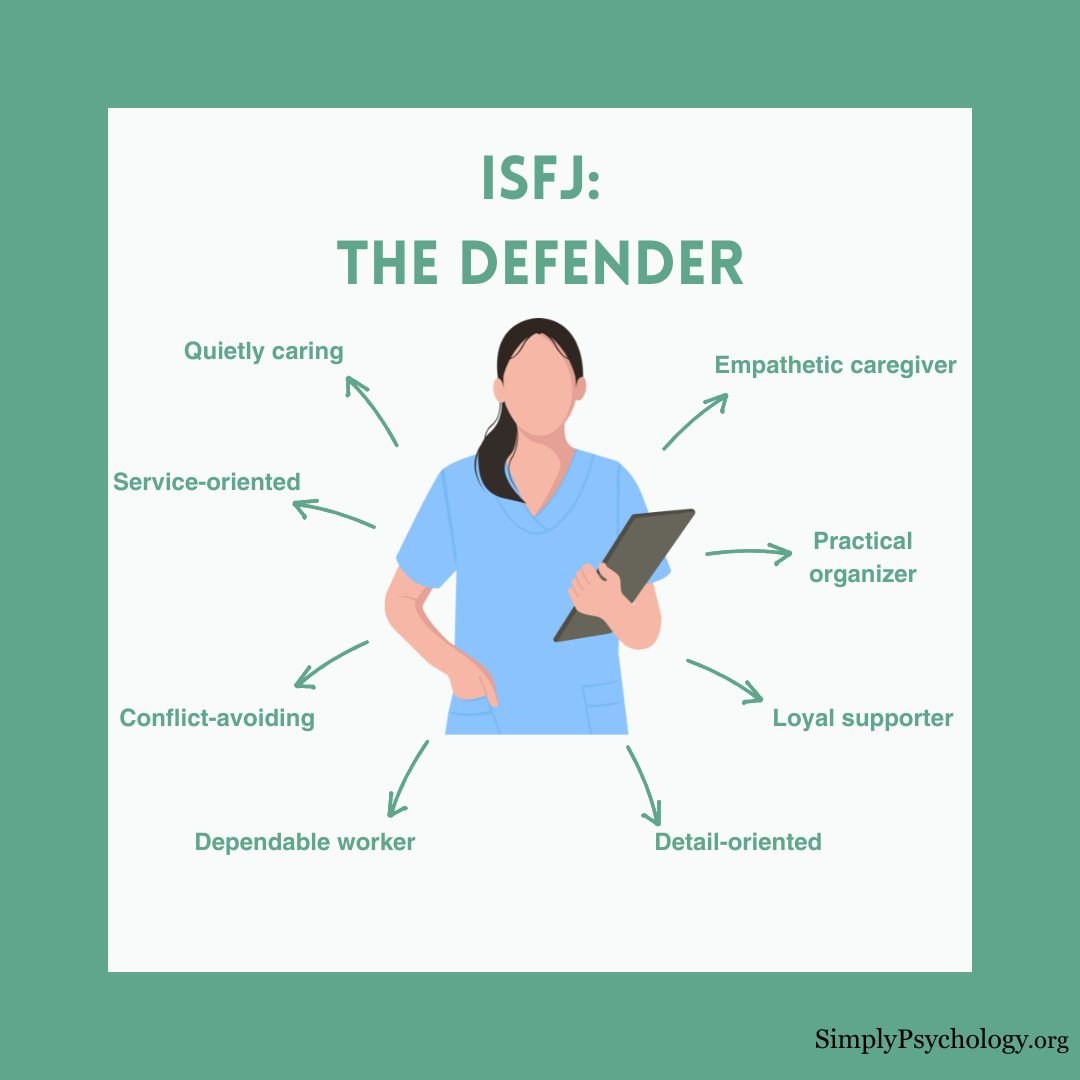
ISFJs are sometimes called “the Protector” or “the Defender.”ENTPis the opposite personality type of ISFJ.
Famous ISFJs include Mother Teresa, George H.W. Bush, Beyonce, Kate Middleton, Rosa Parks, and Vin Diesel.
ISFJ is the most common personality type in the U.S, and the most common personality type among women. ISFJs make up:
People with this personality type tend to be service and work-oriented, committed to meeting their obligations and duties and contributing to the established structures of society.
They are loyal and considerate and place a lot of focus on the care of others. They are non-confrontational and value an orderly and harmonious environment.
StrengthsWeaknessesPracticalSuppress their emotionsTrustworthyReservedOrganizedReluctant to changeCompassionateAvoids confrontation
ISFJ Characteristics
ISFJs are empathetic
ISFJs are traditional
ISFJs are creatures of habit
ISFJs are loyal
Cognitive Functions of an ISFJ
The MBTI suggests that the four different cognitive functions (thinking, feeling, intuition, and sensing) form a hierarchy where each function is either directed outwardly (extroverted) or inwardly (introverted). The order of these functions determines one’s personality.

The dominant function is the primary aspect of personality, while the auxiliary and tertiary functions play supportive roles.
Dominant: Introverted Sensing
Auxiliary: Extraverted Feeling
Tertiary: Introverted Thinking
Inferior: Extraverted Intuition
ISFJ Hobbies, Interests, and Careers
Because ISFJs are so attuned to the feelings of others, they thrive in jobs in mental health or the healthcare industry. They also appreciate order and structure, so they are suited for jobs that involve careful attention to detail and adherence to clear-cut procedures.
They are hardworking and have an unshakable work ethic. Because of these skills, ISFJs tend to succeed in management or administrative roles.
ISFJ personality types also appreciate workplaces that are collaborative and team-oriented so when in a management role, they will aim to build a cohesive and productive environment.
Examples of some popular ISFJ careers include social workers, office managers, teachers, childcare workers, or counselors. In their free time, ISFJs enjoy cooking, gardening, painting, walking, and watching movies.
ISFJ Work Environments
ISFJs are suited for work environments that have clear and established norms and traditions. They will best succeed in organizations that value hard work, attention to detail, and adherence to rules and protocols.
They also appreciate a team-focused environment with a harmonious and fair culture. However, they will struggle in environments that are noisy and distracting. ISFJs like working with tangible products or services rather than theoretical ones.
ISFJ personality types value a job with distinct responsibilities, deadlines, and structure and will feel insecure in positions that are ambiguous or carefree.
They do not like fast-paced, uncontrolled environments, as too much chaos will distract them from the task at hand.
ISFJ Personal Relationships
ISFJs are extremely caring and considerate of others. They tend to have a very close circle of friends and family who they value highly.
ISFJs can be reserved, and it can take them a while to feel comfortable enough to open up to someone new; however, once they form these closer relationships, they are able to act candidly and deepen their connections.
They are committed to supporting and caring for others and will invest a great deal of energy into maintaining strong friendships. They find happiness in helping those around them and will be there for their friends for the long term.
Because they tend to sacrifice their own needs for the desires of others without asking for anything in return, they are sometimes taken for granted.
Tips for Interacting With ISFJs
Friendships
ISFJs are surprisingly social for introverts. They are generous, supportive and selfless friends and partners.
They tend to be private and a bit protective of themselves, so asking them how they are doing and being willing to talk can help them to open up.
It can take them a while to feel comfortable around new people. However, they appreciate the opportunity to deepen their connections over time.
Relationships
As partners, ISFJs are faithful and devoted. They can struggle to express their emotions but tend to feel deeply and find ways to show their affection to their loved ones.
As the partner of an ISFJ, you should make sure to reciprocate their love and care. They give so much of themselves in their relationships so they can feel deeply hurt when their partner does not offer them the same love, commitment, and appreciation in return.
Parenting
As parents, ISFJs are nurturing. They are passionate about their role as a parent and see it as their duty to provide children with a stable and comfortable home life.
They are loving authority figures, imparting structure and order while also offering an abundance of love and support.
Test
Answer these questions to find out if ISFJ might be your personality type:
If you answer “yes” to most of these questions, you may have ISFJ personality traits. However, remember that personality is complex, and a professional assessment would be needed for a definitive personality type determination.
Sources
King, S. P., & Mason, B. A. (2020). Myers‐Briggs Type Indicator. The Wiley Encyclopedia of Personality and Individual Differences: Measurement and Assessment, 315-319.
Myers, I. B. (1962). The Myers-Briggs Type Indicator: Manual (1962).
Myers-Briggs Type Indicator. (2019, May 28). New World Encyclopedia, . Retrieved from https://www.newworldencyclopedia.org/p/index.php?title=Myers-Briggs_Type_Indicator&oldid=1020015.
Myers, Isabel B.; Myers, Peter B. (1995) [1980]. Gifts Differing: Understanding Personality Type. Mountain View, CA: Davies-Black Publishing. ISBN 978-0-89106-074-1.
Pittenger, D. J. (2005).Cautionary Comments Regarding the Myers-Briggs Type Indicator. Consulting Psychology Journal: Practice and Research, 57(3), 210-221.
The purpose of the Myers-Briggs Type Indicator®. The Myers & Briggs Foundation: MBTI Basics. (n.d.). Retrieved from https://www.myersbriggs.org/my-mbti-personality-type/mbti-basics/
 defender personality

Saul McLeod, PhD
BSc (Hons) Psychology, MRes, PhD, University of Manchester
Saul McLeod, PhD., is a qualified psychology teacher with over 18 years of experience in further and higher education. He has been published in peer-reviewed journals, including the Journal of Clinical Psychology.
Julia Simkus
BA (Hons) Psychology, Princeton University
Julia Simkus is a graduate of Princeton University with a Bachelor of Arts in Psychology. She is currently studying for a Master’s Degree in Counseling for Mental Health and Wellness in September 2023. Julia’s research has been published in peer reviewed journals.
