On This Page:ToggleProperties of normal distributionNormal distribution Vs. Standard normal distribution?Why is the normal distribution important?What is the empirical rule formula?How to check data
On This Page:Toggle
On This Page:
A bell-shaped curve, also known as a normal distribution or Gaussian distribution, is a symmetrical probability distribution in statistics. It represents a graph where the data clusters around the mean, with the highest frequency in the center, and decreases gradually towards the tails.

Properties of normal distribution
The normal distribution is a continuous probability distribution that is symmetrical on both sides of the mean, so the right side of the center is a mirror image of the left side.
The area under the normal distribution curve represents the probability and the total area under the curve sums to one.
Most of the continuous data values in a normal distribution tend to cluster around the mean, and the further a value is from the mean, the less likely it is to occur. The tails are asymptotic, which means that they approach but never quite meet the horizon (i.e., the x-axis).

The normal distribution is often called the bell curve because the graph of its probability density looks like a bell. It is also known as called Gaussian distribution, after the German mathematician Carl Gauss who first described it.
Normal distribution Vs. Standard normal distribution?
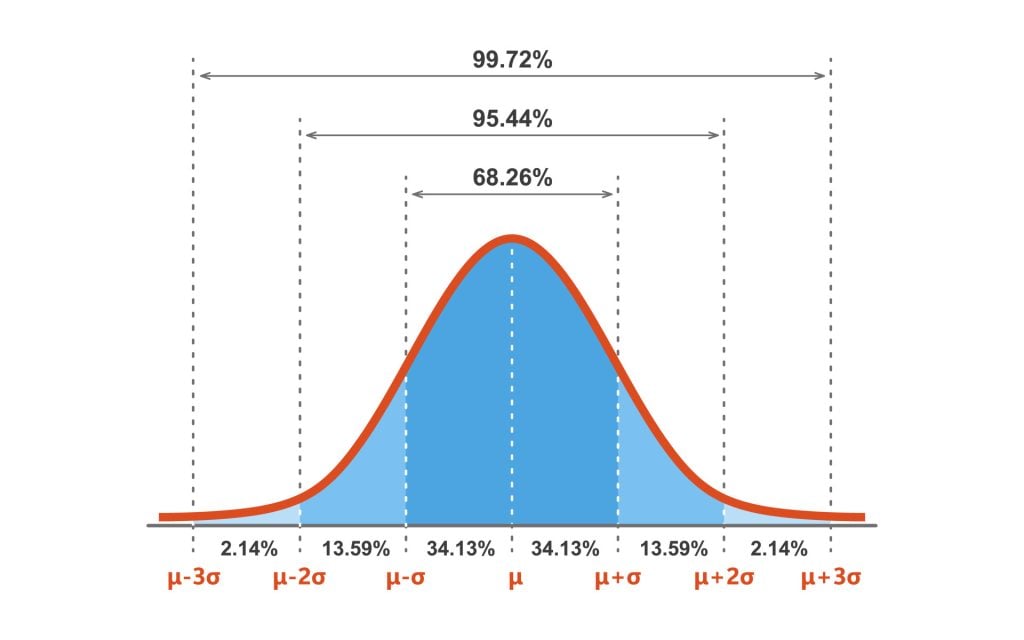
Figure 1.A standard normal distribution (SND).
This is the distribution that is used to constructtables of the normal distribution.
Why is the normal distribution important?
The bell-shaped curve is a common feature of nature and psychologyThe normal distribution is the most important probability distribution in statistics because many continuous data in nature and psychology display this bell-shaped curve when compiled and graphed.For example, if we randomly sampled 100 individuals, we would expect to see a normal distribution frequency curve for many continuous variables, such as IQ, height, weight, and blood pressure.
The bell-shaped curve is a common feature of nature and psychology
The normal distribution is the most important probability distribution in statistics because many continuous data in nature and psychology display this bell-shaped curve when compiled and graphed.For example, if we randomly sampled 100 individuals, we would expect to see a normal distribution frequency curve for many continuous variables, such as IQ, height, weight, and blood pressure.
The normal distribution is the most important probability distribution in statistics because many continuous data in nature and psychology display this bell-shaped curve when compiled and graphed.
For example, if we randomly sampled 100 individuals, we would expect to see a normal distribution frequency curve for many continuous variables, such as IQ, height, weight, and blood pressure.
Parametric significance tests require a normal distribution of the sample’s data pointsThe most powerful (parametric) statistical tests psychologists use require data to be normally distributed. If the data does not resemble a bell curve, researchers may use a less powerful statistical test called non-parametric statistics.
Parametric significance tests require a normal distribution of the sample’s data points
The most powerful (parametric) statistical tests psychologists use require data to be normally distributed. If the data does not resemble a bell curve, researchers may use a less powerful statistical test called non-parametric statistics.
Converting the raw scores of a normal distribution to z-scores
This procedure allows researchers to determine the proportion of the values that fall within a specified number of standard deviations from the mean (i.e., calculate the empirical rule).
What is the empirical rule formula?
The empirical rule in statistics allows researchers to determine the proportion of values that fall within certain distances from the mean. The empirical rule is often referred to as the three-sigma rule or the 68-95-99.7 rule.

If the data values in a normal distribution are converted tostandard score(z-score) in a standard normal distribution, the empirical rule describes the percentage of the data that fall within specific numbers of standard deviations (σ) from the mean (μ) for bell-shaped curves.
The empirical rule allows researchers to calculate the probability of randomly obtaining a score from a normal distribution.
68% of data falls within the first standard deviation from the mean. This means there is a 68% probability of randomly selecting a score between -1 and +1 standard deviations from the mean.

95% of the values fall within two standard deviations from the mean. This means there is a 95% probability of randomly selecting a score between -2 and +2 standard deviations from the mean.

99.7% of data will fall within three standard deviations from the mean. This means there is a 99.7% probability of randomly selecting a score between -3 and +3 standard deviations from the mean.

How to check data
It is also advisable to use a frequency graph too, so you can check the visual shape of your data (If your chart is a histogram, you can add a distribution curve using SPSS: From the menus, choose: Elements > Show Distribution Curve).

Normal distributions become more apparent (i.e., perfect) the finer the level of measurement and the larger the sample from a population.
You can also calculate coefficients which tell us about the size of the distribution tails in relation to the bump in the middle of the bell curve. For example, Kolmogorov Smirnov and Shapiro-Wilk tests can be calculated using SPSS.
These tests compare your data to a normal distribution and provide a p-value, which, if significant (p < .05), indicates your data is different from a normal distribution (thus, on this occasion, we do not want a significant result and need ap-value higher than 0.05).

Further InformationDeep Definition of the Normal Distribution (Kahn Academy)Standard Normal Distribution and the Empirical Rule (Kahn Academy)Statistics for Psychology Book Download
Further Information
Deep Definition of the Normal Distribution (Kahn Academy)Standard Normal Distribution and the Empirical Rule (Kahn Academy)Statistics for Psychology Book Download
Is a normal distribution kurtosis 0 or 3?A normal distribution has akurtosisof 3. However, sometimes people use “excess kurtosis,” which subtracts 3 from the kurtosis of the distribution to compare it to a normal distribution.In that case, the excess kurtosis of a normal distribution would be be 3 − 3 = 0.So, the normal distribution has kurtosis of 3, but its excess kurtosis is 0.
Is a normal distribution kurtosis 0 or 3?
A normal distribution has akurtosisof 3. However, sometimes people use “excess kurtosis,” which subtracts 3 from the kurtosis of the distribution to compare it to a normal distribution.In that case, the excess kurtosis of a normal distribution would be be 3 − 3 = 0.So, the normal distribution has kurtosis of 3, but its excess kurtosis is 0.
A normal distribution has akurtosisof 3. However, sometimes people use “excess kurtosis,” which subtracts 3 from the kurtosis of the distribution to compare it to a normal distribution.
In that case, the excess kurtosis of a normal distribution would be be 3 − 3 = 0.
So, the normal distribution has kurtosis of 3, but its excess kurtosis is 0.

Olivia Guy-Evans, MSc
BSc (Hons) Psychology, MSc Psychology of Education
Olivia Guy-Evans is a writer and associate editor for Simply Psychology. She has previously worked in healthcare and educational sectors.
Saul McLeod, PhD
BSc (Hons) Psychology, MRes, PhD, University of Manchester
Saul McLeod, PhD., is a qualified psychology teacher with over 18 years of experience in further and higher education. He has been published in peer-reviewed journals, including the Journal of Clinical Psychology.
