On This Page:ToggleMeaningCharacteristicsCognitive Functions of an INTJINTJ Hobbies, Interests, and CareersINTJ Work EnvironmentsINTJ Personal RelationshipsTips for Interacting With INTJsTest
On This Page:Toggle
On This Page:
INTJ Meaning
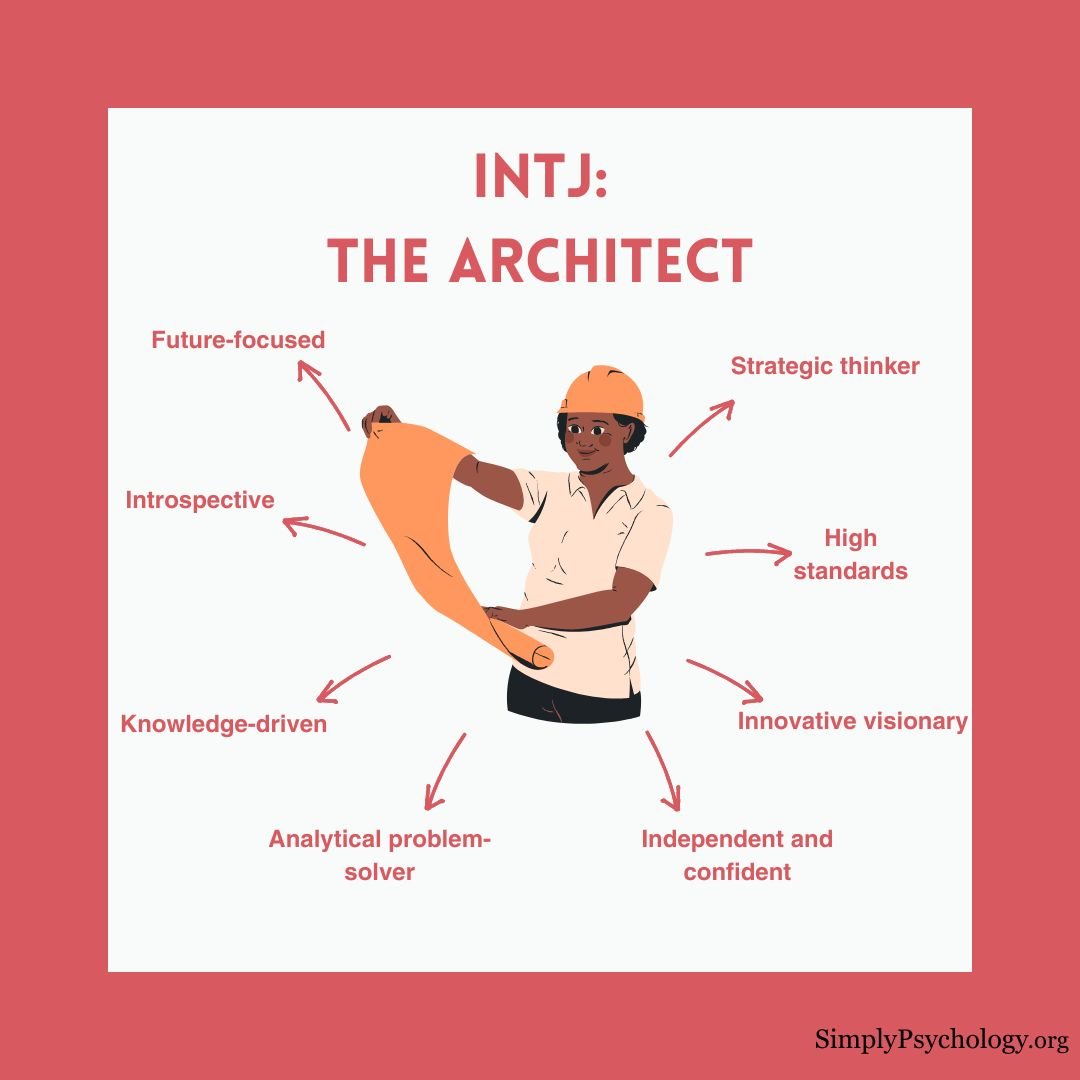
INTJs derive energy from solitary thought and introspection (Introversion), lean towards abstract concepts and future scenarios over immediate facts (Intuition), base their decisions on logical reasoning rather than emotional considerations (Thinking), and prefer planning and structure over spontaneous flexibility (Judging).People with the INTJ personality type tend to be highly independent, confident, and self-sufficient individuals. They are analytical, creative, and driven.INTJs are sometimes referred to as “the Architect” or “the Scientist,” “the Strategist,” or “the Mastermind.”ESFPis the opposite of the INTJ personality type.They place an emphasis on logic and fact rather than emotion and can be viewed as perfectionists. They typically have high expectations of competence and performance for themselves and others.
INTJs derive energy from solitary thought and introspection (Introversion), lean towards abstract concepts and future scenarios over immediate facts (Intuition), base their decisions on logical reasoning rather than emotional considerations (Thinking), and prefer planning and structure over spontaneous flexibility (Judging).
People with the INTJ personality type tend to be highly independent, confident, and self-sufficient individuals. They are analytical, creative, and driven.
INTJs are sometimes referred to as “the Architect” or “the Scientist,” “the Strategist,” or “the Mastermind.”ESFPis the opposite of the INTJ personality type.
They place an emphasis on logic and fact rather than emotion and can be viewed as perfectionists. They typically have high expectations of competence and performance for themselves and others.
Famous INTJs include Hillary Clinton, Ruth Bader Ginsburg, Stephen Hawking, Thomas Jefferson, Lance Armstrong, and Bill Gates.
INTJ is the third rarest type in the population, and the rarest type among women. INTJs make up:
StrengthsWeaknessesHard-workingImpatientIntellectualInsensitiveConfidentSingle-mindedRationalEmotionally disconnectedDeterminedPerfectionistic
Key INTJ Characteristics
INTJs are logical and analytical
People with the INTJ personality type can be arrogant
INTJs are bold dreamers
Cognitive Functions of an INTJ
The MBTI suggests that the four different cognitive functions (thinking, feeling, intuition, and sensing) form a hierarchy where each function is either directed outwardly (extroverted) or inwardly (introverted). The order of these functions determines one’s personality.

The dominant function is the primary aspect of personality, while the auxiliary and tertiary functions play supportive roles.
Dominant: Introverted IntuitionINTJs depend greatly on their introverted intuition and firmly stick to their instincts.They like to look at the big picture and focus on abstract information and meanings rather than concrete details.Auxiliary: Extraverted ThinkingExtraverted thinking is a secondary function of the INTJ personality. This means that these individuals seek order, control, and structure in the world around them.They make decisions based on logic and rationality and ignore subjective emotions.Tertiary: Introverted FeelingIntroverted feeling is a component of the INTJ personality, but to a lesser degree than their dominant and auxiliary functions.This aspect of their personality leads some INTJs to pay more attention to values when making decisions.This is why INTJs connect best with those who are well-aligned with their thoughts and ideas.Inferior: Introverted FeelingThis is the least developed part of the INTJ personality.This function allows some INTJs to process information through their senses and live in the moment rather than the possibilities of the future.
Dominant: Introverted Intuition
Auxiliary: Extraverted Thinking
Tertiary: Introverted Feeling
Inferior: Introverted Feeling
INTJ Hobbies, Interests, and Careers
Because INTJs are so attuned to the feelings of others, they thrive in jobs in mental health or the healthcare industry. They also appreciate order and structure, so they are suited for jobs that involve careful attention to detail and adherence to clear-cut procedures.
They are hardworking and have an unshakable work ethic. Because of these skills, INTJs tend to succeed in management or administrative roles.
INTJ personality types also appreciate workplaces that are collaborative and team-oriented so when in a management role, they will aim to build a cohesive and productive environment.
Examples of some popular INTJ careers include social workers, office managers, teachers, childcare workers, or counselors. In their free time, INTJs enjoy cooking, gardening, painting, walking, and watching movies.
INTJ Work Environments
INTJs are deeply devoted to their work. They hold themselves to extremely high standards and excel in careers that require extreme productivity and the ability to evaluate complex information.
They enjoy creating innovative solutions and using their analytical skills to solve interesting problems, understand complex ideas, and create efficient systems.
They want careers that challenge them intellectually and allow them to innovate and expand their prowess. INTJs know how much they can offer the world so they want a career that will take advantage of their unique gifts.
They are typically drawn to the STEM fields, but they can also be found working in business or the arts. INTJs make great scientists, engineers, mathematicians, teachers, judges, and lawyers.
They also thrive in roles as project managers, systems engineers, marketing strategists, systems analysts, and management consultants.
In their free time, INTJs enjoy reading, cultural events, taking classes, appreciating art, computers and video games, and independent sports such as swimming, backpacking, or running.
INTJ Personal Relationships
INTJs value compatibility, both with friends and partners; however, finding these compatible others tends to be difficult. INTJs are not interested in pursuing a relationship with anyone who does not share their same values and intellectual curiosity.
They are known for theirlow emotional intelligenceand struggle to engage with feelings and respond to the emotional cues and needs of others. They areintroverted individualswho spend a lot of time on their own and prefer to work independently.
They prioritize work and success over relationships and may have difficulty finding people who can keep up with them. Their work ethic can come at the expense of time that might be spent with family, friends, or partners.
Forming new friendships with an INTJ is challenging, as people with this personality often dislike engaging in small talk.
However, they care deeply about their closest friends and family and tend to dive into deep truths with these individuals.
Tips for Interacting With INTJs
Friendships
Establishing a friendship or relationship with an INTJ can be challenging as they are independent, self-sufficient individuals.
They tend to only get close to those with whom they know they will be able to maintain a long-term relationship.
Because of this, they are highly devoted to their small circle friends. They avoid drama and bond best with those who share their same values, interests, and general approach to life.
Relationships
INTJs tend to struggle with romantic relationships. Because they are so independent and closed off, INTJs’ partners often find it difficult to emotionally connect with them and finding a compatible partner can be challenging.
However, once they find the right person who matches their vigor and intellectual pursuits, INTJs are devoted and loyal partners.
They value a significant other that allows them the independence to achieve their goals and does not force them to discuss their emotions.
INTJs appreciate loyalty and understanding and value a partner that allows them to achieve their goals and passions.
Parenting
They want to raise self-directed, independent children who are capable of solving their own problems and thinking for themselves.
Test
Answer these questions to find out if INTJ might be your personality type:
If you answer “yes” to most of these questions, you may have INTJ personality traits. However, remember that personality is complex, and a professional assessment would be needed for a definitive personality type determination.
Sources
King, S. P., & Mason, B. A. (2020). Myers‐Briggs Type Indicator. The Wiley Encyclopedia of Personality and Individual Differences: Measurement and Assessment, 315-319.
Myers, I. B. (1962). The Myers-Briggs Type Indicator: Manual (1962).
Myers-Briggs Type Indicator. (2019, May 28). New World Encyclopedia, . Retrieved from https://www.newworldencyclopedia.org/p/index.php?title=Myers-Briggs_Type_Indicator&oldid=1020015.
Myers, Isabel B.; Myers, Peter B. (1995) [1980]. Gifts Differing: Understanding Personality Type. Mountain View, CA: Davies-Black Publishing. ISBN 978-0-89106-074-1.
Pittenger, D. J. (2005).Cautionary Comments Regarding the Myers-Briggs Type Indicator. Consulting Psychology Journal: Practice and Research, 57(3), 210-221.
The purpose of the Myers-Briggs Type Indicator®. The Myers & Briggs Foundation: MBTI Basics. (n.d.). Retrieved from https://www.myersbriggs.org/my-mbti-personality-type/mbti-basics/
FAQS
What is an INTJ personality like?
INTJs are analytical, strategic, and independent thinkers who thrive on exploring complex ideas and solving problems. They have a strong drive for competence, often setting high standards for themselves and others.
INTJs are reserved and may appear detached in social situations, as they prioritize logic and efficiency over emotions. They excel in areas that require critical thinking, planning, and a long-term perspective.
However, they may struggle with expressing feelings and empathizing with others, leading to misunderstandings or difficulties in personal relationships.
Is an INTJ rare?The INTJ personality type is rare, making up approximately 2-4% of the general population. This introverted, intuitive, thinking, and judging type is known for its analytical and strategic thinking, as well as its high standards and independence.Although a minority, INTJs can significantly impact the world around them, often excelling in roles that require critical thinking, planning, and a long-term perspective.
Is an INTJ rare?
The INTJ personality type is rare, making up approximately 2-4% of the general population. This introverted, intuitive, thinking, and judging type is known for its analytical and strategic thinking, as well as its high standards and independence.Although a minority, INTJs can significantly impact the world around them, often excelling in roles that require critical thinking, planning, and a long-term perspective.
The INTJ personality type is rare, making up approximately 2-4% of the general population. This introverted, intuitive, thinking, and judging type is known for its analytical and strategic thinking, as well as its high standards and independence.
Although a minority, INTJs can significantly impact the world around them, often excelling in roles that require critical thinking, planning, and a long-term perspective.
What does INTJ mean in dating?In the context of dating, an INTJ person tends to approach relationships with a rational, strategic mindset. They value intellectual compatibility and shared interests, often seeking partners who can engage in stimulating conversations and appreciate their analytical nature. INTJs may take time to open up emotionally, as they prioritize logic and efficiency over emotions.When dating, INTJs typically prefer meaningful, deep connections rather than casual encounters. They may be selective about potential partners and take relationships seriously, often investing time and effort into making them work.However, they might struggle with expressing emotions and understanding their partners’ emotional needs, which can be a challenge in maintaining intimacy and harmony in the relationship. Open communication and mutual understanding are crucial for a successful INTJ relationship.
What does INTJ mean in dating?
In the context of dating, an INTJ person tends to approach relationships with a rational, strategic mindset. They value intellectual compatibility and shared interests, often seeking partners who can engage in stimulating conversations and appreciate their analytical nature. INTJs may take time to open up emotionally, as they prioritize logic and efficiency over emotions.When dating, INTJs typically prefer meaningful, deep connections rather than casual encounters. They may be selective about potential partners and take relationships seriously, often investing time and effort into making them work.However, they might struggle with expressing emotions and understanding their partners’ emotional needs, which can be a challenge in maintaining intimacy and harmony in the relationship. Open communication and mutual understanding are crucial for a successful INTJ relationship.
In the context of dating, an INTJ person tends to approach relationships with a rational, strategic mindset. They value intellectual compatibility and shared interests, often seeking partners who can engage in stimulating conversations and appreciate their analytical nature. INTJs may take time to open up emotionally, as they prioritize logic and efficiency over emotions.
When dating, INTJs typically prefer meaningful, deep connections rather than casual encounters. They may be selective about potential partners and take relationships seriously, often investing time and effort into making them work.
However, they might struggle with expressing emotions and understanding their partners’ emotional needs, which can be a challenge in maintaining intimacy and harmony in the relationship. Open communication and mutual understanding are crucial for a successful INTJ relationship.
 architect personality

Saul McLeod, PhD
BSc (Hons) Psychology, MRes, PhD, University of Manchester
Saul McLeod, PhD., is a qualified psychology teacher with over 18 years of experience in further and higher education. He has been published in peer-reviewed journals, including the Journal of Clinical Psychology.
Olivia Guy-Evans, MSc
BSc (Hons) Psychology, MSc Psychology of Education
Olivia Guy-Evans is a writer and associate editor for Simply Psychology. She has previously worked in healthcare and educational sectors.
Julia Simkus
BA (Hons) Psychology, Princeton University
Julia Simkus is a graduate of Princeton University with a Bachelor of Arts in Psychology. She is currently studying for a Master’s Degree in Counseling for Mental Health and Wellness in September 2023. Julia’s research has been published in peer reviewed journals.
