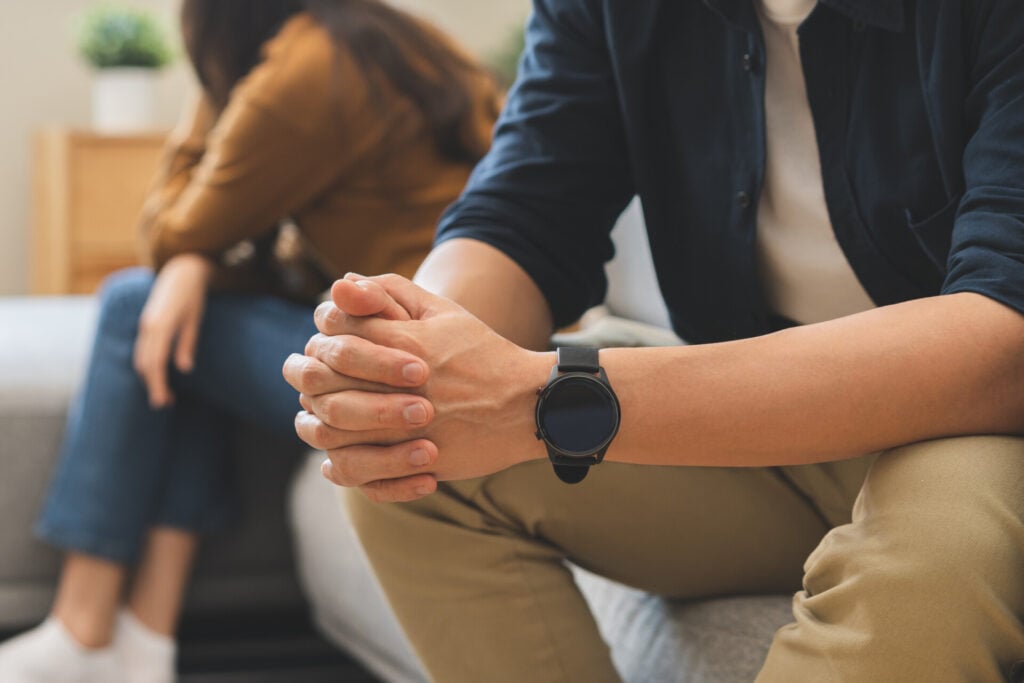
Insecurities in a relationship are feelings of uncertainty, self-doubt, or fear that can manifest in various ways, such as fearing the loss of a partner or questioning one’s self-worth or attractiveness. These insecurities can be deeply rooted in a person’s self-esteem and past experiences, and they can have a significant impact on the dynamics of a relationship.
Relationship insecurities can lead to various behaviors that can be detrimental to a relationship, such as jealousy, clinginess, or an excessive need for reassurance.
In the bookAttached, Amir Levine and Rachel Heller explain that insecure attachment styles develop in childhood when a child’s needs for safety and security are not met.
As adults, individuals with insecure attachment styles often havetrust issues, a fear of abandonment, and/or high levels of anxiety.

Individuals with insecure attachment styles can exhibit a variety of behaviors in their relationships and these behaviors can manifest in different ways.
Here are examples of behaviors that insecurely attached people may display in relationships:
What are the signs of an insecure relationship?
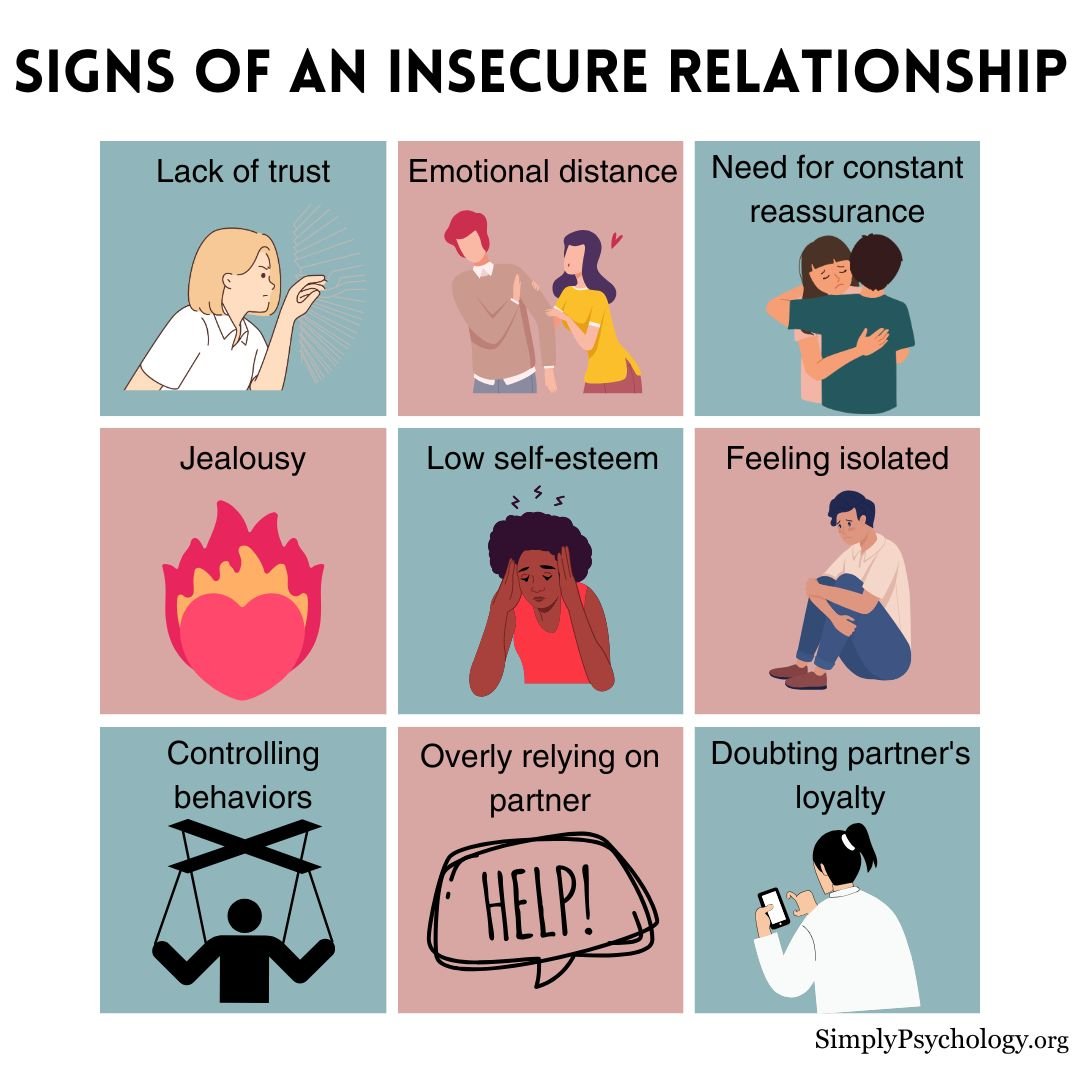
Below are some commonsigns of an insecure relationship:

Lack of Trust
Trust is the foundation of a healthy relationship. If trust is lacking, this can result inanxiety,hyper-vigilance, and resentment. Doubts about a partner’s honesty, intentions, or fidelity can undermine the foundation of the relationship.
Lack of trust in a relationship can manifest in a number of ways, including:
Avoidance of Vulnerability
Partners may avoid vulnerability and emotional intimacy because they fear getting hurt.
If you struggle to connect emotionally with your partner, you may experience feelings of detachment and isolation.
This lack of emotional connection can make it difficult to communicate effectively, understand each other’s needs, and give each other adequate support and intimacy.
Constant Need for Reassurance
Partners in insecure relationships may frequently seek validation and verbal affirmation of love, often needing to hear “I love you” or “I’m committed to you” to feel secure.
This constant need for reassurance and approval can make you overlydependent on your partner for reassurance, which can be emotionally draining for both individuals.
Jealousy and Possessiveness
People who feel insecure are more likely toexperience jealousyand exhibit possessiveness, often resulting in conflict and tension in a relationship.
Signs of jealousyand possessiveness include: monitoring your partner’s social media activity, tracking their movements, and limiting their contact with other people.
They may become jealous or anxious when their partner interacts with others at social gatherings, parties, or events, interpreting these interactions as a threat to the relationship.
Low Self-Esteem
Insecure relationships often involve one or both partners who experience feelings of inadequacy andlow self-esteem.
Individuals with low self-esteem feel unworthy of love and acceptance, which affects their ability to trust and feel secure in a relationship.
This can also manifest as a lack of self-worth and contribute to a negative self-image.
Withdrawal or Isolation
One or both partners may withdraw emotionally or physically from the relationship, creating distance as a defense mechanism against perceived threats.
When feeling insecure, it is common for individuals to withdraw from their partner emotionally, as they fear judgment or rejection.
They may also feel unable to talk to anyone else about their relationship and feel like they have to keep their relationship problems a secret.
Control or Manipulation
In an attempt to gain a sense of security, insecure individuals often try toexert control over their partner’s actions, choices, and interactions.
This can include monitoring their partner’s activities, controlling their finances, or using guilt to gain compliance.
Controlling behaviorcan stem from a desire to maintain power and dominance as individuals try to manage their fears.
Over-Reliance on the Relationship
Insecure individuals may overly depend on the relationship for validation, companionship, emotional well-being, or financial support.
Insecure individuals tend to rely excessively on their partner, feeling incomplete without their partner’s constant presence or validation.
This over-reliance can create anunhealthy relationship dynamic, hinder your personal growth and autonomy, and result in codependency.
Ineffective Communication
Instead of addressing and resolving conflicts, partners in insecure relationships may repeatedly revisit the same issues without making progress.
This can hinder the resolution of conflicts, prevent emotional connection, and lead to exhaustion and frustration.
Why do I feel insecure?
Feeling insecure is a common human experience, and thereasons for insecuritycan vary widely from person to person.
Insecurity often arises from a combination of internal and external factors. Here are some common reasons why individuals may feel insecure:
Past Relationships
Negative experiences in the past, such as rejection, betrayal, or childhood adversity, can leave emotional scars that affect one’s sense of security.
Unresolved traumas or emotional baggage from past relationshipscan be projected onto new partnerswithout valid justification.
“Baggage” can include negative experiences (e.g., betrayal, abandonment, neglect) or positive experiences (e.g., high expectations, unrealistic beliefs about relationships).
Attachment Styles
Attachment insecurity can have significant effects on how people think, feel, and behave in relationships, shaping their expectations, attitudes, and beliefs about romantic partners.
People with insecureattachment styleshave maladaptive responses to stress in relationships, with avoidant individuals using distancing coping strategies and anxious individuals using hyper-activating coping strategies.
Anxiously attachedindividuals fear abandonment, excessively seek reassurance, and worry that their partner will find someone better.
Avoidant individualsstruggle with intimacy and push their partners away, especially when feeling overwhelmed.
A lack of confidence in one’s abilities, appearance, or self-worth can contribute to insecurity, doubts, and fears.
Self-critical and negative self-talk only serves to reinforce these feelings, as individuals internalize harmful beliefs about themselves.
Additionally, constantly comparing yourself to others, especially in terms of achievements, appearances, or social status, can create feelings of inadequacy and insecurity.
Moreover, societal and cultural expectations, such as beauty standards and success benchmarks, can create even more pressure to conform and trigger feelings of insecurity.
Poor Communication Skills
When couples struggle to communicate effectively or openly, it can lead to misunderstandings, assumptions, and a lack of trust.
Difficulty communicating your needs and feelings to your partner can make you feel misunderstood and resentful.
Insecurity often arises when partners feel that their needs, emotions, or concerns are not being heard or validated, leading to doubts about the stability of the relationship.
Relationship Issues
Conflicts or issues within current or past relationships, including trust issues, can lead to insecurity about one’s desirability or worthiness of love.
Furthermore, familial relationships can also impact one’s feelings of insecurity. For example, witnessing parental infidelity can increase the likelihood of being insecure in your adult relationships as this experience creates deep-rooted fears of betrayal and a lack of trust in romantic partners.
Carrying these fears into your own relationships makes it difficult for you to fully trust your partner’s faithfulness.
Anxiety and Depression
Mental health conditions like anxiety and depression can exacerbate feelings of insecurity, as they often involve negative thought patterns and self-doubt.
How do insecurities affect relationships?
Insecurities can have a significant negative impact on relationships (e.g., with partners, friends, children, co-workers), often leading to various challenges and dynamics that can strain the partnership.
Another case study inAttacheddescribes a man named John who was in a relationship with a woman named Jane.
Insecure individuals may unintentionally create a negative cycle in the relationship, where their fears and behaviors reinforce each other, making it challenging to break free from negative patterns.
Additionally, insecurity can limit personal growth and independence, as individuals may avoid pursuing their interests or goals to focus solely on the relationship.
It’s important to recognize that everyone has moments of insecurity from time to time, but chronic and pervasive insecurities can be damaging to a relationship.
How to overcome relationship insecurities
Overcoming relationship insecuritiesis a process that involves self-reflection, communication, and personal growth.
Both partners in the relationship can play a role in addressing and working through these insecurities.
Here are some steps to help you overcome relationship insecurities:
Open Communication
Create a safe and non-judgmental space for open communication with your partner. Share your feelings and insecurities honestly, and encourage your partner to do the same.
Talking to your partner about your insecurities can help build trust and understanding. Be honest and open with your partner and be willing to listen to their perspective.
It’s important to create a safe and non-judgmental environment for these conversations where both partners can actively listen and empathize with each other.
By expressing your fears and concerns, you allow your partner to provide reassurance and support. Sharing your insecurities can provide an opportunity to work together to find solutions.
Challenge Negative Self-Talk
Insecurities often stem from distorted thinking patterns and irrational beliefs. By questioning the validity of these thoughts and challenging their accuracy, you can gain a more balanced and realistic perspective.
Challenging your insecure thoughts and beliefs means asking yourself if there is any evidence to support or disprove them. Try to replace self-criticism with self-compassion and positive affirmations.
Cognitive-behavioral techniques, such as reframing and thought-stopping, are examples of strategies that can help replaceunhelpful thoughtswith more rational ones.
Clinical psychologist Nick Wignall states that, “if you assume that every thought your mind throws at you is important and worth thinking more about, you’re quickly going to get lost in your own thoughts and feel even more uncertain and insecure about the relationship.”
Self-Reflect and Cultivate Individual Growth
Take time to reflect on the specific insecurities you’re experiencing. What triggers these feelings? Are they rooted in past experiences or personal insecurities?Recognize that no one is perfect, and every relationship has its ups and downs.
Take time to reflect on the specific insecurities you’re experiencing. What triggers these feelings? Are they rooted in past experiences or personal insecurities?
Recognize that no one is perfect, and every relationship has its ups and downs.
Consider whether your worries are something that can be resolved or whether they are hypothetical. As you cannot control hypothetical worries, it is best to let them go.
Try the following strategies:
Practice Self-Compassion
Overcoming insecurities is hard work so having compassion for yourself is important.
Practicing self-compassion means:
Psychologist Kristin Neff provides three fundamental ways to develop self-compassion:
Seek Professional Support
Consider seeking support from a therapist or counselor, either individually or as a couple. A trained professional can help you
Meghan Laslocky, author ofThe Little Book of Heartbreak: Love Gone Wrong Through the Ages, was a “textbook case of anxious and avoidant” attachment:
Meghan was able to overcome an insecure attachment style with the help of a trained therapist with expertise in attachment theory. Attachment-specific therapies includeschema therapyor attachment-based therapy.
Acknowledge and celebrate your progress, no matter how small. Recognize and appreciate the positive changes you make in yourself and your relationship.
FAQs:
Is it normal to feel insecure in a new relationship?
Experiencing some level of insecurity in a new relationship is normal and common.
Most people have a fear of rejection, and in a new relationship, there’s a natural concern about whether the other person will truly like and accept you.
Furthermore, building emotional intimacy requires vulnerability, and that can be intimidating. Opening up to someone new can trigger feelings of insecurity.
A new relationship represents uncharted territory. You’re getting to know a new person with their own quirks, preferences, and communication style, which can create uncertainty.
Feeling insecure in a new relationship is normal, but it’s essential to address these feelings constructively to ensure that they don’t negatively impact the development of a healthy and fulfilling partnership.
Can a relationship survive insecurities?A relationship can survive and even thrive despite insecurities. Insecurities are a common part of human nature, and many individuals and couples work through them successfully.However, if insecurities are left unchecked, they can damage a relationship.Effective communication is key. Both partners should work on building trust throughcommunicating openly, offering empathy and emotional support, and demonstrating reliability.Couples can work together on shared goals and personal growth, reinforcing their connection and sense of partnership. Overcoming insecurities takes time, so it’s essential for both partners to be patient and committed to the process of healing and growth.
Can a relationship survive insecurities?
A relationship can survive and even thrive despite insecurities. Insecurities are a common part of human nature, and many individuals and couples work through them successfully.However, if insecurities are left unchecked, they can damage a relationship.Effective communication is key. Both partners should work on building trust throughcommunicating openly, offering empathy and emotional support, and demonstrating reliability.Couples can work together on shared goals and personal growth, reinforcing their connection and sense of partnership. Overcoming insecurities takes time, so it’s essential for both partners to be patient and committed to the process of healing and growth.
A relationship can survive and even thrive despite insecurities. Insecurities are a common part of human nature, and many individuals and couples work through them successfully.
However, if insecurities are left unchecked, they can damage a relationship.
Effective communication is key. Both partners should work on building trust throughcommunicating openly, offering empathy and emotional support, and demonstrating reliability.
Couples can work together on shared goals and personal growth, reinforcing their connection and sense of partnership. Overcoming insecurities takes time, so it’s essential for both partners to be patient and committed to the process of healing and growth.
Can social media cause relationship insecurities?
Platforms like Facebook, Instagram, and Twitter can amplify feelings of insecurity in romantic relationships.
Social media often presents a curated version of people’s lives, highlighting the best moments, experiences, and appearances. Constant exposure to these idealized images can lead individuals to compare their own lives and relationships to what they see on social media, which can trigger feelings of inadequacy and insecurity.
Seeing your partner’s online activity can also cause insecurity and distrust. Seeing them liking or commenting on someone else’s posts or photos can trigger jealousy and insecurity. It’s easy to misinterpret their online interactions as signs of interest or attraction.
Julia Simkusedited this article.
References
Becker-Phelps, L. (2016). Insecure in love: How anxious attachment can make you feel jealous, needy, and worried and what you can do about it. ReadHowYouWant.
Chu, J. (2011). Rebuilding shattered lives. John Wiley & Sons.
Coping With Insecurity in Relationships. (2023). Retrieved 9 July 2023, fromhttps://www.verywellmind.com/coping-with-insecurity-in-a-relationship-5207949
Davenport, B. (2023). 9 Ways To Deal With Insecurity In Your Love Relationship. Retrieved 10 July 2023, fromhttps://liveboldandbloom.com/05/relationships/deal-insecurity-relationship
Gilbert, M., & Blakey, R. (2021). Exploring How UK Adults’ Attachment Style in Romantic Relationships Affects Engagement in Controlling Behaviours. Frontiers In Psychology, 12. doi: 10.3389/fpsyg.2021.649868
Healthy and Unhealthy Insecurity and the Impact on Relationships. (2023). Retrieved 10 July 2023, fromhttps://www.psychologytoday.com/us/blog/peaceful-parenting/202104/healthy-and-unhealthy-insecurity-and-the-impact-relationships
How to Handle Relationship Insecurity | Tony Robbins. (2023). Retrieved 10 July 2023, fromhttps://www.tonyrobbins.com/ultimate-relationship-guide/insecure-in-a-relationship/
How to Stop Attachment Insecurity from Ruining Your Love Life. (2023). Retrieved 11 July 2023, fromhttps://greatergood.berkeley.edu/article/item/how_to_stop_attachment_insecurity_from_ruining_your_love_life
Insecurities in a relationship: How to overcome insecurities – 2023. MasterClass. (n.d.).https://www.masterclass.com/articles/insecurities-in-a-relationship
Kellyagonsalves. (n.d.). 8 signs you’re insecure in your relationship, from psychologists. mindbodygreen.https://www.mindbodygreen.com/articles/insecure-in-relationships
Levine, A., & Heller, R. (2011). Attached: The new science of adult attachment and how it can help you find–and keep–love. TarcherPerigee.
Relationship, 7. (2019). If You’re Always Worried Your Partner’s About To Break Up With You, Read This. Retrieved 10 July 2023, fromhttps://www.womenshealthmag.com/relationships/a27437438/relationship-insecurity/
Simpson, J., & Rholes, W. (2017). Adult attachment, stress, and romantic relationships. Current Opinion In Psychology, 13, 19-24. doi: 10.1016/j.copsyc.2016.04.006
Social Media and Insecurity in Relationships. (2023). Retrieved 10 July 2023, fromhttps://psychcentral.com/blog/social-media-and-insecurity-in-relationships#1
The Cost of Blaming Parents. (2023). Retrieved 11 July 2023, fromhttps://greatergood.berkeley.edu/article/item/the_cost_of_blaming_parents
Using Social Media for Reassurance and Validation. (2023). Retrieved 10 July 2023, fromhttps://www.psychologytoday.com/us/blog/liberate-yourself/202111/using-social-media-reassurance-and-validation
Wignall, N. (2021). 11 Ways to Stop Feeling Insecure in a Relationship – Nick Wignall. Retrieved 11 July 2023, fromhttps://nickwignall.com/11-ways-to-stop-feeling-insecure-in-a-relationship/

Olivia Guy-Evans, MSc
BSc (Hons) Psychology, MSc Psychology of Education
Olivia Guy-Evans is a writer and associate editor for Simply Psychology. She has previously worked in healthcare and educational sectors.
Saul McLeod, PhD
BSc (Hons) Psychology, MRes, PhD, University of Manchester
Saul McLeod, PhD., is a qualified psychology teacher with over 18 years of experience in further and higher education. He has been published in peer-reviewed journals, including the Journal of Clinical Psychology.
Haddi BrowneMental Health Writer, Mental Health Researcher, ProofreaderEducation BSc (Hons) Psychology, MSc Mental Health StudiesMiss Haddi Browne is a freelance mental health writer and proof-reader with over seven years of experience working as a professional researcher with a diverse range of clients across the lifespan, including young adults with post-traumatic stress disorder (PTSD) and depression.
Haddi BrowneMental Health Writer, Mental Health Researcher, ProofreaderEducation BSc (Hons) Psychology, MSc Mental Health Studies
Haddi Browne
Mental Health Writer, Mental Health Researcher, Proofreader
Education BSc (Hons) Psychology, MSc Mental Health Studies
Miss Haddi Browne is a freelance mental health writer and proof-reader with over seven years of experience working as a professional researcher with a diverse range of clients across the lifespan, including young adults with post-traumatic stress disorder (PTSD) and depression.
