Do you constantly doubt yourself and your worthiness of love in your relationship? Do you have excessive fears of abandonment or rejection? If so, you likely suffer from relationship insecurity – and you’re not alone.
Insecurity can sabotage even the strongest relationships. The good news is that you can take steps to overcome these anxious feelings.
In this article, we’ll help you identify the root causes of your relationship worries and outline actionable solutions to start feeling more secure, including:
The key is being proactive. Rather than waiting for your partner to change or for your worries to subside on their own, we’ll give you the tools to take control. With consistent effort, you can create major positive shifts.
 A couple sat back-to-back, facing away from each other. Thought bubble with messy lines.
Being insecure in a relationship refers to a lack of confidence within a romantic relationship, as it often involves doubting your worthiness of love and fearing the loss of the relationship. It means that one or both partners do not feel assured or stable in the relationship, often fearing that it may be at risk in some way.
Common causes of relationship insecurity include past traumas or betrayals, poor communication, and unresolved conflicts.
Relationship insecurity should be addressed because it can lead to unhealthy behaviors such as possessiveness or self-sabotage.
Research has consistently found that relationship/attachment insecurity predicts lower relationship quality and problematic dynamics, especially during stressful times such as the COVID-19 pandemic (Simpson & Rholes, 2017).
Relationship insecurity can manifest in various ways, causing distress and tension. Here are some examples:
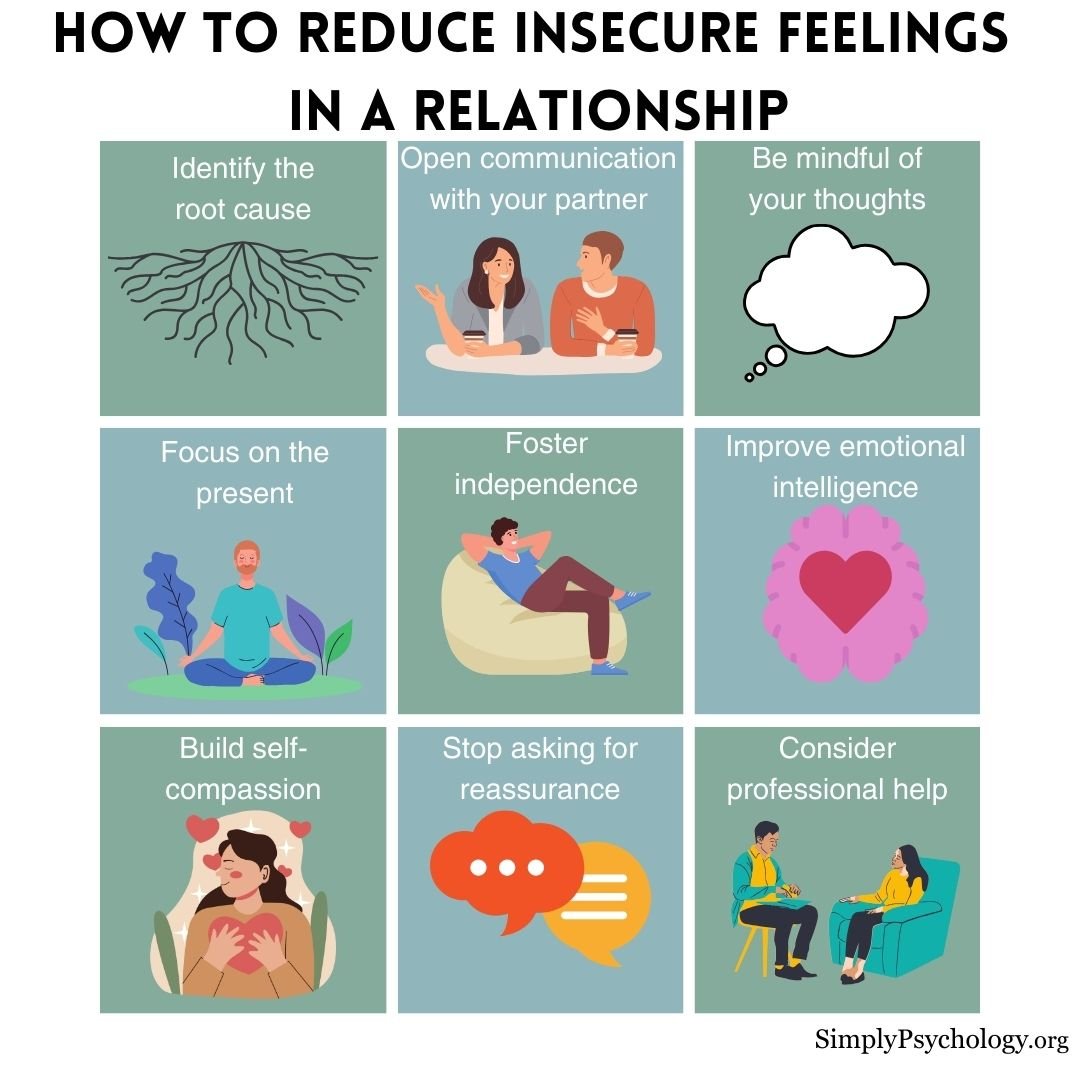
Below are some of the ways in which you can help reduce feelings of insecurity in your relationship:

Identify the root cause
Furthermore, self-help books and therapy provide valuable tools for self-discovery, helping you recognize deep-seated insecurities.
Once you have determined the underlying issues, it is easier to take action to address them. Use practical tips such as building self-awareness,reframing unhelpful thoughts, removing people who exacerbate your insecurities from your life, and seeking support from trusted friends or professionals.
Susan Winter, relationship expert and author, suggests asking yourself three vital questions if you feel insecure in your relationship:
Open communication with your partner
Communicate openly and honestly with your partner about your needs and insecurities. They may offer reassurance or support or alleviate your worries. Additionally, they could have helpful insights or suggestions. For example, a partner may help identify the root cause of insecurity, especially in long-term relationships.
Tips for open communication:
“If my husband and I get in a big fight, he can’t just leave the house- this sets my attachment anxiety on overdrive. If he needs a few minutes to cool down, he’ll text me “I’m going for a walk” and I don’t go into panic mode. This is just one example (and sort of extreme) but examine if there’s anything in your relationship thatcontributesto orexacerbatesyour anxiety.”
Be mindful of your thoughts
Dwelling on a negative thought makes it appear more important and accurate than it actually is. When we overthink, we are more likely to come up with unhelpful or insecure thoughts even if we did not initially have one.
Overthinking leads to anxiety and tension within yourself and your relationship.
Journaling is a helpful tool for recognizing and addressing unhelpful thought patterns and recurring negative beliefs about yourself or your relationship.
When you feel insecure, write down your thoughts and feelings. What are you telling yourself about yourself or your partner?
Once identified, you can become more aware and mindful of your thoughts. Instead of dwelling on insecure thoughts, recognize them and let them go without giving them energy or attention.
You can also challenge unhelpful thoughts and try to replace them with more helpful ones.
Challenging your thoughts involves questioning their accuracy. Ask yourself if these thoughts are really true. Are you basing them on evidence or assumptions and fears? Can you come up with a more positive and realistic interpretation of the situation?
“When I’m insecure, I notice myself becoming more self-involved. Telling myself negative stories. Looking for things that prove my feelings. To balance these things, I do the opposite as well. I tell myself stories that show the same behavior in a positive light!”
Focus on the present
It is easy to overthink and ruminate about past relationship issues or worries about the future.
Improve emotional intelligence
Emotional intelligencerefers to the ability to recognize, understand, manage, and effectively use one’s own emotions and those of others.
It encompasses skills like empathy, self-awareness, and interpersonal communication.Improving emotional intelligenceoffers numerous benefits, including making individuals more resilient, able to adapt to change, and better equipped to handle stress and conflicts.
Practicing empathy can help you understand your partner’s feelings and perspectives, promoting better communication and emotional connection.
Additionally,learning to manage your emotionseffectively will help you express them constructively instead of reactively, leading to fewer arguments and better conflict resolution.
People with higher emotional intelligence have a better ability to navigate relationship challenges with confidence and security.
Build self-compassion
Self-compassion means treating yourself with the same care and kindness that you would offer to a friend or partner. It involves being patient with yourself as you grow and learn.
 self compassion
Foster independence
Furthermore, have your own interests, hobbies, and social activities. Make time for activities that you enjoy without your partner.
For example, you might join a book club, take a dance class, or start a blog. Spending time with yourself could include reading, taking a bath, or going for a walk.
Engaging in activities that make you feel confident in yourself and your abilities can enhance your self-esteem, reducing dependency on external validation. Ways to boost your confidence include setting goals and achieving them and learning new things.
Stop asking for reassurance
Consider professional help
If your feelings of insecurity are affecting your ability to maintainfulfilling and secure relationships, consider seeking guidance from a therapist or counselor.
A qualified mental health professional can provide a safe space to explore your feelings and provide you with tools and strategies to:
Embrace insecurity as a part of being human.
Whilst excessive self-doubt is detrimental to your confidence and relationships, having mild insecurities is just a side effect of being human.
It is easy to believe that you are the only one experiencing such emotions, but in reality, insecurity is a common human experience. Acknowledging your insecurities can lead to greater self-awareness, self-acceptance, and resilience.
“If you are searching for the person who always understands you, never does anything wrong and always “gets you”, please stop looking. Even happy couples have conflicts. It’s how they fix them that is the key. When done with care and awareness, often the repair strengthens the relationship.”
It is crucial to understand that everyone, at some point in their lives, battles feelings of insecurity, whether it is related to relationships, work, or personal identity.
Acknowledging and accepting your vulnerabilities can lead to increased emotional intelligence, empathy, and compassion for yourself and others, as it reminds you that imperfection is a shared human experience.
Recognizing that everyone experiences their own insecurities can help you be supportive rather than judgmental, which is essential for building meaningful relationships.
Moreover, renowned psychologist Brené Brown’s work on vulnerability emphasizes the idea that embracing insecurity is a path to genuine connection (Brown, n.d.). In her TED Talk and books, she emphasizes that vulnerability is the birthplace of trust and authenticity in human relationships.
If you actively put the strategies mentioned in this article into practice and repeat them as often as necessary, you will be able to manage insecurities better.
FAQs
How can insecurities ruin a relationship?
Insecurities can have a detrimental impact on a relationship in various ways, such as causing:
Excessive insecurity can lead to jealousy, possessiveness, suspicion, and controlling behavior.
It can also cause one partner to constantly seek reassurance and validation, which can become emotionally exhausting for the other.
Moreover, insecurity can cause communication issues as individuals may struggle to express their feelings or concerns effectively, fearing rejection or criticism. This lack of open and honest communication can hinder conflict resolution and prevent the growth of a healthy emotional connection.
What can trigger someone’s insecurities?
Traumatic life events such as the loss of a loved one or going through a divorce can impact a person’s sense of security.
Negative past experiences, such as bullying or abusive relationships, can also leave emotional scars and create a belief that we are not good enough or worthy of love and acceptance.
Additionally, personal vulnerabilities, such as a negative self-image or a history of rejection, can magnify feelings of inadequacy and self-doubt when faced with challenges.
Furthermore, mental health conditions, such as anxiety and depression, can make us feel overwhelmed, stressed, and hopeless, making us more likely to focus on our flaws.
Societal pressures and media influences can also set unrealistic standards and expectations, causing individuals to compare themselves unfavorably to others.
How can being cheated on affect the relationship?
Here are some ways that being cheated on can have a devastating impact on a relationship:
If you have been cheated on, it is important to seek support from friends, family, or a therapist. Take some time for yourself to heal and process what has happened.
References
Feeling insecure | Relate. (n.d.).https://www.relate.org.uk/get-help/feeling-insecure
Karney B. R., Bradbury T. N. (1995). The longitudinal course of marital quality and stability: A review of theory, methods, and research. Psychological Bulletin, 118(1), 3–34. https://doi.org/10.1037/0033-2909.118.1.3
Simpson J. A., Rholes W. S. (2017). Adult attachment, stress, and romantic relationships. Current Opinion in Psychology, 13, 19–24.
mindbodygreen. (2023, May 5). 8 Signs You’re Insecure In Your Relationship, From Psychologists. Mindbodygreen.https://www.mindbodygreen.com/articles/insecure-in-relationships
Feeling Insecure in Your Relationship?. (2023). Retrieved 12 September 2023, fromhttps://www.psychologytoday.com/gb/blog/constructive-wallowing/202009/feeling-insecure-in-your-relationship
mindbodygreen. (2023b, May 5). 8 Signs You’re Insecure In Your Relationship, From Psychologists. Mindbodygreen.https://www.mindbodygreen.com/articles/insecure-in-relationships
How to handle relationship insecurity | Tony Robbins. (2023, June 30). tonyrobbins.com.https://www.tonyrobbins.com/ultimate-relationship-guide/insecure-in-a-relationship/
Gupta, S. (2023). Insecurity in relationships: Ways to cope. Verywell Mind.https://www.verywellmind.com/coping-with-insecurity-in-a-relationship-5207949
Geller, L. (2019, May 16). 7 Steps To Actually Overcome Insecurities In Your Relationship. Women’s Health.https://www.womenshealthmag.com/relationships/a27437438/relationship-insecurity/
MasterClass. (2022, June 14). Insecurities in a Relationship: How to Overcome Insecurities – 2023 – MasterClass.https://www.masterclass.com/articles/insecurities-in-a-relationship
8 Practical tips to Stop being Insecure & Build Self-Esteem. (2023, August 11). IvyPanda.https://ivypanda.com/blog/8-practical-tips-to-stop-being-insecure/
Detka, E., Detka, E., & Detka, E. (2023). Protecting your Intimate Relationship from the Impact of Work Stress. Dr. Alexandra Solomon – Supporting Deep, Personal Growth and Authentic, Intimate Connection.https://dralexandrasolomon.com/protecting-your-intimate-relationship-from-the-impact-of-work-stress/
Maintaining healthy relationships and mental wellbeing. (n.d.). nhs.uk.https://www.nhs.uk/every-mind-matters/lifes-challenges/maintaining-healthy-relationships-and-mental-wellbeing/
Insecurity Counselling UK – Therapy. (n.d.).https://www.therapycounselling.org/insecurity
Smith, M., MA. (2023). Improving Emotional intelligence (EQ). HelpGuide.org.https://www.helpguide.org/articles/mental-health/emotional-intelligence-eq.htm
Darcy, A. M., & Jacobson, S. (2023). Self-Compassion – a better way to raise your Self-Esteem? Harley TherapyTM Blog.https://www.harleytherapy.co.uk/counselling/self-compassion.htm
Four Ways to Stop Feeling Insecure in Your Relationships. (2023). Retrieved 13 September 2023, fromhttps://www.psychologytoday.com/gb/blog/living-forward/201609/four-ways-stop-feeling-insecure-in-your-relationships
Wignall, N. (2023). 11 Ways to stop feeling Insecure in a relationship. Nick Wignall.https://nickwignall.com/11-ways-to-stop-feeling-insecure-in-a-relationship/
Touroni, E. (2022). Why do I need constant reassurance? The Chelsea Psychology Clinic.https://www.thechelseapsychologyclinic.com/blog/why-do-i-need-constant-reassurance/
Counselling Directory. (2023). Overcoming relationship anxiety: What it is and how to stop it. Counselling Directory.https://www.counselling-directory.org.uk/memberarticles/overcoming-relationship-anxiety-what-it-is-and-how-to-stop-it
Pace, R., Pace, R., & Pace, R. (2023). Reassurance in relationships: Examples, Signs & Ways to deal. Marriage Advice – Expert Marriage Tips & Advice.https://www.marriage.com/advice/relationship/reassurance-in-a-relationship/
Brown, B. (n.d.). The power of vulnerability [Video]. TED Talks.https://www.ted.com/talks/brene_brown_the_power_of_vulnerability
Relationship Insecurity: 12 Steps to Overcoming Self Doubt. (n.d.). Relish.https://hellorelish.com/articles/12-steps-overcome-relationship-insecurity.html
User, S. (n.d.). 5 ways to deal with an insecure partner. Insight Therapy LLC.https://www.insighttherapyllc.com/mental-health-articles/99-5-ways-to-deal-with-an-insecure-partner
Mairanz, A. (2019). How to Navigate a Relationship with an Insecure Partner. Empower Your Mind Therapy.https://eymtherapy.com/blog/how-to-navigate-a-relationship-with-an-insecure-partner/
How to Help an Insecure Partner Feel Loved. (2023). Retrieved 14 September 2023, fromhttps://www.psychologytoday.com/gb/blog/social-instincts/202306/how-to-make-an-insecure-partner-feel-safe-and-loved
Nash, J., PhD. (2023b). How to set healthy boundaries & Build positive relationships. PositivePsychology.com.https://positivepsychology.com/great-self-care-setting-healthy-boundaries/
Boundaries: What are they and how to create them | Wellness Center | University of Illinois Chicago. (n.d.).https://wellnesscenter.uic.edu/news-stories/boundaries-what-are-they-and-how-to-create-them/
Mishra, A. (2023, July 4). 101 Insecurity in Relationship Quotes to Find Hope And Reassurance. PINKVILLA.https://www.pinkvilla.com/lifestyle/relationships/insecurity-in-relationships-quotes-1227509
Moss, R. (2017, June 7). How Being Cheated On Affects Your Mental Health And Behaviour. HuffPost UK.https://www.huffingtonpost.co.uk/entry/how-being-cheated-on-affects-your-mental-health-and-behaviour_uk_5937b2f1e4b0aba888b9e6af

Olivia Guy-Evans, MSc
BSc (Hons) Psychology, MSc Psychology of Education
Olivia Guy-Evans is a writer and associate editor for Simply Psychology. She has previously worked in healthcare and educational sectors.
Saul McLeod, PhD
BSc (Hons) Psychology, MRes, PhD, University of Manchester
Saul McLeod, PhD., is a qualified psychology teacher with over 18 years of experience in further and higher education. He has been published in peer-reviewed journals, including the Journal of Clinical Psychology.
Haddi BrowneMental Health Writer, Mental Health Researcher, ProofreaderEducation BSc (Hons) Psychology, MSc Mental Health StudiesMiss Haddi Browne is a freelance mental health writer and proof-reader with over seven years of experience working as a professional researcher with a diverse range of clients across the lifespan, including young adults with post-traumatic stress disorder (PTSD) and depression.
Haddi BrowneMental Health Writer, Mental Health Researcher, ProofreaderEducation BSc (Hons) Psychology, MSc Mental Health Studies
Haddi Browne
Mental Health Writer, Mental Health Researcher, Proofreader
Education BSc (Hons) Psychology, MSc Mental Health Studies
Miss Haddi Browne is a freelance mental health writer and proof-reader with over seven years of experience working as a professional researcher with a diverse range of clients across the lifespan, including young adults with post-traumatic stress disorder (PTSD) and depression.
