Social anxietyis a common issue many people face, which may often stem from early life experiences with parents.
If you have social anxiety, you might find yourself avoiding social interactions, feeling nervous about being judged, or experiencing physical symptoms like sweating and trembling.
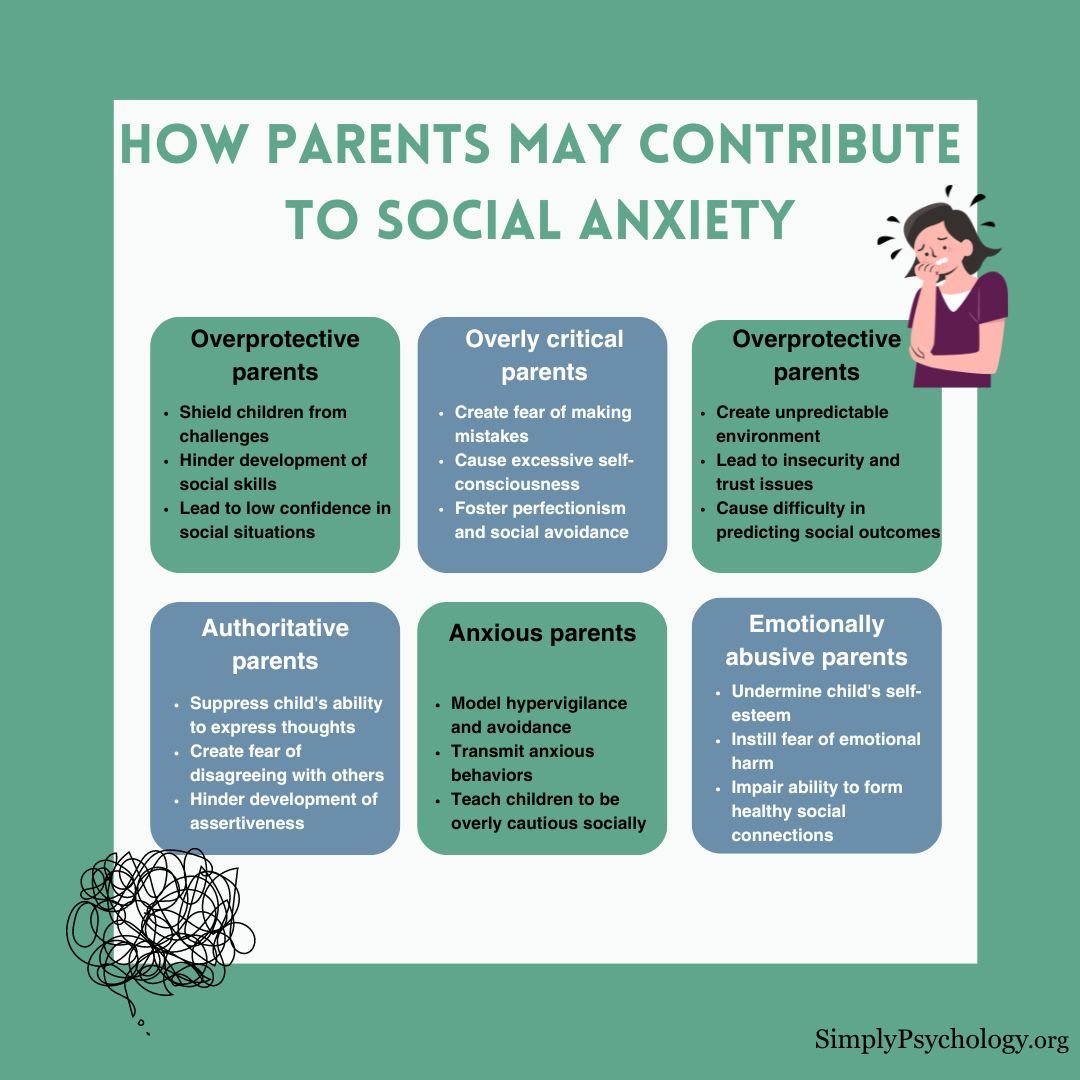
These anxieties can often be traced back to how you were raised. Overprotective, critical, inconsistent, or emotionally abusive parenting can deeply influence how you feel in social settings, even well into adulthood.
While not the sole cause of social anxiety, different parenting styles may contribute to a child going on to struggle with social anxiety.

What kind of parenting can cause social anxiety?
Overprotective parents
Overprotective parents shield their children from challenges and potential failures, leading to underdeveloped social skills and low confidence.
For instance, an overprotective parent might immediately intervene when their child disagrees with a friend about which game to play at recess, suggesting a compromise instead of allowing the children to resolve the issue themselves.
This deprives the child of the opportunity to develop crucial social skills like negotiation and conflict resolution, potentially leading to anxiety in future social interactions.
By constantly intervening, these parents hinder their child’s ability to learn important social cues and problem-solving skills.
Consequently, children may feel ill-equipped to handle social scenarios, resulting in anxiety when interacting with peers or entering new social environments.
Examples of Thoughts:
Examples of Behaviors:
Overly critical or demanding parents
Constant criticism and high expectations from overly critical or demanding parents can make children overly self-conscious and afraid of making mistakes.
“She used to hit me and constantly criticize me and told me I wasn’t as good as my friends or whatever other kid my age was around. Didn’t take much for me to start being scared everyone else was judging me just as harshly.”
This fear extends to social interactions, where they may worry excessively about others’ opinions and potential negative evaluations. The pressure to meet high standards can lead to perfectionism and reluctance to engage socially, fostering anxiety.
Inconsistent parents
Inconsistent parenting creates an unpredictable environment, leading to insecurity. When parents are sometimes supportive and other times neglectful or critical, children struggle to form a stable sense of trust.
For example, an inconsistent parent may encourage their child to attend more social activities with friends, but then when the child actually plans to meet friends, their parent complains that they are ‘always going out’ and should stay home. This can cause the child to be conflicted about attending social events.
This inconsistency makes it hard for children to predict others’ reactions, resulting in anxiety and uncertainty in social interactions. They may become overly cautious or avoidant in relationships, fearing rejection or unpredictability.
While authoritative parenting involves setting clear rules and expectations, it can suppress a child’s ability to voice their thoughts and feelings if it veers into authoritarianism.
This suppression can lead to social anxiety, as children may fear expressing themselves, worry about disagreeing with others, or struggle with asserting their needs and boundaries.
Research has also uncoveredsuch relationships between authoritative styles and increased social anxiety and social withdrawal. This further highlights the detrimental effects of poor parenting on children’s mental health.
Anxious parents
As a result, they may internalize these anxious behaviors, leading to social anxiety. For example, they may become overly cautious in social settings, fear potential negative outcomes, and instinctively mimic what they have observed in their parents.
Emotionally abusive parents
Emotionally abusive parents undermine their child’s self-esteem and sense of worth, significantly contributing to social anxiety. Through verbal abuse, manipulation, or neglect, these parents instill a deep sense of inadequacy and fear.
Constant exposure toemotional abusemakes children feel worthless and overly sensitive to criticism, leading them to avoid social situations where they fear further emotional harm.
This long-lasting impact severely impairs their ability to form healthy social connections.
“I grew up in an abusive household and developed severe social anxiety. I have Autism Spectrum Disorder and PTSD which worsen my SA, but I firmly believe I wouldn’t have full blown SA if I lived with healthy, loving non-judgemental people growing up.”
Recognizing Generational Patterns
Understanding the origins of your social anxiety involves recognizing generational patterns. Often, behaviors and attitudes are passed down unconsciously from parents to children.
By identifying these patterns, you can better understand the context of your anxiety and begin to break the cycle.
Reflect on your parents’ upbringing and how their experiences may have influenced their parenting style. Acknowledging that your parents may have also struggled with similar issues can foster empathy and provide a foundation for change.
Discuss family history with your parents or other relatives to gain insight into generational behaviors. This awareness can help you identify specific patterns and work towards breaking them, fostering a healthier environment for yourself and your children.
Practice Self-Parenting
Self-parenting involves nurturing yourself in ways your parents might not have. This means providing yourself with the support, encouragement, and love that you need. Develop a positive inner voice to counteract any negative messages received in childhood.
Engage in self-care practices that promote mental and emotional well-being. Affirmations, journaling, and self-compassion exercises can be powerful tools in reparenting yourself, helping you build confidence and reduce social anxiety.
An activity for self-parenting:
In your journal, imagine that you are writing a letter to your younger self. In this letter, you can take on the role of your younger self’s parent or older mentor.
Consider what you will say to your younger self. What advice would you give them? What encouragement or reassurance can you offer?
Think specifically about how you can counter some of the criticism you may have heard from your parent/s.
Practice Forgiveness
Forgiveness can be a critical step in healing from parental influences that have contributed to social anxiety.
While it may not be easy, forgiving your parents, whether they were overly critical, inconsistent, or anxious, can free you from lingering resentment and pain.
This does not mean condoning their behavior but rather accepting that they were doing their best with the tools they had (obviously, if the parent was abusive, you may not want to forgive this). Forgiveness can provide emotional relief and allow you to focus on your growth and recovery.
Therapy can also help you process these emotions and move towards forgiveness, providing emotional relief and allowing you to focus on your growth.
Foster Your Own Independence
Cultivating independence is essential in overcoming social anxiety linked to parental influences.
Establishing some distance from your parents’ anxious beliefs helps you form your own identity and perspectives.
Engage in activities that challenge you and build confidence, such as joining clubs, volunteering, or taking up new hobbies. Setting boundaries with your parents allows you to develop autonomy and self-assurance.
While anxiety may feel heightened, to begin with,gradually exposing yourselfto fearful social situations should help your confidence in the long run and ultimately increase your independence.
Likewise, practice setting healthy boundaries with your parents, such as saying no to unreasonable requests or reducing visiting times if you feel more anxious in their presence.
Seek Professional Help
Therapy is an effective way to address social anxiety, particularly when it stems from parental influences.
Cognitive-behavioral therapy(CBT) can help you identify and reframe negative thought patterns, while exposure therapy can gradually reduce fear of social situations.
Family therapy might also be beneficial if your parents are willing to participate, providing a platform to address and resolve underlying issues.
A mental health professional can guide you through these processes, offering support and strategies tailored to your needs.
Lastly, parent-only CBT is available andhas been shown to be an effective treatmentfor reducing anxiety symptoms and relieving anxiety in children when compared to control groups.
Build a Support Network
Creating a support network of friends, mentors, and support groups can significantly help in managing social anxiety. Surround yourself with positive influences who understand and respect your experiences.
Engaging with others who share similar challenges can provide comfort and reduce feelings of isolation.
These connections can offer encouragement, practical advice, and opportunities for social interaction in a safe and supportive environment.
Challenge Negative Thoughts
A key aspect of managing social anxiety is learning to challenge and reframe negative thoughts.
When you catch yourself thinking, “Everyone will judge me,” counter it with evidence-based thoughts like, “Most people are focused on themselves, not on judging me.”
Try to identify where your socially anxious thoughts are coming from and verbalize this to help challenge them.
For example, “I am probably feeling anxious about being judged because my father was very critical of me, but that does not mean everyone is also critical of me.”
Practicing mindfulnessand staying present in the moment can also help prevent anxious thoughts from spiraling.
Techniques such as meditation and deep breathing exercises can reduce anxiety and improve emotional regulation.
Develop Social Skills Gradually
Practicing social skills incrementally helps build confidence and reduces the fear associated with social situations. Over time, these experiences can lessen social anxiety and improve your overall quality of life.
TherapistEmma McAdamshared the following advice:
Implement the stepladder approach, a gradual exposure technique used to overcome social anxiety. This method involves:
For example:
As you gain confidence at each level, move on to more complex social situations.
References
Ilyas, U., & Khan, S. D. (2023). Role of Parenting and Psychosocial Correlates Contributing to Social Anxiety in Asian Adolescents: A Systematic Review.Innovations in Clinical Neuroscience,20(7-9), 30.
Therapy in a Nutshell. (2022, May 26,).3 Skills to Overcome Social Anxiety Post-Pandemic. [Video File]. YouTube.
Yin, B., Teng, T., Tong, L., Li, X., Fan, L., Zhou, X., & Xie, P. (2021). Efficacy and acceptability of parent-only group cognitive behavioral intervention for treatment of anxiety disorder in children and adolescents: a meta-analysis of randomized controlled trials.Bmc Psychiatry,21, 1-12.

Olivia Guy-Evans, MSc
BSc (Hons) Psychology, MSc Psychology of Education
Olivia Guy-Evans is a writer and associate editor for Simply Psychology. She has previously worked in healthcare and educational sectors.
Saul McLeod, PhD
BSc (Hons) Psychology, MRes, PhD, University of Manchester
Saul McLeod, PhD., is a qualified psychology teacher with over 18 years of experience in further and higher education. He has been published in peer-reviewed journals, including the Journal of Clinical Psychology.
Ioanna StavrakiCommunity Wellbeing Professional, EducatorBSc (Hons) Psychology, MSc, Neuropsychology, MBPsSIoanna Stavraki is a healthcare professional leading NHS Berkshire’s Wellbeing Network Team and serving as a Teaching Assistant at The University of Malawi for the “Organisation Psychology” MSc course. With previous experience at Frontiers' “Computational Neuroscience” journal and startup “Advances in Clinical Medical Research,” she contributes significantly to neuroscience and psychology research. Early career experience with Alzheimer’s patients and published works, including an upcoming IET book chapter, underscore her dedication to advancing healthcare and neuroscience understanding.
Ioanna StavrakiCommunity Wellbeing Professional, EducatorBSc (Hons) Psychology, MSc, Neuropsychology, MBPsS
Ioanna Stavraki
Community Wellbeing Professional, Educator
BSc (Hons) Psychology, MSc, Neuropsychology, MBPsS
Ioanna Stavraki is a healthcare professional leading NHS Berkshire’s Wellbeing Network Team and serving as a Teaching Assistant at The University of Malawi for the “Organisation Psychology” MSc course. With previous experience at Frontiers' “Computational Neuroscience” journal and startup “Advances in Clinical Medical Research,” she contributes significantly to neuroscience and psychology research. Early career experience with Alzheimer’s patients and published works, including an upcoming IET book chapter, underscore her dedication to advancing healthcare and neuroscience understanding.
