It can vary in severity, from a fear of specific situations, like public speaking, to a more generalized fear of all social interaction. This fear can interfere with daily activities, work, and relationships, significantly impacting someone’s life.
Cognitive-behavioral therapy (CBT) is a widely used psychotherapytreatment for SADthat focuses on identifying and modifying negative thought patterns to change emotional responses and behaviors.
By working with a trained therapist, people learn coping strategies to manage their anxiety and improve their social interactions.
A CBT session for social anxiety typically involves identifying and challenging negative thought patterns, learning relaxation techniques, gradually confronting feared social situations through exposure exercises, and developing coping strategies to manage anxiety symptoms.

In this article, we will explore how CBT can help those struggling with social anxiety and highlight some of the key techniques used in this therapeutic approach.
Why is CBT recommended for social anxiety?
Research has consistently shownthat CBT is effective in reducing the symptoms of social anxiety and helping individuals develop more positive social interactions.
The structured nature of CBT, with its focus on specific goals and measurable outcomes, makes it particularly well-suited for addressing the specific fears and behaviors associated with social anxiety.
Specifically, it can support with:
Getting started
A crucial step in addressing social anxiety through CBT is creating a personalized Fear and Avoidance Hierarchy. This tool helps you identify and rank your specific anxiety triggers, providing a roadmap for your treatment journey.
How to Create Your Hierarchy:
CBT techniques for social anxiety
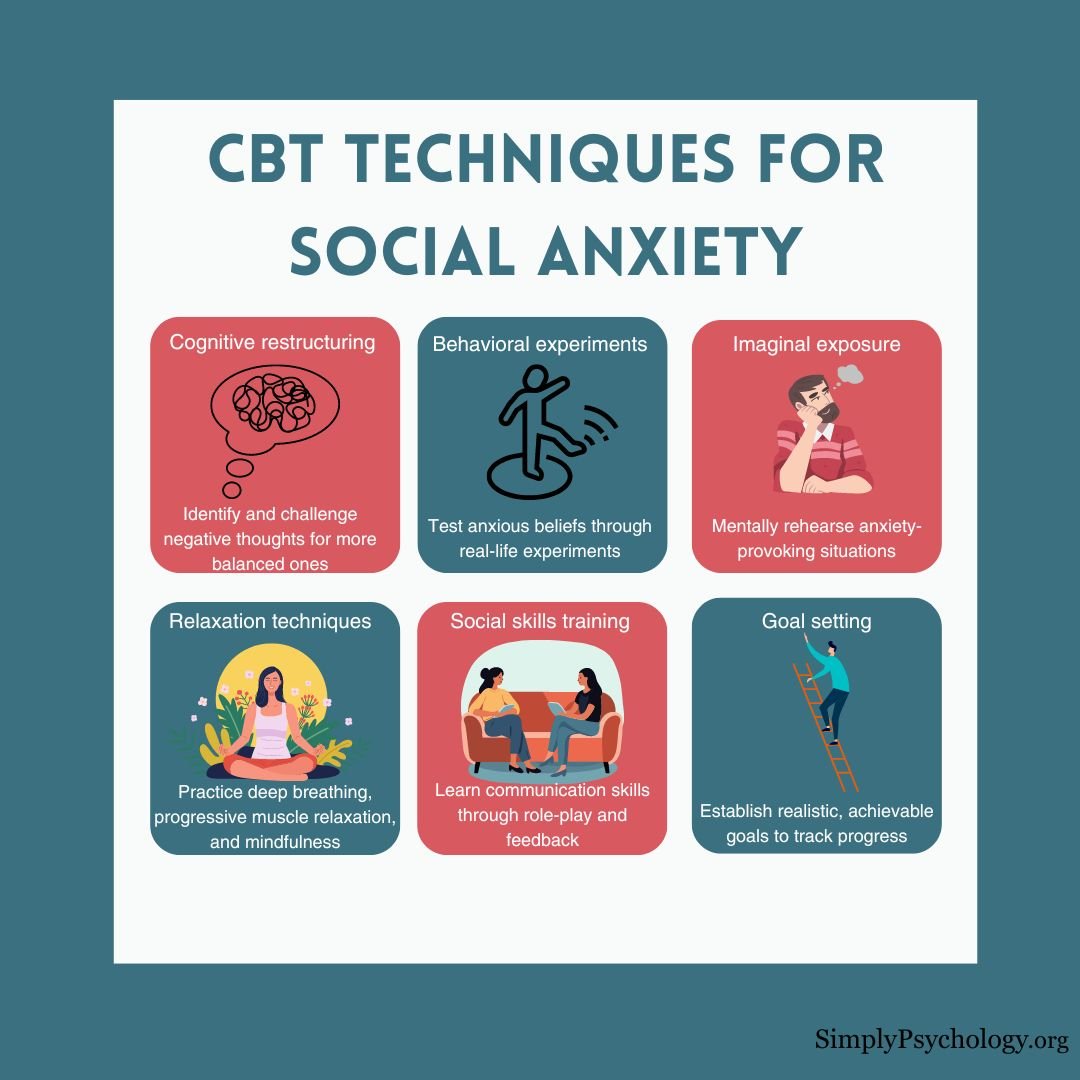
There are many techniques used in CBT, some of which will be discussed below:

Cognitive restructuring
Cognitive restructuring involves identifying and challenging negative thought patterns that contribute to social anxiety.
Often, people with social anxiety have distorted thoughts (also referred to as “hot thoughts”), like believing they will be humiliated or judged in social situations.
These often manifest as core beliefs, rooting themselves deep inside someone’s brain like alarm bells that go off when those hot thoughts occur.
In CBT, a therapist will help the individual recognize these irrational thoughts and replace them with more realistic and positive ones. This process involves examining the evidence for and against these thoughts and developing alternative, balanced perspectives.
For example, the thought:
“I will embarrass myself if I try to speak up during a meeting, and everyone will think I’m stupid” can be altered to
“While it may be possible that I might make a mistake, it is unlikely that everyone will think I am incompetent. Most people understand that mistakes happen. Therefore, if I prepare well, I can share my ideas confidently”.
Over time, cognitive restructuring can reduce the intensity of anxiety and help individuals approach social situations with greater confidence.
Behavioral experiments
Behavioral experiments are a key component of CBT for social anxiety. These experiments involve testing the accuracy of negative beliefs through real-life experiences.
For example, someone who fears public speaking might believe they will embarrass themselves and be judged harshly. A behavioral experiment could involve gradually exposing the individual to speaking in front of small, supportive groups and monitoring the outcomes.
Various sub-techniques can be used based on individual needs, end goals, and fear thresholds. These include the general go-to of “gradual exposure” and at the end of the spectrum a technique called “flooding” (presenting someone with their fear at its maximum capacity without allowing them to flee).
These experiments help people gather evidence that specifically challenges their negative beliefs and demonstrates that their fears are often unfounded. This process can reduce anxiety, build tolerance to it, and gradually increase confidence in social situations.
Imaginal Exposure
This method is particularly useful when real-life exposure is not feasible or when an individual is too anxious to confront the feared situation directly. It focuses on vividly imagining and mentally rehearsing situations that provoke anxiety.
Through using imaginal exposure you will begin to desensitize the feared scenario, reduce anxiety, and overall build confidence over time.
Behavioral Activation
This technique is based on the principle that engaging in positive activities can improve mood, reduce anxiety, and enhance overall well-being. It is used to help individuals engage in activities that are enjoyable or meaningful, which can counteract the tendency to withdraw and avoid situations due to social anxiety.
Here is an example scenario of behavioral activation to feeling isolated due to social anxiety. This has been broken down into steps for you to use and adapt:
Relaxation techniques
Relaxation techniques are used in CBT to help individuals manage the physical symptoms of anxiety. Techniques such as deep breathing, progressive muscle relaxation, grounding, andmindfulness meditationcan reduce physiological arousal and promote a sense of calm.
To practice deep breathing, sit comfortably and inhale slowly through your nose for a count of four, letting your abdomen rise. Hold your breath for four counts, then exhale through your mouth for a count of six. Repeat this cycle for five to ten minutes to achieve a state of relaxation.
5-4-3-2-1 technique: identify five things you can see, four things you can touch, three things you can hear, two things you can smell, and one thing you can taste. This sensory awareness exercise helps divert attention from anxious thoughts and anchors you in the here and now.
To practice mindfulness, sit comfortably in a quiet place and focus on your breath, noticing the sensation as it enters and leaves your nostrils.
When thoughts arise, acknowledge them without judgment and gently bring your focus back to your breath. Start with five to ten minutes daily to build this calming practice.
By practicing these techniques regularly, individuals can learn to control their anxiety responses in social situations.
Relaxation techniques can also work as a coping mechanism during exposure exercises, making it easier for individuals to confront and manage their fears.

Social skills training
Social skills training is an important aspect of CBT for social anxiety. Many people with social anxiety struggle with some basic social interactions and may lack confidence in their communication abilities.
Therefore, social skills training involves teaching specific skills, such as making eye contact, starting and maintaining conversations, andassertiveness. Exercises such as role-playing are often used to practice these skills in a safe and supportive environment.
Let us look at an example:
This is an example of how social skills can help people enhance their social interactions and reduce anxiety over time.
Goal setting
Goal setting is a crucial part of the CBT process. Setting realistic and achievable goals can help individuals track their progress and stay motivated. Goals in CBT for social anxiety might include attending a social event, speaking up in a meeting, or initiating a conversation with a stranger.
How effective is CBT for social anxiety?
CBT has been extensively researched and is widely recognized as one of the most effective treatments for social anxiety disorder.
Numerous studieshave shown that CBT can significantly reduce symptoms of social anxiety and improve overall functioning, with long-term effects.
For example,a meta-analysis of randomized controlled trialsfound that CBT was more effective than placebo and other forms of therapy in reducing social anxiety symptoms.
The effectiveness of CBT is attributed to its structured and goal-oriented approach, which targets the specific thoughts and behaviors that contribute to anxiety.
By addressing these underlying issues, CBT helps individuals develop long-term strategies for managing their anxiety and improving their quality of life.
Additionally, CBT can be tailored to each individual’s needs, making it a versatile and adaptable treatment option.
Lastly, there is evidence to suggest that other forms of therapy can be equally as effective as CBT,such as psychodynamic therapy.
My Story
As someone who struggled with SAD for most of my life, CBT techniques have truly been transformative in my journey. For example, we made a list with the top 10 social phobias with a therapist (1 being the least frightening, 10 being the most), and we slowly started working down that list.
There were struggles in the beginning, such as overwhelming negative thoughts that I would never get better and feeling a loss of safety. SAD can exist to protect you from things your brain perceives as threats.
When you are actively trying to fight SAD tendencies, your body can react negatively at first as it feels it is in danger. Having a good support network and being open with your therapist is key to getting through this hurdle.
Once I started seeing results such as speaking on the phone without severely stuttering, I gained more confidence and began with flooding techniques such as signing up for seminars and conferences.
It was a long journey that took a few years to get me to the social functioning level that I am now. However, my life was forever changed for the better.
I have met so many incredible people and made happy memories that would have never happened had I stayed trapped in my head. I still get flare-ups from time to time, but slow and steady is key. So join me, and let us start living life, one small interaction at a time!
Considerations
While CBT is highly effective for many people with social anxiety, it may not work for everyone.
The success of CBT depends on various factors, including the individual’s commitment to the therapy process, the severity of their anxiety, and the quality of the therapeutic relationship.
As individuals confront their fears through exposure therapy, it is not uncommon for their symptoms to temporarily worsen before improving.
This initial increase in anxiety can be discouraging, and high dropout rates are possible, which can impact the overall effectiveness and progress of the therapy.
To combat this, additional support and reassurance from the therapist may be required. It is important to highlight that recovery and getting better is not linear, so it is completely normal to feel overwhelmed or out of your depth at times.
Additionally, CBT for social anxiety is not an overnight treatment but requires at minimum between 6-12 sessions. The standard course for SAD usually lies between the 12-20 session range.
There is flexibility in the delivery of SAD CBT as well which includes online and group sessions. These can benefit those with:
Some individuals may benefit from a combination of CBT and medication or may require additional support to address other underlying issues. Therefore, it is important to work with a qualified mental health professional to determine the best treatment approach for your specific needs.
Lastly, it may not be applicable to a few people such as those with:
References
Beidel, D. C., Alfano, C. A., Kofler, M. J., Rao, P. A., Scharfstein, L., & Sarver, N. W. (2014). The impact of social skills training for social anxiety disorder: A randomized controlled trial.Journal of anxiety disorders, 28(8), 908-918.https://doi.org/10.1016/j.janxdis.2014.09.016
Heimberg, R. G. (2002). Cognitive-behavioral therapy for social anxiety disorder: current status and future directions.Biological psychiatry, 51(1), 101-108.https://doi.org/10.1016/S0006-3223(01)01183-0
Hofmann, S. G. (2007). Cognitive factors that maintain social anxiety disorder: A comprehensive model and its treatment implications.Cognitive behaviour therapy, 36(4), 193-209.https://doi.org/10.1080/16506070701421313
Hofmann, S. G., Asnaani, A., Vonk, I. J., Sawyer, A. T., & Fang, A. (2012). The efficacy of cognitive behavioral therapy: A review of meta-analyses.Cognitive therapy and research, 36, 427-440.https://doi.org/10.1007/s10608-012-9476-1
Kindred, R., Bates, G. W., & McBride, N. L. (2022). Long-term outcomes of cognitive behavioural therapy for social anxiety disorder: A meta-analysis of randomised controlled trials.Journal of anxiety disorders,92, 102640.https://doi.org/10.1016/j.janxdis.2022.102640
Leichsenring, F., Salzer, S., Beutel, M. E., Herpertz, S., Hiller, W., Hoyer, J., … & Leibing, E. (2014). Long-term outcome of psychodynamic therapy and cognitive-behavioral therapy in social anxiety disorder.American Journal of Psychiatry, 171(10), 1074-1082.https://doi.org/10.1176/appi.ajp.2014.13111514
Mayo-Wilson, E., Dias, S., Mavranezouli, I., Kew, K., Clark, D. M., Ades, A. E., & Pilling, S. (2014). Psychological and pharmacological interventions for social anxiety disorder in adults: a systematic review and network meta-analysis.The Lancet Psychiatry, 1(5), 368-376.https://doi.org/10.1016/S2215-0366(14)70329-3
Otto, M. W. (1999). Cognitive-behavioral therapy for social anxiety disorder: Model, methods, and outcome. Journal of Clinical Psychiatry, 60(9), 14-19.
Stangier, U. (2016). New developments in cognitive-behavioral therapy for social anxiety disorder.Current psychiatry reports, 18, 1-8.https://doi.org/10.1007/s11920-016-0667-4
Stein, M. B., & Stein, D. J. (2008). Social anxiety disorder.The Lancet, 371(9618), 1115-1125.https://doi.org/10.1016/S0140-6736(08)60488-2

Olivia Guy-Evans, MSc
BSc (Hons) Psychology, MSc Psychology of Education
Olivia Guy-Evans is a writer and associate editor for Simply Psychology. She has previously worked in healthcare and educational sectors.
Saul McLeod, PhD
BSc (Hons) Psychology, MRes, PhD, University of Manchester
Saul McLeod, PhD., is a qualified psychology teacher with over 18 years of experience in further and higher education. He has been published in peer-reviewed journals, including the Journal of Clinical Psychology.
Ioanna StavrakiCommunity Wellbeing Professional, EducatorBSc (Hons) Psychology, MSc, Neuropsychology, MBPsSIoanna Stavraki is a healthcare professional leading NHS Berkshire’s Wellbeing Network Team and serving as a Teaching Assistant at The University of Malawi for the “Organisation Psychology” MSc course. With previous experience at Frontiers' “Computational Neuroscience” journal and startup “Advances in Clinical Medical Research,” she contributes significantly to neuroscience and psychology research. Early career experience with Alzheimer’s patients and published works, including an upcoming IET book chapter, underscore her dedication to advancing healthcare and neuroscience understanding.
Ioanna StavrakiCommunity Wellbeing Professional, EducatorBSc (Hons) Psychology, MSc, Neuropsychology, MBPsS
Ioanna Stavraki
Community Wellbeing Professional, Educator
BSc (Hons) Psychology, MSc, Neuropsychology, MBPsS
Ioanna Stavraki is a healthcare professional leading NHS Berkshire’s Wellbeing Network Team and serving as a Teaching Assistant at The University of Malawi for the “Organisation Psychology” MSc course. With previous experience at Frontiers' “Computational Neuroscience” journal and startup “Advances in Clinical Medical Research,” she contributes significantly to neuroscience and psychology research. Early career experience with Alzheimer’s patients and published works, including an upcoming IET book chapter, underscore her dedication to advancing healthcare and neuroscience understanding.
