On This Page:ToggleWhat Is Grounded Theory?Core ComponentsVersionsBenefitsLimitationsPractical StepsReading List
On This Page:Toggle
On This Page:
Grounded theory is a useful approach when you want to develop a new theory based on real-world data Instead of starting with a pre-existing theory, grounded theory lets the data guide the development of your theory.
What Is Grounded Theory?
It is important to note that grounded theory is an inductive approach where a theory is developed from collected real-world data rather than trying to prove or disprove a hypothesis like in a deductive scientific approach
You gather information, look for patterns, and use those patterns to develop an explanation.
It is a way to understand why people do things and how those actions create patterns. Imagine you’re trying to figure out why your friends love a certain video game.
Instead of asking an adult, you observe your friends while they’re playing, listen to them talk about it, and maybe even play a little yourself. By studying their actions and words, you’re using grounded theory to build an understanding of their behavior.
This qualitative method of research focuses on real-life experiences and observations, letting theories emerge naturally from the data collected, like piecing together a puzzle without knowing the final image.
When should you use grounded theory?
Grounded theory research is useful for beginning researchers, particularly graduate students, because it offers a clear and flexible framework for conducting a study on a new topic.
Grounded theory works best when existing theories are either insufficient or nonexistent for the topic at hand.
Since grounded theory is a continuously evolving process, researchers collect and analyze data until theoretical saturation is reached or no new insights can be gained.
What is the final product of a GT study?
The final product of a grounded theory (GT) study is an integrated and comprehensive grounded theory that explains a process or scheme associated with a phenomenon.
The quality of a GT study is judged on whether it produces this middle-range theory
Middle-range theories are sort of like explanations that focus on a specific part of society or a particular event. They don’t try to explain everything in the world. Instead, they zero in on things happening in certain groups, cultures, or situations.
Think of it like this: a grand theory is like trying to understand all of weather at once, but a middle-range theory is like focusing on how hurricanes form.
Core Components of Grounded Theory
This terminology reflects the iterative, inductive, and comparative nature of grounded theory, which distinguishes it from other research approaches.
Versions
Barney Glaser and Anselm Strauss first introduced grounded theory in 1967 in their book,The Discovery of Grounded Theory.
Their aim was to create a research method that prioritized real-world data to understand social behavior.
However, their approaches diverged over time, leading to two distinct versions: Glaserian and Straussian grounded theory.
The different versions of grounded theory diverge in their approaches tocoding, theory construction, and the use of literature.
All versions of grounded theory share the goal of generating amiddle-range theorythat explains a social process or phenomenon.
They also emphasize the importance oftheoretical sampling,constant comparative analysis, andtheoretical saturationin developing a robust theory
Glaserian Grounded Theory
Glaserian grounded theory emphasizes theemergence of theory from dataand discourages the use of pre-existing literature.
Glaser believed that adopting a specific philosophical or disciplinary perspective reduces the broader potential of grounded theory.
For Glaser, prior understandings should be based on the general problem area and reading very wide to alert or sensitize one to a wide range of possibilities.
It prioritizesparsimony,scope, andmodifiabilityin the resulting theory
Straussian Grounded Theory
Strauss and Corbin (1990) focused on developing the analytic techniques and providing guidance to novice researchers.
Straussian grounded theory utilizes a more structured approach to coding and analysis and acknowledges the role of the literature in shaping research.
It acknowledges the role ofdeductionandvalidationin addition to induction.
Strauss and Corbin also emphasize the use ofunstructured interview questionsto encourage participants to speak freely
Critics of this approach believe it produced a rigidity never intended for grounded theory.
Constructivist Grounded Theory
This version, primarily associated with Charmaz, recognizes that knowledge is situated, partial, provisional, and socially constructed. It emphasizes abstract and conceptual understandings rather than explanations.
Kathy Charmaz expanded on original versions of GT, emphasizing the researcher’s role in interpreting findings
Constructivist grounded theory acknowledges the researcher’s influence on the research process and the co-creation of knowledge with participants
Situational Analysis
Situational analysis incorporates postmodern perspectives and considers the role of nonhuman actors
It introduces the method ofmappingto analyze complex situations and emphasizes bothhuman and nonhuman elements.
Benefits
Limitations
Practical Steps
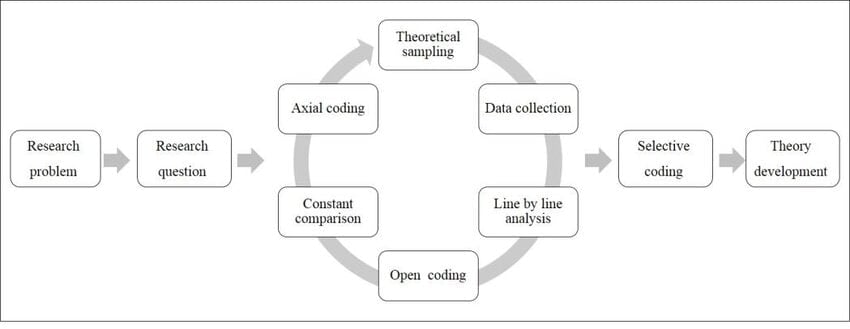
Grounded theory research is typically an iterative process. This means that researchers may move back and forth between these steps as they collect and analyze data.
Instead of doing everything in order, you repeat the steps over and over.
This cycle keeps going, which is why grounded theory is called a circular process.
Theoretical sampling, collecting sufficient and rich data, and theoretical saturationhelp the grounded theorist to avoid a lack of “groundedness,” incomplete findings, and “premature closure.
Source: Choi, Y. J., Choi, H. B., & O’Donnell, M. (2018). Disaster reintegration model: a qualitative analysis on developing Korean disaster mental health support model.International Journal of Environmental Research and Public Health,15(2), 362.
1. Planning and Philosophical Considerations
However, refrain from detailing the specific aspects you seek to uncover about the phenomenon to prevent pre-existing assumptions from skewing the research.
2. Recruit participants using theoretical sampling
As the analysis progresses, transition totheoretical sampling, involving the deliberate selection of participants and data sources to refine your emerging theory.
This method is used to refine and develop a grounded theory. The researcher uses theoretical sampling to choose new participants or data sources based on the emerging findings of their study.
This could mean recruiting participants who can shed light on gaps in your understanding uncovered during the initial data analysis.
The goal is to gather data that will help to further develop and refine the emerging categories and theoretical concepts.
Theoretical sampling starts early in a GT study and generally requires the researcher to make amendments to their ethics approvals to accommodate new participant groups.
3. Collect Data
The researcher might use interviews, focus groups, observations, or a combination of methods to collect qualitative data.
4. Begin open coding as soon as data collection starts
Open codingis the first stage of coding in grounded theory, where you carefully examine and label segments of your data to identify initial concepts and ideas.
This process involves scrutinizing the data and creating codes grounded in the data itself.
The initial codes stay close to the data, aiming to capture and summarize critically and analytically what is happening in the data
To begin open coding, read through your data, such as interview transcripts, to gain a comprehensive understanding of what is being conveyed.
As you encounter segments of data that represent a distinct idea, concept, or action, you assign a code to that segment. These codes act as descriptive labels summarizing the meaning of the data segment.
For instance, if you were analyzing interview data about experiences with a new medication, a segment of data might describe a participant’s difficulty sleeping after taking the medication. This segment could be labeled with the code “trouble sleeping”
Open coding is a crucial step in grounded theory because it allows you to break down the data into manageable units and begin to see patterns and themes emerge.
As you continue coding, you constantly compare different segments of data to refine your understanding of existing codes and identify new ones.
For instance, excerpts describing difficulties with sleep might be grouped under the code “trouble sleeping”.
This iterative process of comparing data and refining codes helps ensure the codes accurately reflect the data.
Open coding is about staying close to the data, using in vivo terms or gerunds to maintain a sense of action and process
During open coding, it’s crucial to engage inmemo writing. Memos serve as your “notes to self”, allowing you to reflect on the coding process, note emerging patterns, and ask analytical questions about the data.
Document your thoughts, questions, and insights in memos throughout the research process.
These memos serve multiple purposes: tracing your thought process, promoting reflexivity (self-reflection), facilitating collaboration if working in a team, and supporting theory development.
Early memos tend to be shorter and less conceptual, often serving as “preparatory” notes. Later memos become more analytical and conceptual as the research progresses.
6. Group codes into categories using axial coding
Axial codingis the process of identifying connections between codes, grouping them together into categories to reveal relationships within the data.
Axial coding seeks to find the axes that connect various codes together.
For example, in research on school bullying, focused codes such as “Doubting oneself, getting low self-confidence, starting to agree with bullies” and “Getting lower self-confidence; blaming oneself” could be grouped together into a broader category representing the impact of bullying on self-perception.
These categories then become part of the emerging grounded theory, explaining the multifaceted aspects of the phenomenon.
Qualitative data analysis software often represents these categories as nested codes, visually demonstrating the hierarchy and interconnectedness of the concepts.
This hierarchical structure helps researchers organize their data, identify patterns, and develop a more nuanced understanding of the relationships between different aspects of the phenomenon being studied.
This process of axial coding is crucial for moving beyond descriptive accounts of the data towards a more theoretically rich and explanatory grounded theory.
7. Define the core category using selective coding
The core category is the central concept that links together the various categories and subcategories identified in the data and forms the foundation of the emergent grounded theory.
This core category will encapsulate the main theme of your grounded theory, that encompasses and elucidates the overarching process or phenomenon under investigation.
This phase involves a concentrated effort to refine and integrate categories, ensuring they align with the core category and contribute to the overall explanatory power of the theory.
The theory should comprehensively describe the process or scheme related to the phenomenon being studied.
Example
For example, in a study on school bullying, if the core category is “victimization journey,” the researcher would selectively code data related to different stages of this journey, the factors contributing to each stage, and the consequences of experiencing these stages.
This might involve analyzing how victims initially attribute blame, their coping mechanisms, and the long-term impact of bullying on their self-perception.
Continue collecting data and analyzing until you reach theoretical saturation
Selective coding focuses on developing and saturating this core category, leading to a cohesive and integrated theory.
Through selective coding, researchers aim to achieve theoretical saturation, meaning no new properties or insights emerge from further data analysis.
This signifies that the core category and its related categories are well-defined, and the connections between them are thoroughly explored.
It’s important to note that while a grounded theory seeks to provide a comprehensive explanation, it remains grounded in the data.
The theory’s scope is limited to the specific phenomenon and context studied, and the researcher acknowledges that new data or perspectives might lead to modifications or refinements of the theory
8. Theoretical coding and model development
Theoretical coding is a process in grounded theory where researchers use advanced abstractions, often from existing theories, to explain the relationships found in their data.
Theoretical coding often occurs later in the research process and involves using existing theories to explain the connections between codes and categories.
This process helps to strengthen the explanatory power of the grounded theory. Theoretical coding should not be confused with simply describing the data; instead, it aims to explain the phenomenon being studied, distinguishing grounded theory from purely descriptive research.
Using the developed codes, categories, and core category, create a model illustrating the process or phenomenon.
9. Write your grounded theory
Present your findings in a clear and accessible manner, ensuring the theory is rooted in the data and explains the relationships between the identified concepts and categories.
The end product of this process is a well-defined, integrated grounded theory that explains a process or scheme related to the phenomenon studied.
Reading List
Grounded Theory Review: This is an international journal that publishes articles on grounded theory.

Olivia Guy-Evans, MSc
BSc (Hons) Psychology, MSc Psychology of Education
Olivia Guy-Evans is a writer and associate editor for Simply Psychology. She has previously worked in healthcare and educational sectors.
Saul McLeod, PhD
BSc (Hons) Psychology, MRes, PhD, University of Manchester
Saul McLeod, PhD., is a qualified psychology teacher with over 18 years of experience in further and higher education. He has been published in peer-reviewed journals, including the Journal of Clinical Psychology.
