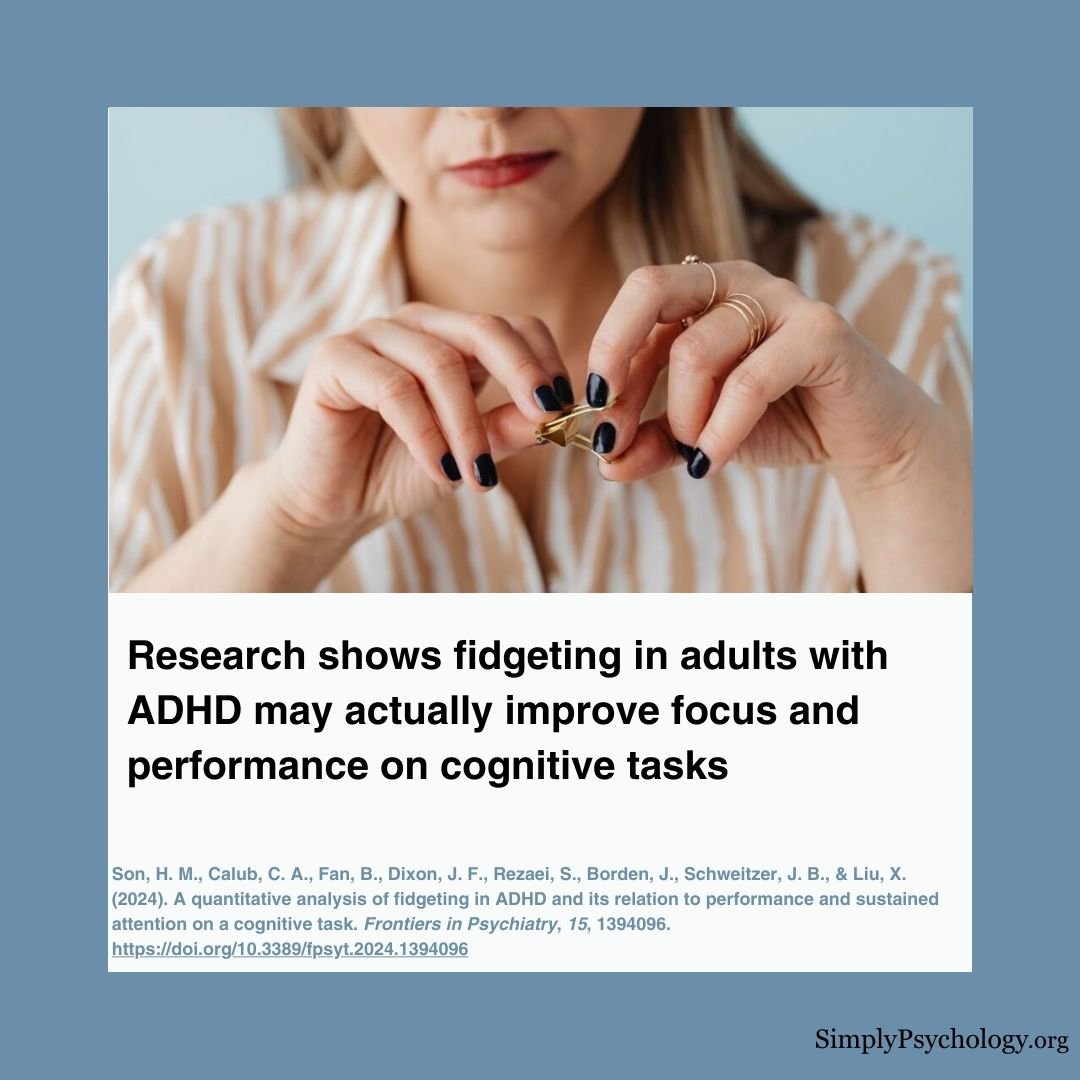
Individuals with ADHD often exhibit fidgeting behaviors, such as tapping feet, drumming fingers, or shifting in their seats.
These movements are thought to be a self-regulatory mechanism that helps maintain arousal and attention, especially during cognitively demanding tasks. Fidgeting may serve as a compensatory strategy to enhance focus and performance.
Studying this phenomenon is crucial because it can lead to better understanding ofADHD symptoms, improved interventions, and more accommodating environments for individuals with ADHD.
Furthermore, insights into the relationship between movement and cognition could have broader implications for learning, attention, and performance optimization in various settings.

Key Points
Rationale
In adults with ADHD, hyperactivity often manifests as fidgeting – repetitive, non-goal-directed movements.
Previous studies have observed increased fidgeting in children with ADHD during cognitively demanding tasks (Dekkers et al., 2020; Hartanto et al., 2015).
However, there is a lack of standardized variables to quantify fidgeting, leading to discrepancies in data interpretation across studies. Additionally, little is known about fidgeting in adults with ADHD compared to youth.
Method
The study employed a quantitative analysis of fidgeting behaviors in adults with ADHD during a cognitive task, using actigraphy devices to measure movement.
Procedure
Participants completed a Flanker task while wearing actigraphy devices on their left wrist and right ankle.
The Flanker task consisted of 120 trials (40 each of congruent, incongruent, and neutral conditions). Participants responded to the direction of a central arrow using a button box.
Sample
The study included 70 adult participants (36% male) aged 18-50 years (mean age 30.5 years), all diagnosed with ADHD.
Participants were recruited through social media, local clinics, and research registries.
Measures
Statistical measures
The study used t-tests to compare fidgeting variables between correct and incorrect trials, and between early (Q1) and late (Q4) trials.
Linear regression models were used to assess correlations between fidget variables and ADHD symptom rating scales. The ex-Gaussian distribution was used to analyze reaction time data.
Results
Hypothesis 1:Fidgeting will be more pronounced during correct trials compared to incorrect trials.
Result:Confirmed. Significant increases in all fidget variables (Number of Fidgets, Fidget Variability, Fidget Intensity) were observed during correct trials (p < 0.05).
Hypothesis 2:Fidgeting will increase over time as the task progresses.
Result:Partially confirmed. Significant increases in Number of Fidgets and Fidget Variability were observed in Q4 compared to Q1 (p < 0.05), but not for Fidget Intensity.
Hypothesis 3:Participants with lower reaction time variability will show increased fidgeting in later trials.
Result:Confirmed. Participants with low reaction time variability (low Sigma and Tau) showed significant increases in Number of Fidgets in Q4 compared to Q1 (p < 0.05).
Result:Confirmed. Fidget variables showed moderate correlations with BAARS-IV, BDEFS, and ARI scores (R values ranging from 0.37 to 0.52, p < 0.01).
Insight
This study provides quantitative evidence supporting the theory that fidgeting in adults with ADHD may serve as a compensatory mechanism to aid sustained attention during cognitively demanding tasks.
The observation of increased fidgeting during correct trials and among participants with lower reaction time variability suggests that fidgeting may help maintain arousal and improve task performance.
The newly defined fidget variables (Number of Fidgets, Fidget Variability, Fidget Intensity) showed significant correlations with ADHD symptom rating scales, validating their relevance to ADHD symptomatology.
Future research could explore the impact of different types of fidgeting (e.g., leg bouncing vs. finger tapping) on cognitive performance, or investigate the effectiveness of fidget-friendly interventions in work or educational settings for adults with ADHD.
Strengths
This study had several methodological strengths, including:
Limitations
This study also had several limitations, including:
These limitations may affect the generalizability of the results and the ability to draw causal conclusions about the relationship between fidgeting and cognitive performance in ADHD.
Implications
The findings of this study have significant implications for understanding and managing ADHD in adults.
If fidgeting indeed serves as a compensatory mechanism for sustained attention, it may be counterproductive to discourage adults with ADHD from fidgeting during cognitively demanding tasks.
Instead, providing accommodations that allow for non-disruptive fidgeting in work or educational settings could potentially improve performance and attention in adults with ADHD.
The development of standardized fidget variables could lead to more consistent and comparable research in the field of ADHD and movement.
This could facilitate better assessment and monitoring of ADHD symptoms, potentially leading to improved diagnosis andtreatment strategies.
The observed relationship between fidgeting and reaction time variability suggests that fidgeting behaviors might be an observable indicator of attention regulation.
This could have implications for real-time monitoring of attention in various settings, potentially leading to the development of adaptive interventions or support systems for individuals with ADHD.
However, it’s important to note that individual differences in ADHD presentation and the specific nature of fidgeting behaviors may influence the effectiveness of any interventions based on these findings.
Further research is needed to explore how these findings translate to real-world settings and how they might be applied in clinical practice.
References
Primary reference
Son, H. M., Calub, C. A., Fan, B., Dixon, J. F., Rezaei, S., Borden, J., Schweitzer, J. B., & Liu, X. (2024). A quantitative analysis of fidgeting in ADHD and its relation to performance and sustained attention on a cognitive task.Frontiers in Psychiatry,15, 1394096.https://doi.org/10.3389/fpsyt.2024.1394096
Other references
American Psychiatric Association. (2022).Diagnostic and statistical manual of mental disorders (5th ed., text rev.).Arlington, VA: American Psychiatric Association.
Dekkers, T. J., Rapport, M. D., Calub, C. A., Eckrich, S. J., & Irurita, C. (2021). ADHD and hyperactivity: The influence of cognitive processing demands on gross motor activity level in children.Child Neuropsychology,27(1), 63-82.https://doi.org/10.1080/09297049.2020.1793924
Porrino, L. J., Rapoport, J. L., Behar, D., Sceery, W., Ismond, D. R., & Bunney, W. E. (1983). A naturalistic assessment of the motor activity of hyperactive boys: I. Comparison with normal controls.Archives of General Psychiatry,40(6), 681-687.
Teicher, M. H., Ito, Y., Glod, C. A., & Barber, N. I. (1996). Objective measurement of hyperactivity and attentional problems in ADHD.Journal of the American Academy of Child & Adolescent Psychiatry,35(3), 334-342.https://doi.org/10.1097/00004583-199603000-00015
Zentall, S. S., & Meyer, M. J. (1987). Self-regulation of stimulation for ADD-H children during reading and vigilance task performance.Journal of Abnormal Child Psychology,15, 519-536.https://doi.org/10.1007/BF00917238
Zentall, S. S., & Zentall, T. R. (1976). Activity and task performance of hyperactive children as a function of environmental stimulation.Journal of Consulting and Clinical Psychology,44(5), 693.https://doi.org/10.1037/0022-006X.44.5.693
Keep Learning
Socratic questions for a college class to discuss this paper:

Saul McLeod, PhD
BSc (Hons) Psychology, MRes, PhD, University of Manchester
Saul McLeod, PhD., is a qualified psychology teacher with over 18 years of experience in further and higher education. He has been published in peer-reviewed journals, including the Journal of Clinical Psychology.
Olivia Guy-Evans, MSc
BSc (Hons) Psychology, MSc Psychology of Education
Olivia Guy-Evans is a writer and associate editor for Simply Psychology. She has previously worked in healthcare and educational sectors.
