On This Page:ToggleCharacteristicsCognitive FunctionsHobbiesWorkPersonal RelationshipsTips for Interacting With ESTPsTest
On This Page:Toggle
On This Page:
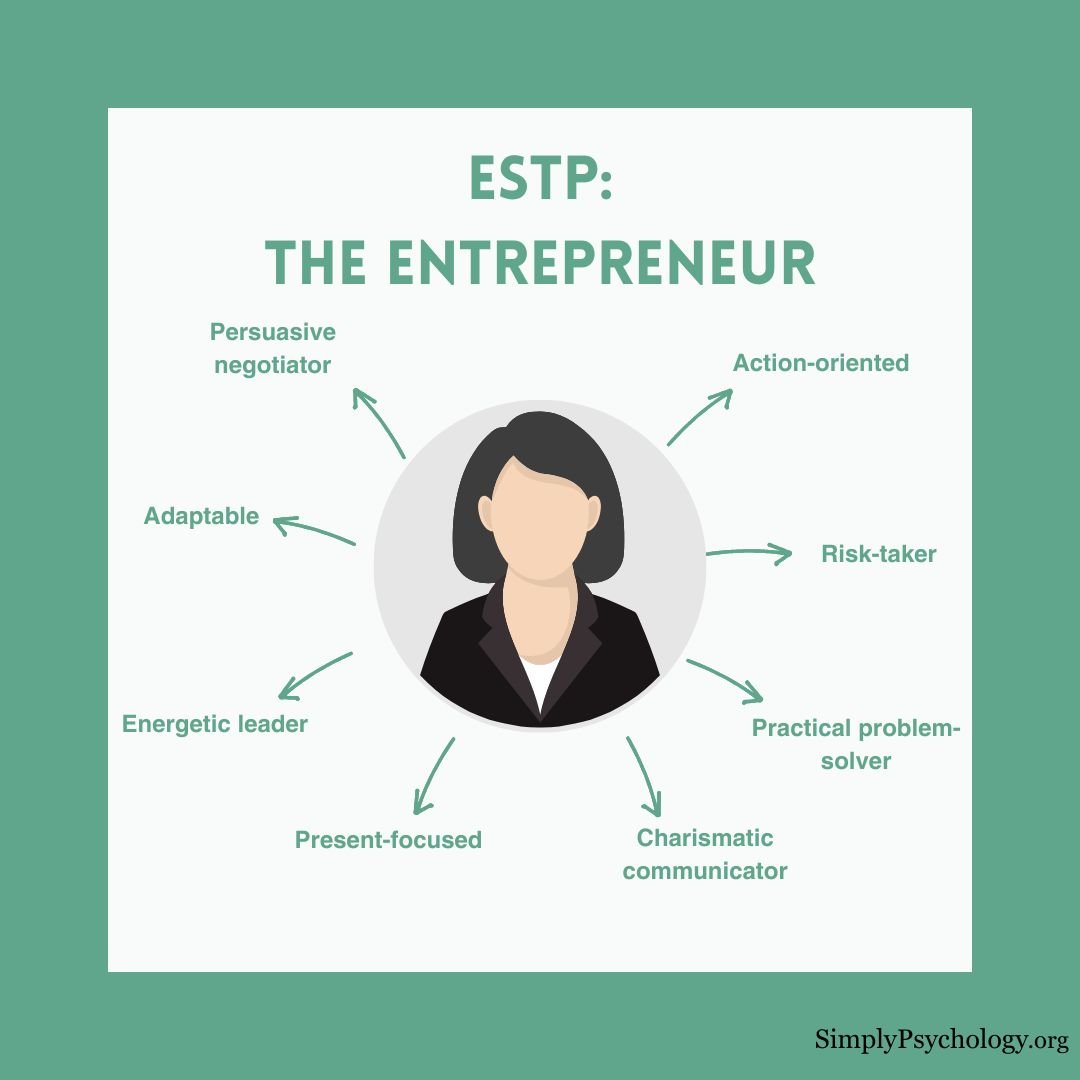
ESTP (extraversion, sensing, thinking, perceiving) is a four-letter code acronym used to represent one of the16 Myers-Briggs personality types.An Overview of the ESTP Personality TypeESTPs are sometimes referred to as “the Persuader,” “the Dynamo,” “the Adventurer,” or “the Entrepreneur.”INFJis the opposite personality type of ESTP.People with this personality type tend to be action-oriented, taking logical approaches to obtain results and solve problems quickly. They are energetic, charming, and outgoing individuals who enjoy spending time and pursuing adventure with wide circles of friends and acquaintances.They enjoy living in the present moment and do not spend a lot of time looking ahead to the future. They are practical thinkers who place a higher value on objectivity rather than personal feelings.
ESTP (extraversion, sensing, thinking, perceiving) is a four-letter code acronym used to represent one of the16 Myers-Briggs personality types.
An Overview of the ESTP Personality Type
ESTPs are sometimes referred to as “the Persuader,” “the Dynamo,” “the Adventurer,” or “the Entrepreneur.”INFJis the opposite personality type of ESTP.
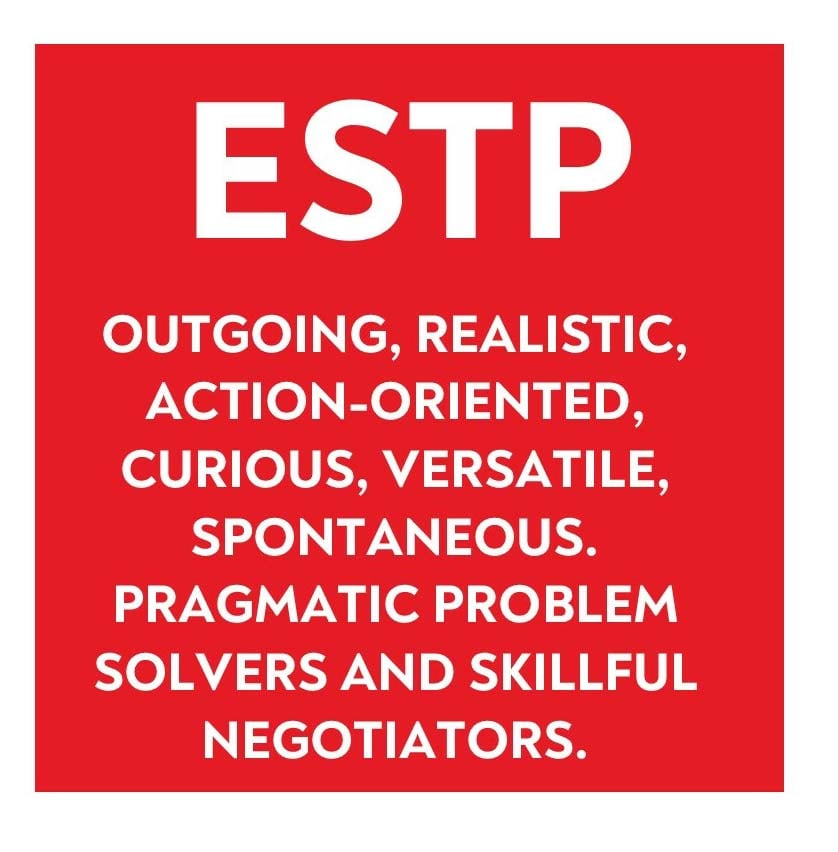
People with this personality type tend to be action-oriented, taking logical approaches to obtain results and solve problems quickly. They are energetic, charming, and outgoing individuals who enjoy spending time and pursuing adventure with wide circles of friends and acquaintances.
They enjoy living in the present moment and do not spend a lot of time looking ahead to the future. They are practical thinkers who place a higher value on objectivity rather than personal feelings.
It is believed to be one of the most common personality types. ESTPs comprise:
Famous ESTPs include Donald Trump, Miley Cyrus, George W. Bush, Madonna, Thomas Edison, and Eddie Murphy.
StrengthsWeaknessesPersonableImpatientEnergeticImpulsiveInfluentialEasily boredObservantJudgmentalIndependentDifficult to please
Key ESTP Characteristics
ESTPs are highly extroverted individuals
ESTPs have strong social skills
People with this personality type are action-oriented
ESTPs are natural leaders
Cognitive Functions
The MBTI suggests that the four different cognitive functions (thinking, feeling, intuition, and sensing) form a hierarchy where each function is either directed outwardly (extroverted) or inwardly (introverted). The order of these functions determines one’s personality.

The dominant function is the primary aspect of personality, while the auxiliary and tertiary functions play supportive roles.
Dominant: Extraverted Sensing
Auxiliary: Introverted Thinking
Tertiary: Extraverted Feeling
Inferior: Introverted Intuition
ESTP Hobbies, Interests, and Careers
People with the ESTP personality type tend to thrive in jobs that involve working with others. Because of their strong people skills, natural boldness, and social intelligence, they tend to do well in careers in sales, business, and marketing.
They are also fast thinkers who act quickly in a crisis, making them well-suited for emergency responder positions such as paramedics, police officers, or soldiers.
ESTPs are concrete and hands-on workers who like a tangible product, so working as a contractor, mechanic, or architect is also well suited for an ESTP.
ESTPs also find success in careers that involve sports, whether on the field as an athlete or coaching on the sidelines. They enjoy the thrill of the competition and pushing themselves to their physical limits.
Popular hobbies for an ESTP include a wide variety of hands-on physical activities, especially team sports and risky or adventurous activities like race car driving, boxing, or flying.
ESTP Work Environments
ESTPs work best in fast-paced, active environments. They dislike routine and monotony and tend to have trouble sitting still or being stuck behind a desk.
They want the flexibility to solve problems without having to follow strict guidelines or plans and the freedom to explore without being micromanaged.
ESTPs are well suited for work environments where they can live on their own terms and set small, measurable, and attainable goals to keep them on track day-to-day.
They are usually the most comfortable in management or freelance positions.
ESTP Personal Relationships
As highly extroverted individuals, ESTPs gain energy from being around others. They have strong people skills and tend to be easygoing, charming, and friendly in social settings.
ESTPs can get along with just about anyone and make new friends wherever they go. They crave adventure and spontaneity and will attract friends who share a similar zest for life.
They are masters at negotiating with others and influencing their friends to join in on their explorations. They sometimes struggle with commitment as they prefer to live in the moment rather than thinking about their long-term plans.
They also have little desire to engage in serious or emotional discussions about feelings as they prefer topics that can be explored through action and adventure.
ESTPs are great at interacting with other people and have charismatic personalities that make them naturally popular.
Tips for Interacting With ESTPs
Friendships
As ESTPs crave thrill and adventure, they get along best with friends who are always ready for a new experience.
They appreciate excitement and novelty and love exploring interesting ideas, so when interacting with an ESTP, it is important you are prepared to have fun and join in on these adventures.
Relationships
As partners, ESTPs are fun-loving and flirtatious, always looking for fun ways to keep their relationships exciting. They grow bored with routine, and want a partner who will appreciate their willingness to explore and allow them the freedom to pursue novel adventures.
It is important to be aware that ESTPs struggle with making long-term commitments.
Parenting
ESTP parents are often described as playful and flexible. They connect with their children through a shared appreciation for spontaneity and hands-on activities.
ESTP parents struggle with emotional connection but rather bond with their children through shared activities and experiences.
Test
Answer these questions to find out if ESTP might be your personality type:
If you answer “yes” to most of these questions, you may have ESTP personality traits. However, remember that personality is complex, and a professional assessment would be needed for a definitive personality type determination.
Take the MBTI (Paper Version)
References
King, S. P., & Mason, B. A. (2020). Myers‐Briggs Type Indicator. The Wiley Encyclopedia of Personality and Individual Differences: Measurement and Assessment, 315-319.
Myers, I. B. (1962). The Myers-Briggs Type Indicator: Manual (1962).
Myers-Briggs Type Indicator. (2019, May 28). New World Encyclopedia, Retrieved from https://www.newworldencyclopedia.org/p/index.php?title=Myers-Briggs_Type_Indicator&oldid=1020015.
Myers, Isabel B.; Myers, Peter B. (1995) [1980]. Gifts Differing: Understanding Personality Type. Mountain View, CA: Davies-Black Publishing. ISBN 978-0-89106-074-1.
Pittenger, D. J. (2005).Cautionary Comments Regarding the Myers-Briggs Type Indicator. Consulting Psychology Journal: Practice and Research, 57(3), 210-221.
The purpose of the Myers-Briggs Type Indicator®. The Myers & Briggs Foundation: MBTI Basics. (n.d.). Retrieved from https://www.myersbriggs.org/my-mbti-personality-type/mbti-basics/

Saul McLeod, PhD
BSc (Hons) Psychology, MRes, PhD, University of Manchester
Saul McLeod, PhD., is a qualified psychology teacher with over 18 years of experience in further and higher education. He has been published in peer-reviewed journals, including the Journal of Clinical Psychology.
Olivia Guy-Evans, MSc
BSc (Hons) Psychology, MSc Psychology of Education
Olivia Guy-Evans is a writer and associate editor for Simply Psychology. She has previously worked in healthcare and educational sectors.
Julia Simkus
BA (Hons) Psychology, Princeton University
Julia Simkus is a graduate of Princeton University with a Bachelor of Arts in Psychology. She is currently studying for a Master’s Degree in Counseling for Mental Health and Wellness in September 2023. Julia’s research has been published in peer reviewed journals.
