On This Page:ToggleENFP MeaningENTP CharacteristicsCognitive FunctionsHobbies & CareersWork EnvironmentsPersonal RelationshipsTips for Interacting With ENFPs
On This Page:Toggle
On This Page:
ENTP, an acronym from the Myers-Briggs Type Indicator (MBTI), stands for Extraversion, Intuition, Thinking, and Perceiving.
ENTPs are dynamic, innovative, and imaginative, thriving on interaction and exploring abstract possibilities. They prefer logical analysis over emotional considerations and value flexibility and spontaneity.
Often seen as strategic thinkers and unafraid innovators, they might struggle with routine tasks and come off as argumentative due to their lively minds.
ENFP Meaning
ENFPs thrive on social engagement (Extraversion), lean towards visionary thinking and possibilities rather than concrete specifics (Intuition), prioritize personal values and emotional impact in their decision-making process (Feeling), and cherish flexibility and openness to new experiences (Perceiving).
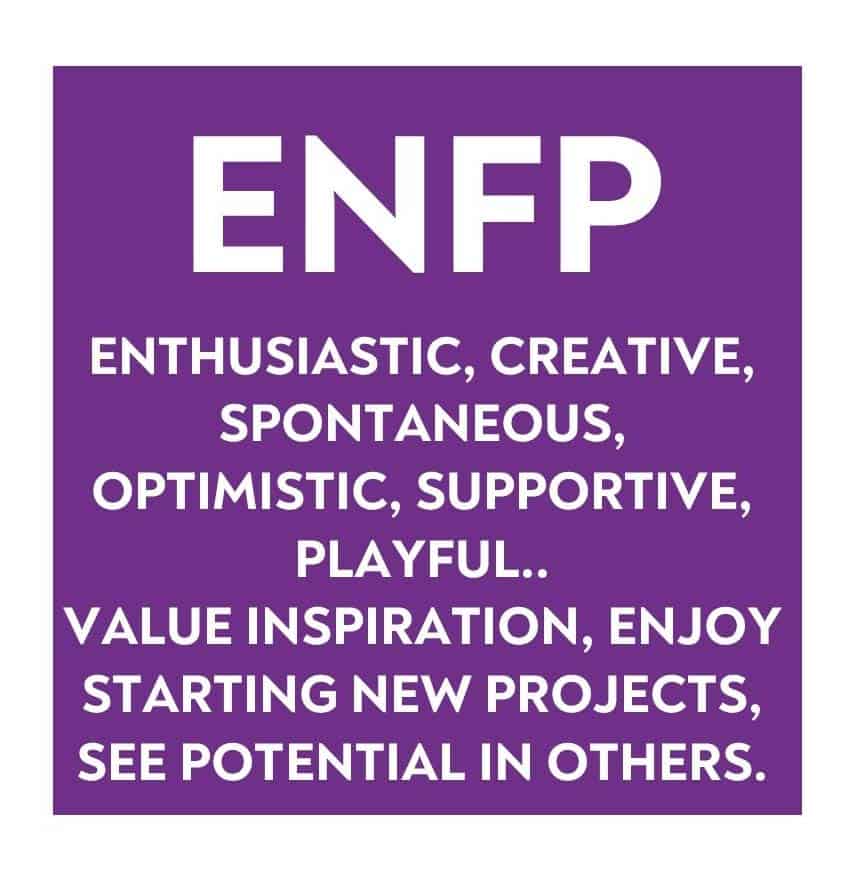
ENFPs are often described as warm, enthusiastic, and creative individuals. They are passionate about their interests, values, and ideas, and they have a natural ability to inspire and motivate others.
ENFP are supportive and appreciative of their loved ones and are often described as charismatic and charming. They often have a strong artistic side and a unique mastery of language.
They have excellent people and communication skills and gain energy from being in the company of others. They are free spirits with an optimistic and lively approach to life.
However, they might also struggle with overthinking, become easily stressed, and may tend to neglect routine or practical matters. They can be highly emotional and sensitive to criticism.
Famous ENTPs include Bill Clinton, Mark Twain, Dr. Suess, Drew Barrymore, Ellen Degeneres, Ron Weasley, and Julie Andrews.
ENFP is a fairly common personality type, and is the fifth most common among women. ENFPs make up:
ESFJs are sometimes referred to as “the Champion” or “the Campaigner.” ISTJ is the opposite personality type of ENFP.
StrengthsWeaknessesOutgoing and carefreeDisorganizedEmpatheticHypersensitiveOutgoing and carefreeOverthinksHighly creativeSeek approval from othersStrong social and communication skillsStruggle to follow through on their ideas
ENTP Characteristics
People with the ENFP personality type are highly imaginative and innovative
ENFPs are enthusiastic, people-centered individuals
ENTPs are known to be laid-back and easy going
ENFPs are natural-born leaders, standing up for what they believe in without hesitation or apology
ENFPs are spontaneous and highly adaptable to change
Cognitive Functions
The MBTI suggests that the four different cognitive functions (thinking, feeling, intuition, and sensing) form a hierarchy where each function is either directed outwardly (extroverted) or inwardly (introverted). The order of these functions determines one’s personality.

The dominant function is the primary aspect of personality, while the auxiliary and tertiary functions play supportive roles.
Dominant: Extraverted Intuition
Auxiliary: Introverted Feeling
Tertiary: Extraverted Thinking
Inferior: Introverted Sensing
ENFP Hobbies, Interests, and Careers
Because of their creative nature and need for flexibility, ENFPs are commonly found in careers in religion, entertainment, and the arts. They are driven, inspired individuals who enjoy taking on problems that call for imaginative, original solutions.
They make great journalists, actors, musicians, and politicians. Additionally, ENFPs often choose careers in nonprofits, public service, counseling, education, customer or public relations as these jobs tend to align with their core values.
They are highly sensitive to people’s feelings and needs, and they tend to be most passionate about careers that enable them to help other people reach their full potential.
In their free time, ENFPs enjoy writing, creating art, playing musical instruments, listening to music, participating in community theater, and reading fiction.
ENFP Work Environments
The ideal work environment for an ENFP is one that is relaxed and flexible with few restrictions on creativity. They dislike predictability, regimentation, and repetitions and tend to avoid careers that involve completing a lot of detailed, routine tasks.
They prefer a workplace where they can set their own schedule, explore new ideas, and use their imaginations in an unstructured way.They enjoy working on a team and establishing connections with the other employees.
They even tend to treat their colleagues not just as coworkers but also as friends. They appreciate an environment where everyone is treated as equals, and they tend to struggle in environments where they are micromanaged or strictly controlled.
ENFP Personal Relationships
ENFPs love spending time with other people. They feel invigorated and energized when socializing with others, and they are able to draw just about anyone into a conversation.
They even feel a sense of gratification when they are able to pull someone out of their shell and watch them gradually open up. They cherish their relationships deeply and have a longing for emotional connection.
ENFPs are empathetic and insightful individuals who are able to bring out the best in almost every person they meet. They are naturally upbeat and enthusiastic, and they love getting to know other people and understanding what drives them.
ENFPs are generous, supportive, and considerate in friendships and relationships and will go to great lengths to care for their loved ones.
ENFPs are dedicated to their relationships – whether with a friend or a partner. They tend to fall in love fast and hard, and can become insecure when they feel their partner’s ardor does not match their own.
Tips for Interacting With ENFPs
Friendships
ENFPs are not too particular in who they befriend as their approachable personalities draw in such a wide variety of people.
Relationships
Parenting
As parents, ENFPs typically have deep, loving relationships with their kids. They encourage their children to embrace their passions and interests and express themselves freely.
They tend not to be strong disciplinarians and do not impart many rules or guidelines in the household, but rather they prioritize imparting their strong system of values on their children.
References
King, S. P., & Mason, B. A. (2020). Myers‐Briggs Type Indicator. The Wiley Encyclopedia of Personality and Individual Differences: Measurement and Assessment, 315-319.
Myers, I. B. (1962). The Myers-Briggs Type Indicator: Manual (1962).
Myers-Briggs Type Indicator. (2019, May 28). New World Encyclopedia, . Retrieved from https://www.newworldencyclopedia.org/p/index.php?title=Myers-Briggs_Type_Indicator&oldid=1020015.
Myers, Isabel B.; Myers, Peter B. (1995) [1980]. Gifts Differing: Understanding Personality Type. Mountain View, CA: Davies-Black Publishing. ISBN 978-0-89106-074-1.
Pittenger, D. J. (2005).Cautionary Comments Regarding the Myers-Briggs Type Indicator. Consulting Psychology Journal: Practice and Research, 57(3), 210-221.
The purpose of the Myers-Briggs Type Indicator®. The Myers & Briggs Foundation: MBTI Basics. (n.d.). Retrieved from https://www.myersbriggs.org/my-mbti-personality-type/mbti-basics/
 campaigner personality

Saul McLeod, PhD
BSc (Hons) Psychology, MRes, PhD, University of Manchester
Saul McLeod, PhD., is a qualified psychology teacher with over 18 years of experience in further and higher education. He has been published in peer-reviewed journals, including the Journal of Clinical Psychology.
Olivia Guy-Evans, MSc
BSc (Hons) Psychology, MSc Psychology of Education
Olivia Guy-Evans is a writer and associate editor for Simply Psychology. She has previously worked in healthcare and educational sectors.
Julia Simkus
BA (Hons) Psychology, Princeton University
Julia Simkus is a graduate of Princeton University with a Bachelor of Arts in Psychology. She is currently studying for a Master’s Degree in Counseling for Mental Health and Wellness in September 2023. Julia’s research has been published in peer reviewed journals.
