On This Page:ToggleWarm and charismaticEmpathetic and insightfulIdealistic and principledGreat LeadersHobbiesCareersWork EnvironmentsPersonal RelationshipsTips for Interacting With ENFJsCognitive FunctionsTest
On This Page:Toggle
On This Page:
ENFJ (extraversion, intuition, feeling, judging) is a four-letter acronym used to represent one of the16 Myers-Briggs personality types. People with the ENFJ personality type tend to be responsible, outgoing, and loyal.
Key TakeawaysExtroversionmeans ENFJs gain energy from interacting with others and enjoy social settings. They are typically outgoing, talkative, and thrive in dynamic environments.Intuitionindicates ENFJs focus on possibilities and the big picture rather than concrete details. They are imaginative and future-oriented, constantly seeking new ideas and insights.Feelinghighlights that ENFJs prioritize emotions and values when making decisions. They are empathetic and strive for harmony in their relationships.Judgingreflects ENFJs’ preference for structure and organization. They are decisive, planful, and prefer to have things settled.
Key Takeaways
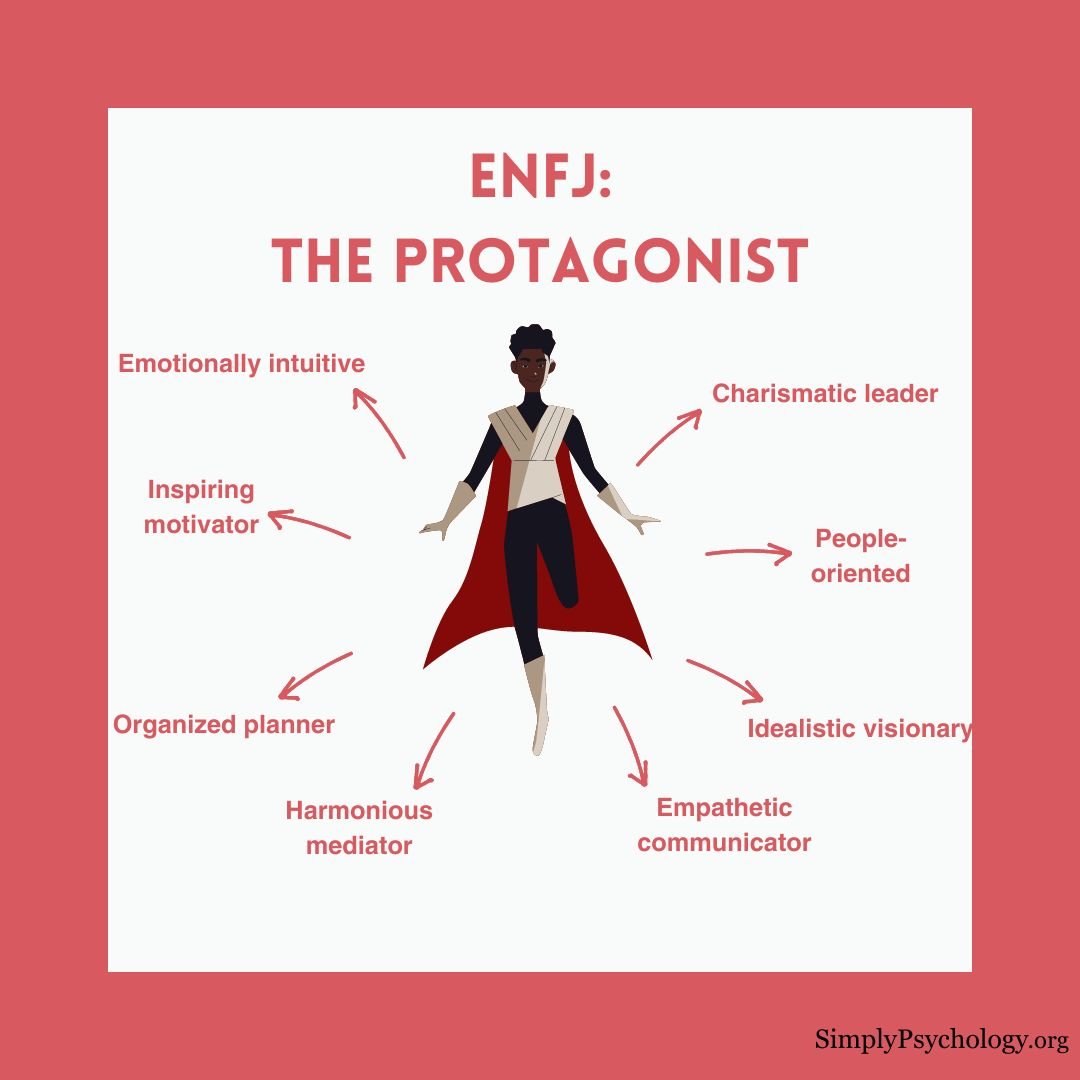 A mindmap infographic titled ENFJ: the protagonist with an image of a super hero in the centre and signs pointing off such as empathetic communicator, charismatic leader, and inspiring motivator.
ENFJ tend to make good leaders as they are highly capable of facilitating agreement among diverse groups of people.
They are charismatic, have excellent communication skills, and are typically very organized and goal-oriented. However, they can sometimes neglect their needs while caring for others and might struggle with taking criticism or dealing with conflict.
Famous ENFJs include Oprah Winfrey, Martin Luther King Jr., Abraham Maslow, Barack Obama, Pope John Paul II, and Maya Angelou.
ENFJ is one of the less common types in the population, especially for men. Among men, ENFJ is the second-rarest type. ENFJs make up:
ENFJs are sometimes referred to as “the Giver,” “the Protagonist,” or “the Teacher.”ISTPis the opposite personality type of ENFJ.
StrengthsWeaknessesAffectionateSelf-sacrificingHarmoniousOverprotectiveReliableIndecisiveAltruisticOverly IdealisticSociableManipulative
Warm and charismatic
ENFJs are naturally engaging and draw people to them with their genuine warmth and enthusiasm
They can form friendships with all types of people and captivate a wide audience with their irresistible charm.
Asextroverts, ENFJs love spending time with other people. They like to be the center of attention and thrive on the energy from being in the company of others.
They have excellent people skills and a unique ability to communicate proficiently in large crowds or small groups.
They are also skilled at establishing harmony among diverse groups of people as their charisma can easily persuade others to their ideas.
ENFJs tend to have large social circles. They work hard to maintain strong relationships and will go to great lengths to care for their loved ones.
However, while ENFJs are highly sociable, they do need time alone to recuperate and organize their thoughts.
Empathetic and insightful
ENFJs are highly attuned to the emotions of others and possess a deep understanding of human nature.
They have a unique ability to understand what others feel while also recognizing the importance of allowing others to express themselves fully.
They enjoy helping others solve their personal problems as they strive to have a positive impact on the world around them.
But, ENFJs can sometimes be too empathetic to the point of being over-involved. They can tend totake on other people’s problems as their own.
Idealistic and principled
ENFJs have strong values and strive to make the world a better place.They are passionate about justice and fairness, often advocating for social causes.
They preach authenticity and altruism and harbor a deep desire to be a force of positivity in the world.
They are driven to stand up for the people and ideas that they believe in because they genuinely believe they can make an impactful difference.
Great Leaders
People with the ENFJ personality type can make great leaders.They tend to be idealists who are driven to implement their visions and achieve their goals in order to benefit society.
ENFJs prefer structure and planning in their lives. They are efficient and decisive, able to take charge and make things happen
They are motivating and inspirational and feel passionate about the potential for humanity. ENFJs feel a personal responsibility to make the world a better place.
They can intuitively see opportunities for improvement in others and thus love to support people in becoming the best versions of themselves.
They are so interested in devoting their time to others, though, that sometimes they neglect their own needs in the process.
Hobbies
ENFJs have a thirst for knowledge and are constantly seeking personal growth. This suggests they might enjoy hobbies related to:
ENFJs are deeply relational and thrive on meaningful connections with others. This suggests they might enjoy hobbies that involve:
Careers
ENFJs are enthusiastic problem-solvers who are particularly skilled at resolving conflicts and creating harmony.
They can excel in essentially any people-oriented field, but tend to feel particularly motivated when they can help others learn and grow.
Work Environments
Their empathy, warmth, and communication skills make them excellent at building relationships and fostering a harmonious atmosphere.
Roles that involve interacting with people, such as teaching, counseling, or social work, often appeal to ENFJs
They thrive in environments that emphasize a clear humanitarian mission and are aligned with their personal values.
ENFJs look for work that allows them to support others and encourage their growth.
Personal Relationships
ENFJs bring a wealth of positive qualities to their relationships:
Compatible Matches: ENFJs and INTPs
Tips for Interacting With ENFJs
Friendships
The ideal friend for an ENFJ appreciates their compassion and support, and accepts the care that they naturally offer.
As people with this personality type enjoy helping others, it is important to make an ENFJ feel appreciated and acknowledged.
It is also important to make an effort to understand the ENFJ’s feelings and values and offer your own support in return.
Relationships
Similarly, as the significant other of an ENFJ, you should let your partner know how much you appreciate their generosity and care.
ENFJs believe relationships are built on trust and mutual support, so you should also be willing to provide the same love and kindness in return.
Parenting
As parents, ENFJs tend to have a more hands-on approach. They take a very active role in their children’s lives and enjoy guiding them through the world.
They can be overprotective and stifling, making it difficult for their children to learn and explore on their own.
They can also hold high expectations for their kids and become disappointed when they do not live up to these expectations.
However, they love their children deeply and tend to create encouraging and supportive home lives.
Cognitive Functions of an ENFJ
The MBTI suggests that the four different cognitive functions (thinking, feeling, intuition, and sensing) form a hierarchy where each function is either directed outwardly (extroverted) or inwardly (introverted). The order of these functions determines one’s personality.

The dominant function is the primary aspect of personality, while the auxiliary and tertiary functions play supportive roles.
Dominant: Extraverted Feeling
Auxiliary: Introverted Intuition
Tertiary: Extraverted Sensing
Inferior: Introverted Thinking
Test
Answer these questions to find out if ENFJ might be your personality type:
If you answer “yes” to most of these questions, you may have ENFJ personality traits. However, remember that personality is complex, and a professional assessment would be needed for a definitive personality type determination.
FAQs
What is an ENFJ personality?
ENFJs are skilled communicators, able to inspire and motivate those around them. They tend to be well-organized and value harmony in their relationships. However, they may struggle with taking criticism or setting personal boundaries, as they are highly attuned to the emotions and needs of others.
Is ENFJ a rare personality?ENFJ is a relatively rare personality type, making up about 2-3% of the general population. As extroverted, intuitive, feeling, and judging individuals, ENFJs are known for their warmth, empathy, and leadership abilities.Although not as rare as some other personality types, their unique combination of traits allows them to significantly impact their personal and professional lives, often excelling in roles that involve helping, teaching, or inspiring others.
Is ENFJ a rare personality?
ENFJ is a relatively rare personality type, making up about 2-3% of the general population. As extroverted, intuitive, feeling, and judging individuals, ENFJs are known for their warmth, empathy, and leadership abilities.Although not as rare as some other personality types, their unique combination of traits allows them to significantly impact their personal and professional lives, often excelling in roles that involve helping, teaching, or inspiring others.
ENFJ is a relatively rare personality type, making up about 2-3% of the general population. As extroverted, intuitive, feeling, and judging individuals, ENFJs are known for their warmth, empathy, and leadership abilities.
Although not as rare as some other personality types, their unique combination of traits allows them to significantly impact their personal and professional lives, often excelling in roles that involve helping, teaching, or inspiring others.
Sources
King, S. P., & Mason, B. A. (2020). Myers‐Briggs Type Indicator. The Wiley Encyclopedia of Personality and Individual Differences: Measurement and Assessment, 315-319.
Myers, I. B. (1962). The Myers-Briggs Type Indicator: Manual (1962).
Myers-Briggs Type Indicator. (2019, May 28). New World Encyclopedia, . Retrieved from https://www.newworldencyclopedia.org/p/index.php?title=Myers-Briggs_Type_Indicator&oldid=1020015.
Myers, Isabel B.; Myers, Peter B. (1995) [1980]. Gifts Differing: Understanding Personality Type. Mountain View, CA: Davies-Black Publishing. ISBN 978-0-89106-074-1.
Pittenger, D. J. (2005).Cautionary Comments Regarding the Myers-Briggs Type Indicator. Consulting Psychology Journal: Practice and Research, 57(3), 210-221.
The purpose of the Myers-Briggs Type Indicator®. The Myers & Briggs Foundation: MBTI Basics. (n.d.). Retrieved from https://www.myersbriggs.org/my-mbti-personality-type/mbti-basics/
 enfj personality type

Saul McLeod, PhD
BSc (Hons) Psychology, MRes, PhD, University of Manchester
Saul McLeod, PhD., is a qualified psychology teacher with over 18 years of experience in further and higher education. He has been published in peer-reviewed journals, including the Journal of Clinical Psychology.
Julia Simkus
BA (Hons) Psychology, Princeton University
Julia Simkus is a graduate of Princeton University with a Bachelor of Arts in Psychology. She is currently studying for a Master’s Degree in Counseling for Mental Health and Wellness in September 2023. Julia’s research has been published in peer reviewed journals.
