On This Page:TogglePurpose of TestTest PreparationProcedureInterpreting ResultsBrain WavesRisks
On This Page:Toggle
On This Page:
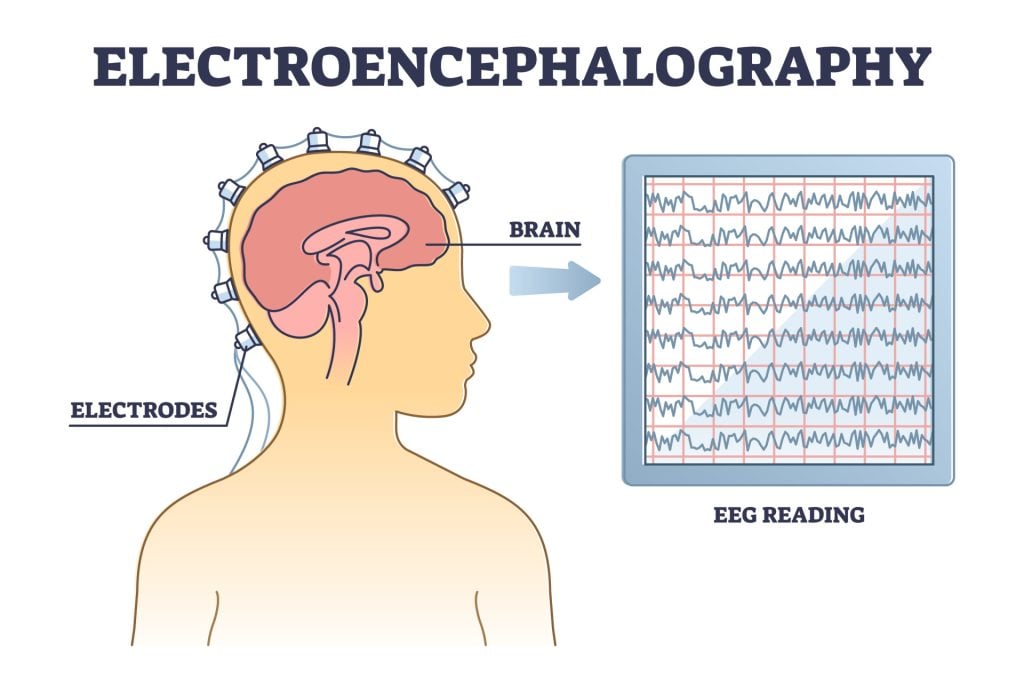
The electroencephalogram (EEG) is a non-invasiveneuroimaging testthat can detect and record minute changes in electrical activity within the brain. This is recorded using microelectrodes (large, flat electrodes stuck to the skin or scalp).
The electrical impulses in an EEG recording appear as wavy lines with peaks and valleys.
German physiologist Hans Berger was known as the inventor of the EEG back in 1924, where he conducted the first EEG on a human.
The electrodes cannot pick up signals for individual neurons. The recording shows the electrical activity from small areas of the brain. EEG is used to show the presence or absence of specific brain activity in specific areas of the brain, with an accuracy within milliseconds.
The electrodes of the EEG analyze the electrical impulses that are being communicated in the brain, which then gets transmitted to a computer which monitors the results.
EEGs record the electrical activity for a period of time to be able to indicate the level of activity in the brain. These electrical impulses are displayed as wavy lines on an EEG recording.
Purpose of Test
A doctor may advise the use of an EEG to be able to diagnose several conditions. As an EEG can determine changes in brain activity, this is a useful method for diagnosing brain disorders.
Below are some of the conditions which can be detected and measured from an EEG:
EEG Test Preparation
When preparing to have an EEG, it is usually advisable to wash your hair the night before or on the day of the test, and to not use conditioners. This is because hair products can make it more difficult for the electrodes to adhere to the scalp.
It is also advisable not to consume anything with caffeine or alcohol as this may affect the results.
If you are supposed to be sleeping during your EEG test, your doctor may advise you to not sleep the night before, or to sleep less, so that you are able to take part in the test.
EEG Procedure
Below is a list of steps that can be expected to happen during an EEG:

Interpreting Results
The electrodes that detect electrical activity will appear either as a graph or on a computer screen and will then be interpreted and sent to the doctor if testing for a diagnosis.
The doctor then might want to schedule an appointment to discuss the results of the test. Special attention will be paid to the basic waveforms, ensuring they follow the normal patterns of frequency.
Attention will also be paid to the bursts of energy and responses to certain stimuli, such as flashing lights.
Abnormal EEG wave patterns could be a result of one of the following:
Seizure activity on an EEG will typically appear as rapid spiking waves. Spikes are very fast waves and called so due to their shape, lasting as little as less than 80 milliseconds and standing out on an EEG.
Focal seizures, which occur in just one area of the brain, can only be seen on electrodes on the part of the brain the seizure is occurring in.
Typically the one electrode can display spikes of activity on the EEG, whereas the other electrodes would only pick up normal brain activity as the seizure is not happening there.
Individuals who have suffered damage to the brain as a result of a stroke or a tumor may present as having abnormally slow EEG waves depending on the size and location of the damage.
EEGs can also be used to evaluate the electrical activity of the brain of coma patients to determine the levels of brain activity they have. These can also be used to determine activity as a result of a trauma or drug intoxication, as well as monitor blood flow in the brain during surgical procedures.
In the field of psychology, EEGs are typically used to record cognitive processes. Comparisons can be made between a resting brain and when presented with a task or stimulus to examine activity in the brain.
Through the electrodes placed on different areas of the scalp, EEGs can be used to determine which parts of the brain correspond with certain behaviors.
Brain Waves
Four types of EEG patterns can be noticed on a recording: alpha waves, beta waves, theta waves, delta, and gamma waves.
The first is amplitude, which shows the intensity or the size of the activity. The other is the frequency, which is the quantity or the speed of activity. The frequency is the number of wave cycles per second, also known as hertz (Hz).

Below are descriptions of the types of EEG patterns:
Alpha WavesAlpha waves have a frequency range of around 8-13 waves per second. Hans Berger named this, being the first type of rhythmic EEG activity he saw.Alpha waves are typically witnessed in people who are awake, with their eyes open or closed, often in a relaxed state. It is noted that alpha waves are most visible in the occipital lobes of the brain, which is the area responsible for vision.Also, most alpha activity tends to be higher in amplitude on the dominant side of the brain in most people.
Alpha Waves
Alpha waves have a frequency range of around 8-13 waves per second. Hans Berger named this, being the first type of rhythmic EEG activity he saw.Alpha waves are typically witnessed in people who are awake, with their eyes open or closed, often in a relaxed state. It is noted that alpha waves are most visible in the occipital lobes of the brain, which is the area responsible for vision.Also, most alpha activity tends to be higher in amplitude on the dominant side of the brain in most people.
Alpha waves have a frequency range of around 8-13 waves per second. Hans Berger named this, being the first type of rhythmic EEG activity he saw.
Alpha waves are typically witnessed in people who are awake, with their eyes open or closed, often in a relaxed state. It is noted that alpha waves are most visible in the occipital lobes of the brain, which is the area responsible for vision.
Also, most alpha activity tends to be higher in amplitude on the dominant side of the brain in most people.
Beta WavesBeta waves have a frequency greater than 13 per second, the usual range being from 13 to about 30Hz.Beta waves are typically seen in people who are awake, with their eyes either opened or closed and are often viewed in the frontal lobes, which is where most conscious thought and movement occur.Low amplitude which has varying frequencies, is most often associated with active thinking, concentration, and anxious thoughts.
Beta Waves
Beta waves have a frequency greater than 13 per second, the usual range being from 13 to about 30Hz.Beta waves are typically seen in people who are awake, with their eyes either opened or closed and are often viewed in the frontal lobes, which is where most conscious thought and movement occur.Low amplitude which has varying frequencies, is most often associated with active thinking, concentration, and anxious thoughts.
Beta waves have a frequency greater than 13 per second, the usual range being from 13 to about 30Hz.
Beta waves are typically seen in people who are awake, with their eyes either opened or closed and are often viewed in the frontal lobes, which is where most conscious thought and movement occur.
Low amplitude which has varying frequencies, is most often associated with active thinking, concentration, and anxious thoughts.
Theta WavesThis pattern of activity usually has a frequency of around 4-7 waves per second. These waves are also known as slow activity, typically occurring during sleep, meditation, and in younger children.If there is an excess of theta activity in older children and adults, this could represent abnormal activity and could relate to drowsiness.
Theta Waves
This pattern of activity usually has a frequency of around 4-7 waves per second. These waves are also known as slow activity, typically occurring during sleep, meditation, and in younger children.If there is an excess of theta activity in older children and adults, this could represent abnormal activity and could relate to drowsiness.
This pattern of activity usually has a frequency of around 4-7 waves per second. These waves are also known as slow activity, typically occurring during sleep, meditation, and in younger children.
If there is an excess of theta activity in older children and adults, this could represent abnormal activity and could relate to drowsiness.
Delta WavesThese waves have a frequency of up to 4Hz, and so are the slowest waves. However, delta waves seem to be the highest in amplitude, so they have the strongest intensity.This wave pattern is most commonly witnessed during slow wave sleep and infants under the age of 1 year old.Gamma WavesGamma waves have a frequency with a range of 30Hz and above.
Delta Waves
These waves have a frequency of up to 4Hz, and so are the slowest waves. However, delta waves seem to be the highest in amplitude, so they have the strongest intensity.This wave pattern is most commonly witnessed during slow wave sleep and infants under the age of 1 year old.
These waves have a frequency of up to 4Hz, and so are the slowest waves. However, delta waves seem to be the highest in amplitude, so they have the strongest intensity.
This wave pattern is most commonly witnessed during slow wave sleep and infants under the age of 1 year old.
Gamma Waves
Gamma waves have a frequency with a range of 30Hz and above.
To conclude, different levels of consciousness appear differently on an EEG. For instance, when awake, the wave patterns tend to move faster than when asleep.
If the frequency of the wave patterns corresponds within the normal range of frequency, this is considered normal activity.
If the frequency is out of range of the normal wave pattern, this could be a sign of abnormal activity and may even suggest a type of brain disorder.
EEG patterns can produce either a synchronized or a desynchronized pattern. Synchronized patters occur when a recognizable waveform is detected (either alpha, beta, theta, or delta).
A desynchronized pattern occurs when no recognizable pattern can be detected.
What are the Risks of an EEG?
EEGs have been in use for many years and are considered a safe procedure, causing no discomfort. As the electrodes do not produce any sensations, there is very little risk, they cause no discomfort, and there is no risk of getting an electric shock.
EEGs are a non-invasive technique, meaning it does not involve any equipment going into the body. This makes EEGs a good choice in research, especially with younger participants.

The need for the participants to remain still are not required as much as with other neuroimaging methods such as with magnetic resonance imaging (MRI). Therefore, participants can carry out a variety of tasks or normal ongoing behaviors for an experiment without the worry of data being disrupted due to movements.
Another advantage of EEGs is that it has very high temporal resolution, meaning it can pick up frequencies really quickly, often within a single millisecond.
In comparison to other neuroimaging techniques such as MRI or positron emission tomography (PET), EEGs hold a strong advantage over these in terms of temporal resolution and cost-effectiveness. Similarly, many other neuroimaging methods will record changes in blood flow or metabolic activity, which are indirect markers of brain activity.
EEGs, however, can measure the brain’s electrical activity directly, making it more efficient in this sense.
Despite these strengths, EEGs main limitation is that it has poor spatial resolution. Spatial resolution refers to the capacity a neuroimaging technique has to show exactly which area of the brain is active.
This is why neuroscientists would discuss EEG activity generated at specific electrode locations rather than concluding that a certain part of the brain generated the activity.
Research studies
References
Bell, M. A. (2012). A psychobiological perspective on working memory performance at 8 months of age.Child Development, 83(1), 251-265.
Coutin-Churchman, P., Anez, Y., Uzcategui, M., Alvarez, L., Vergara, F., Mendez, L., & Fleitas, R. (2003). Quantitative spectral analysis of EEG in psychiatry revisited: drawing signs out of numbers in a clinical setting.Clinical Neurophysiology, 114(12), 2294-2306.
Mayo Clinic. (April 15, 2020).EEG (Electroencephalogram). https://www.mayoclinic.org/tests-procedures/eeg/about/pac-20393875
Further ReadingElectroencephalography (EEG)Casson, A. J., Abdulaal, M., Dulabh, M., Kohli, S., Krachunov, S., & Trimble, E. (2018). Electroencephalogram. In Seamless Healthcare Monitoring (pp. 45-81). Springer, Cham.
Further Reading
Electroencephalography (EEG)Casson, A. J., Abdulaal, M., Dulabh, M., Kohli, S., Krachunov, S., & Trimble, E. (2018). Electroencephalogram. In Seamless Healthcare Monitoring (pp. 45-81). Springer, Cham.

Saul McLeod, PhD
BSc (Hons) Psychology, MRes, PhD, University of Manchester
Saul McLeod, PhD., is a qualified psychology teacher with over 18 years of experience in further and higher education. He has been published in peer-reviewed journals, including the Journal of Clinical Psychology.
Olivia Guy-Evans, MSc
BSc (Hons) Psychology, MSc Psychology of Education
Olivia Guy-Evans is a writer and associate editor for Simply Psychology. She has previously worked in healthcare and educational sectors.
