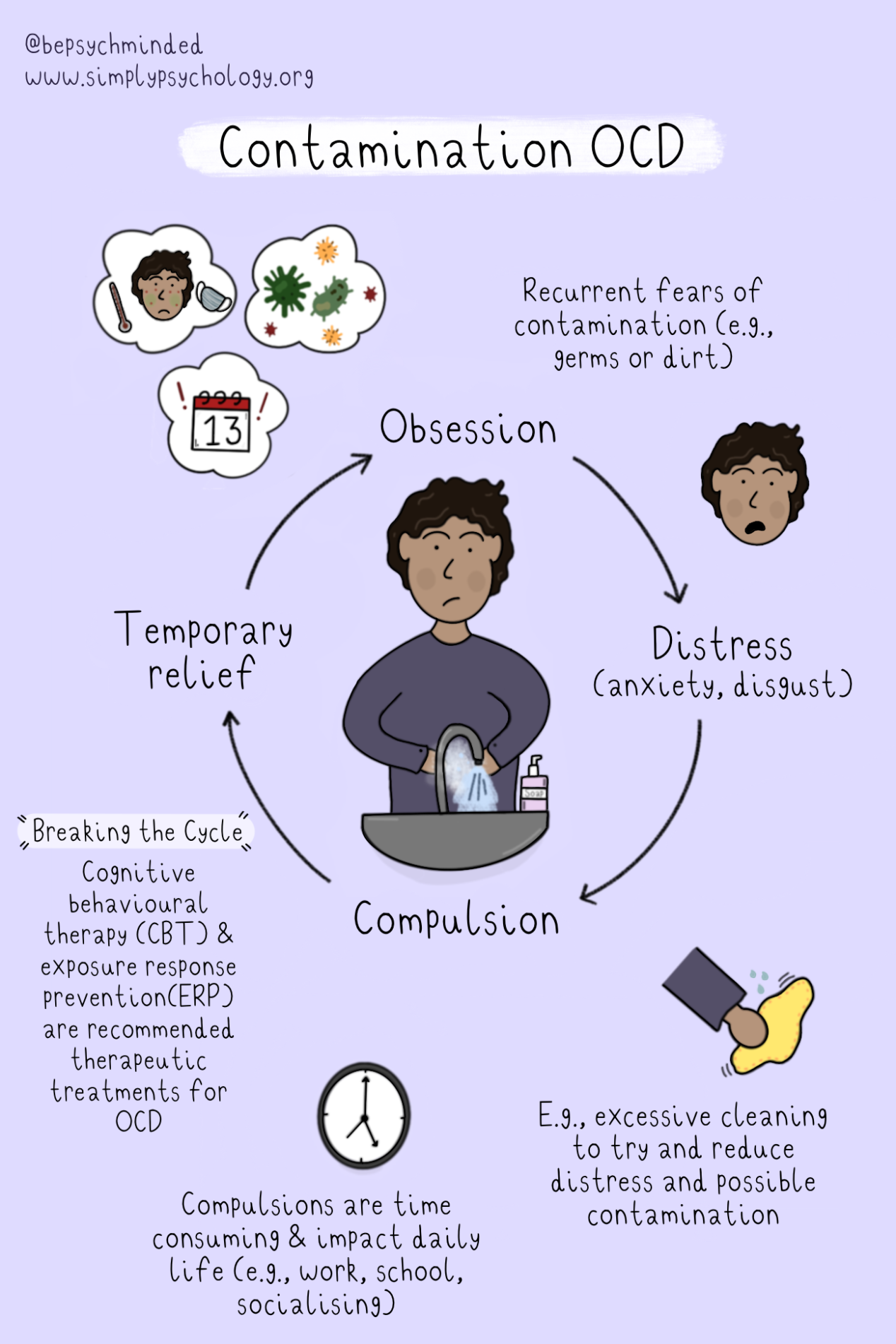

Contamination OCD is a common subtype ofOCDwhere a person experiences unwanted obsessive thoughts and fears of being physically contaminated, contaminating others, or contracting and spreading an illness. They can spend hours a day preoccupied with these fears.
The fear is primarily related to the actual presence of tangible dirt or germs.
In response to these fears, a person with Contamination OCD will attempt to repress their unwanted thoughts, or neutralize them, through ritualistic and repetitive behaviors known as compulsions.
Washing or cleaning behaviors are seen as effective in reducing anxiety and removing physical contaminants.
Examples of contamination OCD compulsions include showering for hours, avoiding crowded spaces, orhand-washinguntil their skin becomes raw.
Contamination OCD is one of the more common and well-known subtypes of OCD.Research suggestsit can affect up to 46% of people with OCD.
Some studieshave found that individuals with OCD and contamination fears tend to have a higher tendency to feel disgusted. This means that they may be more sensitive to things that they perceive as dirty or contaminated, which can contribute to their symptoms.
How do I know if I have contamination OCD?
Symptoms of contamination OCD manifest differently in each sufferer; however, some common thoughts and behaviors may indicate someone suffers from this type of OCD. Below is a list of common obsessions and compulsions associated with contamination OCD.
According to the DSM-5, in order to be diagnosed with OCD, you mustfit the following criteria:
Common Contamination OCD Obsessions
Common Contamination OCD Compulsions
How Does Contamination OCD Affect a Person’s Daily Life?
The obsessive thoughts and compulsions associated with Contamination OCD can greatly impact a person’s daily life and functioning. Contamination OCD can be incredibly time-consuming, disruptive, and draining.
Obsessive thoughts and compulsive behaviors can consume hours of one’s day and feel impossible to stop.
For example, people with a hand-washing compulsion can spend multiple hours in a single day washing their hands, leaving their skin red, wounded, and irritated.
Additionally, individuals with this type of OCD tend to feel great anxiety about being in public spaces, which may lead them to not leave their own home or severely restrict their travel to public places.
As withall types of OCD, the more a person engages in the obsession-compulsion cycle, the stronger the Contamination OCD can become. The more they wash their hands and avoid leaving their home, the more the fear of contamination grows.
Compulsive behaviors only provide small amounts of short-term relief, increasing the fear and obsessions in the long run and eventually taking over a person’s life completely. The condition can make it challenging to hold down a job, maintain a relationship, or simply leave the house.
Is Contamination OCD Treatable?
Although there is no “cure” for OCD, it can betreated and controlled effectively. You can learn tomanage how your symptoms affect your daily lifethrough medication, therapy, mindfulness, or a combination of treatments.
At least half of the patients who seek treatment for OCD will show symptomatic remission over the long term and experience an increased quality of life and improved functioning.
 germ ocd
The bestoutcomes occurin individuals who are diagnosed early and start an intense treatment program right away. Depending on the severity of OCD, some people may need longer-term or more intensive treatment.
“I’ve had contamination OCD for over 14 years now. It was quite severe in the beginning and now I’d say my compulsions and obsessive thoughts take less than 2 hours of my day. Pandemic surely made it worse for a while but I’ve managed to cope with it in time.
What worked for me was exposure therapy. It’s hard and mentally draining and while doing it when my OCD was at its worst, I remember crying because I had to touch ‘dirty’ things and make myself not wash my hands afterwards.
In time it got easier and the calm that comes after that ‘obsession anxiety’ became a much better deal than doing the compulsion.
Don’t lose hope. Everyone’s OCD is different and it can be more or less severe, but you can manage it and live mostly normal life with it.”
Cognitive Behavioral Therapy for Contamination-Related Fears
Cognitive Behavioral Therapy (CBT) is one of the most common and effective treatments for individuals dealing with all types of OCD, including Contamination OCD.
Exposure with Response Prevention (ERP) and Mindfulness-Based Cognitive Therapy (MBCT) are two approaches to CBT that have proven to be particularly beneficial for the treatment of Contamination OCD.
Exposure and Response Prevention for Contamination-Related Fears
Exposure and Response Prevention (ERP), a type of CBT, is considered the first-line psychotherapy for OCD. In ERP, patients work with a therapist to identify both external and internal triggers that cause them stress and make them want to behave compulsively.
ERP is designed to gradually reduce the anxiety that feeds the obsessions and compulsions through a process called habituation. The goal of habituation is to purposely invoke anxiety in attempts to disrupt the neural circuit between the processing and action parts of the brain.
For example, an ERP therapist might encourage a patient with a fear of touching doorknobs to intentionally touch doorknobs without covering their hands, washing their hands immediately after, or engaging in other compulsions.
By staying in a feared situation and leaning into the discomfort and uncertainty, patients learn that they don’t need their compulsions to cope and their fearful thoughts are just thoughts and nothing else.
While ERP can feel very difficult and time-consuming, overtime patients learn that they can cope with their thoughts without relying on ritualistic behaviors.
Mindfulness-Based Cognitive Therapy for Contamination-Related Fears
Mindfulness-Based CBT (MBCT) is a type of psychotherapy that combines the ideas of cognitive therapy, meditative practices, and the cultivation of mindfulness.
In contrast toERP, MBCT encourages patients to observe their unpleasant experiences or thoughts as they arise and label them simply as thoughts, feelings or bodily experiences.
Patients are taught to refrain from judging these thoughts and from acting on them compulsively and to approach their experiences with non-judgmental awareness and acceptance.
Real-Life Personal Experience
“For all those lurkers who were once me. I just want to say that you are able to recover from contamination OCD. I have made so much progress in just a month. I am still a work in progress but it feels good to be able to live again.
Last month I was not able to touch anything. I thought everything was dirty. I had a major fear of feces and thought everything was contaminated.
I didn’t use my pockets or touch the lower half of my body for over a year. Washed my hands for so long every time I went to the bathroom. I’m always scared to share my full story as I don’t want others to have any of the thoughts I did. It was/is difficult. I finally saw a therapist and started my recovery.
ERP works. It is very challenging but well worth it. I cried in my therapist’s room, and still do. Before they were sad and despairing and now they’re usually happy tears.”
“It’s possible to regain control over anxiety and compulsions. Seek a therapist experienced in OCD and Exposure Response Prevention (ERP) therapy, even if you’re unsure about needing one.
I never really saw mine as a huge problem and thought “I’ll get over it” and then one day I showered 3 times in a row and washed my hands for probably 4 hours. I felt like I hit rock bottom.Acknowledging the problem and seeking help is the first step. Despite the exhausting battle, reclaiming your life is worth it. Recovery is possibly! Know that.”
Mental Contamination
However, contamination can also be related to thoughts, memories, emotions, or experiences perceived asmorally or psychologically unclean or repulsive.
Individuals who experience a sense of dirtiness inside have an intense urge to engage in washing or cleansing behaviors to relieve this internal contamination.
However, washing or cleaning behaviors are often ineffective in alleviating the sense of internal dirtiness because dirtiness comes from intangible sources like thoughts or memories.
For example, let’s say you have experienced a traumatic event, such as a sexual assault. Even if there is no physical contact with anything dirty, you may still feel mentally contaminated.
It’s important to understand that mental contamination is a separate concept from traditional contamination. In some cases, people may experience one type without the other, or they may experience both. Everyone’s experience is unique.
Alternative Treatment
OCD is typically treated with medication and exposure therapy, where patients touch contaminated surfaces without washing. However, this therapy can be extremely stressful. Seeking an alternative, researchers tested whether contaminating a rubber hand could help patients overcome contamination fears without the stress (Jalal et al., 2020).
They used the famous “rubber hand illusion,” where stroking a fake hand in sync with someone’s real (hidden) hand can create the sensation that the fake hand is their own. In some psychiatric conditions like OCD, the illusion works even with asynchronous stroking, suggesting more malleable body perceptions.
The researchers recruited 29 OCD patients undergoing intensive residential treatment. Sixteen patients had their hands stroked in sync, while 13 (controls) were stroked out of sync. After 5 minutes, a contaminant was smeared on the rubber hand while the real hand was dabbed with a wet towel.
Patients in both groups initially reported equal levels of contamination. After ten more minutes of stroking and contaminating the fake hand, patients in the sync condition showed more disgust, suggesting a stronger illusion.
Finally, the contaminant was put directly on the patients’ real hands. Now, experimental patients reported much higher disgust, anxiety, and washing urge levels – a 23% difference versus controls.
The experiment shows contaminating a rubber hand could provide effective OCD exposure therapy without the high stress of real contamination.
It also has advantages over other therapies like virtual reality in affordability and accessibility. However, larger randomized trials are still needed to compare this technique to existing treatments. Overall, it suggests a promising alternative OCD treatment using a clever, convenient illusion.
Sources
American Psychiatric Association,DSM-5 The Diagnostic and Statistical Manual of Mental Disorders. 5 ed, ed. D. Kupfer: American Psychiatric Association
Coughtrey, A. E., Shafran, R., Lee, M., & Rachman, S. (2013). The treatment of mental contamination: A case series.Cognitive and Behavioral Practice,20(2), 221-231.
Coughtrey, A. E., Shafran, R., & Rachman, S. J. (2014). The spread of mental contamination.Journal of Behavior Therapy and Experimental Psychiatry,45(1), 33-38.
Fairbrother, N., Newth, S. J., & Rachman, S. (2005). Mental pollution: Feelings of dirtiness without physical contact.Behaviour Research and Therapy,43(1), 121-130.
Jalal, B., McNally, R. J., Elias, J. A., Potluri, S., & Ramachandran, V. S. (2020). “Fake it till You Make it”! Contaminating Rubber Hands (“Multisensory Stimulation Therapy”) to Treat Obsessive-Compulsive Disorder.Frontiers in Human Neuroscience,13, 414.
Nicholson, E., & Barnes-Holmes, D. (2012). Developing an implicit measure of disgust propensity and disgust sensitivity: Examining the role of implicit disgust propensity and sensitivity in obsessive-compulsive tendencies.Journal of Behavior Therapy and Experimental Psychiatry,43(3), 922-930.

Saul McLeod, PhD
BSc (Hons) Psychology, MRes, PhD, University of Manchester
Saul McLeod, PhD., is a qualified psychology teacher with over 18 years of experience in further and higher education. He has been published in peer-reviewed journals, including the Journal of Clinical Psychology.
Olivia Guy-Evans, MSc
BSc (Hons) Psychology, MSc Psychology of Education
Olivia Guy-Evans is a writer and associate editor for Simply Psychology. She has previously worked in healthcare and educational sectors.
Julia Simkus
BA (Hons) Psychology, Princeton University
Julia Simkus is a graduate of Princeton University with a Bachelor of Arts in Psychology. She is currently studying for a Master’s Degree in Counseling for Mental Health and Wellness in September 2023. Julia’s research has been published in peer reviewed journals.
