On This Page:ToggleTypesExamplesExplanationsImplicationsMitigating Confirmation BiasRelated Cognitive BiasesLearning CheckTake-home Messages
On This Page:Toggle
On This Page:
Its results showed that the subjects chose responses that supported their hypotheses while rejecting contradictory evidence, and even though their hypotheses were incorrect, they became confident in them quickly (Gray, 2010, p. 356).
Though such evidence of confirmation bias has appeared in psychological literature throughout history, the term ‘confirmation bias’ was first used in a 1977 paper detailing an experimental study on the topic (Mynatt, Doherty, & Tweney, 1977).
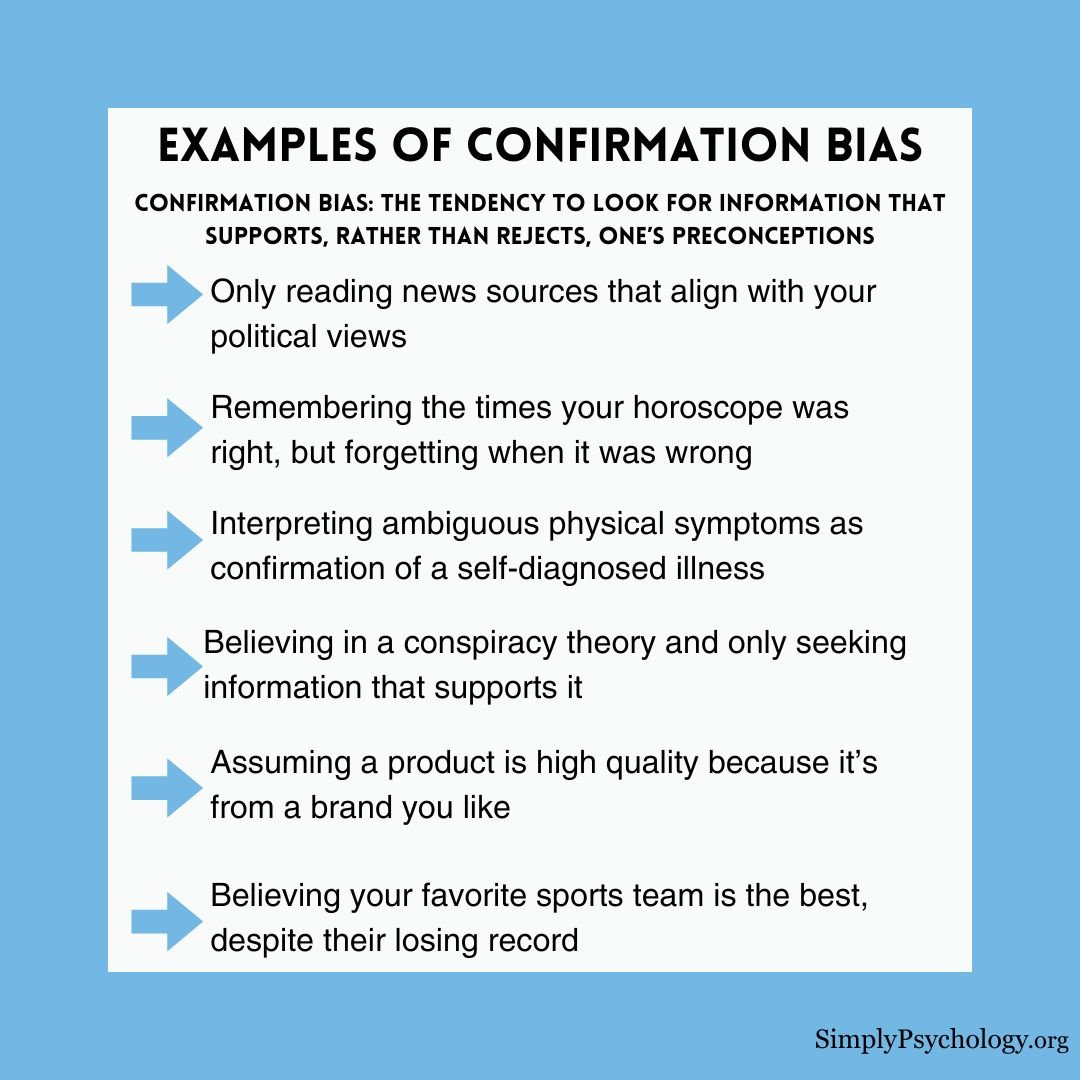
Confirmation bias in psychology is the tendency to favor information that confirms existing beliefs or values. People exhibiting this bias are likely to seek out, interpret, remember, and give more weight to evidence that supports their views, while ignoring, dismissing, or undervaluing the relevance of evidence that contradicts them.

Types
Biased Search for InformationThis type of confirmation bias explains people’s search for evidence in a one-sided way to support their hypotheses or theories.Experiments have shown that people provide tests/questions designed to yield “yes” if their favored hypothesis is true and ignore alternative hypotheses that are likely to give the same result.This is also known as the congruence heuristic (Baron, 2000, p.162-64). Though the preference for affirmative questions itself may not be biased, there are experiments that have shown that congruence bias does exist.For Example:If you were to search “Are cats better than dogs?” in Google, all you would get are sites listing the reasons why cats are better.However, if you were to search “Are dogs better than cats?” google will only provide you with sites that believe dogs are better than cats.This shows that phrasing questions in a one-sided way (i.e., affirmative manner) will assist you in obtaining evidence consistent with your hypothesis.
Biased Search for Information
This type of confirmation bias explains people’s search for evidence in a one-sided way to support their hypotheses or theories.Experiments have shown that people provide tests/questions designed to yield “yes” if their favored hypothesis is true and ignore alternative hypotheses that are likely to give the same result.This is also known as the congruence heuristic (Baron, 2000, p.162-64). Though the preference for affirmative questions itself may not be biased, there are experiments that have shown that congruence bias does exist.For Example:If you were to search “Are cats better than dogs?” in Google, all you would get are sites listing the reasons why cats are better.However, if you were to search “Are dogs better than cats?” google will only provide you with sites that believe dogs are better than cats.This shows that phrasing questions in a one-sided way (i.e., affirmative manner) will assist you in obtaining evidence consistent with your hypothesis.
This type of confirmation bias explains people’s search for evidence in a one-sided way to support their hypotheses or theories.
Experiments have shown that people provide tests/questions designed to yield “yes” if their favored hypothesis is true and ignore alternative hypotheses that are likely to give the same result.
This is also known as the congruence heuristic (Baron, 2000, p.162-64). Though the preference for affirmative questions itself may not be biased, there are experiments that have shown that congruence bias does exist.
If you were to search “Are cats better than dogs?” in Google, all you would get are sites listing the reasons why cats are better.
However, if you were to search “Are dogs better than cats?” google will only provide you with sites that believe dogs are better than cats.
This shows that phrasing questions in a one-sided way (i.e., affirmative manner) will assist you in obtaining evidence consistent with your hypothesis.
Biased Interpretation
Various experiments have shown that people tend not to change their beliefs on complex issues even after being provided with research because of the way they interpret the evidence.
Additionally, people accept “confirming” evidence more easily and critically evaluate the “disconfirming” evidence (this is known as disconfirmation bias) (Taber & Lodge, 2006).
When provided with the same evidence, people’s interpretations could still be biased.
All subjects were provided with the same two studies.
Biased MemoryTo confirm their current beliefs, people may remember/recall information selectively. Psychological theories vary in defining memory bias.Some theories state that information confirming prior beliefs is stored in the memory while contradictory evidence is not (i.e., Schema theory). Some others claim that striking information is remembered best (i.e., humor effect).Memory confirmation bias also serves a role in stereotype maintenance. Experiments have shown that the mental association between expectancy-confirming information and the group label strongly affects recall and recognition memory.Though a certain stereotype about a social group might not be true for an individual, people tend to remember the stereotype-consistent information better than any disconfirming evidence (Fyock & Stangor, 1994).For example:In one experimental study, participants were asked to read a woman’s profile (detailing her extroverted and introverted skills) and assess her for either a job of a librarian or real-estate salesperson.Those assessing her as a salesperson better recalled extroverted traits, while the other group recalled more examples of introversion (Snyder & Cantor, 1979).These experiments, along with others, have offered an insight into selective memory and provided evidence for biased memory, proving that one searches for and better remembers confirming evidence.
Biased Memory
To confirm their current beliefs, people may remember/recall information selectively. Psychological theories vary in defining memory bias.Some theories state that information confirming prior beliefs is stored in the memory while contradictory evidence is not (i.e., Schema theory). Some others claim that striking information is remembered best (i.e., humor effect).Memory confirmation bias also serves a role in stereotype maintenance. Experiments have shown that the mental association between expectancy-confirming information and the group label strongly affects recall and recognition memory.Though a certain stereotype about a social group might not be true for an individual, people tend to remember the stereotype-consistent information better than any disconfirming evidence (Fyock & Stangor, 1994).For example:In one experimental study, participants were asked to read a woman’s profile (detailing her extroverted and introverted skills) and assess her for either a job of a librarian or real-estate salesperson.Those assessing her as a salesperson better recalled extroverted traits, while the other group recalled more examples of introversion (Snyder & Cantor, 1979).These experiments, along with others, have offered an insight into selective memory and provided evidence for biased memory, proving that one searches for and better remembers confirming evidence.
To confirm their current beliefs, people may remember/recall information selectively. Psychological theories vary in defining memory bias.
Some theories state that information confirming prior beliefs is stored in the memory while contradictory evidence is not (i.e., Schema theory). Some others claim that striking information is remembered best (i.e., humor effect).
Memory confirmation bias also serves a role in stereotype maintenance. Experiments have shown that the mental association between expectancy-confirming information and the group label strongly affects recall and recognition memory.
Though a certain stereotype about a social group might not be true for an individual, people tend to remember the stereotype-consistent information better than any disconfirming evidence (Fyock & Stangor, 1994).
In one experimental study, participants were asked to read a woman’s profile (detailing her extroverted and introverted skills) and assess her for either a job of a librarian or real-estate salesperson.
Those assessing her as a salesperson better recalled extroverted traits, while the other group recalled more examples of introversion (Snyder & Cantor, 1979).
These experiments, along with others, have offered an insight into selective memory and provided evidence for biased memory, proving that one searches for and better remembers confirming evidence.
Examples

Social Media
Information we are presented on social media is not only reflective of what the users want to see but also of the designers’ beliefs and values. Today, people are exposed to an overwhelming number of news sources, each varying in their credibility.
To form conclusions, people tend to read the news that aligns with their perspectives. For instance, new channels provide information (even the same news) differently from each other on complex issues (i.e., racism, political parties, etc.), with some using sensational headlines/pictures and one-sided information.
Due to the biased coverage of topics, people only utilize certain channels/sites to obtain their information to make biased conclusions.
Religious Faith
People also tend to search for and interpret evidence with respect to their religious beliefs (if any).
For instance, on the topics of abortion and transgender rights, people whose religions are against such things will interpret this information differently than others and will look for evidence to validate what they believe.
Similarly, those who religiously reject the theory of evolution will either gather information disproving evolution or hold no official stance on the topic.
when Does The Confirmation Bias Occur?
There are several explanations why humans possess confirmation bias, including this tendency being an efficient way to process information, protect self-esteem, and minimize cognitive dissonance.
Information Processing
Confirmation bias serves as an efficient way toprocess informationbecause of the limitless information humans are exposed to.
To form an unbiased decision, one would have to critically evaluate every piece of information present, which is unfeasible. Therefore, people only tend to look for information desired to form their conclusions (Casad, 2019).
Protect Self-esteem
People are susceptible to confirmation bias to protect their self-esteem (to know that their beliefs are accurate).
To make themselves feel confident, they tend to look for information that supports their existing beliefs (Casad, 2019).
Minimize Cognitive Dissonance
Cognitive dissonancealso explains why confirmation bias is adaptive.
Cognitive dissonance is a mental conflict that occurs when a person holds two contradictory beliefsand causes psychological stress/unease in a person.
Challenge avoidance and reinforcement seeking to affect people’s thoughts/reactions differently since exposure to disconfirming information results in negative emotions, something that is nonexistent when seeking reinforcing evidence (“The Confirmation Bias: Why People See What They Want to See”).
Implications
Confirmation bias consistently shapes the way we look for and interpret information that influences our decisions in this society, ranging from homes to global platforms. This bias prevents people from gathering information objectively.
Politics
During the election campaign, people tend to look for information confirming their perspectives on different candidates while ignoring any information contradictory to their views.
This subjective manner of obtaining information can lead to overconfidence in a candidate, and misinterpretation/overlooking of important information, thus influencing their voting decision and, eventually country’s leadership (Cherry, 2020).
Recruitment and Selection
Confirmation bias also affects employment diversity because preconceived ideas about different social groups can introduce discrimination (though it might be unconscious) and impact the recruitment process (Agarwal, 2018).
Existing beliefs of a certain group being more competent than the other is the reason why particular races and gender are represented the most in companies today. This bias can hamper the company’s attempt at diversifying its employees.
Mitigating Confirmation Bias
Change in intrapersonal thought:
To avoid being susceptible to confirmation bias, start questioning your research methods, and sources used to obtain their information.
Expanding the types of sources used in searching for information could provide different aspects of a particular topic and offer levels of credibility.
Alternative hypothesis:
Considering the possibility of beliefs/hypotheses other than one’s own could help you gather information in a more dynamic manner (rather than a one-sided way).
Related Cognitive Biases
Backfire Effect
One piece of disconfirming evidence does not change people’s views, but a constant flow of credible refutations could correct misinformation/misconceptions.
This effect is considered a subtype of confirmation bias because it explains people’s reactions to new information based on their preexisting hypotheses.
While examining two statements, “I am not a Muslim, Obama says.” and “I am a Christian, Obama says,” they concluded that the latter statement is more persuasive and resulted in people’s change of beliefs, thus affirming statements are more effective at correcting incorrect views (Silverman, 2011).
Halo Effect
Experiments have shown that when positive attributes are presented first, a person is judged more favorably than when negative traits are shown first. This is a subtype of confirmation bias because it allows us to structure our thinking about other information using only initial evidence.
Learning Check
When does the confirmation bias occur?
The correct answer is A. Confirmation bias occurs when an individual only researches information consistent with personal beliefs. This bias leads people to favor information that confirms their preconceptions or hypotheses, regardless of whether the information is true.
Take-home Messages
Confirmation bias is the tendency of people to favor information that confirms their existing beliefs or hypotheses.Confirmation bias happens when a person gives more weight to evidence that confirms their beliefs and undervalues evidence that could disprove it.People display this bias when they gather or recall information selectively or when they interpret it in a biased way.The effect is stronger for emotionally charged issues and for deeply entrenched beliefs.
References
Agarwal, P., Dr. (2018, October 19).Here Is How Bias Can Affect Recruitment In Your Organisation.https://www.forbes.com/sites/pragyaagarwaleurope/2018/10/19/how-can-bias-during-interviewsaffect-recruitment-in-your-organisation
American Psychological Association. (n.d.). APA Dictionary of Psychology. https://dictionary.apa.org/confirmation-bias
Baron, J. (2000).Thinking and Deciding (Third ed.).Cambridge University Press.
Casad, B. (2019, October 09).Confirmation bias. https://www.britannica.com/science/confirmation-bias
Cherry, K. (2020, February 19).Why Do We Favor Information That Confirms Our Existing Beliefs?https://www.verywellmind.com/what-is-a-confirmation-bias-2795024
Fyock, J., & Stangor, C. (1994). The role of memory biases in stereotype maintenance.The British journal of social psychology, 33(3), 331–343.
Gray, P. O. (2010).Psychology. New York: Worth Publishers.
Lord, C. G., Ross, L., & Lepper, M. R. (1979). Biased assimilation and attitude polarization: The effects of prior theories on subsequently considered evidence.Journal of Personality and Social Psychology, 37(11), 2098–2109.
Mynatt, C. R., Doherty, M. E., & Tweney, R. D. (1977). Confirmation bias in a simulated research environment: An experimental study of scientific inference.Quarterly Journal of Experimental Psychology, 29(1), 85-95.
Neugaard, B. (2019, October 09).Halo effect.https://www.britannica.com/science/halo-effect
Silverman, C. (2011, June 17).The Backfire Effect. https://archives.cjr.org/behind_the_news/the_backfire_effect.php
Snyder, M., & Cantor, N. (1979). Testing hypotheses about other people: The use of historical knowledge.Journal of Experimental Social Psychology, 15(4), 330–342.
Further InformationWhat Is Confirmation Bias and When Do People Actually Have It?Confirmation Bias: A Ubiquitous Phenomenon in Many GuisesThe importance of making assumptions: why confirmation is not necessarily a biasDecision Making Is Caused By Information Processing And Emotion: A Synthesis Of Two Approaches To Explain The Phenomenon Of Confirmation Bias
Further Information
What Is Confirmation Bias and When Do People Actually Have It?Confirmation Bias: A Ubiquitous Phenomenon in Many GuisesThe importance of making assumptions: why confirmation is not necessarily a biasDecision Making Is Caused By Information Processing And Emotion: A Synthesis Of Two Approaches To Explain The Phenomenon Of Confirmation Bias
When does the confirmation bias occur?Confirmation bias occurs when individuals selectively collect, interpret, or remember information that confirms their existing beliefs or ideas, while ignoring or discounting evidence that contradicts these beliefs.This bias can happen unconsciously and can influence decision-making and reasoning in various contexts, such as research, politics, or everyday decision-making.What is confirmation bias in psychology?Confirmation bias in psychology is the tendency to favor information that confirms existing beliefs or values. People exhibiting this bias are likely to seek out, interpret, remember, and give more weight to evidence that supports their views, while ignoring, dismissing, or undervaluing the relevance of evidence that contradicts them.This can lead to faulty decision-making because one-sided information doesn’t provide a full picture.
When does the confirmation bias occur?Confirmation bias occurs when individuals selectively collect, interpret, or remember information that confirms their existing beliefs or ideas, while ignoring or discounting evidence that contradicts these beliefs.This bias can happen unconsciously and can influence decision-making and reasoning in various contexts, such as research, politics, or everyday decision-making.
Confirmation bias occurs when individuals selectively collect, interpret, or remember information that confirms their existing beliefs or ideas, while ignoring or discounting evidence that contradicts these beliefs.This bias can happen unconsciously and can influence decision-making and reasoning in various contexts, such as research, politics, or everyday decision-making.
Confirmation bias occurs when individuals selectively collect, interpret, or remember information that confirms their existing beliefs or ideas, while ignoring or discounting evidence that contradicts these beliefs.
This bias can happen unconsciously and can influence decision-making and reasoning in various contexts, such as research, politics, or everyday decision-making.
What is confirmation bias in psychology?Confirmation bias in psychology is the tendency to favor information that confirms existing beliefs or values. People exhibiting this bias are likely to seek out, interpret, remember, and give more weight to evidence that supports their views, while ignoring, dismissing, or undervaluing the relevance of evidence that contradicts them.This can lead to faulty decision-making because one-sided information doesn’t provide a full picture.
What is confirmation bias in psychology?
Confirmation bias in psychology is the tendency to favor information that confirms existing beliefs or values. People exhibiting this bias are likely to seek out, interpret, remember, and give more weight to evidence that supports their views, while ignoring, dismissing, or undervaluing the relevance of evidence that contradicts them.This can lead to faulty decision-making because one-sided information doesn’t provide a full picture.
This can lead to faulty decision-making because one-sided information doesn’t provide a full picture.



Saul McLeod, PhD
BSc (Hons) Psychology, MRes, PhD, University of Manchester
Saul McLeod, PhD., is a qualified psychology teacher with over 18 years of experience in further and higher education. He has been published in peer-reviewed journals, including the Journal of Clinical Psychology.
Julia Simkus
BA (Hons) Psychology, Princeton University
Julia Simkus is a graduate of Princeton University with a Bachelor of Arts in Psychology. She is currently studying for a Master’s Degree in Counseling for Mental Health and Wellness in September 2023. Julia’s research has been published in peer reviewed journals.
