On This Page:ToggleCBT TriangleGeneral AssumptionsREBTCognitive TherapyStrengths of CBTLimitations of CBT
On This Page:Toggle
On This Page:
Cognitive behavioral therapy (CBT) is a form of talking therapy that can be used to treat people with a wide range of mental health problems, including anxiety disorders (e.g., generalized anxiety,social anxiety) or depression.
CBT is based on the idea that how we think (cognition), how we feel (emotion) and how we act (behavior) all interact together. Specifically, our thoughts determine our feelings and our behavior.
Therefore, negative and unrealistic thoughts can cause us distress and result in problems. When a person suffers from psychological distress, how they interpret situations becomes skewed, which, in turn, has a negative impact on the actions they take.
CBT aims to help people become aware of when they make negative interpretations and of behavioral patterns that reinforce distorted thinking.
Cognitive therapy helps people develop alternative ways of thinking and behaving to reduce their psychological distress.
CBT Triangle
The cognitive behavioral therapy (CBT) triangle, commonly called the ‘cognitive triangle,’ provides a structured framework to understand the interplay between thoughts, feelings, and behaviors.
It is a foundational element in the study and practice of cognitive behavioral therapy.

The cognitive triangle is a tool used in CBT to demonstrate the interplay between thoughts, feelings, and behaviors.
Addressing these root emotions and modifying thought patterns can lead to positive behavioral changes, aiding in treating mental health issues like anxiety or depression.
Thoughts: Cognitive Processes
Situated at the top of the triangle, thoughts serve as the cognitive foundation. Research indicates that individuals producethousands of thoughts daily.
Among these,cognitive distortions, or erroneous thinking patterns, can significantly influence one’s perceptions and interpretations. Common distortions include:
In CBT, challenging these thoughts is essential, and with practice, the brain can reprogram its default thinking patterns.
The cognitive therapist teaches clients how to identify distorted cognitions through a process of evaluation. The clients learn to discriminate between their own thoughts and reality. They learn the influence that cognition has on their feelings, and they are taught to recognize, observe, and monitor their own thoughts.
The behavior part of the therapy involves setting homework for the client to do (e.g., keeping a diary of thoughts). The therapist gives the client tasks to help them challenge their irrational beliefs.
The idea is that the client identifies their unhelpful beliefs and then proves them wrong. As a result, their beliefs begin to change.
Feelings: Emotional Responses
Feelings are emotional responses that influence our communication, reactions, and decisions.
While they can motivate positive actions, such as waking up energized and preparing breakfast, they can also lead to negative behaviors if not addressed appropriately, like suppressing anger or resorting to substance abuse.
Recognizing and healthily expressing these feelings is crucial for emotional well-being. Dismissing or ridiculing them is counterproductive.
Emotions are best managed through acceptance; understanding and validation can alleviate emotional intensity. Though originating in the brain, feelings manifest in the body, alerting us to potential issues or affirming positive situations.
To establish a healthy relationship with emotions, it’s vital to accept and validate them. This process can reduce their overpowering nature.
When managing challenging feelings, it’s essential to acknowledge them, seek balance, and, if persistent, examine underlying thoughts that might reinforce them.
Behaviors: Observable Actions
For instance, becoming an overly protective parent can be a behavior stemming from certain thoughts and feelings.
Cognitive Behavioral Therapy (CBT) can modify behaviors using techniques likebehavioral activation, which aims to increase engagement in positive activities, andgradual exposure, which systematically introduces individuals to feared or avoided situations in a controlled manner.
For example, someone anxious in social situations may set a homework assignment to meet a friend at the pub for a drink.
Over time, these methods help individuals confront and alter negative patterns, promoting healthier behaviors and responses.
General Assumptions
Cognitive behavioral therapy is, in fact, an umbrella term for many different therapies that share some common elements.
REBT
The goal of this therapy is to change irrational beliefs to more rational ones.
REBT encourages people to identify their general and irrational beliefs (e.g., ‘I must be perfect’) and subsequently persuades them to challenge these false beliefs through reality testing.
Albert Ellis (1957, 1962) proposes that each of us holds a unique set of assumptions about ourselves and our world that guide us through life and determine our reactions to the various situations we encounter.
Unfortunately, some people’s assumptions are largely irrational, guiding them to act and react in inappropriate ways that prejudice their chances of happiness and success. Albert Ellis calls thesebasic irrational assumptions.
According to Ellis, these are othercommon irrational assumptions:
Ellis believes that people often forcefully hold on to this illogical way of thinking and therefore employ highly emotive techniques to help them vigorously and forcefully change this irrational thinking.
The ABC Model
A major aid in cognitive therapy is what Albert Ellis (1957) called theABC Technique of Irrational Beliefs.

Ellis believes that it is not the activating event (A) that causes negative emotional and behavioral consequences (C) but rather that a person interprets these events unrealistically and therefore has an irrational belief system (B) that helps cause the consequences (C).

REBT Example
Gina is upset because she got a low mark on a math test. The Activating event, A, is that she failed her test. The Belief, B, is that she must have good grades or she is worthless. The Consequence, C, is that Gina feels depressed.
A therapist would help Gina realize that there is no evidence that she must have good grades to be worthwhile or that getting bad grades is awful. She desires good grades, and it would be good to have them, but it hardly makes her worthless.
If she realizes that getting bad grades is disappointing but not awful and that it means she is currently bad at math or studying but not as a person, she will feel sad or frustrated but not depressed.
The sadness and frustration are likely healthy negative emotions and may lead her to study harder from then on.
Critical Evaluation
Rational emotive behavior therapists have cited many studies in support of this approach. Most early studies were conducted on people with experimentally induced anxieties or non-clinical problems such as mild fear of snakes (Kendall & Kriss, 1983).
However, several recent studies have been done on actual clinical subjects and have also found that rational emotive behavior therapy (REBT) is often helpful (Lyons & Woods 1991).
Cognitive Therapy
Aaron Beck’s (1967) therapy system is similar to Ellis’s but has been most widely used in cases ofdepression. Cognitive therapists help clients to recognize the negative thoughts and errors in logic that cause them to be depressed.The therapist also guides clients to question and challenge their dysfunctional thoughts, try out new interpretations, and ultimately apply alternative ways of thinking in their daily lives.
Aaron Beck’s (1967) therapy system is similar to Ellis’s but has been most widely used in cases ofdepression. Cognitive therapists help clients to recognize the negative thoughts and errors in logic that cause them to be depressed.
The therapist also guides clients to question and challenge their dysfunctional thoughts, try out new interpretations, and ultimately apply alternative ways of thinking in their daily lives.
Aaron Beck believes that a person’s reaction to specific upsetting thoughts may contribute to abnormality. As we confront the many situations that arise in life, both comforting and upsetting thoughts come into our heads. Beck calls these unbidden cognitions automatic thoughts.
When a person’s stream of automatic thoughts is very negative, you would expect a person to become depressed (e.g., ‘I’m never going to get this essay finished, my girlfriend fancies my best friend, I’m getting fat, I have no money, my parents hate me – have you ever felt like this?’).
Quite often, these negative thoughts will persist despite contrary evidence.
Beck (1967) identified three mechanisms that he thought were responsible for depression:
The Cognitive Triad
The cognitive triad is three forms of negative (i.e., helpless and critical) thinking that are typical of individuals with depression: namely, negative thoughts about the self, the world, and the future.
These thoughts tended to be automatic in depressed people as they occurred spontaneously.
As these three components interact, they interfere with normal cognitive processing, leading to impairments in perception, memory, and problem-solving, with the person becoming obsessed with negative thoughts.

Negative Self-Schemas
Beck believed that depression-prone individuals develop a negative self-schema.
They possess a set of beliefs and expectations about themselves that are essentially negative and pessimistic.
Beck claimed that negative schemas might be acquired in childhood due to a traumatic event. Experiences that might contribute to negative schemas include:
People with negative self-schemas become prone to making logical errors in their thinking, and they tend to focus selectively on certain aspects of a situation while ignoring equally relevant information.
Cognitive Distortions
Beck (1967) identifies several illogical thinking processes (i.e.,distortions of thought processes). These illogical thought patterns are self-defeating and can causegreat anxietyor depression for the individual.
Butler and Beck (2000) reviewed 14 meta-analyses investigating the effectiveness of Beck’s cognitive therapy and concluded that about 80% of adults benefited from the therapy.
It was also found that the therapy was more successful than drug therapy and had a lower relapse rate, supporting the proposition that depression has a cognitive basis.
This suggests that knowledge of the cognitive explanation can improve the quality of people’s lives.
REBT Vs. Cognitive Therapy
Strengths ofCBT
Limitations ofCBT
Lewinsohn (1981) studied a group of participants before they became depressed and found that those who later became depressed were no more likely to have negative thoughts than those who did not develop depression.
This suggests that hopeless and negative thinking may result from depression rather than the cause of it.
References
Beck, A. T. (1967).Depression: Causes and treatment. Philadelphia: University of Pennsylvania Press.
Beck, A. T., Epstein, N., & Harrison, R. (1983). Cognitions, attitudes and personality dimensions in depression.British Journal of Cognitive Psychotherapy.
Beck, A. T, & Steer, R. A. (1993).Beck Anxiety Inventory Manual. San Antonio: Harcourt Brace and Company.
Butler, A. C., & Beck, J. S. (2000). Cognitive therapy outcomes: A review of meta-analyses.Journal of the Norwegian Psychological Association, 37, 1-9.
Cuijpers, P., Miguel, C., Harrer, M., Plessen, C. Y., Ciharova, M., Ebert, D., & Karyotaki, E. (2023). Cognitive behavior therapy vs. control conditions, other psychotherapies, pharmacotherapies and combined treatment for depression: a comprehensive meta‐analysis including 409 trials with 52,702 patients.World Psychiatry,22(1), 105-115.
Dobson, K. S., & Block, L. (1988).Historical and philosophical bases of cognitive behavioral theories. Handbook of Cognitive behavioral Therapies.Guilford Press, London.
Ellis, A. (1957). Rational Psychotherapy and Individual Psychology.Journal of Individual Psychology, 13: 38-44.
Ellis, A. (1962).Reason and Emotion in Psychotherapy. New York: Stuart.
Hollon, S. D., & Beck, A. T. (1994). Cognitive and cognitive-behavioral therapies. In A. E. Bergin & S.L. Garfield (Eds.),Handbook of psychotherapy and behavior change(pp. 428—466). New York: Wiley.
Kendall, P. C., & Kriss, M. R. (1983). Cognitive-behavioral interventions. In: C. E. Walker, ed.The handbook of clinical psychology: theory, research and practice,pp. 770–819. Homewood, IL: Dow Jones-Irwin.
Lewinsohn, P. M., Steinmetz, J. L., Larson, D. W., & Franklin, J. (1981). Depression-related cognitions: antecedent or consequence?.Journal of abnormal psychology, 90(3), 213.
Lyons, L. C., & Woods, P. J. (1991). The efficacy of rational-emotive therapy: A quantitative review of the outcome research.Clinical Psychology Review, 11(4), 357-369.
Rimm, D. C., & Litvak, S. B. (1969). Self-verbalization and emotional arousal.Journal of Abnormal Psychology, 74(2), 181.
Further Information
 Cognitive Behavioral Therapy Model
What is the main difference between CBT and DBT?The maindifference between CBT and DBTis CBT focuses on challenging negative thought patterns, while DBT emphasizes acceptance and change, offering skills for emotional regulation, interpersonal effectiveness, distress tolerance, and mindfulness.
What is the main difference between CBT and DBT?
The maindifference between CBT and DBTis CBT focuses on challenging negative thought patterns, while DBT emphasizes acceptance and change, offering skills for emotional regulation, interpersonal effectiveness, distress tolerance, and mindfulness.

 Yellow Cognitive Behavioural Therapy Information Poster
 CBT Cognitive Triad
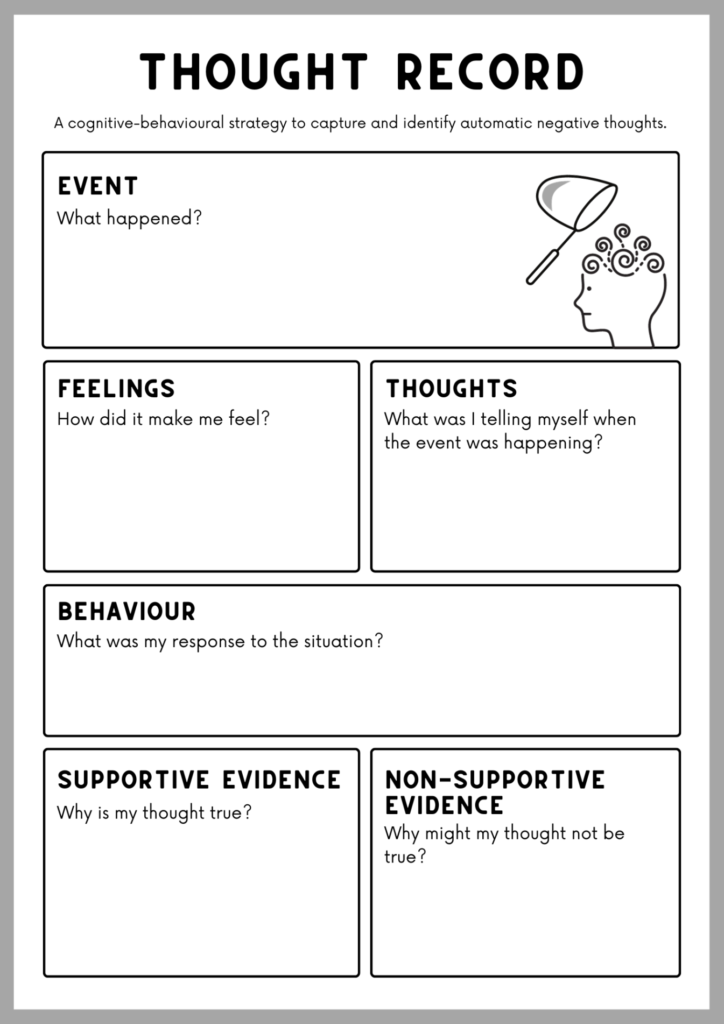 Thought Record
Downloadthis worksheet as a PDF

Olivia Guy-Evans, MSc
BSc (Hons) Psychology, MSc Psychology of Education
Olivia Guy-Evans is a writer and associate editor for Simply Psychology. She has previously worked in healthcare and educational sectors.
Saul McLeod, PhD
BSc (Hons) Psychology, MRes, PhD, University of Manchester
Saul McLeod, PhD., is a qualified psychology teacher with over 18 years of experience in further and higher education. He has been published in peer-reviewed journals, including the Journal of Clinical Psychology.
