Although having a panic attack can make youfeellike you are dying, you will not die from a panic attack.
 Common symptoms of panic attack and panic disorder.
Panic attacks are often a symptom ofpanic disorderand sometimes other mental health difficulties or conditions. However, anyone can experience a panic attack during their life, which does not necessarily indicate a mental health condition.
It is not “in someone’s head”, it is the body and mind reacting to a perceived threat. It is an abrupt onset of intense terror, fear, and dread that peaks within a few minutes.
Feeling like you will die is another common symptom of having a panic attack and why many people seek medical assistance. However, a panic attack is not inherently dangerous and will not cause you to die.
Why Do Panic Attacks Feel Like Dying
Panic attacks result from your mind and body going intofight/ flight mode, often without an apparent cause. Because there is no clear cause, the physical symptoms can feel extremely alarming, and you may fear the worst is happening.
Panic is a state of acute and intense anxiety that comes on so abruptly that your mind and body have an extreme reaction (or at least this iswhat it feels like). Your heart starts racing, breathing becomes more difficult and you may hypo- or hyperventilate.
Fearful and racing thoughts and a sense of impending death often accompany the physical symptoms.
In basic terms, when the fight/ flight system is activated, your “fearful mind” (limbic system) takes over your “rational mind” (prefrontal cortex).
This is because the fearful mind has the task of keeping you alive, which is more important than rational thought in a moment of danger.
That’s why the fearful mind has anegative biasand sees things from the worst possible perspective – “I’m going to die if I don’t get out of here”.
This serves the purpose of keeping you safe. Because, if you were actually in danger, it would be potentially fatal to think “Oh I’m sure it’s fine” or “Let me weigh up all my options”.
So, a panic attack is your body and mind falsely believing you are in acute danger and wanting to ensure your survival.
The reaction can be so extreme and abrupt that sometimes the only explanation seems to be a heart attack, stroke, or another potentially fatal condition.
Can Panic Attack Cause Chest Pain?
Panic attacks can cause a feeling of tightness or pain in the chest. Your brain sends a surge of stress hormones into the bloodstream, which triggers a rapid and abrupt rise in blood pressure and heart rate.
This can cause pain and tightness in your chest.
When you have a panic attack, this feeling stays in the chest and usually subsides after a few minutes. When you have a heart attack, the pain spreads to other parts of your body, like your jaw, arms, or neck, and progressively worsens.
A panic attack will not cause a heart attack. However, chronic stress and anxietycan increase the riskof certain cardiovascular issues such as high blood pressure, coronary heart disease, and heart attacks.
The issue is not the panic attack itself, it’s chronically high levels of anxiety and stress that can cause heart problems and these should therefore be addressed.
The differences between a heart attack and a panic attack include
Heart attack
Panic attack
Shared symptoms
Can You Die From Anxiety Shortness of Breath?
This can make you feel short of breath, but you will not stop breathing or suffocate.
When you experience panic, your breathing often becomes shallow. This means you are getting less oxygen, and this can make youfeel faint and dizzy. That’s why, when you are experiencing a panic attack, it’s important to focus on your breathing and try to bring it back to a natural, slow rhythm.
Knowing that it is a panic attack and that it is not fatal can also provide some reassurance and allow the symptoms to subside more quickly.
What’s the Worst a Panic Attack Can Do?
Panic attacks do not usually have severe physical consequences although they might make you think you are about to have a heart attack or die.
People who have experienced severe panic attacks report feeling like they cannot breathe, their chest is tightening, and they are about to faint.
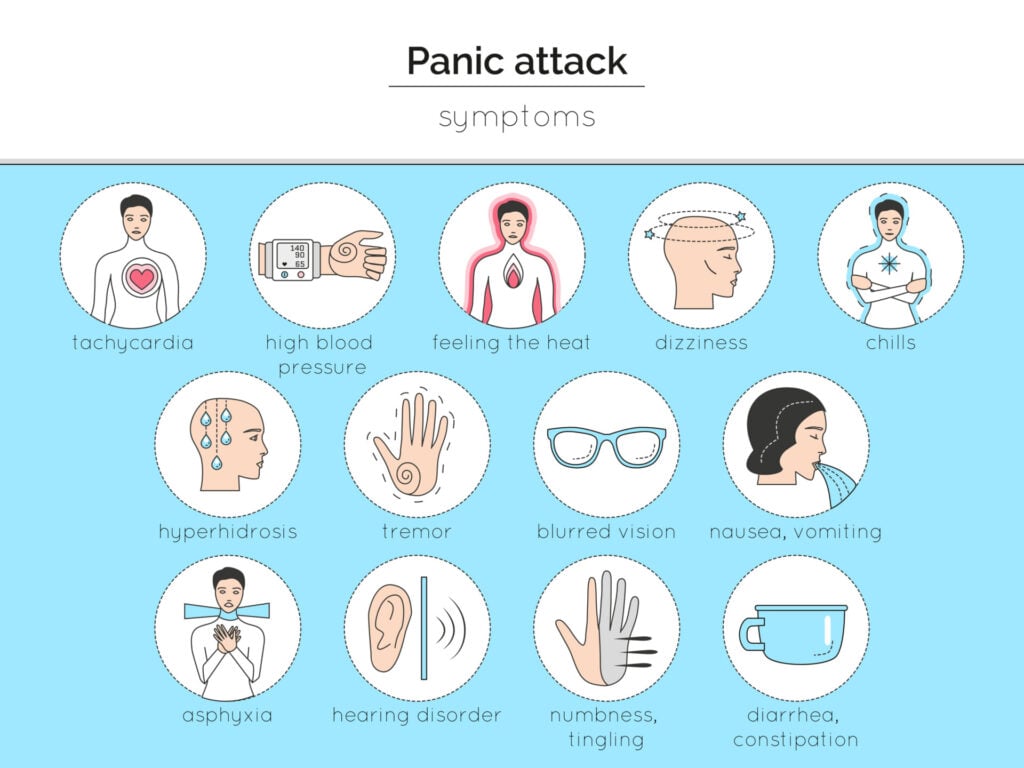 Set of icons about panic attack symptoms. Isolated pictures for illustrating medical article, internet site, poster about panic attack.
However, the symptoms generally subside within 15-20 minutes. In some cases, they can last longer but they will eventually fade.
Long-term, having frequent panic attacks and chronically high levels of anxiety and stress is bad for your physical health and may contribute to a weakened immune system and heart problems.
The emotional and mental consequences can be significant because experiencing this sort of panic can be very distressing. People may become more anxious in anticipation of another panic attack and feel unsafe andhypervigilant.
Thus, although panic attacks are not fatal, it is important to address them. Reducing your overall levels of anxiety through exercise, a healthy diet, relaxation, and social support will also reduce the likelihood of having a panic attack.
It is often a good idea to seek professional help as well because the triggers and causes of panic attacks and anxiety are not always clear or straightforward.
Should You Be Hospitalized for a Panic Attack?
Because of the physical symptoms of a panic attack, you might think you should go to hospital.
If you have never had a panic attack and the symptoms suddenly come on, it’s understandable you may want to see a medical professional to make sure everything is okay.
However, once the doctor has reassured you that you are physically healthy, it is not necessary to go to the hospital or seek medical attention when you have a panic attack.
Instead, what you should do is:
 coping with a panic attack
Sources
Celano, C.M., Daunis, D.J., Lokko, H.N., Campbell, K.A. & Huffman, J.C. (2016). Anxiety Disorders and Cardiovascular Disease.Current Psychiatry Reports, 18(11), 101.
Fleet, R.P. & Beitman, B.D. (1998). Cardiovascular death from panic disorder and panic-like anxiety: a critical review of the literature.Journal of Psychosomatic Research, 44(1), 71-80.

Saul McLeod, PhD
BSc (Hons) Psychology, MRes, PhD, University of Manchester
Saul McLeod, PhD., is a qualified psychology teacher with over 18 years of experience in further and higher education. He has been published in peer-reviewed journals, including the Journal of Clinical Psychology.
Anna DrescherMental Health WriterBSc (Hons), Psychology, Goldsmiths University, MSc in Psychotherapy, University of QueenslandAnna Drescher is a freelance writer and solution-focused hypnotherapist, specializing in CBT and meditation. Using insights from her experience working as an NHS Assistant Clinical Psychologist and Recovery Officer, along with her Master’s degree in Psychotherapy, she lends deep empathy and profound understanding to her mental health and relationships writing.
Anna DrescherMental Health WriterBSc (Hons), Psychology, Goldsmiths University, MSc in Psychotherapy, University of Queensland
Anna Drescher
Mental Health Writer
BSc (Hons), Psychology, Goldsmiths University, MSc in Psychotherapy, University of Queensland
Anna Drescher is a freelance writer and solution-focused hypnotherapist, specializing in CBT and meditation. Using insights from her experience working as an NHS Assistant Clinical Psychologist and Recovery Officer, along with her Master’s degree in Psychotherapy, she lends deep empathy and profound understanding to her mental health and relationships writing.
