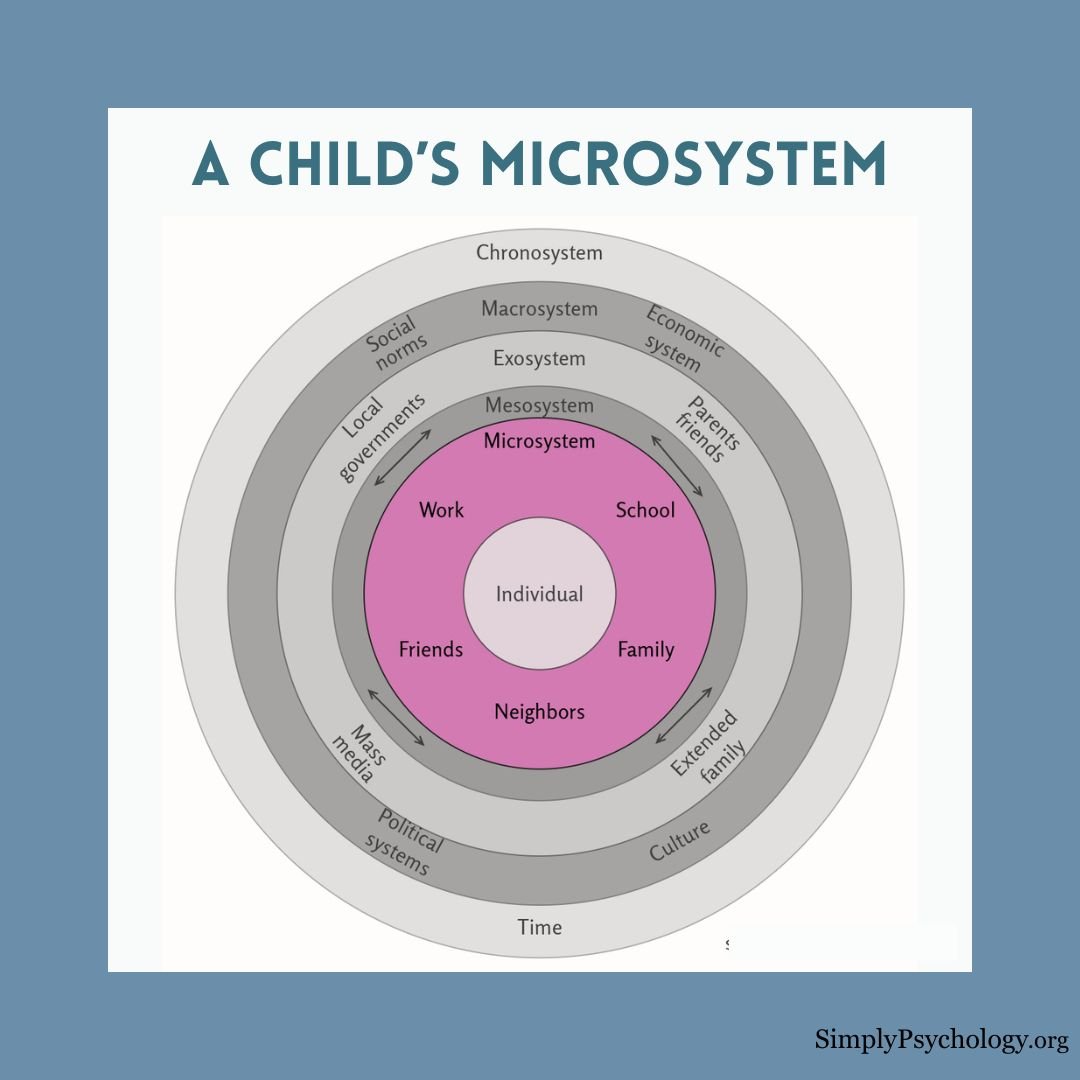
Bronfenbrenner’s Microsystem is the innermost layer of hisecological systems theory, later renamed theBioecological Model.
It encompasses an individual’s immediate environment and direct interactions. This includes family, peers, school, and neighborhood.
These close relationships and settings have the most direct impact on a person’s development. The microsystem influences behavior, beliefs, and overall growth through daily, face-to-face interactions.
It’s particularly crucial in early childhood development but remains important throughout life.
The microsystem is the immediate environment in which a child directly interacts and develops relationships, including family, school, and peers, and it’s crucial for child development because these close, ongoing interactions significantly shape a child’s cognitive, social, emotional, and physical growth through bi-directional influences.

By understanding the dynamics within the microsystem, we can better appreciate how these early experiences lay the foundation for a child’s future growth and well-being.
Examples of the Microsystem
Here are some examples of common microsystems:
Family
School
Peer Group
Religious Institutions
Neighbourhood
The Child as an Active Participant
The microsystem, as the most proximal layer of a child’s environment, plays a crucial role in shaping development through direct, face-to-face interactions and relationships. However, it’s essential to recognize that children are not passive recipients of these influences.
Instead, they actively participate in and shape their microsystem, a concept central to Bronfenbrenner’s bioecological systems theory.
This active participation is evident in several ways:
Understanding the child as an active participant in the microsystem highlights the complex, dynamic nature of early development.
It emphasizes that while the immediate environment significantly influences a child’s growth, the child’s own characteristics and actions play a pivotal role in shaping their developmental journey.
Recent Findings and Evolving Understanding
Virtual Microsystems in the Digital Age
Recognizing the significant role of technology in children’s lives,Navarro & Tudge (2022)proposed the neo-ecological theory.
They emphasize the unique features of virtual environments, such as constant availability, publicness, and asynchronicity, suggesting that these factors can influence a child’s social connections, identity formation, and exposure to diverse values and information.
Culture’s Pervasive Influence
Contemporary research increasingly emphasizes the integral role of culture in shaping child development within microsystems.
Vélez-Agostoet al. (2013)challenge the initial placement of culture solely within themacrosystem, arguing that cultural values and practices are woven into the fabric of everyday routines and interactions within the family, school, and peer groups.
They advocate for a more nuanced understanding of culture’s pervasive influence on proximal processes and their developmental consequences.
Moving Beyond Single-Variable Outcomes
Researchers acknowledgea shift in developmental science towards studying multiple, interconnected developmental outcomes rather than focusing on isolated variables.
This approach aligns with the bioecological model’s emphasis on the interconnectedness of various psychological domains.
For instance, a child’s experiences in the family microsystem can influence their cognitive, social, and emotional development simultaneously.
Future research should investigate how proximal processes within different microsystems may have differential effects across these various developmental domains, contributing to a more holistic understanding of a child’s growth.
By understanding the interconnectedness of the systems influencing child development, parents, educators, community leaders, and policymakers can contribute to creating supportive environments that foster positive outcomes for children.
Putting Theory into Practice: Applications of the Bioecological Model
For Parents and Caregivers:
For Educators and School Systems:
For Community Leaders and Policymakers:
References
Bronfenbrenner, U., & Ceci, S. J. (1994). Nature-nurture reconceptualised: A bio-ecological model.Psychological Review, 10(4), 568–586.
Bronfenbrenner, U. (1995). Developmental ecology through space and time: A future perspective. In P. Moen, G. H. Elder, Jr., & K. Lüscher (Eds.),Examining lives in context: Perspectives on the ecology of human development(pp. 619–647). American Psychological Association.https://doi.org/10.1037/10176-018
Bronfenbrenner, U. (1999). Environments in developmental perspective: Theoretical and operational models. In S. L. Friedman & T. D. Wachs (Eds.),Measuring environment across the life span: Emergingmethodsand concepts(pp.3-28). American Psychological Association.https://doi.org/10.1037/10317-001
Cassells, R., & Evans, G. (2020). Concepts from the bioecological model of human development. In L. Tach, R. Dunifon, & D. L. Miller (Eds.),Confronting inequality: How policies and practices shape children’s opportunities(pp. 221–232). American Psychological Association.https://doi.org/10.1037/0000187-010
Ferguson, K. T., & Evans, G. W. (2019). Social ecological theory: Family systems and family psychology in bioecological and bioecocultural perspective. In B. H. Fiese, M. Celano, K. Deater-Deckard, E. N. Jouriles, & M. A. Whisman (Eds.),APA handbook of contemporary family psychology: Foundations, methods, and contemporary issues across the lifespan(pp. 143–161). American Psychological Association.https://doi.org/10.1037/0000099-009
Guy-Evans, O. (2024, January 17).Bronfenbrenner’s Ecological Systems Theory. Simply Psychology.https://www.simplypsychology.org/bronfenbrenner.html
Navarro, J. L., & Tudge, J. R. (2022). Technologizing Bronfenbrenner: neo-ecological theory.Current Psychology, 1-17.https://doi.org/10.1007/s12144-022-02738-3
McLeod, S. (2024, January 24).Vygotsky’s Theory Of Cognitive Development. Simply Psychology.https://www.simplypsychology.org/vygotsky.html
Rosa, E. M., & Tudge, J. (2013). Urie Bronfenbrenner’s theory of human development: Its evolution from ecology to bioecology.Journal of family theory & review,5(4), 243-258.https://doi.org/10.1111/jftr.12022
Vélez-Agosto, N. M., Soto-Crespo, J. G., Vizcarrondo-Oppenheimer, M., Vega-Molina, S., & García Coll, C. (2017). Bronfenbrenner’s bioecological theory revision: Moving culture from the macro into the micro.Perspectives on psychological science,12(5), 900-910.https://doi.org/10.1177/1745691617704397

Saul McLeod, PhD
BSc (Hons) Psychology, MRes, PhD, University of Manchester
Saul McLeod, PhD., is a qualified psychology teacher with over 18 years of experience in further and higher education. He has been published in peer-reviewed journals, including the Journal of Clinical Psychology.
Olivia Guy-Evans, MSc
BSc (Hons) Psychology, MSc Psychology of Education
Olivia Guy-Evans is a writer and associate editor for Simply Psychology. She has previously worked in healthcare and educational sectors.
