The chronosystem, inBronfenbrenner’s bioecological systems theory, refers to the element of time and its influence on a person’s development.
This encompasses both the individual’s personal timeline, experiencing events at specific ages and stages, and the broader socio-historical context, where cultural shifts and historical events shape the environment.
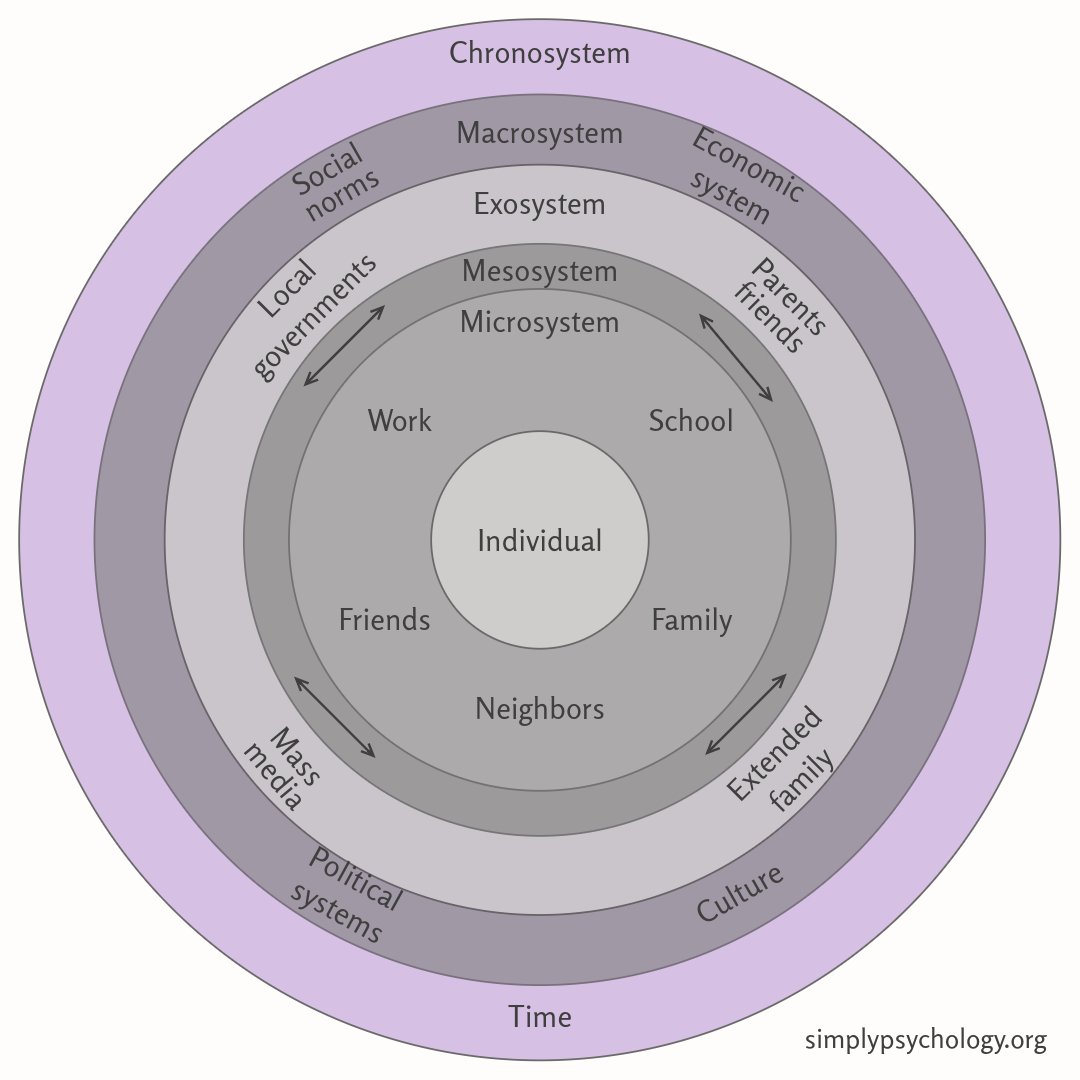
Levels of the chronosystem
Bronfenbrenner, in his later work, expanded the chronosystem into three distinct levels: micro-time, meso-time, and macro-time:
By integrating the chronosystem into his bioecological model, Bronfenbrenner highlighted that understanding human development requires considering not just what happens but also when it happens in the individual’s life and against the backdrop of a changing world.
Examples of the chronosystem
Technological Advancements
Historical Events
Societal Changes
Life Transitions
Strengths of the chronosystem concept
Below are some strengths of the chronosystem concept:
Limitations of the chronosystem concept
Below are some limitations of the chronosystem concept:
Practical Applications of Bronfenbrenner’s Chronosystem
Below are some ways in which Bronfenbrenner’s chronosystem concept can be applied to support child development:
Understanding the Impact of Timing on Interventions
The chronosystem’s emphasis on the importance of timing has significant implications for interventions aimed at promoting development.
Designing Age-Appropriate Policies and Programmes
The chronosystem underscores the need to consider the age and developmental stage when designing policies and programs.
Supporting Individuals Through Life Transitions
Recognizing that life transitions, both normative and non-normative, can significantly impact development is crucial for providing adequate support.
Promoting Intergenerational Understanding
By acknowledging the influence of historical time on development, the chronosystem encourages intergenerational understanding and empathy.
Conclusion
The chronosystem, while a complex concept, provides a valuable framework for understanding how time influences development.
By considering the practical implications of the chronosystem, we can design interventions, policies, and programs that are more responsive to the needs of individuals at different life stages and against the backdrop of a changing world.
References
Bronfenbrenner, U., & Ceci, S. J. (1994). Nature-nurture reconceptualised: A bio-ecological model.Psychological Review, 10(4), 568–586.
Bronfenbrenner, U. (1995). Developmental ecology through space and time: A future perspective. In P. Moen, G. H. Elder, Jr., & K. Lüscher (Eds.),Examining lives in context: Perspectives on the ecology of human development(pp. 619–647). American Psychological Association.https://doi.org/10.1037/10176-018
Bronfenbrenner, U. (1999). Environments in developmental perspective: Theoretical and operational models. In S. L. Friedman & T. D. Wachs (Eds.),Measuring environment across the life span: Emergingmethodsand concepts(pp.3-28). American Psychological Association.https://doi.org/10.1037/10317-001
Guy-Evans, O. (2024, January 17).Bronfenbrenner’s Ecological Systems Theory. Simply Psychology.https://www.simplypsychology.org/bronfenbrenner.html
McLeod, S. (2024, January 24).Vygotsky’s Theory Of Cognitive Development. Simply Psychology.https://www.simplypsychology.org/vygotsky.html
Navarro, J. L., & Tudge, J. R. (2023). Technologizing Bronfenbrenner: neo-ecological theory.Current Psychology,42(22), 19338-19354.https://doi.org/10.1007/s12144-022-02738-3
O’Regan, C., Brady, B., & Connolly, C. (2023). Building back better – using an ecological lens to argue for strengthening mesosystemic connections for young people in a post-pandemic world.Child Care in Practice, 29(4), 358–370.https://doi.org/10.1080/13575279.2022.2084364
Rosa, E. M., & Tudge, J. (2013). Urie Bronfenbrenner’s theory of human development: Its evolution from ecology to bioecology.Journal of family theory & review,5(4), 243-258.https://doi.org/10.1111/jftr.12022
Vélez-Agosto, N. M., Soto-Crespo, J. G., Vizcarrondo-Oppenheimer, M., Vega-Molina, S., & García Coll, C. (2017). Bronfenbrenner’s bioecological theory revision: Moving culture from the macro into the micro.Perspectives on psychological science,12(5), 900-910.https://doi.org/10.1177/1745691617704397

Saul McLeod, PhD
BSc (Hons) Psychology, MRes, PhD, University of Manchester
Saul McLeod, PhD., is a qualified psychology teacher with over 18 years of experience in further and higher education. He has been published in peer-reviewed journals, including the Journal of Clinical Psychology.
Olivia Guy-Evans, MSc
BSc (Hons) Psychology, MSc Psychology of Education
Olivia Guy-Evans is a writer and associate editor for Simply Psychology. She has previously worked in healthcare and educational sectors.
