On This Page:ToggleBackgroundImportant Brodmann AreasAll Brodmann AreasBrodmann Areas List
On This Page:Toggle
On This Page:
Different parts of thecerebral cortexare involved in cognitive and behavioral functions.
Despite controversy about how precise these areas are located, Brodmann’s areas are still widely used today. However, some areas have since been subdivided or are only present in nonhuman primates.
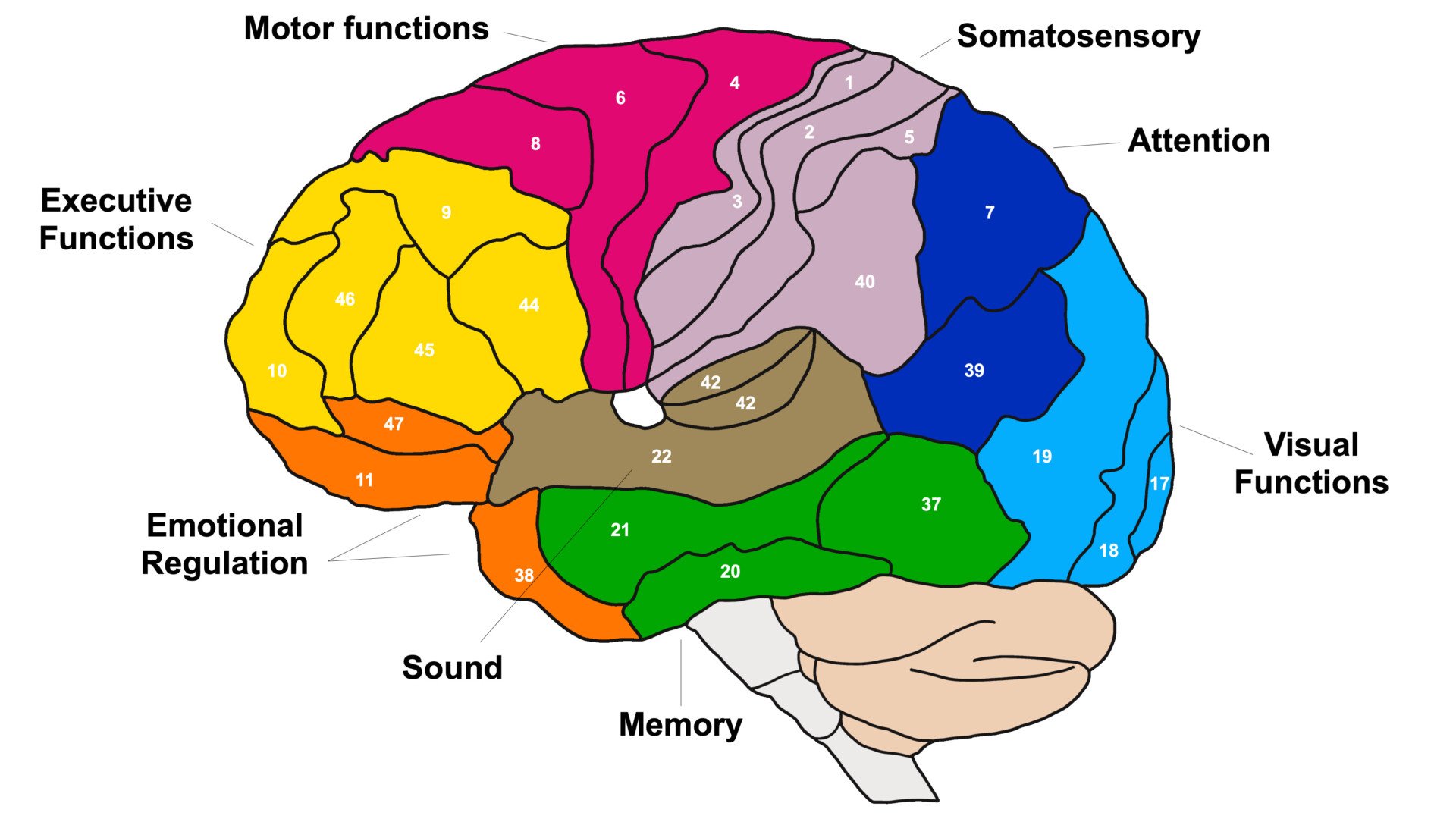 Brodmann Areas, named after German neurologist Korbinian Brodmann, are a system for mapping and categorizing regions of the human cerebral cortex based on their distinct cellular architecture and functions. These numbered areas, which range from 1 to 52, provide a structural framework for understanding different brain functions, such as sensory processing, motor control, and higher cognitive processes, contributing to our knowledge of brain organization and function.
History of Brodmann Areas
Korbinian Brodmann (1868-1918) was a German neurologist who published research on cortical cytoarchitectonics in many species, including humans. This publication contained what was believed to be the first map of the cerebral cortex based on variations in neural structure.
Brodmann (1909) studied the cortex in detail, observing how its layers, tissues, neurons, and other cells varied in structure and size.
He identified and numbered different areas of the brains of many mammals, ending some of the considerable confusion in naming parts of the cortex that existed at the time.
Before Brodmann’s research, some areas of the brain were beginning to be identified, such asBrocaandWernicke’sareas. These areas were identified after damage was discovered in these areas, after language deficits were noticed in these individuals.
Brodmann’s mapping of the brain takes this further and details all the functional areas of the cortex based on gross anatomical features and cortical micro-structures.
Brodmann’s areas have been widely discussed, debated, and refined throughout the years and remain the most widely known and most frequently used mapping of the cortex.
Important Brodmann Areas
Brodmann areas 1, 2, and 3 – Primary somatosensory cortexThe primary somatosensory cortex is responsible for processing sensations of the body. Receptors throughout the body pick up these sensations, responsible for detecting touch, pain, temperature, and localization of touch.This region is also important for skilled and coordinated movements as well as motor learning.
Brodmann areas 1, 2, and 3 – Primary somatosensory cortex
The primary somatosensory cortex is responsible for processing sensations of the body. Receptors throughout the body pick up these sensations, responsible for detecting touch, pain, temperature, and localization of touch.This region is also important for skilled and coordinated movements as well as motor learning.
The primary somatosensory cortex is responsible for processing sensations of the body. Receptors throughout the body pick up these sensations, responsible for detecting touch, pain, temperature, and localization of touch.
This region is also important for skilled and coordinated movements as well as motor learning.
Brodmann area 4 – Primary motor cortexThe primary motor cortex is essential for initiating motor movements as well as coordinating these movements. Each area of the motor cortex corresponds precisely to specific body parts on the contralateral side of the body.E.g., in order to move the left leg, part of the primary motor cortex in the right hemisphere is stimulated.
Brodmann area 4 – Primary motor cortex
The primary motor cortex is essential for initiating motor movements as well as coordinating these movements. Each area of the motor cortex corresponds precisely to specific body parts on the contralateral side of the body.E.g., in order to move the left leg, part of the primary motor cortex in the right hemisphere is stimulated.
The primary motor cortex is essential for initiating motor movements as well as coordinating these movements. Each area of the motor cortex corresponds precisely to specific body parts on the contralateral side of the body.
E.g., in order to move the left leg, part of the primary motor cortex in the right hemisphere is stimulated.
Brodmann area 9 – Dorsolateral prefrontal cortexThe dorsolateral prefrontal cortex is located in the frontal lobe and is essential for ‘higher’ cognitive functions such as working memory, planning, abstract reasoning, motor planning, and organization.Due to its importance for many executive functions, this area has multiple connections between cortical and subcortical areas of the brain.
Brodmann area 9 – Dorsolateral prefrontal cortex
The dorsolateral prefrontal cortex is located in the frontal lobe and is essential for ‘higher’ cognitive functions such as working memory, planning, abstract reasoning, motor planning, and organization.Due to its importance for many executive functions, this area has multiple connections between cortical and subcortical areas of the brain.
The dorsolateral prefrontal cortex is located in the frontal lobe and is essential for ‘higher’ cognitive functions such as working memory, planning, abstract reasoning, motor planning, and organization.
Due to its importance for many executive functions, this area has multiple connections between cortical and subcortical areas of the brain.
Brodmann area 17 – Primary visual cortexThe primary visual cortex, located in the occipital lobes, is a structure essential to the processing of visual stimuli.This area is the most widely studied visual area of the brain and is highly specialized for the processing of static and moving objects, as well as being good at recognizing patterns.
Brodmann area 17 – Primary visual cortex
The primary visual cortex, located in the occipital lobes, is a structure essential to the processing of visual stimuli.This area is the most widely studied visual area of the brain and is highly specialized for the processing of static and moving objects, as well as being good at recognizing patterns.
The primary visual cortex, located in the occipital lobes, is a structure essential to the processing of visual stimuli.
This area is the most widely studied visual area of the brain and is highly specialized for the processing of static and moving objects, as well as being good at recognizing patterns.
Brodmann area 21 – Middle temporal gyrusThe middle temporal gyrus is one of the main gyri (ridge) on the surface of the temporal lobes.This area is believed to be involved in functions such as sound recognition and semantic retrieval, as well as semantic memory, language processing, and processing of verbal and mental arithmetic.
Brodmann area 21 – Middle temporal gyrus
The middle temporal gyrus is one of the main gyri (ridge) on the surface of the temporal lobes.This area is believed to be involved in functions such as sound recognition and semantic retrieval, as well as semantic memory, language processing, and processing of verbal and mental arithmetic.
The middle temporal gyrus is one of the main gyri (ridge) on the surface of the temporal lobes.
This area is believed to be involved in functions such as sound recognition and semantic retrieval, as well as semantic memory, language processing, and processing of verbal and mental arithmetic.
Brodmann area 22 – Superior temporal gyrusThe superior temporal gyrus is also located within the temporal lobes and has a role in both verbal and non-verbal communication.This area has been found to be important for contributing to the processing of both object and space-related information, and processing non-verbal social cues.As well as this, this area is involved in auditory short-term memory and the production of speech. Wernicke’s area is also considered to be located in this area, a region associated with language comprehension and the production of language.
Brodmann area 22 – Superior temporal gyrus
The superior temporal gyrus is also located within the temporal lobes and has a role in both verbal and non-verbal communication.This area has been found to be important for contributing to the processing of both object and space-related information, and processing non-verbal social cues.As well as this, this area is involved in auditory short-term memory and the production of speech. Wernicke’s area is also considered to be located in this area, a region associated with language comprehension and the production of language.
The superior temporal gyrus is also located within the temporal lobes and has a role in both verbal and non-verbal communication.
This area has been found to be important for contributing to the processing of both object and space-related information, and processing non-verbal social cues.
As well as this, this area is involved in auditory short-term memory and the production of speech. Wernicke’s area is also considered to be located in this area, a region associated with language comprehension and the production of language.
Brodmann areas 23, 24, 28 and 33 – Cingulate gyrusThe cingulate gyrus is a large arched fold above the corpus callosum. It is an important part of the limbic system, helping to regulate emotions and pain.Thisgyrusis believed to directly drive the body’s conscious response to unpleasant experiences, as well as being involved in fear and avoidance of negative stimuli. As the cingulate gyrus learns to avoid negative consequences, it also plays a role in memory.
Brodmann areas 23, 24, 28 and 33 – Cingulate gyrus
The cingulate gyrus is a large arched fold above the corpus callosum. It is an important part of the limbic system, helping to regulate emotions and pain.Thisgyrusis believed to directly drive the body’s conscious response to unpleasant experiences, as well as being involved in fear and avoidance of negative stimuli. As the cingulate gyrus learns to avoid negative consequences, it also plays a role in memory.
The cingulate gyrus is a large arched fold above the corpus callosum. It is an important part of the limbic system, helping to regulate emotions and pain.
Thisgyrusis believed to directly drive the body’s conscious response to unpleasant experiences, as well as being involved in fear and avoidance of negative stimuli. As the cingulate gyrus learns to avoid negative consequences, it also plays a role in memory.
Brodmann areas 44 and 45 – Broca’s areaLocated within the frontal lobes,Broca’s areais an essential region for the production of language. This area is able to put together the elements of language, select information from a variety of sources, and help produce information about the motor movements required for spoken and written language.Similarly, Broca’s area can help control mechanisms for syntactic processing and construct complex sentences and speech patterns.
Brodmann areas 44 and 45 – Broca’s area
Located within the frontal lobes,Broca’s areais an essential region for the production of language. This area is able to put together the elements of language, select information from a variety of sources, and help produce information about the motor movements required for spoken and written language.Similarly, Broca’s area can help control mechanisms for syntactic processing and construct complex sentences and speech patterns.
Located within the frontal lobes,Broca’s areais an essential region for the production of language. This area is able to put together the elements of language, select information from a variety of sources, and help produce information about the motor movements required for spoken and written language.
Similarly, Broca’s area can help control mechanisms for syntactic processing and construct complex sentences and speech patterns.
Broadman Areas Location and Function
 Brodmann areas as anatomical brain region zones of the cerebral cortex outline diagram. Labeled educational cytoarchitecture and histological structure and organization of cells vector illustration.
Brodmann Areas List

References
Brodmann K. 1909. Vergleichende Lokalisationslehre der Grobhirnrinde in ihren Prinzipien dargestellt auf Grund des Zellenbaues. Leipzig: J.A. Barth
Carter, R. (2019). The Human Brain Book: An Illustrated Guide to its Structure, Function, and Disorders (3rd ed). DK.
Ferng, A. (2021, May 31). Brodmann areas. Kenhub. https://www.kenhub.com/en/library/anatomy/brodmann-areas
Hacking, C. Gaillard et al., (n.d.). Brodmann areas. Radiopaedia. Retrieved August 6, 2021, from: https://radiopaedia.org/articles/brodmann-areas?lang=gb
Further ReadingŠimic, G., & Hof, P. R. (2015). In search of the definitive Brodmann’s map of cortical areas in human. Journal of Comparative Neurology, 523(1), 5-14.Judaš, M., Cepanec, M., & Sedmak, G. (2012). Brodmann’s map of the human cerebral cortex—or Brodmann’s maps?. Translational Neuroscience, 3(1), 67-74.
Further Reading
Šimic, G., & Hof, P. R. (2015). In search of the definitive Brodmann’s map of cortical areas in human. Journal of Comparative Neurology, 523(1), 5-14.Judaš, M., Cepanec, M., & Sedmak, G. (2012). Brodmann’s map of the human cerebral cortex—or Brodmann’s maps?. Translational Neuroscience, 3(1), 67-74.

Saul McLeod, PhD
BSc (Hons) Psychology, MRes, PhD, University of Manchester
Saul McLeod, PhD., is a qualified psychology teacher with over 18 years of experience in further and higher education. He has been published in peer-reviewed journals, including the Journal of Clinical Psychology.
Olivia Guy-Evans, MSc
BSc (Hons) Psychology, MSc Psychology of Education
Olivia Guy-Evans is a writer and associate editor for Simply Psychology. She has previously worked in healthcare and educational sectors.
