The bourgeoisie is the social class that owns the means of production and derives wealth and status from private capital or commercial activity rather than wages.
It includes businessmen, bankers, factory owners, managers, entrepreneurs, merchants, traders, and other professionals and property owners making income outside of salary.
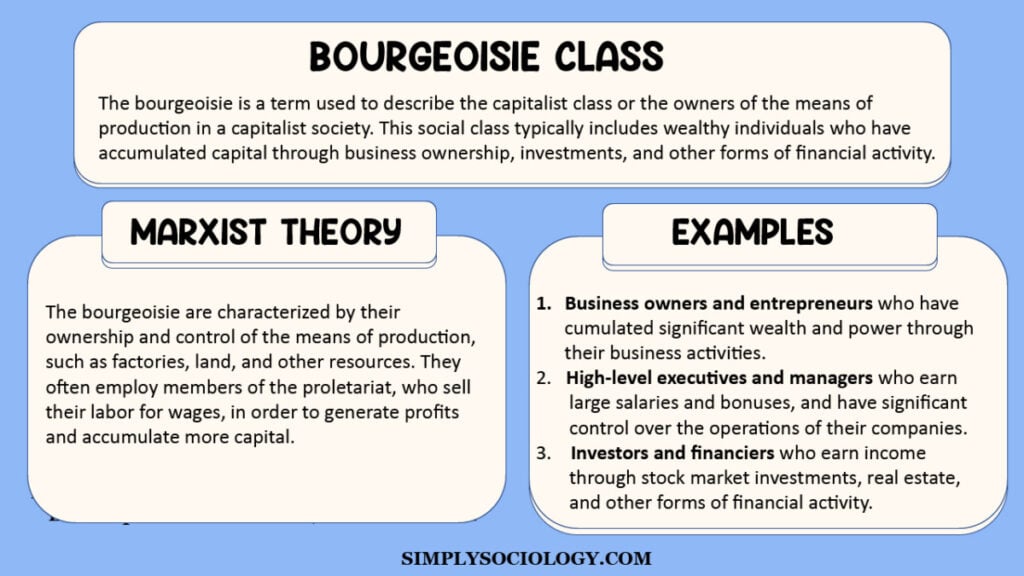 bourgeoisie class 1
Key Takeaways
Definition
Themeans of productionrefers to all of the equipment and materials needed to produce goods and services, apart from labor.
For example, the means of production for wheat may include fields and farm tools, while the means of production for cotton shirts may include fabric, sewing machines, and storage space in a factory.
It is important to note, however, that capital (the money required to purchase machinery, raw materials, and labor) is not considered to be a direct means of production; some Marxists call it an indirect means of production.
The Emergence of the Bourgeoisie
Scholars consider there to be three phases in the development of the Bourgeoisie. These are an ascendant phase from the 18th to early 19th century, a culminating phase from the mid-19th century to World War I, and a period of differentiation, dissolution, and rebirth lasting into the late 20th century.
The older urban bourgeoisie of cities and communes;Civil servants of the modern territorial state who were not part of a feudal hierarchy;Merchants, bankers, industrial entrepreneurs, and independent artisans who were able to remove themselves from the order of cooperative estatesProfessionals, literati, and artists;Enlightened or economically innovative portions of the landholding nobility, as well as non-noble estate owners and agriculturalists; and,Participants in freedom movements that were cultural or confessional, liberal or democratic, or regional or national.
The older urban bourgeoisie of cities and communes;
Civil servants of the modern territorial state who were not part of a feudal hierarchy;
Merchants, bankers, industrial entrepreneurs, and independent artisans who were able to remove themselves from the order of cooperative estates
Professionals, literati, and artists;
Enlightened or economically innovative portions of the landholding nobility, as well as non-noble estate owners and agriculturalists; and,
Participants in freedom movements that were cultural or confessional, liberal or democratic, or regional or national.
According to Siegrist (2007), the bourgeoisie created a common language of communication and symbolism through their collaboration with the monarchs and the state.
The bourgeoisie instituted various reforms and revolutions that imposed freedom of trade, religious freedom, freedom of association, freedom of speech and the press, political participation, and accountability.
The bourgeoisie gathered in circles such as free academies, scientific academies, literary circles, the media, and the reformed institutions of higher education, administration, law, legislation, and government (Siegrist, 2007).
These provided forums for the emerging bourgeoisie to criticize existing conditions, conceive of new social orders, and lay claims to dictating central functions of society.
The Proletariat vs. the Bourgeoisie
TheBourgeoisie and the Proletariatare the two dominant classes in Marxism. Marx believed these two classes had inherently opposed values, which would drive class conflict.
In essence, this means that someone who owns the factory or the farm that others work in or on is a member of the bourgeoisie, while those who work for the owner are members of the proletariat.
Class Conflict
The force that transforms someone’s class membership into a struggle of classes is class interests. Marx believed that those in similar classes develop interdependence, community, and shared interests related to a common income of profit or wages.
To Marx, individuals form classes to the extent that their interests position them in a struggle with the opposite class (Mandel & Mandel, 1979).
In particular, Marx believed that the distribution of political power is dependent on power over production. Capital can confer political power, which the bourgeois class can then use to legitimize and protect their property and consequent social relations.
Because class relations are political, the mature capitalist society’s government is primarily concerned with the interests of the bourgeoisie. Additionally, the intellectual basis of the state rule — the ideas that justify the use of state power and its distribution — are those of the ruling class.
Hence, in the view of Marx, both intellectual and social culture are merely constructions that rest on top of the relations between those who do and do not own the means of production.
Marx believed that the division between classes would widen over time, and that the conditions of the exploited working class would deteriorate to the extent that the social structure collapses.
He saw thisproletarian revolutionas wiping away the idea of class. Since political power to protect the bourgeoisie would become unnecessary in this scenario, he believed that political authority and the state would diminish (Mandel & Mandel, 1979).
Implications in Marxism
Marx perceived politics and political power to be the result of the divisions that occurred between the bourgeoisie and industrial workers (Mandel & Mandel, 1979).
This prestigious conspicuous consumption culture concentrated, according to Benjamin, on mass-produced luxury goods. For example, an early 19th-century bourgeois house may contain hand-painted porcelain, machine-printed cotton fabrics and wallpaper, and stainless steel.
Max Weber (Swidler, 1973) argued that bourgeois values are dependent on Rationalism. More modern sociologists have considered “progressive” middle-class values, such as individualism, autonomy, gender equality, and innovation, as a transposition of the Victorian bourgeoisie system of social values to the United States.
The bourgeoisie class considered itself to be in opposition to the nobility and clergy, instead claiming to represent the general public and valuing dynamism and orientation toward achievement over birth.
Implications beyond Marxism
According to Marx and Engels, the Bourgeoisie was thought to have arisen in Europe around the 12th century within strictly city limits (Siegrist, 2007).
Typically, the word bourgeoisie is used now to describe the feelings of materialism in the middle class.
Twentieth-century historians used the word bourgeoisie to denote people who work as merchants, non-nobles, pensioners, officials, and financiers. However, in the strictly Marxist sense, the bourgeoisie represents those who own the means of production.
Marx’s history saw the bourgeoisie as a politically progressive social class during the 17th and 18th centuries who supported both the principles of constitutional government and natural rights and the claims of divine right that nobles had used as justifications for their rule during Feudalism.
At the time, members of the bourgeoisie included those in the more educated middle class, such as doctors, lawyers, and merchants. In their promotion of liberalism and religious and civil liberties for themselves and those of lower social classes, the bourgeoisie played a progressive role in Western societies (Siegrist, 2007).
While the haute bourgeoisie consisted of bankers and industrialists, the petite bourgeoisie was constituted of tradesmen and white-collar workers.
For example, a blacksmith who owns his own shop and the tools in it may be considered to be part of the petite bourgeoisie, especially in a situation where he is still working in his shop, contributing his own labor to the production of his products.
By the end of the 19th century, however, the haute bourgeoisie, or the capitalist class, had ascended to the upper ranks of society, while the development of technology and technical occupations allowed those from the working class to rise to the lower strata of the bourgeoisie — however, this was not particularly common (Siegrist, 2007).
Examples
The bourgeoisie, both in the Marxist sense and elsewhere, encompasses a wide array of professions and social statuses. On a broad level, Marx divided his bourgeoisie into the haute, or high bourgeoisie and the petite, or small bourgeoisie. Scholars have made various distinctions between various layers of class status within the bourgeoisie.
For example, in many Francophone countries, the bourgeoisie is considered to consist of five evolving social layers: the petite, moyen, grande, haute, and ancienne bourgeoisie.
Petite bourgeoisie, are the equivalent to what many would call the modern-day lower middle class — a social class between the middle and lower classes.
The moyenne, or middle bourgeoisie, contains people who have solid incomes and assets but not the historical legacy of those whose assets have been established intergenerationally. This is equivalent to the British and American upper-middle classes.
The grande, or great bourgeoisie, are families that have been bourgeois for several generations. These families may intermarry with aristocracy and are often known in the city where they reside and may have contributed to a region’s history.
The haute bourgeoisie, meanwhile, is composed of even longer-standing bourgeoisie families. The intergenerational wealth of these families is often contrasted with that of the nouveau riche.
In addition to differentiating between how long families have been in the bourgeoisie, some scholars have drawn further lines between those who are bourgeoisie on virtue of their education and those who are simply on the basis of their wealth.Again, in a purely Marxist sense, one’s status in the bourgeoisie depends mainly on the ownership of the means of production, not on wealth or income.The most notable example of the educated bourgeoisie are the intelligentsia. The so-called intelligentsia are a class of highly educated people who remain engaged in personal intellectual pursuits through their lives.Intelligentsia can include academics, artists, writers, and journalists. Although these members may not be particularly wealthy, they may view themselves as bourgeoisie on virtue of their connections to prestigious institutions and those who have powerful spheres of intellectual influence.In contrast, entrepreneurs or capitalists are bourgeoisie in the classic sense. In Marx’s view, this class acquires the means of production and then gains wealth through exploiting workers, in the form of compensating them less than the value of the goods that they produce (Sagarra, 2017).
In addition to differentiating between how long families have been in the bourgeoisie, some scholars have drawn further lines between those who are bourgeoisie on virtue of their education and those who are simply on the basis of their wealth.
Again, in a purely Marxist sense, one’s status in the bourgeoisie depends mainly on the ownership of the means of production, not on wealth or income.
The most notable example of the educated bourgeoisie are the intelligentsia. The so-called intelligentsia are a class of highly educated people who remain engaged in personal intellectual pursuits through their lives.
Intelligentsia can include academics, artists, writers, and journalists. Although these members may not be particularly wealthy, they may view themselves as bourgeoisie on virtue of their connections to prestigious institutions and those who have powerful spheres of intellectual influence.
In contrast, entrepreneurs or capitalists are bourgeoisie in the classic sense. In Marx’s view, this class acquires the means of production and then gains wealth through exploiting workers, in the form of compensating them less than the value of the goods that they produce (Sagarra, 2017).
What is the Difference between Bourgeois and Bourgeoisie?
Bourgeoisie is a word derived from French that functions as a noun, and refers to a society’s middle class, generally described as the group of people between the affluent upper class and the poor working class (writingexplained.org).
Bourgeois is also a French loanword that refers to the middle class. Unlike bourgeoisie, however, it can also refer to an individual belonging to the middle class, and be employed as an adjective to denote traits of the middle class.
References
Mandel, E., & Mandel, E. (1979). Introduction to Marxism. Ink Links.
Marx, K., & Engels, F. (1967).The communist manifesto. 1848. Trans. Samuel Moore. London: Penguin, 15.
Rémond, A. (2013). Un jeune homme est passé. Média Diffusion.
Sagarra, E. (2017). The bourgeoisie. In A Social History of Germany 1648-1914 (pp. 253-262). Routledge.
Siegrist, E. (2007). Bourgeoisie, History of. in Ritzer, G. (Ed.). Blackwell Encyclopedia of Sociology.
Swidler, A. (1973). The concept of rationality in the work of Max Weber. Sociological Inquiry, 43(1), 35-42.

Saul McLeod, PhD
BSc (Hons) Psychology, MRes, PhD, University of Manchester
Saul McLeod, PhD., is a qualified psychology teacher with over 18 years of experience in further and higher education. He has been published in peer-reviewed journals, including the Journal of Clinical Psychology.
Olivia Guy-Evans, MSc
BSc (Hons) Psychology, MSc Psychology of Education
Olivia Guy-Evans is a writer and associate editor for Simply Psychology. She has previously worked in healthcare and educational sectors.
Charlotte NickersonResearch Assistant at Harvard UniversityUndergraduate at Harvard UniversityCharlotte Nickerson is a student at Harvard University obsessed with the intersection of mental health, productivity, and design.
Charlotte NickersonResearch Assistant at Harvard UniversityUndergraduate at Harvard University
Charlotte Nickerson
Research Assistant at Harvard University
Undergraduate at Harvard University
Charlotte Nickerson is a student at Harvard University obsessed with the intersection of mental health, productivity, and design.
