Behavioral activation (BA) is acognitive-behavioral therapy method for depression. It illuminates the link between behavior, emotion, and thought. By modifying depressive behaviors and increasing involvement in positive activities, BA enhances mood. The central idea is that changing behavior can alter emotions and thoughts. The emphasis is on what sustains depression rather than its initial triggers.
Washing up can be a form of behavioral activation, particularly when a task has been sidelined due to depressive symptoms. Engaging in this chore can instill a sense of accomplishment, interrupt inactivity patterns, and pave the way for other positive behaviors, like cooking in a clean kitchen. Within the framework of behavioral activation, it’s essential to not only do the activity but also to observe its impact on mood and well-being, leveraging this feedback to inspire more positive actions.

Key Points
Rationale
Depression affects 8-34% of adolescents globally, causing severe current and future impairment (Shorey et al., 2022).
Despite the need, many youths lack access to evidence-based therapies like cognitive behavioral therapy (CBT) due to limited specialized staff (Kitchen et al., 2021).
While quantitative trials have shown promise, few studies qualitatively explored youths’, parents’, and therapists’ experiences during BA.
Their rationale aligns with Medical Research Council guidance to optimize complex interventions through qualitative participant feedback (Skivington et al., 2021).
Method
This qualitative study was nested within a BA feasibility randomized controlled trial with depressed adolescents ages 12-17 in UK mental health services.
Semi-structured interviews were conducted with 6 adolescents, 5 parents, and 5 therapists who delivered BA.
The therapists had varying roles and experience levels. Inductive thematic analysis was utilized to elucidate key factors influencing BA delivery and engagement.
Sample:
Qualitative Analysis
Thematic analysis was conducted per Braun and Clarke’s (2006) principles.
Transcripts were coded to develop an initial framework, refined through consensus with experienced researchers, and final themes identified. Contextual clinical information aided analysis.
Results
Four key themes were identified: intervention delivery, adolescent needs, parent involvement, and therapist factors.
1. Intervention Delivery:
2. Adolescent Needs:
3. Parent Involvement:
4. Therapist Factors:
Implications
Strengths & Limitations
The study had many methodological strengths, including:
However, this thematic analysis was limited in a few ways:
Conclusion
The study provided crucial insights into real-world perspectives on implementing manualized BA for youth depression.
Key facilitators were adolescent motivation, tailored parental roles, and positive therapist alliances. Barriers included developmental and comorbidity considerations, parental difficulties, and therapist doubts in BA applicability.
Further research should:
References
Primary Paper
Kitchen, C. E. W., Lewis, S., Ekers, D., Gega, L., & Tiffin, P. A. (2023). Barriers and enablers for young people, parents and therapists undertaking behavioural activation for depression: A qualitative evaluation within a randomised controlled trial.Psychology and Psychotherapy: Theory, Research and Practice, 96(2), 504-524.https://doi.org/10.1111/papt.12452
Other References
Braun, V., & Clarke, V. (2006). Using thematic analysis in psychology. Qualitative Research in Psychology, 3(2), 77-101.https://doi.org/10.1191/1478088706qp063oa
Malik, K., Ibrahim, M., Bernstein, A., Kodihalli Venkatesh, R., Rai, T., Chorpita, B., & Patel, V. (2021). Behavioral activation as an ‘active ingredient’ of interventions addressing depression and anxiety among young people: A systematic review and evidence synthesis.BMC Psychology, 9, Article 150.https://doi.org/10.1186/s40359-021-00661-7
Martin, F., & Oliver, T. (2019). Behavioral activation for children and adolescents: A systematic review of progress and promise.European Child & Adolescent Psychiatry, 28(4), 427–441.https://doi.org/10.1007/s00787-018-1207-3
Shorey, S., Ng, E. D., & Wong, C. H. J. (2022). Global prevalence of depression and elevated depressive symptoms among adolescents: A systematic review and meta-analysis.The British Journal of Clinical Psychology, 61(2), 287–305.https://doi.org/10.1111/bjc.12358
Tindall, L., Toner, P., Mikocka-Walus, A., & Wright, B. (2021). Perceptions of and opinions on a computerized behavioral activation program for the treatment of depression in young people: Thematic analysis.Journal of Medical Internet Research, 23(4), Article e19743.https://doi.org/10.2196/19743
Further Reading
Behavioral activation for depression(worksheet)
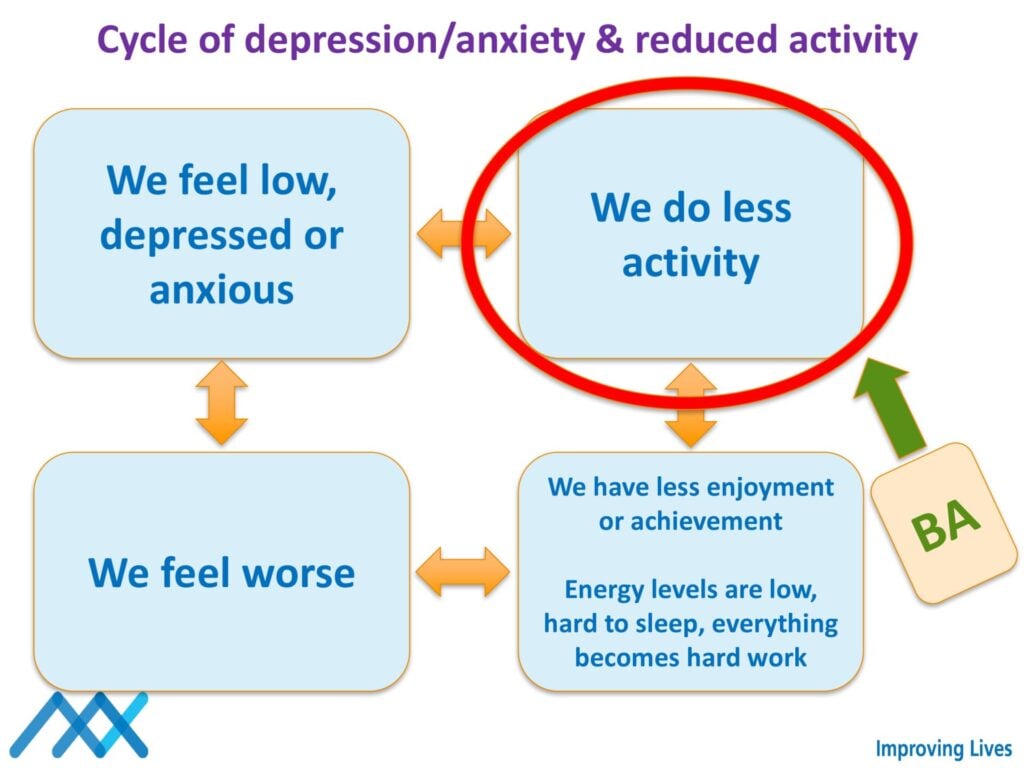 Source:https://www.gmmh.nhs.uk/behavioural-activation/
Learning Check
What strategies can help motivate adolescents to engage more fully in BA treatment?How might BA be adapted to better suit young people with learning differences, ASD, or other comorbidities?What are effective ways to involve parents that provide benefits without hindering adolescent sharing?How can therapists be better prepared and supported to deliver BA as intended to diverse youths?What system-level implementation supports (training, supervision, etc.) facilitate BA adoption in youth mental health settings?How can we promote therapist openness to evidence-based yet brief therapies like BA as valuable options for youths?

Olivia Guy-Evans, MSc
BSc (Hons) Psychology, MSc Psychology of Education
Olivia Guy-Evans is a writer and associate editor for Simply Psychology. She has previously worked in healthcare and educational sectors.
Saul McLeod, PhD
BSc (Hons) Psychology, MRes, PhD, University of Manchester
Saul McLeod, PhD., is a qualified psychology teacher with over 18 years of experience in further and higher education. He has been published in peer-reviewed journals, including the Journal of Clinical Psychology.
