Avoiding situations or people is not setting a boundary.Boundariesare clear, communicated limits that protect your well-being. Avoidance may provide temporary relief but doesn’t address underlying issues or promote healthy relationships.
AvoidanceBoundariesPassive approachProactive approachCan lead to a lack of communication, honesty, authenticity, and unaccountabilityInvolves assertive communication, honesty, accountability, and authentic self-expressionDoesn’t allow people to grow and experience intimacy or closeness.Comes from wanting a positive outcome and growth in the relationshipMakes solving problems and disagreements very difficultLeads to trust and greater closeness in the long termMight seem easier to implement because you don’t have to deal with discomfortCan be difficult to implement and can cause discomfort at timesIs generally a maladaptive interpersonal strategy that comes from insecurity and having difficulties setting boundaries.Are essential for personal and relational well-being
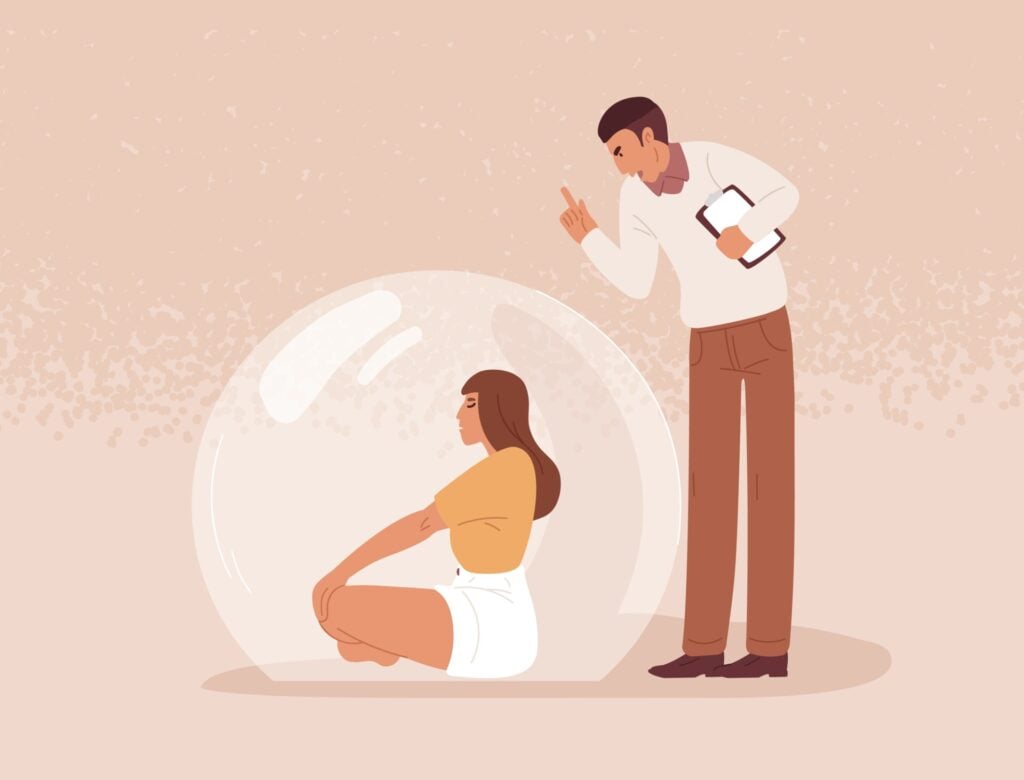 illustration of a woman sat in a protective bubble while a man is shouting at her
Avoidance does not equal effectiveboundary settingand actually tends to signal a lack of boundaries. While there are times when avoidance can protect you from a threat or danger, it’s generally an unhelpful coping and interpersonal strategy.
Avoidance canfeellike a boundary because you’re removing yourself from a situation, avoiding certain conversations, or creating distance between yourself and others.
However, in the long term, it’s damaging (or at least unproductive) for relationships because you’re not communicating your needs and limits openly.
Setting boundaries involves proactive and assertive communication that can be uncomfortable at times but is ultimately much healthier and more productive for relationships.
What is Avoidance and How Does it Relate to Boundaries?
There are different types of avoidance, including:
Avoidance results from fear andinsecurity, so it can be useful when you’re in danger. However, in most cases, people don’t use avoidance to avoid danger but to avoid discomfort and anxiety.
In line with the above types of avoidance, it could be fear of experiencing overwhelming emotions because you didn’t learn how to manage them; fear of being rejected, misunderstood, or hurt if you express yourself; fear of something bad happening if you go to certain places; or feeling insecure about yourself as a result of low self-esteem and confidence.
When you have clear and firm boundaries, avoidance is rarely necessary because:
When you’reavoidant in relationships(or avoid them altogether), you’re not communicating your needs and limits.
There’s a risk of growing increasingly resentful and angry because your needs and limits aren’t being met. Because of fear, you miss out on the joys of intimacy and vulnerability and inadvertently push people away.
Examples of Avoidance
Paul
What he’s actually doing isavoiding getting close to othersbecause he subconsciously believes that they’ll hurt him and eventually leave. He associates closeness with pain and, therefore, finds it easier to avoid intimacy altogether.
If Paul were to set real boundaries, his approach would be different. For example, he might say, “It takes me a while to open up to people and trust them, so give me some time before asking me personal/emotional questions.”
He could also say, “I need a lot of alone time, so don’t take it personally if I’m not always available to meet up,” or “I would prefer if we only saw each other once a week for now.”
This way, others are not left guessing because he has communicated his limits and where he stands, which also allows others to decide whether that aligns with their own needs and limits (their boundaries).
Lara
Lara said her partner would rarely tell her when she did something wrong, but “Eventually, he’d get really angry at the smallest thing, and everything I’d done wrong over the last 6 months would explode out of him. It felt like an attack on me so we would end up in a huge fight.”
Instead of communicating his boundary in the moment like “Hey, please don’t do that”, he avoided it until he reached the end of his tether.
Lara can’t read his mind and won’t know where his boundaries are unless he tells her. Most of the time, people aren’t purposefully disrespecting your boundaries or trying to upset you; mostly, they’re unaware and careless, so it’s up to you to teach them how you’d like to be treated and loved.
Monesha
Monesha has a difficult relationship with some of her family members, especially her sister, Naomi. They often comment on her weight, and Naomi teases her about not having a boyfriend and says things like, “You’re going to end up alone if you don’t hurry up.”
She avoids her family because she’s unable to set boundaries with them effectively. Avoiding them might feel like a boundary to her but it doesn’t solve the problem and it isolates her from her family.
How to Overcome Avoidance with Boundaries
Learning how to set and maintain healthy boundaries can help you to overcome the tendency to avoid.
The first step is always awareness and seeing as you’re reading this article, you probably already suspect that you use avoidance as a coping strategy.
Contemplating these questions can give you a better understanding of where your need to avoid comes from and what triggers your need to avoid. That will make it easier to work on it.
The opposite of avoidance is to embrace and face yourself, others, and situations head-on (that’s easier said than done, I know!).
As with everything, changing unhelpful patterns takes time and patience, but when you have firm and clear boundaries, it will become much easier.
Some Advice:

Saul McLeod, PhD
BSc (Hons) Psychology, MRes, PhD, University of Manchester
Saul McLeod, PhD., is a qualified psychology teacher with over 18 years of experience in further and higher education. He has been published in peer-reviewed journals, including the Journal of Clinical Psychology.
Olivia Guy-Evans, MSc
BSc (Hons) Psychology, MSc Psychology of Education
Olivia Guy-Evans is a writer and associate editor for Simply Psychology. She has previously worked in healthcare and educational sectors.
Anna DrescherMental Health WriterBSc (Hons), Psychology, Goldsmiths University, MSc in Psychotherapy, University of QueenslandAnna Drescher is a freelance writer and solution-focused hypnotherapist, specializing in CBT and meditation. Using insights from her experience working as an NHS Assistant Clinical Psychologist and Recovery Officer, along with her Master’s degree in Psychotherapy, she lends deep empathy and profound understanding to her mental health and relationships writing.
Anna DrescherMental Health WriterBSc (Hons), Psychology, Goldsmiths University, MSc in Psychotherapy, University of Queensland
Anna Drescher
Mental Health Writer
BSc (Hons), Psychology, Goldsmiths University, MSc in Psychotherapy, University of Queensland
Anna Drescher is a freelance writer and solution-focused hypnotherapist, specializing in CBT and meditation. Using insights from her experience working as an NHS Assistant Clinical Psychologist and Recovery Officer, along with her Master’s degree in Psychotherapy, she lends deep empathy and profound understanding to her mental health and relationships writing.
