The autonomic nervous system (ANS) is a nervous system component responsible for regulating involuntary bodily functions, such as heart rate, digestion, respiratory rate, and pupillary response.
It consists of two main divisions: the sympathetic and parasympathetic systems, which often work in opposition to maintaining the body’s internal balance or homeostasis.

The autonomic nervous system (ANS) is part of theperipheral nervous systemand controls vital functions such as heartbeat, breathing, and digestion.
It is also involved in the acute stress response, where it works with the endocrine system to prepare the body tofight-or-flight. It can be further subdivided into sympathetic and parasympathetic divisions.
The ANS transmits information from and to the internal body organs such as the liver and the lungs. It operates automatically and is generally considered to be outside the realm of voluntary control.
The ANS, therefore, differs from thesomatic nervous system(another branch of the peripheral nervous system) as this system is associated with controlling voluntary body movements. Although most of the functions of the ANS are automatic, they can, however, work in conjunction with the somatic nervous system.
Functions of the ANS
The ANS is important for regulating the body, and essential for maintaining homeostasis. This means balancing the body’s conditions and functions necessary for living.
 Human nervous system. Sympathetic and parasympathetic nerves anatomy and functions. Spinal cord controls body internal organs vector diagram. Illustration anatomy biology nerve
More recently, the ANS is believed to be associated with emotions. Activation of the ANS was found when people responded to positive and negative emotions (Shiota et al., 2011). Below is a list of some of the functions of the ANS:
What controls the autonomic nervous system?
The hypothalamus, which is right above the brain stem, receives autonomic regulatory input from thelimbic system(a group of structures deep in the brain that is associated with functions such as memory, emotion, and fear). The hypothalamus uses this input to control much of the activity of the ANS.
There are also three critical neurotransmitters involved in successful communication within the ANS:
Divisions of the ANS
There are three branches to the ANS; thesympathetic nervous system, theparasympathetic nervous system, and the enteric nervous system.
The sympathetic and parasympathetic divisions of the autonomic nervous system have the opposite effects on various systems.
The two systems have complementary functions, operating in tandem to maintain the body’s homeostasis. The nerves in the sympathetic nervous system help to prepare the body for something happening within the environment and expend energy.
Sympathetic Nervous SystemThesympathetic nervous systemis involved in responses that help us deal with emergencies. It slows bodily processes that are less important in emergencies, such as digestion.For instance, if the temperature of a room is hot, the sympathetic system will encourage the body to sweat in response to this change.
Sympathetic Nervous System
Thesympathetic nervous systemis involved in responses that help us deal with emergencies. It slows bodily processes that are less important in emergencies, such as digestion.
For instance, if the temperature of a room is hot, the sympathetic system will encourage the body to sweat in response to this change.

The most noticeable function of the sympathetic branch is during thefight-or-flight response.
The sympathetic system activates during threatening or stressful conditions, providing an automatic response.
For example, walking home alone down a dark street can be scary for many people. Whilst walking, your pupils may dilate, your heart rate may increase, and you may sweat.
The purpose of stimulating these bodily responses is to prepare the individual to either escape or fight in dangerous situations. Although the sympathetic nervous system was evolutionarily used in life-threatening situations, modern-day life and mental health can also trigger this response.
Work-related stress, financial concerns, and relationship problems are examples of when the sympathetic nervous system can produce this stress response.
Similarly, those withanxiety disordersand phobias experience high quantities of epinephrine, resulting in them experiencing the same autonomic responses as in life-threatening situations.
Parasympathetic Nervous System

The parasympathetic nervous system is associated with returning thebody to resting state functions such as regulating heart rate, relaxing muscles, and controlling the bladder. This makes the parasympathetic nervous system important in supporting homeostasis.The parasympathetic nervous system can also act once a threatening situation is over. For instance, when walking home alone at night, the body relaxes once returning home, and the threatening situation is over.The pupils will constrict, the heart rate will return to a resting rhythm, and sweating will be reduced or stopped. The parasympathetic system is therefore important for ensuring we return to normal after a stressful situation.Without this system, the body will be constantly alert, draining all energy, and this can lead to chronic stress.Enteric Nervous SystemThe enteric nervous system (ENS) is a branch of the ANS which operates independently of thecentral nervous system.This system consists of neurons confined to the gastrointestinal tract (also known as the gut).
The parasympathetic nervous system is associated with returning thebody to resting state functions such as regulating heart rate, relaxing muscles, and controlling the bladder. This makes the parasympathetic nervous system important in supporting homeostasis.The parasympathetic nervous system can also act once a threatening situation is over. For instance, when walking home alone at night, the body relaxes once returning home, and the threatening situation is over.The pupils will constrict, the heart rate will return to a resting rhythm, and sweating will be reduced or stopped. The parasympathetic system is therefore important for ensuring we return to normal after a stressful situation.Without this system, the body will be constantly alert, draining all energy, and this can lead to chronic stress.
The parasympathetic nervous system is associated with returning thebody to resting state functions such as regulating heart rate, relaxing muscles, and controlling the bladder. This makes the parasympathetic nervous system important in supporting homeostasis.
The parasympathetic nervous system can also act once a threatening situation is over. For instance, when walking home alone at night, the body relaxes once returning home, and the threatening situation is over.The pupils will constrict, the heart rate will return to a resting rhythm, and sweating will be reduced or stopped. The parasympathetic system is therefore important for ensuring we return to normal after a stressful situation.Without this system, the body will be constantly alert, draining all energy, and this can lead to chronic stress.
The parasympathetic nervous system can also act once a threatening situation is over. For instance, when walking home alone at night, the body relaxes once returning home, and the threatening situation is over.
The pupils will constrict, the heart rate will return to a resting rhythm, and sweating will be reduced or stopped. The parasympathetic system is therefore important for ensuring we return to normal after a stressful situation.
Without this system, the body will be constantly alert, draining all energy, and this can lead to chronic stress.
Enteric Nervous SystemThe enteric nervous system (ENS) is a branch of the ANS which operates independently of thecentral nervous system.This system consists of neurons confined to the gastrointestinal tract (also known as the gut).
Enteric Nervous System
The enteric nervous system (ENS) is a branch of the ANS which operates independently of thecentral nervous system.This system consists of neurons confined to the gastrointestinal tract (also known as the gut).
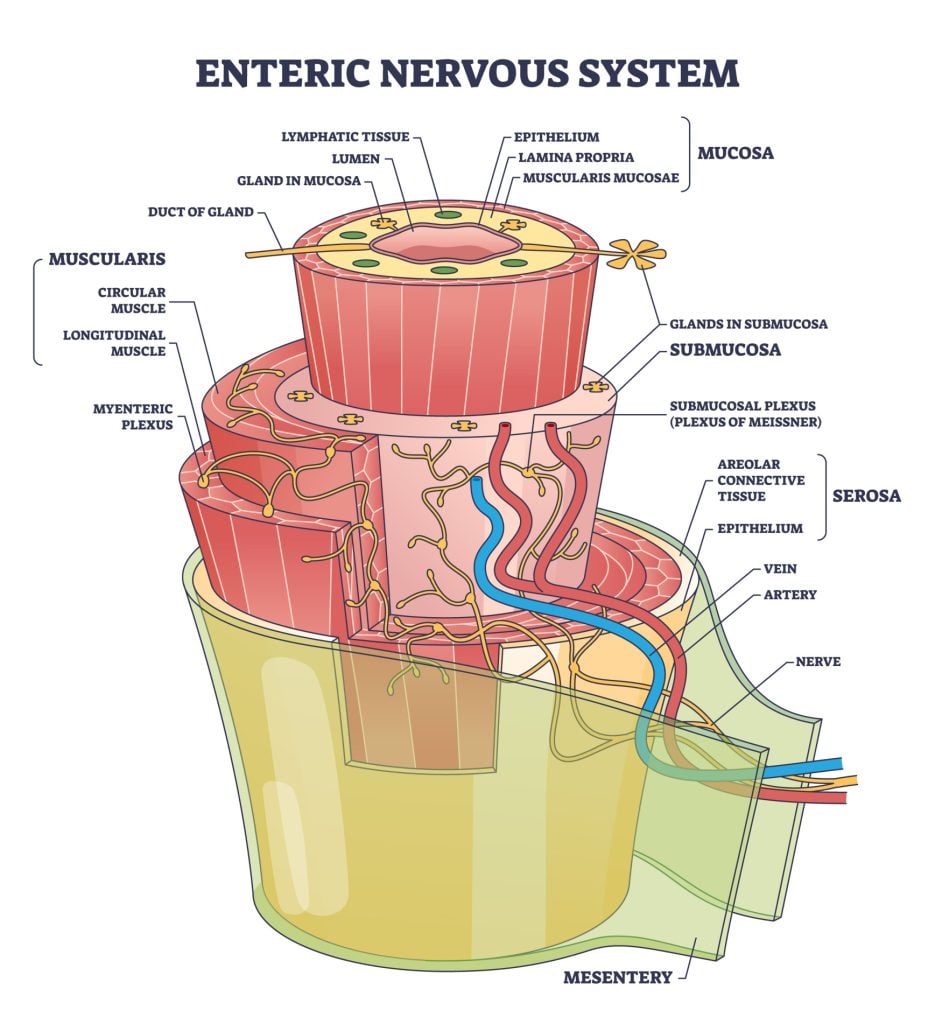
It can also function autonomously in the sympathetic and parasympathetic nervous systems, although they may influence it.The neurons that comprise the enteric system are responsible for controlling the motor functions of the system as well as secreting enzymes within the gastrointestinal tract. The types of neurons within the enteric system as sensory, motor, and interneurons.The neurons within this system communicate through many neurotransmitters, such as dopamine,serotonin, and acetylcholine. The circuits of neurons within this system as also able to control local blood flow and modulate immune functions.
It can also function autonomously in the sympathetic and parasympathetic nervous systems, although they may influence it.
The neurons that comprise the enteric system are responsible for controlling the motor functions of the system as well as secreting enzymes within the gastrointestinal tract. The types of neurons within the enteric system as sensory, motor, and interneurons.
The neurons within this system communicate through many neurotransmitters, such as dopamine,serotonin, and acetylcholine. The circuits of neurons within this system as also able to control local blood flow and modulate immune functions.
Autonomic Dysfunction
Dautonomic dysfunction, or dysautonomia, is a condition in which the autonomic nervous system (ANS) does not function properly.
In developed countries, the most common cause of issues with ANS result from diabetes (Bishop, 2010). However, other reasons could be due to hereditary reasons, aging, Parkinson’s disease, cancer, or chronic fatigue syndrome. Other reasons could be inflicted on someone via damage to the head, damage to the neck nerves, alcohol and drug abuse, or infections.
If someone believes they may have an issue with their ANS, they could be displaying one or more of the following symptoms:
Autonomic neuropathy refers to the damage of autonomic nerves. These are disorders that can affect the sympathetic nerves, parasympathetic nerves, or both.
The features of autonomic neuropathy include having a fixed heart rate, constipation, abnormal sweating, decreased pupil size, and absent or delayed light reflexes (Bankenahally & Krovvidi, 2016).
There are a number of other disorders which can be the result of ANS dysfunction:
Autonomic Dysfunction Diagnosis and Treatment
Suppose experiencing the aforementioned symptoms and an individual wants to know whether this is related to their ANS being dysfunctional.
In that case, many tests can be carried out, depending on the symptom that is being experienced. For instance, if experiencing abnormal heart rhythms, a doctor may use an electrocardiogram to measure electrical activity within the heart.
Blood pressure monitors can also test whether blood pressure is abnormally high or low. Sweat tests can assess whether the sweat glands are functioning properly.
This involves using electrodes to stimulate the glands and measure the sweat volumes produced when presented with a stimulus. Pupillary light reflex tests can also be used to determine how sensitive pupils are to changes in light and whether they respond appropriately.
These types of physical examinations are required if someone believes they may have an issue with their ANS. Typically, if there is an issue, this may require a lot of trial and error of many tests to diagnose a condition.
To be able to treat a dysfunctional ANS, again, depends on the type of diagnosis given. For example, if the cause of dysfunction is due to diabetes, controlling blood sugar will be the primary treatment.
This can include medications used to lower blood pressure and non-steroid anti-inflammatories to help control pain (especially for fibromyalgia). Similarly,antidepressantsand anti-anxiety medications can assist with anxiety symptoms and have been shown to help re-balance the ANS.
FAQS
Which division of the autonomic nervous system returns the body to a relaxed condition after an emergency?The parasympathetic division of the autonomic nervous system is responsible for returning the body to a relaxed and restorative state after an emergency or stress.It counteracts the effects of the sympathetic division, which initiates the “fight or flight” response during emergencies. The parasympathetic system promotes “rest and digest” functions, restoring balance and conserving energy.
Which division of the autonomic nervous system returns the body to a relaxed condition after an emergency?
The parasympathetic division of the autonomic nervous system is responsible for returning the body to a relaxed and restorative state after an emergency or stress.It counteracts the effects of the sympathetic division, which initiates the “fight or flight” response during emergencies. The parasympathetic system promotes “rest and digest” functions, restoring balance and conserving energy.
The parasympathetic division of the autonomic nervous system is responsible for returning the body to a relaxed and restorative state after an emergency or stress.
It counteracts the effects of the sympathetic division, which initiates the “fight or flight” response during emergencies. The parasympathetic system promotes “rest and digest” functions, restoring balance and conserving energy.
Which division of the autonomic nervous system prepares the body for action in a stressful situation?The sympathetic division of the autonomic nervous system prepares the body for action in stressful situations, often referred to as the “fight or flight” response. It increases heart rate, dilates airways, and redirects blood flow to muscles, among other responses, to ready the body for immediate action.
Which division of the autonomic nervous system prepares the body for action in a stressful situation?
The sympathetic division of the autonomic nervous system prepares the body for action in stressful situations, often referred to as the “fight or flight” response. It increases heart rate, dilates airways, and redirects blood flow to muscles, among other responses, to ready the body for immediate action.

Saul McLeod, PhD
BSc (Hons) Psychology, MRes, PhD, University of Manchester
Saul McLeod, PhD., is a qualified psychology teacher with over 18 years of experience in further and higher education. He has been published in peer-reviewed journals, including the Journal of Clinical Psychology.
Olivia Guy-Evans, MSc
BSc (Hons) Psychology, MSc Psychology of Education
Olivia Guy-Evans is a writer and associate editor for Simply Psychology. She has previously worked in healthcare and educational sectors.
